
On this page
Start here
Quick answer
If a Daewoo refrigerator is not cooling, first protect the food and check that the appliance has power, the temperature control is set for cooling rather than an off or convertible mode, and the doors close fully. Then look for blocked interior air outlets, overloading, a nearby heat source, or inadequate clearance around the cabinet. Daewoo's refrigerator guidance says that frequent or prolonged door opening, inhibited air circulation, incorrect controls, heat, and insufficient rear space can reduce cooling; it also says a refrigerator may need several hours after startup to reach temperature. Listen and look from outside: a normal compressor or circulation-fan hum is only evidence that a component is running, not proof that the compartments are cold. If the freezer is also warm, the unit is silent despite power, frost blocks an air path, the compressor or fan runs abnormally, or cooling does not recover after the visible checks, stop short of removing panels or testing components. Fans, sensors, compressor, refrigerant circuit, and sealed-system work require qualified service.
Before you begin
Safety first
- The user may verify a safe power connection, exact model setting, door obstruction, visible gasket contact, food placement, and external environment. Qualified service must handle wiring, control boards, sensors, fan and compressor access, defrost components behind covers, refrigerant, tubing, sealed-system testing, and any panel removal.
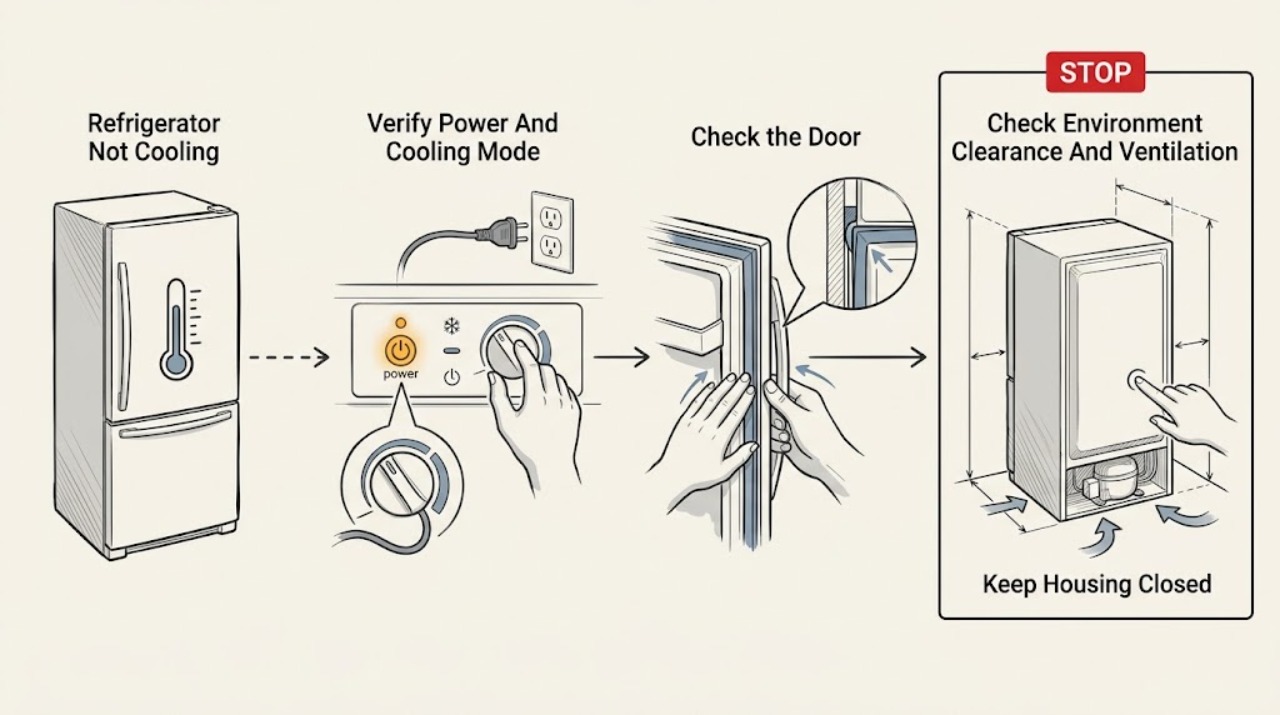
Work through in order
Diagnostic checks
Use only checks that match the exact appliance or system and its official guide.
-
Check 1
Check from a dry, safe position that the interior light or display behaves normally, the plug is fully inserted, and the refrigerator is not in an off, demo, vacation, or convertible mode. Verify the refrigerator and freezer controls against the exact Daewoo manual; do not assume a dial or button has the same meaning on another model. If the refrigerator was just installed or reconnected, allow the manual's stated cool-down period before judging its temperature.
Expected result: There is no power, the control is set too warm or to a non-cooling mode, the appliance was recently reconnected, or power and settings appear normal but both compartments remain warm.
Next step: Correct only the clearly identified setting or power connection and allow the exact manual's stabilization time. If power is present and the settings are correct but cooling does not improve, continue with the external checks below and prepare for service if the fault persists.
Stop if: Do not repeatedly unplug and reconnect a warm refrigerator, bypass a control, or remove a control panel.
Why this matters
Why: No light or display behavior can indicate a supply or control issue, while a wrong mode or a recent startup can explain warmth without a failed sealed system. Normal power and settings move the check toward doors, airflow, environment, load, and observable running behavior.
-
Check 2
Close each door slowly and inspect the visible gasket contact, shelves, drawers, and packages for an item holding the door open. Confirm that no package covers an interior cold-air outlet and that the cabinet is not packed so tightly that air cannot circulate. Do not pull the gasket out or adjust hinges; simply correct an obvious obstruction and close the doors.
Expected result: A door is held open, the gasket has a visible gap or damage, doors have been opened frequently, food blocks a vent, or the doors seal and the load leaves air paths clear.
Next step: Remove only the visible obstruction, rearrange food to leave the manual's air paths clear, and monitor with the doors closed. If the gasket still gaps, the door sags, or both compartments remain warm, arrange service without removing hinges or panels.
Stop if: Do not force the door, tape over an air outlet, remove the gasket, or disassemble a hinge or door switch.
Why this matters
Why: Warm air entering through a gap or frequent opening and restricted circulation can make a working refrigerator appear not to cool. A damaged gasket or a door that remains misaligned needs model-specific service rather than force. Clear doors and vents with no improvement make a system or environmental cause more likely.
-
Check 3
From outside, note whether the refrigerator is in direct sun, next to a radiator, oven, or other heat-producing appliance, or pressed tightly against a wall or cabinet. Check that visible ventilation openings are not covered by storage or dust. Do not move a built-in or loaded refrigerator by yourself and do not expose the rear heat exchanger by removing covers.
Expected result: The room is unusually hot, a heat source warms the cabinet, required clearance is missing, or the installation environment and visible openings are reasonable.
Next step: Remove nearby heat sources where practical and restore only the clearance specified for the exact model, without blocking ventilation. Allow the refrigerator time to stabilize. If it remains warm, continue to the operating-sign check and call service if indicated.
Stop if: Do not place a fan against the cabinet as a substitute for ventilation, wash electrical parts, or pull a heavy built-in unit through a tight opening.
Why this matters
Why: The official Daewoo manual says ambient conditions and inadequate rear space can weaken cooling and that the appliance's climate category matters. Improving an obvious environmental obstruction can help; it cannot repair a fan, sensor, compressor, or sealed-system fault.
-
Check 4
Without opening panels or touching moving parts, compare the refrigerator and freezer temperatures and listen during a normal cooling period for the compressor or circulation fan to start. Look only for an unusual frost mass visible in the compartment or a fan noise that changes when a door is opened, if the exact model makes that behavior observable. Do not use a probe, thermometer inside a sealed area, forced-defrost command, or live test to chase a diagnosis.
Expected result: The freezer is cold but the refrigerator is warm, both sections are warm, the compressor/fan is silent, it runs continuously without cooling, frost blocks a visible air path, or the sound and cooling appear normal after the prior corrections.
Next step: If cooling returns after settings, door, load, or environment correction, monitor. If sections remain warm, the sound is abnormal, frost is extensive, or the compressor/fan runs without recovery, stop user troubleshooting and provide the observations to a qualified Daewoo technician.
Stop if: Do not remove an evaporator or fan cover, chip ice, bypass a door switch, test capacitors or sensors live, or add refrigerant.
Why this matters
Why: A cold freezer with a warm refrigerator can make an airflow or door-sealing problem more likely; both sections warm or a compressor that runs without cooling raises concern for a system fault. Silence is not enough to identify a fan, sensor, start device, or compressor. Heavy frost may restrict airflow, but its cause and safe defrost method are model-dependent.
-
Check 5
If the refrigerator remains warm after the exact model's visible setting, door, load, airflow, and environment checks, switch it off when safe and record the model, whether the freezer is also warm, whether the compressor or fan runs, the frost pattern visible without disassembly, and when the problem began. Use Daewoo's after-sales or technical-service route for diagnosis.
Expected result: Cooling does not recover, the appliance trips a breaker, the cord or cabinet is damaged, the compressor or fan is inaccessible or abnormal, or a sensor, sealed-system, or refrigerant fault is suspected.
Next step: Keep the appliance out of use when unsafe, protect food, and arrange qualified Daewoo service. Give the technician the exact model and the recorded pattern instead of ordering a generic fan, sensor, compressor, or refrigerant part.
Stop if: Do not remove panels, open the refrigerant circuit, perform live measurements, replace a start device, or access the compressor compartment.
Why this matters
Why: These symptoms require electrical, airflow, control, compressor, or sealed-system diagnosis. The external symptom cannot identify a safe replacement component or prove that refrigerant needs to be added.
Use your observations
Decision map
Find the observation that best matches what you see, then follow the next safe action.
-
PATH 01Safety boundary
What you see
The interior light/display is off, the plug or circuit supply is abnormal, or the control is set to a non-cooling or excessively warm mode.
Do this next
Restore only a clearly safe power connection or correct the exact model setting, then allow the documented cool-down time. If the supply is unsafe or the refrigerator remains warm, use qualified service.
Why this path and its safety boundary
Why it matters: A supply or setting issue is more likely than a refrigerant or compressor diagnosis. The manual's first checks include power connections and correct temperature-control settings.
Safety stop: Do not bypass controls or work on the cord, receptacle, or control board.
-
PATH 02Safety boundary
What you see
The freezer is colder than the refrigerator, a door has a visible gap, doors are opened often, or packages block a cold-air outlet.
Do this next
Correct only visible obstructions, leave the documented air paths clear, close doors, and monitor. A recurring gasket gap, sagging door, or persistent warm compartment needs service.
Why this path and its safety boundary
Why it matters: Warm-air entry or restricted internal circulation is more likely than a whole-system cooling failure. The manual specifically identifies door closure and inhibited air circulation as checks for insufficient temperature.
Safety stop: Do not remove gaskets, hinges, fan covers, or door switches.
-
PATH 03Safety boundary
What you see
The refrigerator was recently installed or reconnected, sits near a heat source, lacks the model's clearance, or has been loaded with warm food and opened frequently.
Do this next
Follow the exact model's stabilization and clearance instructions, remove an obvious heat source, keep doors closed, and reassess. If temperature does not improve after stabilization, arrange service.
Why this path and its safety boundary
Why it matters: The cabinet may not have reached its operating temperature, or heat load and ventilation are reducing performance. The manual notes several hours may be needed after startup and that ambient conditions and door openings affect temperature.
Safety stop: Do not use an arbitrary temperature or clearance value from another Daewoo model.
-
PATH 04Safety boundary
What you see
Both compartments are warm, the compressor or fan runs continuously without cooling, the unit is silent despite normal power, frost blocks an air path, or cooling remains poor after all visible corrections.
Do this next
Stop testing, protect food, and arrange qualified Daewoo service with the model and observations. The technician can perform model-specific electrical, airflow, and sealed-system diagnosis.
Why this path and its safety boundary
Why it matters: A control, sensor, fan, start, compressor, defrost, or sealed-system problem becomes more likely, but the sound or frost pattern does not identify one part. Opening the cabinet or circuit is not a user check.
Safety stop: Do not force defrost, chip frost, bypass a switch, test live components, or add refrigerant.
Helpful context
Understand the symptom
Cooling depends on more than the temperature knob
Daewoo refrigerators have different controls and layouts across model families. The accessible DFF470/DFF530/RN30/RN40 manual uses refrigerator and freezer controls, while other Daewoo products may use a different panel or a convertible function. Use the model and serial information from the rating label or inside wall to find the matching instructions. A warm compartment can result from a setting, a door that is not actually sealing, blocked air circulation, a hot room or heat source, or a cooling-system fault; do not choose a part based on warmth alone.
Keep the inspection external and safe
Do not remove the rear cover, reach into a fan or compressor area, pierce frost, handle refrigerant tubing, or perform a live voltage test. Unplug before cleaning or any permitted maintenance, and never use the appliance with a damaged power cord. If the cabinet is hot with a burning smell, the breaker trips, the cord or plug is damaged, or the refrigerant circuit may be damaged, stop using it and arrange qualified service. Keep the doors closed as much as practical while protecting perishable food by another safe means.
A running sound is a clue, not a diagnosis
The Daewoo manual describes compressor and cold-air-circulation fan humming, and refrigerant-flow or gurgling sounds, as possible normal sounds. Conversely, silence does not identify one failed part: power, control, sensor, start, or compressor problems can have similar symptoms. Observe whether the freezer, refrigerator compartment, or both are warm; whether the compressor or fan starts and stops; and whether frost is limited to a normal thin surface or blocks an air path. Do not force a defrost cycle or open panels unless the exact model instructions explicitly authorize that user procedure.
Safety boundary
Stop conditions
- Stop immediately for a damaged cord or plug, burning smell, repeated breaker trips, smoke, a flooded electrical area, or a cabinet/refrigerant circuit that may be damaged.
- Do not remove rear, evaporator, fan, control, or compressor covers; perform live voltage, sensor, capacitor, or start-device tests; or work on wiring.
- Do not chip or pierce frost, force a defrost cycle, add refrigerant, weld tubing, or open the sealed cooling circuit.
- Do not infer a failed compressor, fan, sensor, or refrigerant leak from one sound, a warm cabinet, or a thin frost pattern. Confirm the exact model and use qualified diagnosis.
- If food safety is in doubt, keep the doors closed and move perishable food to a safe cold-storage method while arranging service.
Only after diagnosis
Potential parts
- door gasket or door-alignment component
Consider only if the exact model has a confirmed persistent gasket gap or door-alignment fault after visible obstructions are removed; warmth alone does not prove a gasket fault.
Confirm the full Daewoo model and documented fit before ordering; hinge and gasket work may require qualified service. - air-circulation fan or fan assembly
Consider only after a qualified diagnosis confirms a fan fault, such as abnormal operation or an airflow failure, rather than a blocked load or frost condition.
Fan location and fit vary by model and may require panel removal; do not order from noise or warmth alone. - temperature sensor or control component
Consider only when model-specific testing confirms a control or sensor fault after power, settings, door, airflow, load, and environment checks.
Use the exact model documentation and qualified diagnosis; do not infer sensor compatibility or perform a live test. - compressor start or sealed-system component
Consider only after a qualified technician confirms a compressor, start, refrigerant, tubing, or sealed-system fault; a continuously running refrigerator is not proof of one specific part.
Sealed-system and compressor work is professional service and requires exact model, refrigerant, and safety verification.
When checks do not resolve it
Need a professional?
Arrange qualified Daewoo service when the refrigerator remains warm after the exact model's visible power, mode, door, load, airflow, and environment checks; when both compartments are warm; when the compressor or fan is abnormal or continuously running without cooling; when frost blocks an inaccessible air path; or when any cord, electrical, compressor, refrigerant, sensor, or internal panel work is required. Use the model's after-sales route and provide the model number and observed operating pattern.
Safety scope: The user may verify a safe power connection, exact model setting, door obstruction, visible gasket contact, food placement, and external environment. Qualified service must handle wiring, control boards, sensors, fan and compressor access, defrost components behind covers, refrigerant, tubing, sealed-system testing, and any panel removal.
Common questions
FAQ
Why is my Daewoo refrigerator running but not cooling?
A running sound only shows that a component is operating; it does not prove that air is circulating or that the sealed cooling system is producing cold. First check the exact temperature mode, door seal, blocked vents, load, heat sources, and required clearance. If it continues to run without cooling, stop before opening panels and arrange qualified diagnosis of the fan, sensor, compressor, defrost, or sealed system.
What should I check if the Daewoo freezer is cold but the refrigerator is warm?
Look for a door gap, frequent door opening, food blocking the refrigerator's visible cold-air outlet, or a load that prevents circulation. Correct only visible obstructions and monitor with the doors closed. If the refrigerator remains warm, an internal airflow or control fault may be involved; do not remove the fan cover or force a defrost cycle.
How long should a Daewoo refrigerator take to cool after startup?
The published DFF470/DFF530/RN30/RN40 manual says to allow several hours after starting before storing food and notes that a newly connected appliance takes time to reach its proper temperature. Use the exact model manual for the applicable stabilization guidance, keep the doors closed, and call service if it remains warm after that period and the visible checks pass.
Can a hot room or lack of clearance make a Daewoo refrigerator stop cooling?
Yes, heat and insufficient clearance can reduce cooling performance. Check for direct sun, a nearby heat-producing appliance, or blocked ventilation, and restore only the clearance specified for the exact model. If the environment is reasonable and the compartments remain warm, the cause may be internal and should be diagnosed by a qualified technician.
Should I remove the back panel to check a Daewoo refrigerator fan or compressor?
No. The fan and compressor area can contain moving, electrical, and sealed-system hazards, and the visible symptom does not identify a safe replacement. Unplug only from a safe position when required, keep the refrigerator out of use if damaged or unsafe, and arrange qualified Daewoo service for panel removal and testing.
Read the exact guide
Official sources
- Servicio Técnico y GarantíaDaewoo · Supports routing a malfunctioning Daewoo appliance to the brand's technical-service network and following the product manual and installation guidance. Service availability and warranty terms are region-dependent.
- Model No DFF470.. / DFF530.. RN30.. / RN40..Daewoo Electronics · Model-family evidence for power, temperature controls, door closure, air circulation, environment, clearance, startup cooling time, normal operating sounds, and the boundary against user disassembly. It is not a universal procedure for every Daewoo refrigerator.
Community feedback
Share a repair observation
Share a plain-text repair observation. Accepted observations are published automatically; this page may take a moment to update.