
On this page
Start here
Quick answer
Many Daewoo refrigerator sounds are part of normal operation: a compressor hum or brief louder startup, bubbling or splashing as refrigerant moves, air movement from a fan, water flow during defrost, and cracking as materials expand or contract. The Daewoo user-manual guidance also lists dust on the condenser, insufficient rear or side space, an overloaded cabinet, a door that is not closed properly, and an unlevel surface as things to check when operation is poor or noisy. First record the sound, where it comes from, and whether it happens at startup, shutdown, defrost, door movement, or an ice-making event. From outside, remove only loose items that are vibrating against the cabinet, confirm the refrigerator is stable, and keep vents and required clearances open. Do not pull the refrigerator out, remove a rear cover, touch the compressor, fan, tubing, wiring, or defrost parts, or make a live test. A grinding or scraping noise, sharp electrical crackle, smoke, burning smell, hot plug, repeated breaker trip, water near electrical parts, or noise accompanied by rising food temperature requires immediate stop-use and qualified service.
Before you begin
Safety first
- Owner checks stop at listening, external stability, visible clearance, loose-item/load, normal control readings, and documentation. Qualified service must handle compressors, fans, refrigerant lines, defrost components, water paths, internal mounts, wiring, and live testing.
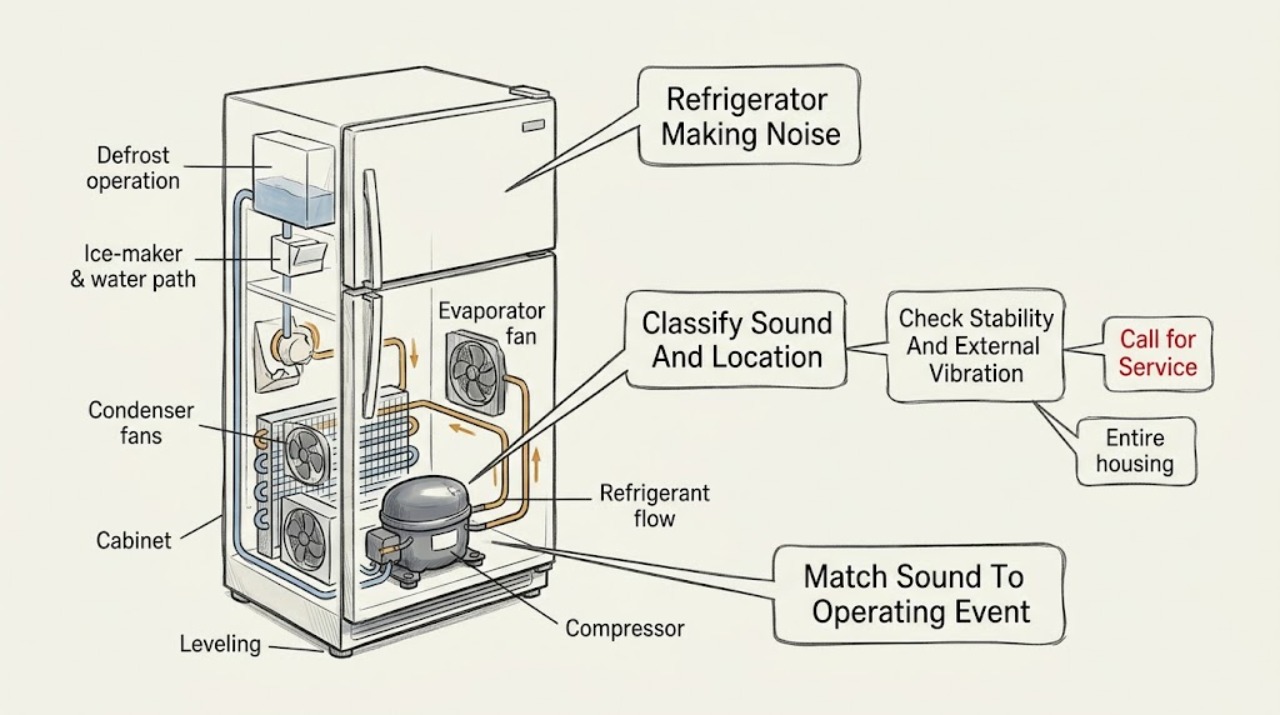
Work through in order
Diagnostic checks
Use only checks that match the exact appliance or system and its official guide.
-
Check 1
From a safe position, listen and note the sound's character and apparent location without touching the refrigerator: hum or motor, bubbling or splashing, airflow, click or crackle, water flow, rattle, vibration, grinding, scraping, or electrical buzz.
Expected result: The sound resembles a compressor hum, refrigerant bubbling, fan airflow, a short click or defrost crackle, water flow, a cabinet rattle, a metallic scrape, or an electrical crackle.
Next step: Record the sound and location, then compare its timing with startup, shutdown, defrost, door opening, or ice-making. Stop and isolate power from a safe dry point for smoke, burning odor, arcing, or hot electrical parts.
Stop if: Do not put a hand near a fan, compressor, tubing, outlet, or rear cover to locate the sound more precisely.
Why this matters
Why: Hum, bubbling, airflow, short clicks, and defrost water sounds can match Daewoo's normal sound categories when their timing is appropriate. A new metallic scrape, harsh grinding, or electrical crackle is not safely identified by listening and moves toward service.
-
Check 2
Without forcing controls or starting a test cycle, note whether the sound begins when the compressor starts, shortly after a temperature change, during automatic defrost, when water drains, while air circulates, after a door closes, or during an ice-maker fill or harvest event if the exact model has that feature.
Expected result: The sound is brief and event-linked, becomes quieter after the refrigerator reaches temperature, occurs only during defrost or water flow, repeats with fan operation, or has no clear event and continues.
Next step: If the sound is brief, event-linked, and cooling is normal, monitor it without intervention. If it is continuous, worsening, or paired with poor cooling, frost, leakage, or a safety symptom, leave internal diagnosis to qualified service.
Stop if: Do not force the ice maker, enter an undocumented diagnostic mode, or repeatedly cycle power to recreate the sound.
Why this matters
Why: Daewoo describes event-linked motor, refrigerant, defrost, water, and air-circulation sounds as normal categories, and notes that startup noise can decrease after the required temperature is reached. An unchanging or worsening sound with no normal event is less likely to be a normal operating sound.
-
Check 3
Check from the front and sides that the refrigerator stands firmly, is not visibly touching a wall or cabinet, and has no loose bottle, tray, item on top, or nearby object vibrating against it. Remove only an accessible loose item; do not move the refrigerator to inspect the back.
Expected result: The cabinet rocks or sits unevenly, a loose item or wall contact is visible, the refrigerator is overcrowded, or it stands firmly with no external vibration source.
Next step: Remove the loose accessible object and keep the cabinet stable. Do not adjust hidden feet or pull a built-in unit unless the exact manual and a qualified person support that work; arrange service for persistent rattling, shaking, or metallic contact.
Stop if: Do not brace the refrigerator with improvised material, rock it, pull it forward, or touch rear tubing or the compressor.
Why this matters
Why: An unlevel cabinet, loose object, wall contact, or overloaded arrangement can amplify normal compressor or fan vibration and cause rattling. If the sound remains with a stable, clear exterior, an internal fan, compressor, pipe, or mounting issue becomes more plausible.
-
Check 4
Check visible side and rear clearance without moving the unit, confirm the doors close fully, and rearrange only accessible food or packaging that blocks closure or visibly presses on a wall or air outlet. Note dust that is visible on an accessible external grille or floor area, but do not remove a cover.
Expected result: Clearance is restricted, a door is held open, food or packaging touches the cabinet or outlet, visible external dust is heavy, or the installation and load look normal.
Next step: Correct only the accessible food, packaging, or loose external obstruction. If cleaning is permitted by the exact manual, disconnect power before cleaning an accessible external area; otherwise arrange service for restricted access, persistent noise, or internal dust.
Stop if: Do not remove the rear grille, touch condenser coils or a fan, spray liquid, or clean near live wiring.
Why this matters
Why: Daewoo troubleshooting guidance links insufficient rear or side space, a poorly closed door, overload, and condenser dust with poor operation; these conditions can make the compressor or fan run longer or sound louder. A clear installation with normal cooling makes an internal sound source more likely if the noise persists.
-
Check 5
From outside the appliance, observe whether the noise is accompanied by loss of cooling, rising food temperature, heavy frost, leaking water, smoke, burning odor, an unusually hot cord or plug, sparks, exposed wiring, or a breaker or RCD trip.
Expected result: The refrigerator cools normally with no safety symptom, the noise is paired with poor cooling or frost, or smoke, odor, heat, arcing, water near electrical parts, or a protective-device trip is present.
Next step: For smoke or fire, leave the area and contact local emergency services. Otherwise isolate power only from a safe dry point, keep the refrigerator out of service, and arrange qualified Daewoo service; involve an electrician when the cord, outlet, wiring, or breaker is implicated.
Stop if: Do not reset repeatedly, reconnect to test, touch a hot or wet plug, or open the refrigerator to inspect the fan, compressor, defrost system, or wiring.
Why this matters
Why: A normal event-linked sound without a performance change is more likely benign. Noise with poor cooling or frost can involve a fan, defrost, or refrigeration fault. Any electrical, fire, or water-near-electricity symptom is an immediate stop-use condition regardless of the sound's apparent type.
-
Check 6
Read the exact Daewoo model or product code from an exterior label, paperwork, or the manufacturer's support record while the refrigerator remains in its normal position. Record the sound, timing, location, cooling result, frost or water, and any safety symptom for the technician.
Expected result: The full model and sound pattern are known, only a partial model is available, the model has an ice maker or fan system, or the sound cannot be localized without moving or opening the appliance.
Next step: Use the exact model manual and arrange qualified service for an unexplained, persistent, or performance-related noise. Give the technician the event sequence rather than trying to reproduce it.
Stop if: Do not remove panels, move the refrigerator, adjust internal mounts, replace a fan or compressor part, or perform live testing.
Why this matters
Why: Daewoo's product range includes different cooling and defrost architectures, so model identity changes which sounds and controls are expected. A partial identity or unknown location is still useful service information but not a basis for selecting a part or internal adjustment.
Use your observations
Decision map
Find the observation that best matches what you see, then follow the next safe action.
-
PATH 01Safety boundary
What you see
The noise is a brief hum, click, gurgle, airflow, defrost crackle, or water-flow sound tied to compressor operation, temperature change, defrost, or water movement, and the refrigerator cools normally.
Do this next
Monitor the sound and keep the exact model manual available. No internal intervention is needed while the sound remains event-linked and performance is normal.
Why this path and its safety boundary
Why it matters: A normal operating sound is more likely than a failed component. Daewoo's user-manual guidance lists these sound categories and notes that startup compressor noise may decrease after the required temperature is reached.
Safety stop: Escalate if the sound becomes continuous, metallic, much louder, or is joined by poor cooling, frost, water, odor, or electrical symptoms.
-
PATH 02Safety boundary
What you see
Rattling or vibration changes when a loose item is removed, a wall or cabinet contact is cleared, the load is rearranged, or the refrigerator is found to be uneven, overloaded, dusty, or short of visible clearance.
Do this next
Remove only accessible loose objects or food obstructions and keep the refrigerator stable with model-required clearance. Arrange service if noise remains or correcting it would require moving a heavy or built-in unit.
Why this path and its safety boundary
Why it matters: An external vibration source or installation/load condition is more likely than a compressor or fan failure.
Safety stop: Do not rock, pull, brace, or open the refrigerator to adjust hidden mounts or tubing.
-
PATH 03Safety boundary
What you see
The sound persists without a clear normal event, becomes grinding or scraping, or occurs with rising food temperature, heavy frost, water, a fan-like noise that does not stop, or a failure to recover cooling.
Do this next
Keep vents and doors in their normal condition, avoid repeated power cycles, and arrange qualified Daewoo refrigerator service using the exact model and symptom record.
Why this path and its safety boundary
Why it matters: An internal fan, defrost, compressor, refrigerant, drain, or control issue is more likely, but the sound alone cannot identify the component or justify opening the cabinet.
Safety stop: Do not remove panels, touch a fan or compressor, clear internal ice with a tool, alter a defrost control, or perform live measurements.
-
PATH 04Safety boundary
What you see
The noise includes sharp electrical crackle or arcing, or there is smoke, burning odor, abnormal heat, a hot or scorched plug/outlet, exposed wiring, water near electrical parts, or repeated breaker/RCD operation.
Do this next
Leave for fire or spreading smoke and contact local emergency services. Otherwise keep clear, isolate power only from a dry safe upstream point, and arrange electrical and qualified appliance service.
Why this path and its safety boundary
Why it matters: An immediate electrical, fire, or shock hazard is more likely than a normal refrigerator sound and the appliance should not be approached for a closer listen.
Safety stop: Do not touch a hot or wet connection, cross water to reach the plug or panel, use water on an electrical fire, or reconnect to test.
Helpful context
Understand the symptom
Sound, timing, and consequence are the useful clues
A hum, gurgle, hiss, fan whoosh, brief click, or defrost crackle can be normal when it follows a cooling, defrost, or water event and the compartments hold temperature. The same word—such as buzzing or rattling—can mean something different if it is new, continuous, metallic, associated with vibration, or accompanied by poor cooling. Classify the sound and its timing before looking for a part.
External vibration is the low-risk branch
Daewoo's troubleshooting material points to an overloaded cabinet, insufficient space, dust at the condenser, a door that is not closed properly, and an unlevel surface as external conditions to check. A bottle, item on top, cabinet touching a wall, or an uneven floor can amplify a normal motor or refrigerant sound. Rear tubing, fans, and the compressor remain service areas even when the sound seems to come from there.
A model manual controls the interpretation
Daewoo sells different refrigerator and freezer types, including frost-free, no-frost, and lower-frost designs. Fan, water, and defrost behavior therefore varies by model. Use the exact model or product code when checking a manual, and do not copy a service adjustment or ice-maker sequence from another Daewoo appliance.
Safety boundary
Stop conditions
- Stop immediately for smoke, flame, burning odor, sparks, sharp electrical crackle, exposed wiring, a hot or scorched plug/outlet, water near electricity, or repeated breaker/RCD trips.
- Isolate power only from a dry, safe, accessible point; do not touch a hot or wet plug, cord, outlet, cabinet, or rear connection.
- Do not remove panels, touch the compressor, fans, refrigerant tubing, condenser, defrost parts, wiring, or internal ice, and do not perform live testing.
- Do not repeatedly cycle power, force an ice maker, enter an undocumented diagnostic mode, or move a heavy or built-in refrigerator to locate noise.
- Arrange qualified service for persistent grinding, scraping, severe vibration, noise with poor cooling or frost, or any sound whose diagnosis requires internal access.
When checks do not resolve it
Need a professional?
Safety scope: Owner checks stop at listening, external stability, visible clearance, loose-item/load, normal control readings, and documentation. Qualified service must handle compressors, fans, refrigerant lines, defrost components, water paths, internal mounts, wiring, and live testing.
Common questions
FAQ
What Daewoo refrigerator noises are usually normal?
A compressor hum or brief startup increase, refrigerant bubbling or splashing, fan airflow, short thermostat clicks, cracking during defrost or temperature change, and water flow during defrost can be normal when cooling is otherwise normal and the sound follows the related event.
Why is my Daewoo refrigerator rattling?
Check for a loose item, wall contact, an unlevel cabinet, overload, a door that is not fully closed, restricted clearance, or visible external dust. Remove only accessible obstructions; persistent metallic rattling or vibration needs service.
Can I open the rear cover to find the noise?
No. Do not remove panels or touch the compressor, fans, refrigerant tubing, defrost parts, or wiring. Record the sound and timing from outside and arrange qualified service if it is persistent, severe, or paired with poor cooling.
When is a Daewoo refrigerator noise an emergency?
Stop using it for smoke, burning odor, sparks or electrical crackle, a hot or scorched plug/outlet, exposed wiring, water near electrical parts, or repeated breaker/RCD trips. Isolate power only from a safe dry point and contact emergency, electrical, and appliance professionals as appropriate.
Read the exact guide
Official sources
- Fridge-Freezer – DaewooDaewoo · Opened official Daewoo product collection; it demonstrates that refrigerator architecture varies across models, so the exact manual is required for model-specific sound interpretation.
- Fridge - Freezer / User ManualDaewoo Electronics · Official Daewoo manual page for a specific fridge-freezer family; sound categories and model controls are examples and must not be generalized to every Daewoo refrigerator.
Community feedback
Share a repair observation
Share a plain-text repair observation. Accepted observations are published automatically; this page may take a moment to update.