
On this page
Start here
Quick answer
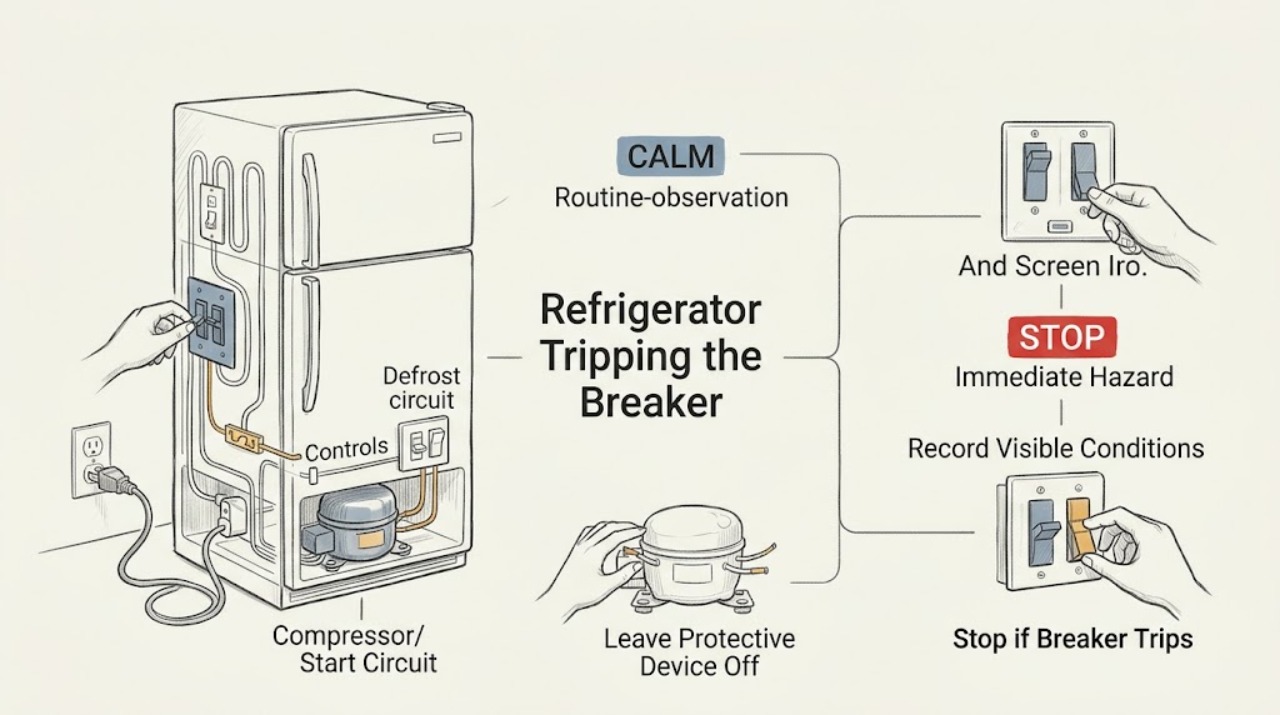
Treat a Daewoo refrigerator that trips a breaker as an electrical fault to isolate, not as a resettable refrigerator error. Do not keep turning the breaker back on or use a larger fuse or breaker. From a dry, safe position, note whether the trip happened when the refrigerator started, after it had run, during defrost, or after water was present, then leave the circuit off if it trips again or if the plug, cord, outlet, or refrigerator is hot, wet, scorched, sparking, or smells burned. Daewoo manuals require a properly installed supply, warn against damaged plugs, extension leads, adapters, and trapped cords, and tell owners to disconnect power before cleaning; Electrical Safety Foundation guidance says repeated trips can indicate a defect that may cause fire or shock and calls for immediate disconnection and repair. Do not open the rear cover, test live wiring, replace a start device, inspect the defrost heater, or work on the compressor or controls. A qualified appliance technician should diagnose the refrigerator, and a qualified electrician should inspect a hot, damaged, wet, or repeatedly tripping circuit.
Before you begin
Safety first
- The user may stop use, observe from a dry distance, leave a protective device off, document timing, and make safe external visual observations. Internal wiring, compressor and start components, defrost heater, fan, controls, insulation, water-connected electrical parts, and sealed-system work are for qualified service personnel.
Work through in order
Diagnostic checks
Use only checks that match the exact appliance or system and its official guide.
-
Check 1
Stop using the refrigerator and observe from a dry, safe position. Without touching the appliance, plug, or outlet, look for smoke, sparks, arcing, a burning smell, a hot or melted plug, a damaged cord, water on the floor, or water near the outlet or electrical parts.
Expected result: There is smoke, a spark, a burning odor, unusual heat, visible damage, water near electrical equipment, or no immediate hazard is visible.
Next step: If there is fire or spreading smoke, leave the area and contact local emergency services. Otherwise keep clear and, only if it can be reached without crossing water or approaching the hazard, switch off power at a safe upstream isolation point. Do not restart the refrigerator.
Stop if: Do not touch a wet plug or appliance, cross water to reach the panel, or pull a plug from a sparking or hot outlet.
Why this matters
Why: Smoke, heat, arcing, burning odor, or water near electrical equipment is an immediate shock or fire risk. The absence of a visible sign does not make a repeated trip safe to test.
-
Check 2
If the breaker or RCD has tripped, leave it in its protective state and note whether this was the first event or a repeat. Record what else lost power and whether the Daewoo was connected through a wall outlet, extension lead, adapter, or shared circuit. Do not reset the device repeatedly, replace a fuse, or fit a higher-rated protective device.
Expected result: The trip is repeated, only the refrigerator circuit is affected, several appliances share the circuit, or the protective device does not remain on.
Next step: Keep the refrigerator out of service and arrange qualified appliance service; request electrical inspection when the circuit, outlet, or protective device is also implicated. Protect perishable food without moving a wet or damaged appliance.
Stop if: Do not cycle the breaker to see whether the refrigerator starts, bypass the protective device, or alter the circuit rating.
Why this matters
Why: Repeated or immediate trips can indicate a refrigerator fault, an overloaded circuit, leakage, damaged wiring, or a protective-device issue. A larger fuse or breaker would remove protection rather than correct the fault.
-
Check 3
Using only the history of the event and observations from outside, record whether the trip happened immediately when the refrigerator was connected or started, after several minutes of cooling, after a door or water function was used, or after a defrost period. Note whether the display, interior light, and cooling stopped before the trip.
Expected result: The trip occurred at startup, after a run period, after water or defrost activity, or at an inconsistent time.
Next step: Give the timing and any display or cooling change to the technician. Do not reproduce the event by reconnecting or cycling power.
Stop if: Do not hold a door switch, run a water or ice cycle, enter a service mode, or make a live current or voltage measurement.
Why this matters
Why: Startup timing can make a compressor/start path or supply issue more relevant; a delayed trip can involve a heating, defrost, fan, moisture, or insulation fault; water-related timing raises a leakage or dispenser/valve concern. Timing narrows the service diagnosis but does not identify a part.
-
Check 4
Only while power remains isolated and from an accessible dry position, visually inspect the plug, cord, outlet face, and any visible extension or adapter for looseness, scorch marks, melting, pinching, fraying, or moisture. Confirm from the model manual that the appliance is intended for the available supply; do not remove an outlet cover or open the refrigerator.
Expected result: The cord or plug is damaged, the outlet is hot or scorched, the cord is trapped or pinched, an extension/adapter is being used, moisture is visible, or the accessible supply looks intact.
Next step: Keep the appliance disconnected. Arrange an electrician for a damaged, hot, wet, or suspect outlet or fixed wiring, and arrange appliance service for a refrigerator fault. Do not substitute another cable or outlet as a test.
Stop if: Do not touch exposed conductors, tighten live terminals, change a fuse or breaker rating, or use an extension lead to bypass the outlet.
Why this matters
Why: A damaged cord, poor connection, extension/adapter, or moisture can create a supply-side fault and must be corrected by an appropriately qualified person. An intact exterior does not clear the refrigerator's internal circuits.
-
Check 5
Without moving the refrigerator, inspect the accessible floor and front or side edges for water, a wet mat, condensation running toward the outlet, or a visibly damaged water connection. For a freestanding model, note whether the cabinet is stable and the cord is trapped; for a built-in or plumbed model, do not pull it out to reach the rear.
Expected result: Water is present or has reached the outlet area, the cord is trapped, the cabinet is unstable, or the visible installation is dry and undamaged.
Next step: Keep power off and, only from a dry accessible location, close a clearly reachable water shutoff if the model has one. Arrange appliance and electrical service as appropriate; do not move the refrigerator or wipe inside electrical areas while connected.
Stop if: Do not cross water, handle wet electrical parts, remove rear panels, or work on the water circuit or refrigerant tubing.
Why this matters
Why: Water near electrical equipment or a trapped cord can explain a protective trip and creates an immediate safety boundary. An unstable or poorly positioned cabinet can damage a cord or connection, but a dry exterior does not rule out an internal leak or electrical fault.
-
Check 6
Find the exact Daewoo model and prepare a service report containing the trip count, timing, affected circuit, cooling status, visible cord or water evidence, and any error or alarm shown before power was isolated. Do not open the cabinet or test the compressor, start device, defrost system, fan, control board, or wiring.
Expected result: The refrigerator trips again when professionally assessed, remains dead after the trip, shows a cooling or alarm change, or has no obvious external supply cause.
Next step: Leave the refrigerator out of service and arrange qualified Daewoo appliance diagnosis. If the outlet, cord, fixed wiring, breaker/RCD, or water-connected electrical area is implicated, arrange electrical inspection as well.
Stop if: Do not re-energize for a home test, bypass protection, probe live parts, replace an internal component, or open the sealed cooling system.
Why this matters
Why: An internal compressor/start, defrost, fan, control, wiring, insulation, or moisture fault is possible, but a breaker symptom cannot safely identify the failed assembly. A supply-side fault may still be present even when the refrigerator is the only appliance that trips the circuit.
Use your observations
Decision map
Find the observation that best matches what you see, then follow the next safe action.
-
PATH 01Safety boundary
What you see
Smoke, sparks, arcing, burning odor, hot or melted plug, damaged cord, water near electrical parts, or a wet floor near the outlet is present.
Do this next
Keep people away and isolate power only from a dry, safe position that does not require crossing water or approaching the hazard. Do not restart; arrange urgent qualified appliance or electrical help.
Why this path and its safety boundary
Why it matters: The immediate shock or fire risk overrides any attempt to classify the refrigerator fault.
Safety stop: Do not touch wet electrical equipment, pull a hot plug, or continue troubleshooting at the appliance.
-
PATH 02Safety boundary
What you see
The breaker or RCD trips again, trips immediately on connection or startup, or will not remain on after the fault event.
Do this next
Keep the protective device and refrigerator out of service. Give the technician the exact model and trip timing; use an electrician when the circuit or outlet is also affected.
Why this path and its safety boundary
Why it matters: A refrigerator fault, overload, leakage, damaged wiring, or protective-device problem is more likely than a harmless transient.
Safety stop: Do not keep resetting, use a larger fuse or breaker, or connect through an extension lead.
-
PATH 03Safety boundary
What you see
The cord, plug, outlet, extension, adapter, or accessible installation is damaged, hot, loose, wet, or visibly trapped, while the refrigerator itself has not been safely assessed.
Do this next
Leave power isolated and arrange qualified electrical inspection. Have the appliance checked before it is returned to service, especially if water or cord damage was present.
Why this path and its safety boundary
Why it matters: A supply-side or installation fault can trip protection and can damage the appliance; replacing an internal refrigerator part would not correct it.
Safety stop: Do not repair terminals, change the receptacle, alter the protective device, or use a different outlet as a live test.
-
PATH 04Safety boundary
What you see
The trip happened after the refrigerator ran for a while, or followed defrost, water dispensing, ice making, or another normal operating event, with no visible external damage.
Do this next
Do not reproduce the cycle. Leave the refrigerator disconnected and provide the timing, cooling status, and model documentation to qualified service.
Why this path and its safety boundary
Why it matters: A load that appears only during a later cycle—such as a defrost, fan, water, control, or compressor-related circuit—becomes more relevant, but the symptom does not identify which component failed.
Safety stop: Do not access a heater, fan, valve, control board, or wiring to confirm the cycle fault.
-
PATH 05Safety boundary
What you see
The event was isolated, there is no visible cord, outlet, or water damage, but the refrigerator remains without power or the breaker has tripped more than once.
Do this next
Keep the refrigerator out of service and request appliance diagnosis, with electrical inspection if the protective device or circuit behavior is abnormal. Protect food using a safe alternative appliance.
Why this path and its safety boundary
Why it matters: A hidden appliance or circuit fault remains possible; a clean exterior does not make repeated re-energizing safe.
Safety stop: Do not assume the breaker is defective, bypass it, or replace the compressor, control, or wiring based on the symptom alone.
Helpful context
Understand the symptom
A breaker trip is a protective event, not a diagnosis
A single trip can follow an overload or a fault, but a second trip after the refrigerator is re-energized is not a reason to keep experimenting. The safe first distinction is whether the refrigerator was the only affected appliance and whether the trip occurred at startup, after running, or when moisture or defrost activity was present. A refrigerator that trips repeatedly may have an appliance fault or a supply fault; the breaker itself cannot identify which internal part failed.
Use the exact Daewoo model and its electrical environment
Daewoo sells different refrigerator architectures and feature sets. An official current product page lists a freestanding side-by-side model with an inverter compressor, electronic controls, automatic no-frost defrosting, and a water dispenser, while the opened Daewoo manual covers a particular refrigerator family and its own supply and safety instructions. Record the model from the rating label and do not substitute a fuse rating, breaker rating, wiring diagram, or diagnostic sequence from another Daewoo family.
Keep water, refrigerant, and internal electrics closed
A wet floor, leaking water line, damaged cord, or moisture near the outlet changes this from a simple power observation to a shock and fire concern. Daewoo's manual warns not to let water reach electrical components, not to damage the refrigerant circuit, and to disconnect power before cleaning. Do not pull a built-in or loaded refrigerator, remove covers, puncture tubing, or test energized parts to locate the trip.
Safety boundary
Stop conditions
- Stop immediately for smoke, sparks, arcing, burning odor, a hot or melted plug, a damaged cord, water near electrical parts, or a wet floor near the outlet; isolate power only from a dry, safe position.
- Do not repeatedly reset the breaker or RCD, replace a fuse, install a larger protective device, or bypass electrical protection.
- Do not use an extension lead, adapter, damaged outlet, damaged cord, or wet connection to restore refrigerator operation.
- Do not remove panels, probe live wiring, access the compressor/start device, defrost heater, fan, control board, or water valve, or open the sealed cooling system.
- Do not move a loaded or built-in refrigerator to reach rear plumbing or electrical parts; use qualified appliance and electrical service.
Only after diagnosis
Potential parts
- power cord, plug, or outlet connection
Consider this category only if an electrician or appliance technician finds visible heat, damage, looseness, or a failed connection at the supply path.
The correct cord, plug, outlet, and local supply depend on the exact model and installation; do not substitute a cable or change a protective device as a test. - compressor start or inverter-drive assembly
Consider this category only after qualified diagnosis links a startup trip or compressor circuit fault to the model's start or drive assembly.
Compressor and drive arrangements vary across Daewoo refrigerator families; a breaker symptom does not establish fit or failure. - defrost heater or defrost control
Consider this category only when a delayed trip is professionally reproduced or traced to the defrost circuit rather than the supply or another load.
Automatic and other defrost arrangements vary by model; do not access the heater or control while connected. - main control board, fan, or water-valve assembly
Consider these categories only after qualified testing identifies the affected operating circuit, particularly when the trip follows fan, water, ice, or control activity.
Feature availability and assembly fitment vary by Daewoo model; confirm the exact service documentation before ordering.
When checks do not resolve it
Need a professional?
Arrange qualified Daewoo appliance service after any repeated or immediate breaker trip, a trip linked to startup, defrost, water, or cooling operation, loss of cooling after the event, or any unresolved trip with no safe external cause. Arrange electrical inspection as well when the outlet, cord, fixed wiring, breaker/RCD, or water-near-electric area is hot, wet, damaged, scorched, or also affects other appliances.
Safety scope: The user may stop use, observe from a dry distance, leave a protective device off, document timing, and make safe external visual observations. Internal wiring, compressor and start components, defrost heater, fan, controls, insulation, water-connected electrical parts, and sealed-system work are for qualified service personnel.
Common questions
FAQ
Why does my Daewoo refrigerator keep tripping the breaker?
A repeated trip can come from the refrigerator, its cord or plug, the outlet, the branch circuit, or the protective device. Startup timing, a delayed trip during cooling or defrost, water near the appliance, or visible heat changes the service diagnosis, but none identifies a part safely. Leave it disconnected and arrange qualified appliance or electrical inspection rather than repeatedly resetting the breaker.
Should I reset the breaker after my Daewoo refrigerator trips?
Do not keep resetting it to test the refrigerator. Leave the protective device in its tripped or off state, especially if the trip repeats or there is heat, smoke, an odor, visible damage, or water. A qualified person can determine whether the refrigerator or the circuit is at fault before power is restored.
Can a damaged Daewoo refrigerator cord or outlet cause a breaker trip?
Yes. Daewoo's manual warns against damaged or trapped cords, damaged plugs, extension leads, adapters, and improperly installed supplies. Inspect only from a dry, unpowered, accessible position; if the cord, plug, or outlet is hot, scorched, loose, wet, or damaged, leave it isolated and arrange electrical inspection.
What if the breaker trips only when the Daewoo refrigerator starts?
Startup timing makes the compressor/start or inverter-drive path and the supply more relevant, but it does not prove either is defective. Do not reconnect the refrigerator to reproduce the event. Record the timing and model, leave power isolated, and have qualified service diagnose the appliance and circuit.
Could water or defrosting make a Daewoo refrigerator trip?
It is possible for a delayed trip to involve a water-connected circuit, moisture, defrost, fan, control, or another load, but an external symptom cannot identify which one. Look only for visible water from a dry safe position; do not move the refrigerator, open panels, touch a heater or valve, or use a live test. Keep it disconnected and call qualified service.
Read the exact guide
Official sources
- FLS396FDR0UA / FLS396FLR0UA User ManualDaewoo Electronics · Specific Daewoo refrigerator family; supply, controls, defrost, and service instructions must be checked against the user's exact model.
- Understanding Your Home Electrical SystemElectrical Safety Foundation International · General household circuit guidance; it does not diagnose a Daewoo refrigerator or authorize appliance disassembly.
- DAEWOO CSMSBS2ELVA2 90 CM Side by Side with E Class, 532 L RefrigeratorDaewoo · Specific Daewoo side-by-side model; used to establish that controls, defrost, water features, inverter compressor, and electrical characteristics vary by model.
- Appliance Safety TipsElectrical Safety Foundation International · General household electrical safety guidance, not a Daewoo service manual; local electrical requirements and qualified assessment control.
Community feedback
Share a repair observation
Share a plain-text repair observation. Accepted observations are published automatically; this page may take a moment to update.