
On this page
Start here
Quick answer
The “Dansby” name in the question appears to refer to Danby. Danby’s official record identifies the DDW1899BLS-1 as a discontinued 18-inch dishwasher, and its owner guide specifically links odors to food trapped in the seals, moisture left inside, infrequent use, and a filter or drain that is not being maintained. Start with the complete model label, then inspect and rinse the filter assembly, wipe the door edge and seal with a damp cloth, check for standing water and a slow sink drain, and leave the door only slightly ajar after a wash when that is safe in a small apartment. Do not spray cleaner into the door lock or electrical area, mix chemicals, or remove panels to chase the smell.
Before you begin
Safety first
- Do not spray cleaner into the door lock or electrical area, mix cleaning chemicals, touch the heating element after a cycle, pull the unit out to reach wiring, or operate it with enclosure panels removed.
Work through in order
Diagnostic checks
Use only checks that match the exact appliance or system and its official guide.
-
Check 1
Read the dishwasher rating label and compare the complete model suffix with the task’s DDW1899BLS identity before applying the owner guide. Record whether the label shows DDW1899BLS or DDW1899BLS-1.
Expected result: The label confirms the DDW1899BLS family, or it identifies another Danby model.
Next step: If the family matches, continue with the checks below. If it does not, stop model-specific cleaning instructions and use the manual for the actual label or Danby support.
Why this matters
Why: The opened Danby product page and manual are for the DDW1899BLS-1 family. A different label would make the exact filter, seal, and cycle instructions uncertain.
-
Check 2
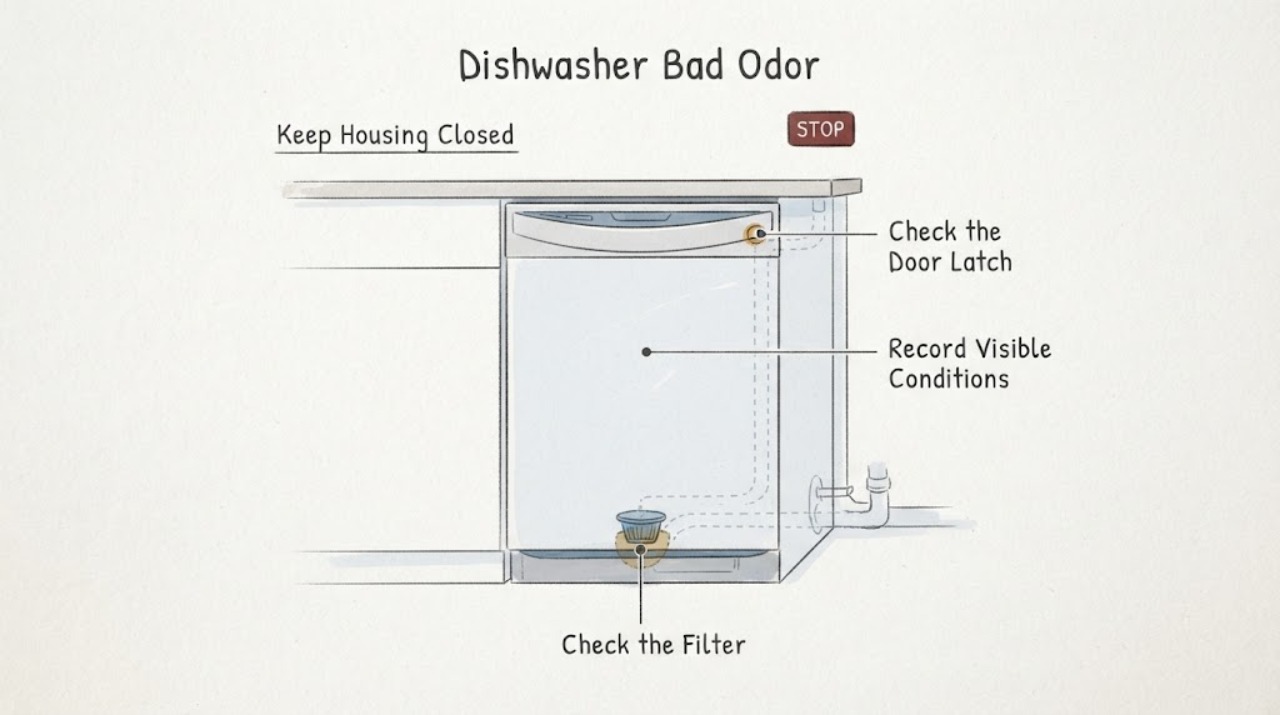
With the dishwasher stopped and cool, inspect the filter assembly and visible sump area for food residue or obstructions. Remove and rinse the filter components only as the owner guide describes, then reinstall them in their original positions.
Expected result: Food residue or an obstruction is present, or the filters are visibly clear.
Next step: Rinse away visible residue and monitor the next cycle. If the filter is damaged, will not seat, or odor and standing water persist, stop short of removing internal parts and arrange service.
Why this matters
Why: Danby says the filters retain soil and food residue and should be inspected for obstructions and cleaned under running water. Residue can contribute to a bad smell, but a clear filter does not rule out a seal or drain issue.
-
Check 3
Wipe the door edge and rubber seal with a soft warm damp cloth, looking for trapped food or a sour residue. Do not spray cleaner toward the latch, door lock, or electrical area.
Expected result: Residue is trapped in the seal, or the seal and door edge are clean but the odor remains.
Next step: Remove only the visible residue with the damp cloth. If the seal is torn, loose, or remains odorous after cleaning, request service rather than applying adhesive or removing the door.
Why this matters
Why: Danby identifies food trapped in the seals as one cause of odor and directs periodic cleaning with a damp sponge. The guide also warns that spray cleaner can penetrate the door lock and electrical components.
-
Check 4
After the next safe cycle, look for water left in the tub and check whether the kitchen sink drains normally. Keep the check external; do not pull the dishwasher out or open its junction box.
Expected result: Water remains beyond the normal small amount around the tub outlet, the sink drains slowly, or the tub is clear and the sink drains normally.
Next step: Correct only a visible sink/drain obstruction within normal household maintenance and reassess. For persistent standing water, leak, sewage-like odor, or an unclear connection, stop using the dishwasher and contact Danby service or a qualified technician.
Why this matters
Why: Danby says a small amount of clean water at the outlet can lubricate the seal, but water that does not pump out points to a clogged drain path and the sink should drain well.
-
Check 5
Vent the dishwasher after washing by leaving the door only slightly ajar when the apartment layout makes that safe; if the unit is rarely used, run a regular rinse/empty cycle as directed by the guide.
Expected result: The odor decreases with drying and regular use, or it returns quickly despite a clean filter, seal, and clear visible drain behavior.
Next step: Continue the safe drying routine if effective. If the smell returns, is sewage-like, or is accompanied by a leak or abnormal drain behavior, stop and arrange service.
Why this matters
Why: Danby says moisture trapped after washing and infrequent use can contribute to odor, and recommends a slightly ajar door plus weekly fill-and-pump-out for an infrequently used unit. A persistent odor after these checks needs a service diagnosis rather than stronger chemicals.
Use your observations
Decision map
Find the observation that best matches what you see, then follow the next safe action.
-
PATH 01Next step
What you see
Food residue is visible in the filter or door seal and there is no standing water or leak.
Do this next
Rinse the filter, wipe the seal with a damp cloth, reinstall the filter correctly, and monitor one normal cycle.
Why this path and its safety boundary
Why it matters: The supported evidence points first to a cleanable odor reservoir rather than a confirmed internal component failure.
-
PATH 02Next step
What you see
The filter and seal are clean but water remains in the tub or the kitchen sink drains slowly.
Do this next
Address only the visible sink/drain issue that is safe to access. If standing water continues, stop using the dishwasher and request qualified service.
Why this path and its safety boundary
Why it matters: A drain-path issue is more plausible than an odor-only problem; Danby’s troubleshooting table distinguishes normal small seal water from water that does not pump out.
-
PATH 03Next step
What you see
The machine is used rarely and the smell improves when it is dried and run regularly.
Do this next
Keep the door slightly ajar only where it is safe and not a trip hazard, and follow the guide’s regular fill-and-pump-out advice.
Why this path and its safety boundary
Why it matters: That pattern is consistent with Danby’s moisture and infrequent-use guidance and does not prove a failed pump, heater, or seal.
-
PATH 04Next step
What you see
The odor is sewage-like or persists after the filter, seal, drying, and visible drain checks, or there is a leak.
Do this next
Stop using the dishwasher if water is leaking or remains dirty, keep detergent and standing water away from children, and arrange Danby or qualified appliance service.
Why this path and its safety boundary
Why it matters: The official user-level checks have not resolved the problem; an internal drain, seal, installation, or plumbing issue cannot be identified safely from odor alone.
Helpful context
Understand the symptom
Confirm the Danby identity before cleaning
The title spells the brand “Dansby,” but the supplied model and the opened official records point to Danby. Danby’s page identifies the DDW1899BLS-1 as an 18-inch dishwasher, while the linked owner guide has the same model family on its cover. Keep the task identity as DDW1899BLS, but read the complete label and suffix before following a model-specific service instruction. The small footprint explains the apartment context; it does not change the cleaning or safety limits.
Remove the common odor reservoirs
Danby’s guide identifies several low-risk places for odor to persist: food residue in the door seals, soil held by the filter assembly, and moisture trapped after a wash. Inspect the filter area and door edge only with the appliance in a safe, unpowered state. Use a damp cloth on the seal and door edge, and rinse the removable filter components under running water as the guide describes. Do not spray into the latch or electrical area.
Treat standing water as a drain clue
A small amount of clean water around the tub outlet can be normal for the seal, but the manual treats water that does not pump out as a drain-path problem and directs the owner to check whether the kitchen sink drains well. In an apartment, check the visible sink/disposal connection and the sink’s own drainage behavior without pulling the dishwasher out or opening its junction box. Persistent standing water, a leak, or a sewage-like odor belongs with Danby service or a qualified appliance technician.
Keep the interior dry between cycles
After a wash, Danby recommends turning off the water supply and leaving the door slightly ajar so moisture and odors are not trapped. In a small apartment, open it only enough to vent and only when the doorway is not a trip hazard. If the machine is used infrequently, the guide says to fill and pump it out weekly to keep the seal moist; if odor remains, use an empty cycle or a dishwasher-specific cleaning product rather than improvised chemical mixtures.
When checks do not resolve it
Need a professional?
Arrange Danby or qualified appliance service when the odor persists after the documented filter, seal, drying, and visible drain checks; when the seal is damaged; when water remains beyond the normal small amount; or when there is a leak or sewage-like odor.
Safety scope: Do not spray cleaner into the door lock or electrical area, mix cleaning chemicals, touch the heating element after a cycle, pull the unit out to reach wiring, or operate it with enclosure panels removed.
Have this ready
- Provide the complete model suffix, odor timing, whether water remains in the tub, the filter/seal findings, and whether the sink drains normally.
Common questions
FAQ
Is the bad smell caused by the small apartment?
The apartment size does not identify the cause. Danby’s guide points instead to food in the seals, moisture trapped after washing, infrequent use, and filter or drain maintenance. Vent the door slightly only when that is safe for the room layout.
Can I spray cleaner around the dishwasher door?
Danby says to use a soft warm damp cloth on the door edge and warns against spray cleaner near the door lock and electrical components. Use only a dishwasher-specific cleaning product as directed by its label, and do not mix products.
Is a little water in the bottom always a blockage?
No. Danby says a small amount of clean water around the tub outlet can keep the seal lubricated. Water that does not pump out, dirty standing water, a slow sink drain, or a leak needs drain checking and possibly service.
Read the exact guide
Official sources
- DDW1899BLS EFOM.qxp — Owner’s Use and Care GuideDanby · Danby DDW1899BLS-1 dishwasher operation, care, odor prevention, filters, seals, drain checks, and safety boundaries
- Danby Designer 8 Place Setting Dishwasher - DDW1899BLS-1Danby · Danby DDW1899BLS-1 dishwasher identity, compact size, manual link, and service scope
- Service & Support — Danby AppliancesDanby Appliances · Danby manuals, service requests, and support routing
Community feedback
Share a repair observation
Share a plain-text repair observation. Accepted observations are published automatically; this page may take a moment to update.