
On this page
Start here
Quick answer
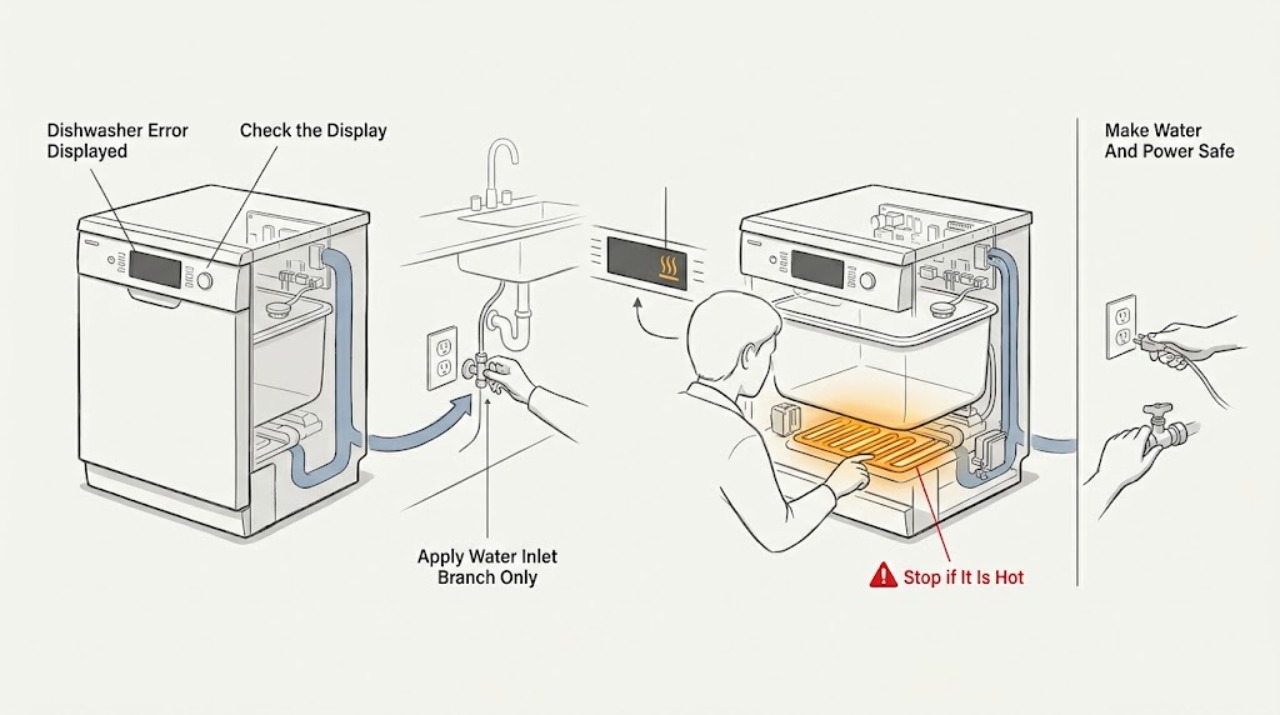
Do not diagnose a Danby dishwasher error from the code alone: first photograph the display and read the full model number from the rating label. Danby's official DDW631WDB/DDW631SDB manual assigns E1 to insufficient water, E3 to a temperature problem, E4 to overflow, and Ed to a control-board communication fault; a separate DDW18D1 series manual instead uses FF for a water-inlet warning and F1 for an overflow warning. Those code sets are model-specific and must not be merged into a universal Danby table. With water and power made safe, use only the matching manual for external checks such as a fully closed door, open water supply, visible inlet or drain-hose restriction, and an accessible filter. If water is leaking, the code returns after the manual's permitted reset, or the code points to heating, a pump, a sensor, or the control board, stop the dishwasher and arrange qualified service. Do not remove panels, reach into live wiring, bypass a door or water sensor, or test the heater, pump, or control board.
Before you begin
Safety first
- The user may identify the model, photograph the code, make the area safe, check an accessible water valve/hose/door closure, inspect an accessible filter when the exact manual permits it, and perform a model-documented one-time power reset. Inlet valves, pumps, heaters, sensors, control boards, wiring, interlocks, and live electrical testing are for qualified service personnel.
Work through in order
Diagnostic checks
Use only checks that match the exact appliance or system and its official guide.
-
Check 1
Before resetting or clearing the display, photograph the exact code, symbols, and any flashing indicators. Read the complete model number and serial information from the rating label on the door edge, frame, or appliance body, and note whether the dishwasher is portable, countertop, or built-in.
Expected result: The code and full model are known, only a generic warning is visible, or the model cannot be read.
Next step: Search Danby's official manual lookup by SKU and use the manual matching the label. If water, smoke, burning odor, or a damaged cord is present, follow the stop boundary before any further check.
Stop if: Do not apply a code table from another Danby model or erase the only evidence by repeated resets.
Why this matters
Why: A model-specific manual is required because Danby uses different code sets across dishwasher families. An unreadable model makes a code interpretation unsafe rather than a reason to guess from a similar-looking panel.
-
Check 2
If there is standing water, an overflow indication, a leak, a wet plug, a damaged cord, smoke, or a burning odor, stop the cycle. From a dry, safe position, disconnect power and close the water supply if the installation allows it without reaching into the appliance.
Expected result: No leak or electrical hazard is present, or water is escaping, the plug/cord is wet or damaged, or the unit trips protection.
Next step: Keep the dishwasher out of service and arrange qualified service for any leak, wet electrical area, damaged cord, smoke, odor, or repeated trip. If the area is dry and safe, continue with the model-matched external branch.
Stop if: Do not touch wet plugs, continue a leaking cycle, reset a breaker repeatedly, or remove the kick plate to reach wiring or a pump.
Why this matters
Why: An overflow warning and a live electrical hazard require different priorities from a dry inlet warning. Water near electrics or repeated protection trips can make further operation unsafe even if a reset might clear a display.
-
Check 3
If the exact manual maps the code to water entering the machine—such as E1 on DDW631WDB/DDW631SDB or FF on the DDW18D1 series—check only the accessible water supply valve, hose connection, and obvious external kink or restriction. Confirm the door closes and latches normally; do not dismantle the inlet valve.
Expected result: The water valve is closed, the hose is kinked, the door does not latch, water enters after the external correction, or the code returns with supply and closure normal.
Next step: Correct only the accessible supply or closure issue and run one model-permitted test. If the code returns, stop using the dishwasher and request service.
Stop if: Do not remove the inlet valve, bridge a door switch, bypass a flow sensor, or run the appliance with a leaking connection.
Why this matters
Why: A closed supply, restricted hose, or door-latch condition can explain a model-documented inlet warning. A recurring code after those checks may involve the inlet valve, flow sensing, wiring, or control and is not identified by the code alone.
-
Check 4
If the matching manual maps the code to overflow or a drain warning—such as E4 on DDW631WDB/DDW631SDB or F1 on the DDW18D1 series—stop the cycle and look only for accessible standing water, a visibly kinked external drain hose, or an accessible filter blockage described by that manual. Do not reach below the tub or remove the pump cover.
Expected result: There is standing water or a visible external drain restriction, the accessible filter is blocked, or the code persists with no external obstruction.
Next step: Make only the manual-approved external correction with power isolated, then perform at most one permitted test. If water remains, leaks, or the code returns, keep the water supply closed and arrange service.
Stop if: Do not bail water into electrical areas, dismantle the pump, probe the level sensor, or continue a cycle that is overflowing.
Why this matters
Why: A drain restriction can be consistent with the model's overflow warning. Persistent overflow indication without an accessible cause can involve the drain pump, level sensor, hose connection, or control and needs professional diagnosis.
-
Check 5
For a code that the matching manual ties to temperature or control communication—E3 or Ed on DDW631WDB/DDW631SDB—do not attempt to test the heater, temperature sensor, pump, or control board. If the exact manual permits a power reset, perform that reset once with the appliance dry and safely disconnected, then record whether the same code returns.
Expected result: The code clears and the dishwasher completes a normal cycle, or the code returns, the cycle stops, the unit does not heat, or the controls remain abnormal.
Next step: If the code returns or the cycle remains abnormal, leave the dishwasher out of service and give the technician the model, code, program, stage, and reset result.
Stop if: Do not open the control panel, test live circuits, bypass sensors, replace a heater or board, or repeatedly reset a persistent code.
Why this matters
Why: A one-time cleared display does not identify or prove repair of a temperature/control fault. A recurring code or failed cycle is more consistent with an internal heater, sensor, wiring, or control problem.
Use your observations
Decision map
Find the observation that best matches what you see, then follow the next safe action.
-
PATH 01Safety boundary
What you see
A Danby error is visible but the full model cannot be read, or the code is not present in the matching manual.
Do this next
Preserve the display evidence, identify the SKU from the rating label or retailer records, and use Danby's official manual lookup before trying a reset.
Why this path and its safety boundary
Why it matters: The symptom is under-specified; a brand-level code mapping would risk applying another model's meaning.
Safety stop: Do not guess from a similar control panel or substitute a code meaning from another Danby family.
-
PATH 02Safety boundary
What you see
The identified model is DDW631WDB/DDW631SDB with E1, or a DDW18D1-series model with FF, and the area is dry with no leak.
Do this next
Check the accessible water supply, hose, and normal door latch once. If the warning returns, stop and arrange service.
Why this path and its safety boundary
Why it matters: The matching manual treats the display as a water-inlet warning, but the code does not distinguish a closed supply from an inlet valve or sensing fault.
Safety stop: Do not dismantle or electrically test the inlet valve or flow sensor.
-
PATH 03Safety boundary
What you see
The identified model is DDW631WDB/DDW631SDB with E4, or a DDW18D1-series model with F1, and overflow or standing water is present.
Do this next
Stop the cycle, isolate water and power safely, perform only the manual-approved external inspection, and call service for persistent water or a returning code.
Why this path and its safety boundary
Why it matters: The model-specific manual points to overflow/drain behavior; a visible hose or accessible filter restriction is possible, but a pump or level-sensing fault remains possible.
Safety stop: Do not run through an overflow, remove the pump, or reach below the tub into wiring.
-
PATH 04Safety boundary
What you see
The identified DDW631WDB/DDW631SDB shows E3 or Ed, or any model displays a code tied by its own manual to temperature, sensor, or control communication, and external supply/water checks are normal.
Do this next
Use the matching manual's one-time reset only if permitted; if the code returns or the cycle fails, keep the dishwasher out of service and arrange qualified diagnosis.
Why this path and its safety boundary
Why it matters: An internal heater, sensor, control board, wiring, or communication fault is more likely than a user-correctable inlet or drain condition.
Safety stop: Do not test or replace internal heating, pump, sensor, board, or wiring components yourself.
-
PATH 05Safety boundary
What you see
The code returns after the model-permitted external checks or reset, or the dishwasher leaks, trips protection, smells burnt, smokes, or has a damaged cord.
Do this next
Stop using the appliance, isolate power/water only when safe, preserve the model and code information, and contact Danby support or a qualified appliance service provider.
Why this path and its safety boundary
Why it matters: A persistent fault or safety hazard cannot be resolved safely by code clearing and may involve an internal pump, heater, sensor, control, or wiring issue.
Safety stop: Do not repeatedly reset, continue a leaking cycle, or open the cabinet.
Helpful context
Understand the symptom
The code is not enough without the model
Danby's official manual lookup is organized by SKU. That matters because the DDW631WDB/DDW631SDB manual documents E1, E3, E4, and Ed, while the DDW18D1 series manual documents FF and F1. A code that means an inlet warning on one family can have no meaning on another. Photograph the display before switching the unit off and record the exact model, not just the Danby brand.
Use the code to choose a safe external check
Once the family is confirmed, follow only that manual's external checks. In the DDW631 manual, E1 is tied to water entering the machine, E4 to overflow, E3 to reaching the correct temperature, and Ed to a control-board communication fault. In the DDW18 manual, FF is a water-inlet warning and F1 is an overflow warning. Water-supply and drain observations are different from a heating or control fault and should not be treated as interchangeable.
Reset only when the matching manual permits it
Both cited Danby manuals describe a power reset for a displayed error, but their model families and instructions are separate. Disconnect power only from a dry, safe position and use the exact manual's waiting instruction; if the code persists or the dishwasher leaks, leave it out of service. A reset is not a repair and does not authorize opening the base, checking a pump, or testing electrical parts.
Safety boundary
Stop conditions
- Stop the dishwasher for leaking or overflowing water, smoke, burning odor, a damaged or wet cord/plug, abnormal heat, or repeated breaker/RCD trips; isolate water and power only from a safe, dry position.
- Do not merge Danby error codes across models. E1/E3/E4/Ed belong to the cited DDW631 family, while FF/F1 belong to the cited DDW18D1 family; other models may use different codes or none at all.
- Do not bypass a door latch, water-level/flow sensor, overflow sensor, or other interlock, and do not run the unit with a leak or missing safety component.
- Do not open the base or control panel, test live wiring, or work on the inlet valve, drain pump, heater, temperature sensor, control board, or harness.
- Do not repeat a power reset to hide a returning code. Record the model, code, cycle, water state, and reset result for service.
When checks do not resolve it
Need a professional?
Contact Danby support or a qualified dishwasher service provider when the exact model's error code is not documented, a code returns after the matching manual's permitted external check or one-time reset, water remains or leaks, or the code indicates heating, sensor, pump, or control-board behavior. Provide the full model and display evidence because Danby code meanings vary by model family.
Safety scope: The user may identify the model, photograph the code, make the area safe, check an accessible water valve/hose/door closure, inspect an accessible filter when the exact manual permits it, and perform a model-documented one-time power reset. Inlet valves, pumps, heaters, sensors, control boards, wiring, interlocks, and live electrical testing are for qualified service personnel.
Common questions
FAQ
Are Danby dishwasher error codes universal?
No. Danby's DDW631WDB/DDW631SDB manual uses E1, E3, E4, and Ed, while the DDW18D1 series uses FF and F1 with different meanings. Identify the full model and use its matching manual before interpreting a code.
What does E1 mean on a Danby dishwasher?
In the official DDW631WDB/DDW631SDB manual, E1 means not enough water is getting into the unit. That meaning is not a brand-wide Danby rule. Check the matching manual and, if the supply and door are normal but E1 returns, arrange service.
What do FF and F1 mean on a Danby dishwasher?
In the official DDW18D1EW/DDW18D1EB/DDW18D1ESS manual, FF is a water-inlet warning and F1 is an overflow warning. Do not transfer those meanings to another Danby model; use the exact SKU manual.
Can I reset a Danby dishwasher error code?
Some Danby manuals describe a one-time power reset, but the waiting instruction and applicable model family must be confirmed first. Disconnect power only from a dry, safe position. If the code returns, the dishwasher leaks, or the code indicates heating, sensing, pump, or control behavior, stop using it and arrange qualified service.
Read the exact guide
Official sources
- Danby DDW18D1EW / DDW18D1EB / DDW18D1ESS Owner's ManualDanby · DDW18D1 series only; its FF and F1 meanings must not be applied to other Danby models.
- Dishwashers FAQsDanby Appliances · General Danby dishwasher guidance; the owner manual controls model-specific errors and procedures.
- Customer SupportDanby Appliances · Support route; availability and service options depend on model and market.
- Danby DDW631WDB / DDW631SDB Owner's ManualDanby · DDW631WDB/DDW631SDB only; its E1, E3, E4, and Ed meanings must not be applied to other Danby models.
- Product ManualsDanby Appliances · Manual navigation resource; the matching SKU manual controls the error interpretation.
Community feedback
Share a repair observation
Share a plain-text repair observation. Accepted observations are published automatically; this page may take a moment to update.