
On this page
Start here
Quick answer
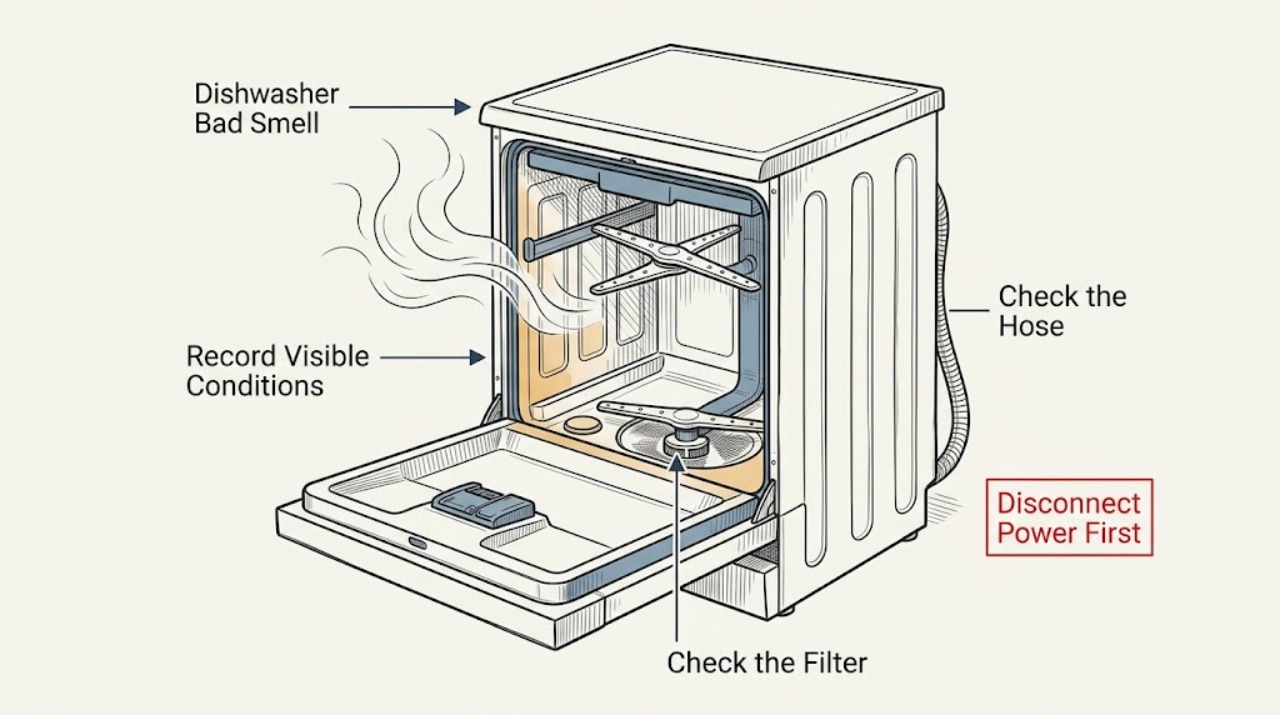
A bad smell in a Danby dishwasher usually starts with trapped food in the filter, sump, spray arms, or door seal, or with water and moisture that did not leave the tub. First note whether the odor is sour or sewage-like, food-related, chemical or sudsy, or electrical/burning. For a food or moisture odor, turn the dishwasher off, close the water supply if the model's cleaning instructions require it, and disconnect power before cleaning the accessible filters, door seal, and spray arms. Use only a soft cloth, warm water, and mild detergent as the manual allows; do not mix cleaners or put soap, laundry detergent, solvents, or abrasive products in the dishwasher. Check the visible drain area and hose for standing water, kinks, or a backup, but do not dismantle the drain pump. Leave the door slightly open after a cycle so moisture can escape. Persistent standing dirty water, repeated overflow, sewage backflow, a chemical or electrical odor, smoke, heat, or a leak near wiring is a stop condition for qualified Danby service.
Before you begin
Safety first
- Disconnect power and follow the exact model's water-isolation instruction before accessible cleaning. Do not mix cleaners, use drain opener, use solvents or abrasive products, run the dishwasher without its filters, open the drain pump, disconnect plumbing, remove door or kickplate panels, or work near energized wiring. Stop immediately for electrical or burning odor, smoke, heat, a leak near wiring, overflow, sewage backflow, or contaminated standing water.
Work through in order
Diagnostic checks
Use only checks that match the exact appliance or system and its official guide.
-
Check 1
Classify the odor before cleaning: food or sour, sewage-like, detergent or chemical, or hot/electrical/burning. Note whether it occurs only after a cycle, with standing water, with suds, or when the dishwasher is idle. Record the complete Danby model number so the correct manual can be used.
Expected result: The odor is food-related or damp, sewage-like with dirty water, chemical or sudsy, or hot/electrical with smoke, heat, or a damaged cord.
Next step: For smoke, burning odor, heat, damaged wiring, or water near electrical parts, stop using the dishwasher and isolate power only from a safe position. For other odors, continue only with the model-specific accessible cleaning and drain observations below.
Why this matters
Why: Food and damp odors can come from residue or trapped moisture. A sewage-like odor with water left in the tub makes drainage or plumbing more likely. Suds or chemical odor makes product selection or quantity more likely. Burning or electrical odor is a safety fault, not routine maintenance.
-
Check 2
With the dishwasher off and safely disconnected as directed by the model manual, remove and rinse only the accessible filter components. Inspect the filter cup and sump opening for food, labels, glass, or other residue; keep the filter assembly in place before operating the appliance again.
Expected result: The filter is coated or blocked, residue is present below it, the filter is damaged or missing, or the filter and accessible sump appear clean.
Next step: Rinse and reinstall the filter exactly as the manual shows; do not run the dishwasher without the filter. If the filter is damaged, missing, or the sump contains standing dirty water that will not clear, stop and arrange service rather than reaching into the pump.
Why this matters
Why: Danby says regular filter cleaning prevents odor buildup, and its FAQ links a clogged filter to poor draining and maintenance. Residue below the filter can continue to smell or restrict drainage. A clean filter does not rule out a blocked drain hose or pump fault.
-
Check 3
Check the visible drain result and hose path without disconnecting plumbing. After a completed cycle, note whether dirty water remains in the tub, whether an error or overflow indication appears, and whether the accessible drain hose is kinked or visibly backed up. Do not remove the drain pump cover or loosen a hose connection.
Expected result: Water remains, the drain hose is kinked or backed up, an overflow or drain warning appears, or the tub is empty and the visible drain path looks normal.
Next step: Correct only an obvious accessible kink when safe and allowed by the manual. For standing dirty water, overflow, repeated drain warnings, backflow, or an apparently normal path that still leaves water, stop using the dishwasher and call a qualified technician.
Why this matters
Why: Danby's manual identifies a drain warning when water cannot exit and lists a kinked drain hose, clogged filter, or drain-pump malfunction as possible drainage causes. Standing dirty water can create a sewage-like odor and can make a cleaning cycle ineffective.
-
Check 4
Inspect the door seal, inner door edge, and removable spray arms for food particles or mineral buildup. Clean the seal with a damp sponge and clean spray arms only by the model-approved removable procedure; make sure the arms can rotate freely and do not use sharp tools to open holes.
Expected result: Food is trapped in the seal, spray-arm holes are visibly restricted, an arm is obstructed by a dish or residue, or the seal and arms appear clean and undamaged.
Next step: Clean only the accessible seal and spray arms with the model-approved method and reinstall each part correctly. If the seal is torn, the arm will not seat or rotate, or odor persists despite a clear path, arrange service rather than removing door panels.
Why this matters
Why: Danby identifies food trapped in the door seal as an odor source and recommends regular spray-arm cleaning to remove hard-water buildup. A blocked arm can leave residue in the tub, while a damaged seal can allow leaks and moisture to remain.
-
Check 5
Review detergent and loading conditions. Confirm that only automatic-dishwasher detergent and the model-approved rinse aid are used, that detergent is not overfilled, that no hand soap or laundry detergent was added, and that dishes are not blocking the spray arms or detergent dispenser.
Expected result: There are suds, a chemical smell, detergent residue, an overfilled dispenser, wrong detergent, or an overloaded rack; alternatively, products and loading are correct.
Next step: Stop adding mixed or non-dishwasher products. Follow the exact manual for a rinse or empty cleaning cycle and use one compatible product only; never combine cleaners. If suds persist, the smell is chemical, or water leaks, stop using the unit and arrange service.
Why this matters
Why: Danby's manual warns that wrong or excessive detergent can leave suds and residue, and that too much rinse aid can also remain. Overloading or blocked spray arms can leave food behind, which later smells.
-
Check 6
Improve drying and idle storage after the accessible checks. Leave the door slightly open after a wash so moisture is not trapped. If the dishwasher has been unused for a long period, follow the model manual's empty-cycle and drying guidance rather than storing it sealed and wet.
Expected result: The smell is strongest after the door stays closed, the tub is damp between cycles, the dishwasher was unused for a long period, or the odor returns despite a dry tub and clean parts.
Next step: Keep the door ajar only when safe and when children or pets cannot access the appliance. If odor returns quickly, dirty water remains, or the source seems to be behind the tub or under the unit, stop cleaning attempts and arrange qualified service.
Why this matters
Why: Danby links trapped moisture and food particles in the seal to odor formation and recommends a slightly open door after washing. Recurrent odor with a dry, clean tub makes hidden drainage, plumbing backflow, or an internal leak more likely.
Use your observations
Decision map
Find the observation that best matches what you see, then follow the next safe action.
-
PATH 01Next step
What you see
The odor is food-like or sour, with residue on the filter, sump, seal, or spray arms and no standing dirty water.
Do this next
Maintain the filter, spray arms, and seal on the schedule in the exact manual and leave the door slightly open after cycles. If the odor returns or dirty water appears, arrange service.
Why this path and its safety boundary
Why it matters: Recovery supports trapped residue or moisture as the source. Recurrence despite clean accessible parts makes hidden drainage, a leak, or contamination below the user-cleanable boundary more likely.
-
PATH 02Next step
What you see
The smell is sewage-like and the tub has water, a drain warning, overflow, backflow, or a visibly kinked drain hose.
Do this next
Do not run repeated cycles over standing dirty water or open the pump. Stop using the dishwasher and arrange qualified drain or appliance service, especially for overflow or leakage.
Why this path and its safety boundary
Why it matters: Improvement supports a visible drain restriction. Persistent water or warning with no safe external cause makes a drain pump, internal hose, check-valve, or plumbing connection problem more likely.
-
PATH 03Next step
What you see
The odor is chemical or accompanied by suds, detergent residue, or a product-loading problem.
Do this next
Use only the exact manual's compatible detergent and rinse aid amounts, and never combine cleaners. If the odor persists, stop using the dishwasher and contact Danby or a qualified technician.
Why this path and its safety boundary
Why it matters: Recovery supports wrong product, excess detergent, or excess rinse aid. Persistent chemical odor or leakage may involve residue trapped in the dispenser or a component affected by incompatible chemicals.
-
PATH 04Next step
What you see
The smell is hot, electrical, or burning, or there is smoke, heat, a leak near wiring, or visible damage.
Do this next
Stop using the dishwasher and isolate power only from a safe position. Do not open panels or run a cleaning cycle; arrange qualified service and report the odor, location, timing, and any smoke or leak.
Why this path and its safety boundary
Why it matters: This is not a filter or cleaning diagnosis. Continued operation can worsen an electrical, motor, heater, pump, or wiring fault.
-
PATH 05Next step
What you see
The accessible filter, drain, seal, spray arms, detergent, and drying checks are normal, but the odor returns or comes from below or behind the tub.
Do this next
Stop using the dishwasher if there is water below it, standing contaminated water, or repeated odor. Do not remove the kickplate, pump, or hoses; arrange Danby-authorized or qualified service.
Why this path and its safety boundary
Why it matters: A hidden drain restriction, plumbing backflow, pump, seal, or internal leak is more likely than user-cleanable residue. The exact model manual and a technician are needed to identify the component.
Helpful context
Understand the symptom
A Danby dishwasher odor is most useful when described by both smell and location. Food or sour odor after a cycle points toward residue, the filter, spray arms, door seal, or moisture left in the tub. A sewage-like odor with visible dirty water points toward the drain path or a plumbing connection. Suds or a chemical smell can follow the wrong detergent or too much product. A hot, electrical, or burning smell is not a cleaning problem: stop using the dishwasher and arrange service.
Danby dishwasher layouts differ by model, so use the exact Owner's Manual before removing a filter or spray arm. Keep cleaning at the accessible boundary: disconnect power and follow the model's water-isolation instruction, clean only removable parts, and use one approved cleaning method at a time. Never mix vinegar, detergent, bleach, drain opener, or other chemicals, and never pour a drain product into the dishwasher. Do not open the pump, drain hose connection, electrical enclosure, or leak-protection area.
When checks do not resolve it
Need a professional?
Arrange qualified Danby service for persistent odor after the accessible filter, drain, seal, spray-arm, detergent, and drying checks; standing water, a drain warning, overflow, sewage backflow, a leak, a damaged seal or spray arm, a chemical odor that does not clear, or any hot, electrical, smoke, or burning odor. Use Danby's model-specific manual and support route for the correct service contact.
Safety scope: Disconnect power and follow the exact model's water-isolation instruction before accessible cleaning. Do not mix cleaners, use drain opener, use solvents or abrasive products, run the dishwasher without its filters, open the drain pump, disconnect plumbing, remove door or kickplate panels, or work near energized wiring. Stop immediately for electrical or burning odor, smoke, heat, a leak near wiring, overflow, sewage backflow, or contaminated standing water.
Have this ready
- Provide the complete Danby model number, odor description and location, when it appears, filter and sump condition, standing-water or drain-warning observations, hose visibility, door-seal and spray-arm condition, detergent and rinse-aid products, loading pattern, recent cleaning steps, and any suds, leak, overflow, heat, smoke, or electrical symptom.
Common questions
FAQ
Why does my Danby dishwasher smell bad after a wash?
Food residue or trapped moisture is a common starting point. Clean the exact model's accessible filters, door seal, and spray arms, check that dirty water is not left in the tub, and leave the door slightly open after a cycle. If the smell returns quickly or standing water remains, arrange service.
Can a clogged Danby dishwasher filter cause an odor?
Yes. Danby says regular filter cleaning helps prevent odor buildup and links a clogged filter with poor drainage. Disconnect power as directed by the model manual, rinse and reinstall the accessible filter, and do not operate the dishwasher without it. Persistent standing water needs service.
What detergent should I use when my Danby dishwasher smells chemical or has suds?
Use only detergent and rinse aid intended for an automatic dishwasher and follow the exact model instructions. Danby's manual warns against soap, laundry detergent, hand-washing detergent, excessive detergent, and excessive rinse aid. Do not mix cleaners; stop and arrange service if a chemical odor or suds persists.
When is a Danby dishwasher odor a service problem?
Call service for sewage-like odor with standing water, overflow, drain warnings, backflow, leaks, an odor from below or behind the tub, or any hot, electrical, smoke, or burning smell. Do not open the pump, disconnect plumbing, remove panels, or run repeated cycles over contaminated water.
Read the exact guide
Official sources
- Owner's Manual — DDW18D1EW, DDW18D1EB, DDW18D1ESS DishwashersDanby · Filter, drain, door-seal, spray-arm, detergent, odor-prevention, and cleaning safety guidance for the covered Danby dishwasher family
- Product Manuals — Danby CanadaDanby · Finding the exact Danby dishwasher manual before removing model-specific filters, spray arms, or other parts
- Dishwashers FAQs — Danby USADanby · Filter, drain hose, spray-arm, door-gasket, cleaner-cycle, detergent, and service guidance for Danby dishwashers
Community feedback
Share a repair observation
Share a plain-text repair observation. Accepted observations are published automatically; this page may take a moment to update.