
On this page
Start here
Quick answer
If detergent or a pod remains after a Danby dishwasher cycle and the dishes are dirty, first check whether a dish blocked the dispenser, whether the detergent was added just before starting, and whether the selected program was long enough for the detergent type. Danby's official DDW18D1 series manual says tablets may not fully dissolve in a short program and that dishes can block the dispenser from opening; it also says to use only automatic-dishwasher detergent and to keep it out of the rinse-aid dispenser. Check the accessible filter and spray arms and the visible water-flow condition only as your model permits. If the dispenser does not open, the wash path is clear but detergent remains, or the problem repeats, stop relying on a replacement-part guess and arrange qualified Danby service.
Work through in order
Diagnostic checks
Use only checks that match the exact appliance or system and its official guide.
-
Check 1
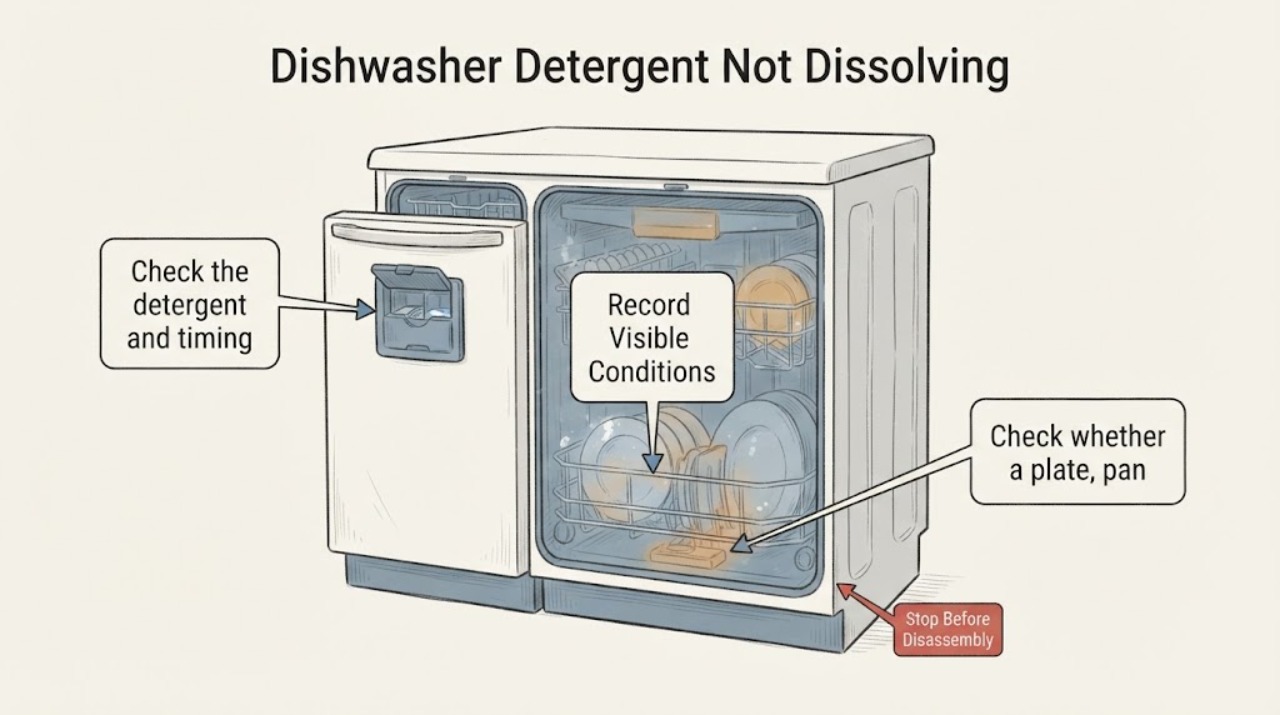
After the wash action has stopped and the water is safe to approach, record where the detergent is: inside a closed dispenser, in an open dispenser, on the tub floor, or as residue on the dishes. Do not reach into moving spray arms or hot water.
Expected result: The dispenser stayed closed, opened but contains detergent, opened and released a partly dissolved tablet, or is empty while the dishes remain dirty.
Next step: Photograph the result and continue only with the branch matching the dispenser state. If water is hot, wait for the model-permitted safe access condition before inspecting anything.
Why this matters
Why: Danby's manual treats a dispenser that is blocked from opening differently from detergent that remains after release. A partly dissolved tablet can also reflect the selected program rather than a failed dispenser.
-
Check 2
Check the detergent and timing against the exact Danby manual: use only automatic-dishwasher detergent, add it immediately before starting, keep powder dry, and do not put detergent in the rinse-aid dispenser.
Expected result: The detergent was added early or is damp or caked, the wrong detergent compartment was used, the product is not for automatic dishwashers, or the detergent is fresh and correctly placed.
Next step: Discard contaminated or caked detergent, clean only the accessible dispenser surfaces as the manual permits, and reload the correct compartment at the next test. Do not mix detergents or add extra product to compensate for residue.
Why this matters
Why: Danby says early-added detergent can become damp and fail to dissolve, and putting detergent in the rinse-aid dispenser can damage that dispenser and leave a soap film. A fresh, correctly placed detergent makes a loading, program, water, or dispenser-release issue more likely.
-
Check 3
Check whether a plate, pan, tall cup, utensil, or overloaded rack is in front of the dispenser lid or prevents the racks and spray arms from moving freely; rearrange only the accessible load after the machine is stopped.
Expected result: A dish blocks the dispenser, the rack is overloaded, a spray arm cannot rotate freely, or the load has clear dispenser and spray-arm clearance.
Next step: Remove the visible obstruction and reload so the lid and spray arms have clearance. If the dispenser still fails to open with clear loading, stop forcing the lid and arrange service.
Why this matters
Why: Danby's troubleshooting table identifies dishes blocking the dispenser from fully opening and overloading as causes of detergent left in the dispenser. A clear load makes a mechanical dispenser or water-delivery problem more concerning, but it does not identify the failed part.
-
Check 4
With power isolated as the exact manual requires, remove and clean only the user-accessible filter and spray arm, then refit them correctly; check for loose food debris without inserting tools into the sump or wash pump.
Expected result: The filter or spray-arm openings are clogged, the spray arm was mis-seated, or the accessible wash path is clear but spray action is weak or absent.
Next step: Correct only the accessible filter or spray-arm condition described by the model manual and run one suitable test if the appliance remains safe. Do not remove the pump or run the dishwasher without its filter.
Why this matters
Why: Danby recommends checking blocked spray arms and cleaning the filter when dishes are not cleaned properly. A clear path with weak spray or detergent still present moves suspicion toward water flow, circulation, heating, dispenser drive, or control and needs diagnosis.
-
Check 5
Compare the detergent form and program with the model manual, especially when using a tablet or pod; choose a model-approved longer program for a tablet rather than adding more detergent, and note whether the dispenser opened during the test.
Expected result: A tablet was used on a short program, a longer approved program dissolves it, or the same residue remains despite a suitable program and clear loading.
Next step: Use the detergent and program combination allowed by the exact manual. If residue repeats with correct loading and program, stop changing products at random and arrange qualified service.
Why this matters
Why: The DDW18D1 manual says tablets may not fully dissolve during a short program and recommends them only with longer programs. A repeat on an appropriate program points away from a simple program mismatch and toward release, water, spray, or temperature diagnosis.
-
Check 6
Observe one attended normal cycle after the accessible correction, noting whether water enters, the spray arms operate, the dispenser opens, the detergent dissolves, and the dishes clean; stop immediately for a leak, electrical sign, or uncontrolled hot water.
Expected result: The detergent dissolves and dishes clean, the dispenser remains closed, residue returns with weak spray or poor water flow, or a safety symptom appears.
Next step: Use the appliance only while it remains dry, stable, and normal. For a returning dispenser or wash problem, keep the model and observations for Danby service; for a safety symptom, stop and isolate the appliance from a dry, safe position.
Why this matters
Why: A single successful cycle supports the corrected loading, detergent, or program condition but does not prove an intermittent dispenser or wash fault is gone. Persistent residue with a clear external path needs professional diagnosis.
Use your observations
Decision map
Find the observation that best matches what you see, then follow the next safe action.
-
PATH 01Next step
What you see
The dispenser opened, the load is clear, and a tablet was used on a short program, while powder or gel behavior is otherwise normal.
Do this next
Use the exact model's approved longer program for that tablet or use the detergent form the manual permits. Test once with an attended cycle.
Why this path and its safety boundary
Why it matters: This matches Danby's model-specific warning that tablets may not fully dissolve during a short program; the program and detergent form are a better first explanation than a replacement dispenser.
-
PATH 02Next step
What you see
The dispenser lid stayed closed or a plate, pan, tall cup, or overloaded rack was directly in front of it.
Do this next
Rearrange the visible load so the lid and spray arms have clearance and run one suitable cycle. If the lid still will not open, arrange service rather than forcing it.
Why this path and its safety boundary
Why it matters: Danby's manual identifies loading that blocks the dispenser from fully opening as a cause of detergent remaining after the cycle.
-
PATH 03Next step
What you see
The dispenser opens and the detergent and program are correct, but residue and dirty dishes return after the filter and spray-arm path are clear.
Do this next
Stop ordering parts from the symptom. Provide Danby service with the model, detergent form, program, dispenser result, spray and filter observations, and whether water entered normally.
Why this path and its safety boundary
Why it matters: The simple detergent and loading explanations are less likely; Danby points to water flow, spray-arm blockage, filter condition, and the inlet valve as checks for poor cleaning, while the remaining internal cause is not identified by residue alone.
-
PATH 04Next step
What you see
Detergent was put in the rinse-aid dispenser, the product is not intended for an automatic dishwasher, or excessive suds or film appears.
Do this next
Stop using that product and follow the manual's cleaning and detergent instructions. Arrange service if the dispenser is damaged or residue persists after the correct setup.
Why this path and its safety boundary
Why it matters: The manual warns that the wrong compartment or detergent can damage the rinse-aid dispenser, leave a soap film, or create suds rather than solve the wash problem.
-
PATH 05Next step
What you see
The dishwasher leaks toward electrical parts, the cord or outlet is damaged, a breaker trips, water is uncontrolled or dangerously hot, or an enclosure must be opened.
Do this next
Stop the cycle and isolate power only from a dry, safe position; close the water supply for an active leak when safe, and arrange qualified appliance or electrical service.
Why this path and its safety boundary
Why it matters: The safety risk overrides detergent troubleshooting and cannot be resolved by changing detergent, loading, or program.
Helpful context
Understand the symptom
Separate a detergent problem from a dispenser or wash problem
Detergent remaining after a cycle does not identify one failed part. On the Danby DDW18D1 series manual, the dispenser should be open and empty at the end of a wash program, but a short program may leave a tablet partly dissolved, and a dish may prevent the dispenser from opening. The first useful observation is therefore whether the dispenser opened and whether the residue is a dry tablet, damp powder, gel, or film.
The model manual controls the detergent choice
Danby says to add detergent just before starting because adding it too early can make it damp and harder to dissolve. The DDW18D1 manual also says tablets may not fully dissolve on a short program and recommends them only with longer programs, while the detergent instructions must be followed. Use the exact manual for a different Danby model before changing detergent form or program.
When checks do not resolve it
Need a professional?
Arrange qualified Danby dishwasher service when the dispenser will not open with clear loading, detergent remains after a model-appropriate program and accessible filter or spray-arm checks, water flow or spray action is weak, the dispenser or rack is damaged, or the problem repeats. Provide the exact model and serial number, detergent type and timing, program, dispenser position, residue appearance, loading result, filter and spray observations, and any water or leak symptoms. Do not order a dispenser, inlet valve, pump, heater, or control from detergent residue alone.
Common questions
FAQ
Why is detergent still in my Danby dishwasher after the cycle?
On the DDW18D1 series, a dish can block the dispenser from opening, and a tablet may not fully dissolve during a short program. Danby also says detergent added too early can become damp. Check loading, timing, detergent form, and program before suspecting an internal part.
Can I use a pod on a short Danby dishwasher cycle?
The official DDW18D1 manual says detergent tablets may not fully dissolve during a short program and recommends them only with longer programs. Follow the exact manual for your Danby model instead of adding extra detergent.
What should I check when detergent remains and dishes are dirty?
Check whether the dispenser opened, whether a dish blocked it, whether the detergent was fresh and correctly placed, whether the spray arms and filter are clear, and whether water enters normally. Danby directs owners to correct detergent amount, blocked spray arms, filter condition, and water-inlet flow.
Should I replace the detergent dispenser?
Not from residue alone. First establish whether the lid was blocked, whether the program and detergent were suitable, and whether spray and water flow were normal. A dispenser that still will not open with clear loading needs model-specific service diagnosis before a part is selected.
Read the exact guide
Official sources
- The dishwasher is not cleaning dishes properly. What should I do?Danby · Danby dishwasher poor-cleaning checks for detergent, spray arms, filter, and water-inlet flow
- DISHWASHER Owner's ManualDanby · Danby DDW18D1EW, DDW18D1EB, and DDW18D1ESS dishwasher detergent, loading, spray, filter, safety, and troubleshooting guidance
Community feedback
Share a repair observation
Share a plain-text repair observation. Accepted observations are published automatically; this page may take a moment to update.