
On this page
Start here
Quick answer
A Danby freezer's outside cabinet can feel warm because the appliance transfers heat from the frozen interior to the room; warmth alone does not prove overheating. Treat a cabinet that becomes unusually hot to approach, smoke, burning odor, melted material, a damaged cord, repeated electrical trip, unusual mechanical noise, or food warming as a stop condition. If there is no danger sign, check the model's required clearance and ventilation, make sure interior air vents and the door or lid seal are clear, review the temperature setting and recent warm-food load, and clean only a model-approved condenser or fan area with the freezer safely disconnected and cool. Do not open the sealed refrigeration system or perform live electrical tests. If the freezer remains hot, runs continuously, fails to hold safe cold, or the symptom returns after these checks, keep it out of service and arrange qualified Danby service.
Before you begin
Safety first
- This article covers ordinary-access observation and model-approved cleaning of exposed user-accessible areas only. A qualified technician must handle cabinet access, wiring, compressor, fan, refrigerant, sealed-system, and live electrical diagnosis.
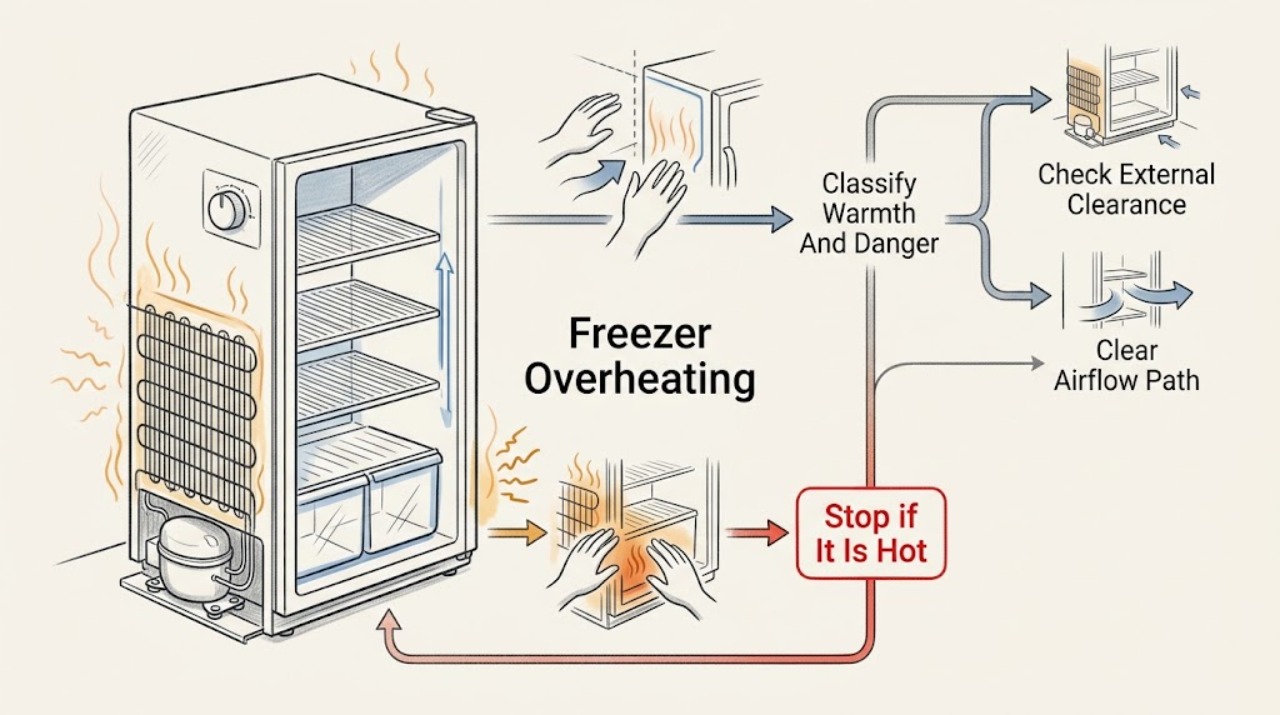
Work through in order
Diagnostic checks
Use only checks that match the exact appliance or system and its official guide.
-
Check 1
From a safe position, classify the symptom as a generally warm exterior with a cold, stable interior, or an unusually hot cabinet with smoke, burning odor, melted material, damaged cord, repeated trip, unusual noise, or warming food; do not touch a surface that may burn you.
Expected result: Record where the heat is noticed, whether the food remains solidly frozen, whether the compressor runs continuously, and whether any odor, smoke, scorch mark, liquid, warning, or electrical trip occurs.
Next step: For smoke, burning odor, melted material, a damaged cord, repeated protection trip, or a cabinet too hot to approach safely, stop using the freezer, keep clear, disconnect it only through a normally accessible point if safe, and arrange professional service. Otherwise continue to the airflow check.
Stop if: Do not restart a freezer showing smoke, burning odor, scorching, melted material, damaged wiring or cord, repeated electrical trips, or unsafe surface heat; never open the cabinet to investigate.
Why this matters
Why: Danby describes some outside warmth as normal heat rejection. A sudden or extreme change, odor, smoke, damage, repeated trip, or loss of freezing is not established as normal cabinet warmth.
-
Check 2
With the freezer off and cool enough to approach, inspect the visible space around the cabinet, base, and any manufacturer-provided ventilation opening for boxes, dust, fabric, or a wall or cabinet enclosure that blocks airflow; use the exact model manual for the required clearance.
Expected result: Record a clear airflow path, or an external obstruction, insufficient space, heat source, direct sun, or installation restriction that cannot be corrected without moving the appliance.
Next step: Remove only loose external items without reaching behind live equipment. Do not move a heavy or built-in freezer alone; arrange qualified service for installation changes or if the heat remains abnormal.
Stop if: Do not fully enclose the freezer, cover ventilation openings, pull a heavy unit by its cord, or remove rear or base covers to create airflow.
Why this matters
Why: Danby says airflow clearance is needed to help prevent overheating. An obstructed or heat-loaded installation can make the compressor work harder and raise external heat; a clear path does not rule out an internal fault.
-
Check 3
Inspect the door or lid from normal access: confirm it closes fully, the gasket is not visibly folded or damaged, packages are not preventing closure, and interior air vents are not covered by food; do not pry the seal or remove trim.
Expected result: Record a secure closure and open vents, or a gap, damaged or dirty gasket, package obstruction, heavy frost, or blocked vent that changes when the load is rearranged.
Next step: Rearrange only loose packages and close the door or lid normally. Follow the exact manual for cleaning or defrosting; if the gasket is damaged, the freezer cannot close, or frost requires disassembly, keep it out of service and arrange qualified help.
Stop if: Do not force the door or lid, chip frost with a sharp tool, heat the cabinet to defrost it, or operate with a torn seal or blocked vent.
Why this matters
Why: Danby guidance identifies blocked vents, an improperly closed door or lid, and excessive frost as causes of warm temperatures or longer motor operation. A visible seal or packaging issue is a user-level condition; a damaged gasket or persistent frost may require service or model-specific defrosting.
-
Check 4
Review the temperature control and recent use from the model manual: note whether a large amount of unfrozen food was added, the door was opened frequently, the room is unusually hot, or the control was changed; do not guess a setting outside the manual's range.
Expected result: Record the current control position, whether the interior is returning to cold after recent loading, and whether continuous operation started after a large load, frequent opening, or a warmer room condition.
Next step: Close the door, avoid adding more warm food, and allow the freezer to stabilize according to the exact manual while monitoring from nearby. If it does not regain normal cold or the cabinet becomes dangerously hot, stop use and request service.
Stop if: Do not keep opening the freezer to repeatedly measure it, overfill it, change controls randomly, or leave food in a freezer that is no longer maintaining safe cold storage.
Why this matters
Why: Danby manuals identify a warm setting, recent warm food, frequent opening, and warm ambient conditions as reasons the motor may run longer or the freezer may be warm. If the load and setting are reasonable but food remains warm, the issue needs service assessment.
-
Check 5
If the exact Danby manual identifies an accessible condenser coil, fan area, or base grille for cleaning, disconnect power through the normal accessible point, let the freezer cool, and clean only that exposed area by the manual's method; do not open the sealed refrigeration system.
Expected result: Record whether dust or debris is visibly restricting the permitted condenser or fan area, whether the grille can be restored securely, and whether cleaning would require removing a protective cover or reaching wiring.
Next step: Restore the grille or cover exactly as instructed and monitor one normal operating period without opening the cabinet. If the area is inaccessible, damaged, or the freezer still overheats or runs continuously, arrange qualified service.
Stop if: Do not clean energized parts, spray liquid into the machine, remove sealed refrigerant lines or electrical covers, or perform live voltage or refrigerant tests.
Why this matters
Why: Danby freezer guidance says dirty condenser coils on some models can block heat transfer and make the motor work harder. A hidden coil, fan, compressor, refrigerant circuit, or electrical part is professional territory.
-
Check 6
After only the applicable external checks, monitor the freezer while nearby through one normal operating period and note the cabinet heat, interior cold, compressor cycling, noise, odor, and any warning; do not use repeated power cycling as a test.
Expected result: Record normal cold storage with ordinary cabinet warmth, continued excessive heat, continuous operation, food warming, unusual noise, odor, smoke, repeated trip, or a failure to restart.
Next step: Keep the freezer out of service for recurring overheating or any danger sign. Give the technician the model, installation context, control setting, load change, runtime, food condition, and observed safety symptoms.
Stop if: Stop immediately for smoke, burning odor, scorching, damaged cord, unsafe surface heat, water near electrical parts, repeated trips, or any need to open the cabinet.
Why this matters
Why: A return to stable cold with ordinary warmth supports airflow, loading, or setting as a contributor. Persistent or returning heat, poor cooling, unusual noise, or electrical symptoms indicate that a safe user check has not established the cause.
Use your observations
Decision map
Find the observation that best matches what you see, then follow the next safe action.
-
PATH 01Safety boundary
What you see
The exterior is warm but approachable, the interior remains properly cold, the door or lid seals, there is no odor or smoke, and the freezer is not showing a new abnormal behavior.
Do this next
Keep the required clearance and vents clear, avoid heat sources, and continue ordinary monitoring without opening the cabinet.
Why this path and its safety boundary
Why it matters: Danby's manual says some outside warmth is normal heat transfer from the frozen interior to room air.
Safety stop: Stop if the warmth changes sharply, food begins to thaw, an odor or smoke appears, or the freezer becomes unsafe to approach.
-
PATH 02Safety boundary
What you see
The external clearance, base or cabinet ventilation, or an internal air vent is blocked, or the unit is close to a heat source.
Do this next
Remove only loose external obstructions and restore the model-specified installation condition; use qualified help for a heavy or built-in unit, then monitor one normal period.
Why this path and its safety boundary
Why it matters: Restricted airflow can increase heat rejection demand and contribute to overheating or poor cooling.
Safety stop: Do not cover vents, fully enclose the unit, move it alone, or access rear wiring or the sealed system.
-
PATH 03Safety boundary
What you see
The door or lid does not seal, packages block a vent, a large warm load was added, the control is too warm for the conditions, or the door is opened frequently, with no immediate danger sign.
Do this next
Correct only the visible load, closure, or manual-specified setting issue and monitor from nearby. Escalate if cold storage does not return or the cabinet becomes unusually hot.
Why this path and its safety boundary
Why it matters: Danby identifies these conditions as reasons for warm temperatures or longer motor operation.
Safety stop: Do not force the seal, overfill the freezer, repeatedly change the control, or keep food in an appliance that cannot maintain safe cold.
-
PATH 04Safety boundary
What you see
There is smoke, burning odor, melted material, a damaged cord, repeated electrical protection trip, unusual mechanical noise with rising heat, or a cabinet too hot to approach safely.
Do this next
Stop using the freezer, keep clear, disconnect it only through a normally accessible point if safe, and arrange professional diagnosis; if there is a fire, leave and contact emergency services.
Why this path and its safety boundary
Why it matters: This is a potential fire, electrical, or mechanical hazard outside safe user troubleshooting.
Safety stop: Do not restart, open the cabinet, remove covers, or perform live electrical or refrigeration tests.
-
PATH 05Safety boundary
What you see
Clearance, visible vents, door or lid closure, load, manual-specified setting, and any permitted condenser cleaning are correct, but the freezer remains hot, runs continuously, or fails to keep food cold.
Do this next
Leave the freezer out of service and arrange qualified Danby service. Provide the model, symptom timeline, runtime, food condition, installation context, and checks already completed.
Why this path and its safety boundary
Why it matters: An internal fan, compressor, control, condenser, or sealed-system fault remains possible and cannot be identified safely by cabinet warmth alone.
Safety stop: Do not guess a replacement part, open the sealed system, bypass a control, or continue operating while food is warming.
Helpful context
Understand the symptom
Separate normal cabinet warmth from a real overheating event
Danby's freezer manual explains that the outside may feel warm because the freezer removes heat from the interior and transfers it to room air. That is different from a cabinet that becomes too hot to approach, an odor of burning, smoke, melted material, a damaged cord, repeated electrical protection trips, or food that is warming. The cabinet temperature is not a substitute for a safe internal diagnosis, so use the combination of exterior behavior, food condition, runtime, airflow, and warning signs to decide whether to stop.
Airflow and loading affect the heat the freezer must reject
A freezer needs room around its exterior and unobstructed internal vents. Danby says restricted clearance can contribute to overheating, and its freezer guidance identifies blocked internal vents, a door or lid that is not closing, warm food added recently, heat sources, and high ambient conditions as reasons for warm temperatures or longer motor operation. Check only what is visible and accessible; do not move a heavy freezer alone or remove covers to reach the compressor or wiring.
A failed safe check points to service, not a guessed part
If correcting an external obstruction, restoring the door or lid seal, using the model's temperature setting, and cleaning a permitted condenser area do not restore normal cooling and runtime, the cause may be an internal fan, control, compressor, or sealed-system problem. Those possibilities cannot be distinguished safely by smell or cabinet warmth. Preserve the model information and the sequence of observations for a qualified technician rather than adjusting sealed components or testing energized parts.
Safety boundary
Stop conditions
- Stop immediately for smoke, burning odor, melted material, a damaged cord, repeated electrical protection trips, unusual mechanical noise with rising heat, or a cabinet too hot to approach safely.
- Do not open the cabinet, remove electrical or compressor covers, perform live electrical tests, alter controls beyond the manual, or open the sealed refrigeration system.
- Do not cover external or internal vents, fully enclose the freezer, move a heavy unit alone, or use a freezer with a damaged door or lid seal that cannot close securely.
- Do not chip frost with sharp tools, spray liquid into the cabinet, or use unapproved cleaners near electrical or refrigeration components.
- Do not keep operating when food is warming or repeat power cycles to reproduce overheating; arrange qualified service after the safe checks fail.
Only after diagnosis
Potential parts
- condenser fan or airflow assembly
Consider this category only after qualified diagnosis finds inadequate heat transfer or airflow with the model's external clearance and permitted cleaning already correct.
Confirm the exact Danby model and manufacturer's fit information with the technician; do not remove fan or compressor covers as a user check. - temperature control or sensor
Consider this category only when service diagnosis confirms that the control or sensor is not regulating the freezer after airflow, seal, loading, and setting conditions are verified.
Confirm the exact Danby model and professional diagnosis before selecting a part; do not bypass or substitute a control. - compressor or sealed-system assembly
Consider this category only when a qualified technician identifies a compressor or sealed-system fault after the accessible causes of heat and poor cooling are ruled out.
Sealed-system work requires qualified service and exact model identification; do not open sealed refrigerant lines or infer compatibility from appearance.
When checks do not resolve it
Need a professional?
Arrange qualified Danby service when the freezer stays unusually hot, runs continuously, fails to maintain cold, develops smoke, burning odor, unusual mechanical noise, a damaged cord, melted material, repeated electrical trips, or a persistent symptom after clearance, vent, seal, load, setting, and model-approved condenser checks. Internal fan, compressor, control, wiring, refrigerant, and sealed-system diagnosis is professional work.
Safety scope: This article covers ordinary-access observation and model-approved cleaning of exposed user-accessible areas only. A qualified technician must handle cabinet access, wiring, compressor, fan, refrigerant, sealed-system, and live electrical diagnosis.
Common questions
FAQ
Is it normal for the outside of a Danby freezer to feel warm?
Often, yes. Danby's freezer manual says heat removed from the interior is transferred to room air, so the outside can feel warm. A sudden or extreme change, smoke, burning odor, melted material, or poor cooling is not something to dismiss as normal.
Can poor ventilation make a Danby freezer overheat?
Yes. Danby recommends clearance around the freezer for proper airflow and to help prevent overheating. Keep the model-required space and visible vents clear, and get help before moving a heavy or built-in unit.
Why does a Danby freezer run continuously when it feels hot?
Possible user-level contributors include blocked vents, a door or lid that does not seal, a large recent warm load, a warm room, a control setting, or a dirty condenser on models that have one. If these checks do not restore cold operation, arrange service.
Should I keep using a freezer that smells burnt or is too hot to approach?
No. Stop using it, keep clear, disconnect it only through a normally accessible point if safe, and arrange professional diagnosis. Do not open the cabinet or perform live electrical tests.
When does Danby freezer overheating need a technician?
Use qualified service for persistent excessive heat, food warming, continuous operation after safe airflow and seal checks, smoke, burning odor, unusual noise, a damaged cord, repeated trips, or any issue requiring compressor, fan, wiring, control, refrigerant, or sealed-system access.
Read the exact guide
Official sources
- Electrical fire safety: Tumble dryersWarwickshire County Council · Public-sector electrical fire-safety guidance for household appliances; it is general safety advice, not a Danby freezer repair procedure.
- How much ventilation space do I need around my freezer?Danby · Danby manufacturer FAQ for freezer ventilation; exact model installation instructions control the required space.
- The freezer is not cooling properly. What should I do?Danby · Danby USA manufacturer FAQ for freezers that are not cooling properly; model-specific troubleshooting remains in the owner's manual.
- Freezer Use and Care ManualDanby · Danby freezer use-and-care manual covering several models; feature locations and requirements vary, so the exact model manual controls.
- TROUBLESHOOTING AND FREQUENTLY ASKED QUESTIONSDanby · Danby compact freezer manual; it is supporting guidance for the same freezer mechanisms and does not replace the assigned model manual.
Community feedback
Share a repair observation
Share a plain-text repair observation. Accepted observations are published automatically; this page may take a moment to update.