
On this page
Start here
Quick answer
A Kenmore freezer can feel warm on the outside because the refrigeration system releases heat, especially after startup, a large load, frequent door openings, or operation in a hot location. It is not a normal warm-cabinet symptom when the inside is also warming, the compressor runs continuously without reaching a safe temperature, the exterior is too hot to touch, the fan is blocked or silent when cooling is demanded, or you smell burning, see smoke, hear arcing, or the breaker trips. First protect the food and people, then check the model manual, airflow around the freezer, door seal, interior vents, control setting, and visible dust or obstruction without opening panels. Stop and arrange qualified service for persistent heat, loss of cooling, unusual electrical symptoms, or any sealed-system or compressor diagnosis.
Before you begin
Safety first
- A technician can safely assess airflow, fan operation, temperature sensing, controls, compressor starting, defrost behavior, and the sealed system. Do not open panels, test live circuits, or open a refrigerant circuit as a user.
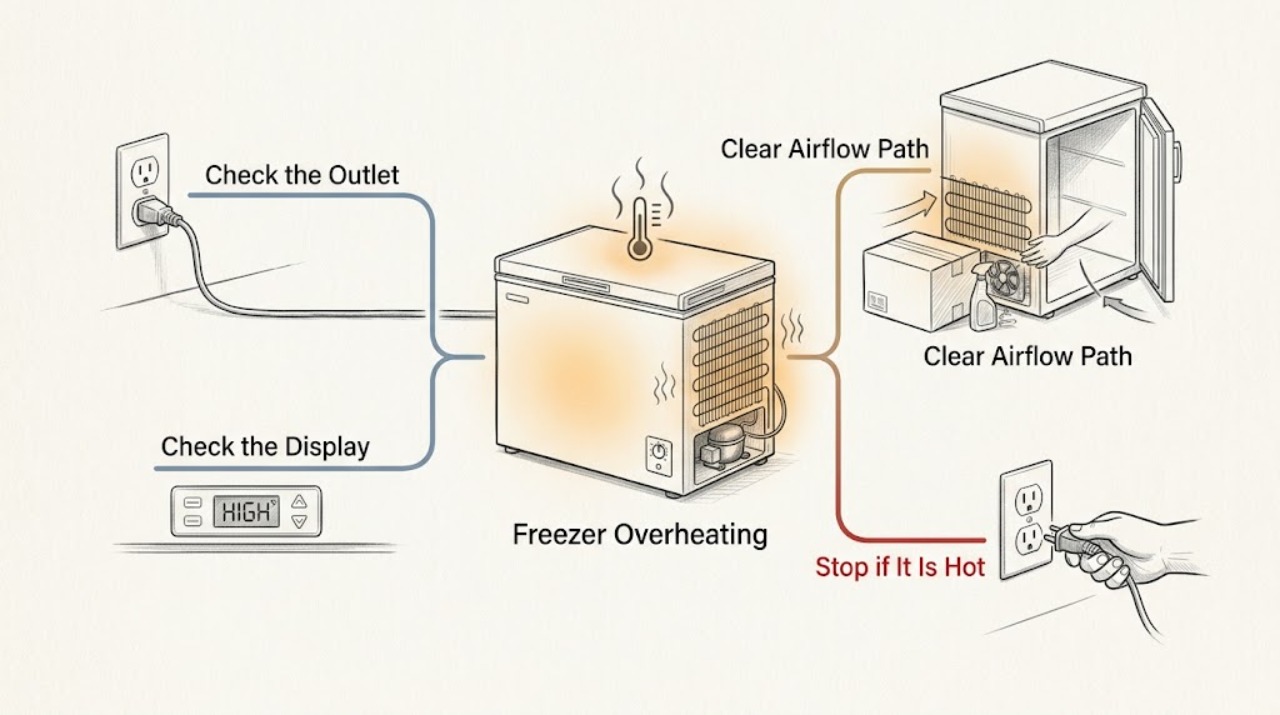
Work through in order
Diagnostic checks
Use only checks that match the exact appliance or system and its official guide.
-
Check 1
Check for smoke, a burning odor, arcing, a damaged cord, a hot plug or outlet, a tripped breaker, leaking fluid, or a surface too hot to approach safely. Keep people away and stop using the freezer if any of these signs are present.
Expected result: The freezer is dry and electrically quiet with no odor, smoke, arcing, damaged cord, hot outlet, or uncontrolled heat, or a hazard is present.
Next step: For any hazard, isolate the area without touching unsafe electrical parts and arrange qualified appliance or electrical service. If none is present, distinguish cabinet warmth from loss of interior cooling.
Stop if: Smoke, burning odor, arcing, hot electrical parts, damaged insulation, or a tripped circuit ends testing.
Why this matters
Why: A fire or electrical symptom is an immediate safety issue, not a user cooling diagnosis. A stable freezer permits only external, low-risk observations.
-
Check 2
Compare the interior condition with the exterior heat. Check whether food remains hard-frozen, whether a freezer thermometer or the model display shows a rising temperature, whether the compressor is cycling, and which cabinet area feels warm without touching an unsafe surface.
Expected result: The inside remains cold while the cabinet is warm, or the interior is warming and the compressor runs continuously, stops repeatedly, or does not start.
Next step: If the interior is warming, protect the food and continue only with safe visual checks; arrange service if it does not recover. If the interior remains cold, check room conditions, clearance, and door sealing.
Stop if: Stop if temperature is rising rapidly, food is thawing, the compressor or wiring smells hot, or the freezer cannot maintain safe cold storage.
Why this matters
Why: Cold contents with moderate cabinet warmth can be normal heat rejection. Interior warming with abnormal compressor behavior indicates a cooling, airflow, control, or power fault rather than normal surface warmth.
-
Check 3
Check the freezer's location and visible airflow without moving it: compare the space around the cabinet with the exact Kenmore manual, clear nearby boxes and heat sources, and confirm that external vents are not covered by dust or stored items.
Expected result: The freezer is in a hot location, crowded against a wall or cabinet, surrounded by blocked airflow, or the placement and visible vents appear clear.
Next step: Clear only the accessible area and let the appliance operate with the door closed while observing recovery. If heat or poor cooling persists, stop and provide the location and clearance details to service.
Stop if: Do not move the freezer, remove panels, or reach behind a hot compressor compartment as an owner test.
Why this matters
Why: Poor airflow or a hot environment makes heat rejection harder and can make the exterior feel hotter or extend compressor run time. Clear placement does not rule out an internal fan or sealed-system fault.
-
Check 4
Inspect the closed door or lid and interior air path visually. Look for a package preventing full closure, a torn or folded gasket, heavy frost covering vents, or food packed tightly against the cold-air openings. Do not chip ice with a sharp tool or use a heat source inside the cabinet.
Expected result: The door seal has a visible gap, the door is obstructed, vents are covered by food or frost, or the door and air path appear clear.
Next step: Remove only an obvious storage obstruction and close the door promptly. If frost or a damaged gasket remains, use the model manual or arrange service rather than scraping, heating, or disassembling the freezer.
Stop if: Stop if the gasket is damaged, ice is thick, food is thawing, or correcting the condition would require a tool inside the cabinet.
Why this matters
Why: Warm air entering through a poor seal or blocked air movement can force longer cooling operation and add heat at the exterior. A clear seal and vent path move suspicion toward the cooling system or control.
-
Check 5
Read the exact Kenmore model number from the rating label and compare the temperature control, ambient-location guidance, alarm behavior, and cleaning instructions with the model manual. Confirm that the control has not been changed and that the freezer is not in a special or display mode if the manual describes one.
Expected result: The control or location does not match the manual, or the settings and mode match but the freezer is still hot or warm inside.
Next step: Correct only the documented control setting and make one observation after the freezer has had time to stabilize. If the problem remains, stop changing settings and arrange model-specific service.
Stop if: Do not use a jumper, bypass a sensor, test live voltage, or open the control compartment.
Why this matters
Why: A setting or environment mismatch can cause long run times without an internal component failure. Matching settings with persistent overheating points toward a sensor, fan, compressor, defrost, or sealed-system fault.
-
Check 6
Record the service evidence without opening the cabinet: model number, interior temperature trend, location and clearance, door-seal condition, frost pattern, compressor sound, fan sound if externally audible, control setting, and whether heat changes after one safe airflow correction.
Expected result: The freezer returns to a stable cold state after an external correction, or it remains warm, runs continuously, cycles abnormally, or develops a safety symptom.
Next step: Use Kenmore's manuals and repair-support path with the recorded evidence. Keep the freezer out of service if a hazard is present or food cannot be kept safely frozen.
Stop if: Do not continue testing a freezer with smoke, burning odor, arcing, damaged electrical parts, or a compressor that overheats or repeatedly fails to start.
Why this matters
Why: Recovery after a clear airflow or door issue supports an external load problem. Persistent overheating or poor cooling requires a technician to separate fan, control, compressor, defrost, and sealed-system causes.
Use your observations
Decision map
Find the observation that best matches what you see, then follow the next safe action.
-
PATH 01Next step
What you see
Smoke, burning odor, arcing, hot electrical parts, damaged cord, or a tripped breaker
Do this next
Stop using the freezer, keep clear of unsafe electrical parts, and arrange qualified appliance or electrical service before restoring operation.
-
PATH 02Next step
What you see
The cabinet is warm but the interior remains cold and no hazard is present
Do this next
Check the model's placement and airflow guidance, door sealing, and room conditions. Moderate cabinet warmth may reflect normal heat rejection; service is needed if it becomes excessive or cooling declines.
-
PATH 03Next step
What you see
The interior is warming or food is soft while the freezer runs for long periods
Do this next
Protect the food, keep the door closed, check only the visible seal, vents, placement, and control, then arrange service if it does not recover.
-
PATH 04Next step
What you see
Airflow or a door obstruction is found and there is no safety symptom
Do this next
Clear the accessible obstruction without moving the freezer or using sharp tools, make one recovery observation, and escalate if heat or poor cooling remains.
-
PATH 05Next step
What you see
Placement, door, vents, and settings are correct but the freezer still overheats or cannot cool
Do this next
Stop repeated resets and request model-specific service for the fan, sensor, compressor, defrost, control, or sealed-system diagnosis.
Helpful context
Understand the symptom
First decide what is actually overheating
A warm side or front frame is different from an overheating compressor or a freezer that is losing its cold temperature. Note whether the interior food is still hard-frozen, whether the display or alarm reports a warm condition, whether the compressor cycles off, and whether the hot area is the cabinet, rear compartment, plug, or outlet. Do not press a bare hand against a surface that may burn.
Restore airflow and reduce heat load without opening the unit
Check the space around the freezer against the exact Kenmore manual and clear boxes, curtains, dust, and other obstructions from visible vents. Keep the door closed and move heat-producing equipment away. Do not pull the freezer out or remove a rear cover just to reach a fan or compressor; if access requires moving the appliance or exposing wiring, use service.
Check the cold side before blaming the cabinet
A freezer that remains at its proper cold state while its cabinet feels warm may be rejecting heat normally. A freezer that is warm inside, has heavy frost blocking air movement, or runs without recovering needs a different diagnosis. Check the door seal and internal vents visually, and keep food from blocking the cold-air path.
Stop at electrical, fire, or sealed-system symptoms
Burning odor, smoke, arcing, a hot plug or outlet, a tripped breaker, oil residue, or a compressor that repeatedly starts and stops is not a cleaning or temperature-setting problem. Disconnecting a hot appliance may itself be unsafe if the outlet is damaged; isolate the area only when safe and obtain qualified help.
Only after diagnosis
Potential parts
- condenser fan or fan motor
Consider this category only if a technician confirms inadequate heat rejection or a failed fan after safe external airflow checks.
Confirm the complete model and exact fan configuration before ordering; do not reach into a running or powered compartment. - door gasket
Consider this category only if the model-specific inspection confirms a torn, distorted, or non-sealing gasket that allows warm air into the cabinet.
Match the exact model and door configuration; a warm exterior alone does not establish gasket failure. - temperature control or sensor
Consider this category only if the control setting is correct but a technician confirms incorrect temperature sensing or control behavior.
Verify the exact model and control platform before any replacement. - compressor or sealed-system component
Consider this category only after a qualified technician confirms a compressor, refrigerant circuit, or sealed-system fault; exterior heat is not enough evidence.
Sealed-system work requires qualified service and model-specific equipment; do not open the refrigerant circuit.
When checks do not resolve it
Need a professional?
Arrange qualified service for a freezer that is warm inside, cannot maintain cold storage, has a compressor or fan that behaves abnormally, remains excessively hot after airflow and door checks, or shows smoke, burning odor, arcing, a hot outlet, or a tripped breaker.
Safety scope: A technician can safely assess airflow, fan operation, temperature sensing, controls, compressor starting, defrost behavior, and the sealed system. Do not open panels, test live circuits, or open a refrigerant circuit as a user.
Have this ready
- Provide the complete model number, interior temperature trend, food condition, hot area, room and placement details, door-seal and vent observations, control setting, frost pattern, compressor or fan sounds, and any electrical or odor symptoms.
Common questions
FAQ
Is it normal for a Kenmore freezer to feel warm on the outside?
Some cabinet warmth can occur while the refrigeration system releases heat. It is concerning when the interior warms, cooling does not recover, the surface is unsafe to approach, or electrical and odor symptoms appear.
Can poor ventilation make a Kenmore freezer overheat?
Yes. ENERGY STAR advises leaving air circulation behind a freezer and avoiding extreme ambient conditions. Check the exact Kenmore manual for its clearance requirements and do not move the appliance if doing so would expose unsafe connections.
Why is my Kenmore freezer hot and not keeping food frozen?
Check the door seal, blocked vents, room conditions, placement, and control setting without opening panels. If the inside stays warm or the compressor runs abnormally, protect the food and arrange service for the cooling system.
Should I unplug a Kenmore freezer that feels too hot?
If there is smoke, burning odor, arcing, a hot outlet, or a damaged cord, do not touch unsafe electrical parts; keep clear and obtain qualified help. If no hazard is present, use the model manual and service guidance rather than repeated power cycling.
What information will a technician need for a hot Kenmore freezer?
Have the complete model number, interior temperature trend, food condition, location of heat, clearance, door-seal and vent observations, control setting, frost pattern, compressor or fan sounds, and any odor or electrical symptoms ready.
Read the exact guide
Official sources
- FreezersENERGY STAR · General freezer guidance on ambient conditions, rear airflow, door seals, and door-open time; use the Kenmore manual for model-specific requirements.
- Kenmore ManualsKenmore · Official model-number lookup and owner-manual resource for Kenmore freezers; exact clearances and controls depend on the model.
- 20.9 cu. ft. Upright Freezer - WhiteKenmore · Kenmore upright-freezer product information and model-specific owner-center entry; product features and clearances vary by model.
- Customer CareKenmore · Official support and repair escalation path when owner checks do not resolve a Kenmore freezer issue.
Community feedback
Share a repair observation
Share a plain-text repair observation. Accepted observations are published automatically; this page may take a moment to update.