
On this page
Start here
Quick answer
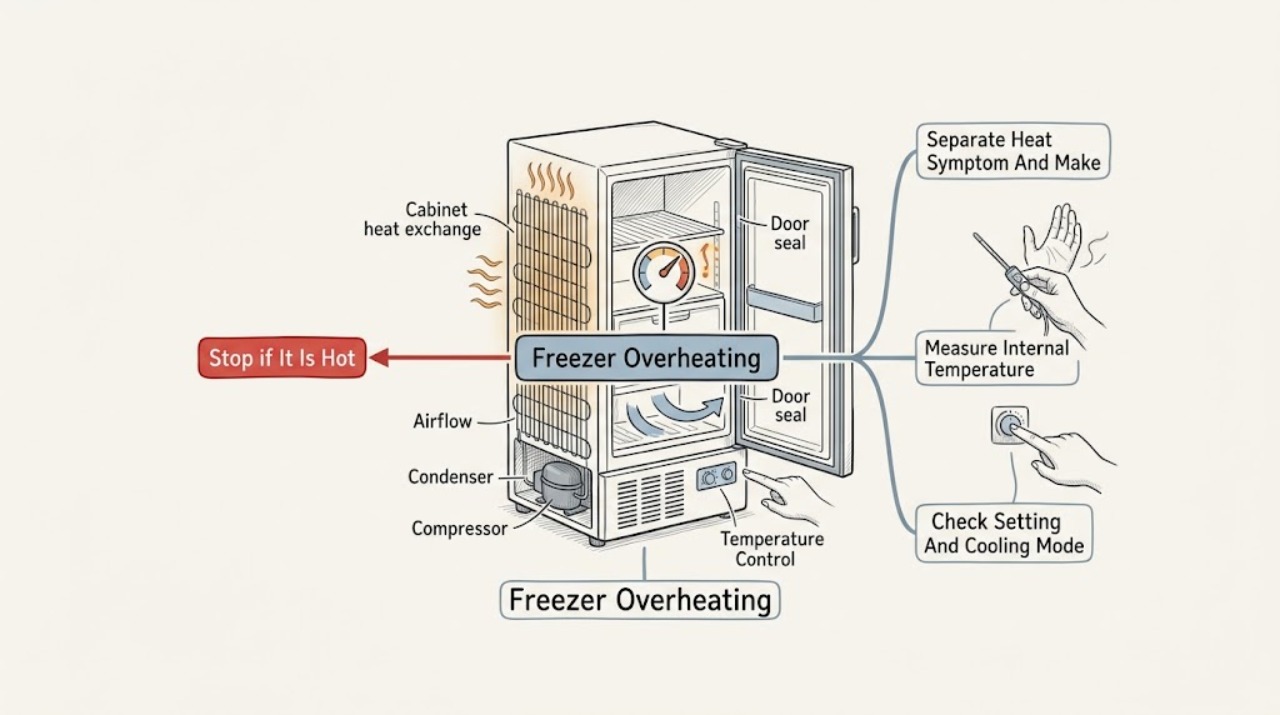
A freezer's warm side or front edge is not automatically overheating: manufacturers describe cabinet warmth as a normal part of moving heat from the frozen compartment into the room. The urgent distinction is whether the inside is staying at a safe freezing temperature and whether the warm area is mildly warm or abnormally hot with poor cooling, a burning odour, smoke, a hot plug or wire, repeated clicking, or a trip. Keep the door closed while checking, use an appliance thermometer rather than touch alone, and record whether the problem is internal temperature, exterior cabinet heat, or the compressor area. Check the setting, door seal, interior vents, load, room heat, and model-specific clearance without opening panels. If food is softening, the temperature is rising, frost is blocking airflow, the compressor runs continuously without cooling, or any electrical or burning symptom appears, protect the food and arrange qualified appliance service.
Before you begin
Safety first
- This article covers temperature measurement, external inspection, door-seal and airflow observation, and model-approved controls only. A qualified technician must handle electrical measurements, compressor or fan access, refrigerant and sealed-system work, cabinet panels, damaged wiring, and persistent overheating.
Work through in order
Diagnostic checks
Use only checks that match the exact appliance or system and its official guide.
-
Check 1
From a dry position, inspect the freezer without removing panels. Stop using it if there is smoke, a burning odour, melted material, a hot or damaged plug or wire, sparks, water at electrical parts, repeated clicking with no cooling, or a tripped circuit; isolate power only when this can be done safely and arrange service.
Expected result: Record whether the heat is on the side or front cabinet, inside the compartment, around the compressor area, or at the plug and cord; note food condition, frost, noise, and any error indication.
Next step: If no hazard is present, continue with an internal thermometer and external checks. If a hazard is present, keep the door closed, protect food from a safe location, and obtain qualified appliance or electrical service.
Stop if: Do not touch a hot or damaged electrical connection, open the compressor compartment, remove covers, or restart a freezer that smokes, smells burnt, sparks, or trips.
Why this matters
Why: Warm cabinet surfaces can be a normal heat-exchange effect, but internal warming or abnormal heat at the power or compressor area indicates a cooling, airflow, electrical, or sealed-system concern.
-
Check 2
Place an appliance thermometer among frozen packages or in the location specified by the model manual, close the door, and record the temperature without repeatedly opening the freezer.
Expected result: Record whether the contents remain solid and the reading is at or below the model's recommended freezing target, whether it is rising or above target, or whether the thermometer cannot be used safely because food is melting or the compartment is wet.
Next step: Keep the door shut, move food to a safe cold location if needed, and use the setting, seal, airflow, and environment checks only when the reading remains safe enough for ordinary inspection.
Stop if: Stop handling food or the appliance when water reaches electrical parts, food is leaking across other packages, the cabinet has abnormal heat, or the reading is unsafe and cooling is not returning.
Why this matters
Why: A freezer can have warm sides while its internal temperature is healthy. A rising internal reading, soft food, or a failed temperature display is a cooling or food-safety issue even if the cabinet warmth is expected.
-
Check 3
Read the temperature control and display from the model manual, checking for a warm setting, cooling-off or demo mode, alarm, or recent adjustment; make only one small, documented model-approved change and keep the door closed while the temperature stabilizes.
Expected result: Record the original setting, any cooling-off or fast-freeze state, the new setting if changed, the alarm or display state, and the later thermometer result.
Next step: Allow the stabilization interval specified by the manual, then compare the thermometer and food condition. If the setting is correct but cooling does not recover, arrange service rather than making repeated large changes.
Stop if: Do not defeat an alarm, enter a hidden diagnostic mode, repeatedly cycle the control, or continue operation when the interior warms, food thaws, or any hazard appears.
Why this matters
Why: A control state can explain an interior that is too warm without proving a failed compressor. If the setting is correct and the temperature continues to rise, the fault is not resolved by selecting a colder number.
-
Check 4
With the freezer door open only briefly, inspect the gasket all around, the hinge-side seal, interior vents, package spacing, and frost pattern; clean a dirty gasket with the method in the manual and move packages away from vents without forcing frozen items.
Expected result: Record whether the gasket is clean and continuous, the door closes squarely, a paper test has even resistance if the model allows it, vents are blocked, packages are overpacked, or frost is concentrated around the gasket, rear wall, or an air path.
Next step: Restore only the manual-approved organization or defrost procedure, keep the door closed, and recheck the thermometer after stabilization; request service for a damaged seal, recurring frost, or poor cooling.
Stop if: Do not chip ice with a sharp object, use flame or a heat gun, pull a gasket from its channel, dismantle the door, or continue if melting water reaches electrical parts.
Why this matters
Why: A weak seal, warm-air leak, blocked vent, or heavy frost can make the compressor run longer and reduce cold-air distribution. A distorted gasket, persistent ice blanket, or frost that returns after safe defrost guidance points to service.
-
Check 5
Compare the installation with the exact manual: check that the freezer is not pressed against a wall or heat source, that external air paths are not covered, and that a large warm load or frequent door opening has not just occurred; do not move a heavy freezer or inspect a concealed condenser alone.
Expected result: Record room heat, direct sunlight or nearby cooking heat, visible clearance, whether the cabinet heat began after startup or a large load, and whether the compressor has been running almost continuously.
Next step: Restore the manual-approved clearance and keep the door closed while monitoring the thermometer. If the exterior remains abnormally hot, the compressor never settles, or cooling does not return, arrange qualified service.
Stop if: Do not place the freezer in an unsafe location, block ventilation to hide heat, move it while loaded, or touch a compressor or pipe that is abnormally hot.
Why this matters
Why: Heat-exchange surfaces normally feel warm, but restricted room airflow, a hot environment, startup, or a large warm load can temporarily increase cabinet heat and run time. Persistent abnormal heat together with poor internal cooling suggests a service fault.
-
Check 6
If the internal reading is rising or food is softening, keep the freezer closed and transfer food to a safe cold location only when that can be done without exposure to a hazard; document the temperature, time, ice-crystal condition, and any food-contact contamination.
Expected result: Classify food as solidly frozen, partly frozen with ice crystals, at or below refrigerator temperature, warmer than the safe limit, or unknown after prolonged warming; never taste food to decide.
Next step: Keep questionable food separate and follow USDA food-safety guidance; give the technician the temperature history and freezer condition, and do not resume normal storage until the freezer reaches its model target.
Stop if: Stop using the freezer after flood exposure, contaminated water, smoke or fire exposure, or an electrical or thermal hazard; do not refreeze food without assessing its temperature history.
Why this matters
Why: USDA says food may remain usable when ice crystals remain or it is at refrigerator temperature, but perishable food held above 40°F for more than the stated safe interval should be discarded. Food safety can require action even when appliance repair is still pending.
Use your observations
Decision map
Find the observation that best matches what you see, then follow the next safe action.
-
PATH 01Safety boundary
What you see
The outside sides or front edge feel warm, but the internal thermometer and food remain at the model's safe target with no abnormal smell, noise, or electrical symptom.
Do this next
Keep the manual-specified clearance and monitor internal temperature; avoid covering external air paths.
Why this path and its safety boundary
Why it matters: The warmth is likely the freezer rejecting heat as designed rather than internal overheating.
Safety stop: Arrange service if internal temperature rises, cooling performance falls, or the warm area becomes abnormally hot with a smell, smoke, or electrical symptom.
-
PATH 02Safety boundary
What you see
The internal thermometer is above the model target or rising, food is softening, or the freezer is not maintaining frozen storage.
Do this next
Keep the door closed, protect food, check setting, seal, vents, load, and environment once, then request service if cooling does not recover.
Why this path and its safety boundary
Why it matters: This is a cooling-performance problem even if the cabinet warmth is a normal heat-exchange effect.
Safety stop: Stop for smoke, burning odour, abnormal electrical heat, water near power, repeated clicking with no cooling, or a trip.
-
PATH 03Safety boundary
What you see
The door gasket leaks, frost is concentrated at the gasket or rear airflow path, vents are blocked, or packages prevent circulation.
Do this next
Clean and reposition only as the manual permits, use a safe manual defrost procedure if documented, and monitor the temperature after stabilization.
Why this path and its safety boundary
Why it matters: Warm air entry or restricted cold-air movement can increase run time and reduce internal cooling.
Safety stop: Do not chip ice, use flame or high heat, remove the gasket, or continue if meltwater can contact electrical parts.
-
PATH 04Safety boundary
What you see
The cabinet became warmer after first startup, a large warm load, frequent door opening, direct heat, or restricted room clearance, while internal cooling is gradually improving.
Do this next
Restore manual-specified clearance, keep doors shut, avoid adding warm food, and monitor the thermometer through the manual's stabilization interval.
Why this path and its safety boundary
Why it matters: The refrigeration system may be shedding extra heat during recovery rather than failing.
Safety stop: Request service if the internal temperature does not recover, the compressor never settles, or abnormal heat, smell, smoke, or electrical symptoms occur.
-
PATH 05Safety boundary
What you see
The compressor area or plug is too hot to approach normally, cooling is poor, the compressor repeatedly clicks, or the circuit trips.
Do this next
Keep the freezer off and arrange qualified appliance or electrical service; protect food without touching the hot area.
Why this path and its safety boundary
Why it matters: The condition may involve airflow, electrical supply, compressor start, or sealed-system work and is beyond safe ordinary inspection.
Safety stop: Do not open the compressor compartment, test live circuits, add refrigerant, bypass a protector, or repeatedly restore power.
-
PATH 06Safety boundary
What you see
Frozen food has thawed or is at an unknown temperature after the freezer warmed or lost power.
Do this next
Keep the door closed, transfer food to a known-safe cold location when possible, record time and temperature, and follow USDA discard or refreeze guidance.
Why this path and its safety boundary
Why it matters: Food safety decisions are separate from appliance repair; touch and smell alone cannot establish safety.
Safety stop: Do not taste questionable food, keep food exposed to flood water, or resume storage before cooling is verified.
Helpful context
Understand the symptom
First decide what is actually hot
There are three different complaints hidden in “the freezer is overheating.” The outer sides or front frame may be warm while the contents remain properly frozen; the interior may be too warm; or the compressor and plug area may be abnormally hot. GE describes warm sides as a normal heat-exchange effect on upright and chest freezers, but that explanation does not cover a rising internal temperature, a burning smell, smoke, a damaged cord, or a compressor that cannot cool the cabinet.
Use a thermometer and protect food before experimenting
Check the internal temperature with an appliance thermometer placed among frozen packages, then keep the door shut as much as possible. USDA identifies 0°F or below as the long-term freezer target and says frozen food may remain safe when ice crystals remain or it is still at refrigerator temperature, while food held above 40°F for too long must be discarded. Do not taste questionable food to decide whether it is safe.
Warm cabinets need airflow, but internal overheating needs diagnosis
A warm cabinet can become warmer after startup, a large load of unfrozen food, frequent door openings, or poor room ventilation. Whirlpool notes that inadequate ventilation can make the unit work harder and that the exterior can feel warm during normal heat exchange. Check the model manual for clearance rather than copying a dimension from another freezer, and keep interior vents and the door gasket clear. Do not remove covers to reach a concealed condenser or fan.
Frost and settings can change the cooling path
A setting that is too warm, a cooling-off or display mode, a door that does not seal, an overpacked interior, or frost covering an air path can make the inside warm while the cabinet still feels hot. Make one model-approved setting change at a time, keep packages clear of vents, and allow the freezer to stabilize before judging the result. A persistent temperature rise, heavy recurring frost, or a compressor that runs without restoring cooling belongs with a technician.
Safety boundary
Stop conditions
- Stop for smoke, burning odour, sparks, a hot or damaged plug or wire, water near electrical parts, repeated clicking with no cooling, or a tripped circuit.
- Do not open compressor or electrical covers, test energized circuits, add refrigerant, bypass a protector, or improvise sealed-system work.
- Do not chip frost with a sharp object, use a flame or heat gun, or force a gasket, shelf, vent, or frozen package.
- Do not assume warm side walls prove a fault or assume a cool cabinet proves safe food; verify internal temperature with an appliance thermometer.
- Keep the freezer closed and protect or discard food according to temperature history when the internal temperature rises or food thaws.
Only after diagnosis
Potential parts
- door gasket
Consider this category only if the exact model inspection confirms a warped, split, loose, or non-sealing gasket that remains faulty after cleaning and alignment checks.
Confirm the exact freezer model and gasket profile with the manufacturer or qualified technician; do not stretch, trim, or substitute a seal by appearance. - airflow or condenser fan component
Consider this category only when service diagnosis identifies an airflow component that is failed or damaged after external clearance and vent checks.
Confirm exact model fit and electrical safety; fan or condenser access is not an ordinary user repair. - temperature sensor or control
Consider this category only when a verified temperature reading conflicts with the control and service diagnosis identifies a sensor or control fault.
Confirm the exact model, sensor specification, and control revision with the manufacturer or qualified technician; do not bypass temperature protection.
When checks do not resolve it
Need a professional?
Arrange qualified appliance service when the internal temperature remains above the model target, food is softening, the compressor runs continuously without restoring cooling, frost returns after a manual-approved defrost, the door gasket is warped, the control does not respond, the cabinet becomes abnormally hot, or an error, burning odour, smoke, spark, hot plug, water-at-power, or repeated trip occurs. Use a licensed electrician for damaged wiring, a hot plug, circuit faults, or uncertain supply work.
Safety scope: This article covers temperature measurement, external inspection, door-seal and airflow observation, and model-approved controls only. A qualified technician must handle electrical measurements, compressor or fan access, refrigerant and sealed-system work, cabinet panels, damaged wiring, and persistent overheating.
Common questions
FAQ
Is it normal for the outside of a freezer to feel hot?
Often, yes. GE and Whirlpool explain that a freezer transfers heat from the frozen compartment to the room, so sides or the front edge can feel warm. Check the internal temperature and food condition instead of judging by touch alone. Abnormal heat with poor cooling, a burning odour, smoke, sparks, a hot plug, or a trip needs service.
What freezer temperature should I use?
USDA recommends 0°F or below for long-term frozen-food storage and recommends an appliance thermometer. Use the installed model manual for the control setting, make one change at a time, and allow the manual's stabilization interval before judging the result.
Why is my freezer hot outside but not cold inside?
The heat-exchange surface may be shedding heat while the cooling system is not keeping the compartment cold. Check the setting or cooling-off mode, door seal, interior vents, load, room heat, and model clearance once. If the internal temperature rises or the compressor runs without recovery, request service.
Can a bad door seal make a freezer overheat?
Yes. A leaking gasket lets warm air in, which can increase run time, frost, and cabinet heat while reducing internal cooling. Inspect and clean the seal as the manual permits, keep packages clear, and request service for a warped gasket or frost that returns.
What should I do with food after the freezer gets warm?
Keep the door closed and use the thermometer and temperature history. USDA says food may remain usable when ice crystals remain or it is still at refrigerator temperature, but perishable food held above 40°F for too long should be discarded. Never taste questionable food, and discard food exposed to contaminated flood water.
Read the exact guide
Official sources
- Why Does the Outside of the Freezer Cabinet Feel WarmWhirlpool Product Help · Manufacturer example for Whirlpool freezer construction and use conditions; it does not establish the behavior of every freezer.
- Upright & Chest Freezer - Exterior Case WarmGE Appliances · Manufacturer example for upright and chest freezer cabinet warmth; exact construction and clearance depend on the installed model.
- Cooling issues with Samsung refrigerator or freezerSamsung Support · Manufacturer example for Samsung refrigerator-freezer systems; exact controls, clearances, and operating modes vary by model.
- Appliance ThermometersUSDA Food Safety and Inspection Service · Government food-safety guidance for refrigerator and freezer temperature monitoring.
- Freezing and Food SafetyUSDA Food Safety and Inspection Service · Government food-safety guidance for household frozen food; local public-health guidance may add requirements.
- Keep Your Food Safe During Emergencies: Power Outages, Floods & FiresUSDA Food Safety and Inspection Service · Government food-safety guidance for household emergencies and freezer failures.
- What's the Best Freezer Temperature?Whirlpool · Manufacturer guidance and examples for freezer temperature and storage; the installed model manual controls its setting and timing.
Community feedback
Share a repair observation
Share a plain-text repair observation. Accepted observations are published automatically; this page may take a moment to update.