
On this page
Start here
Quick answer
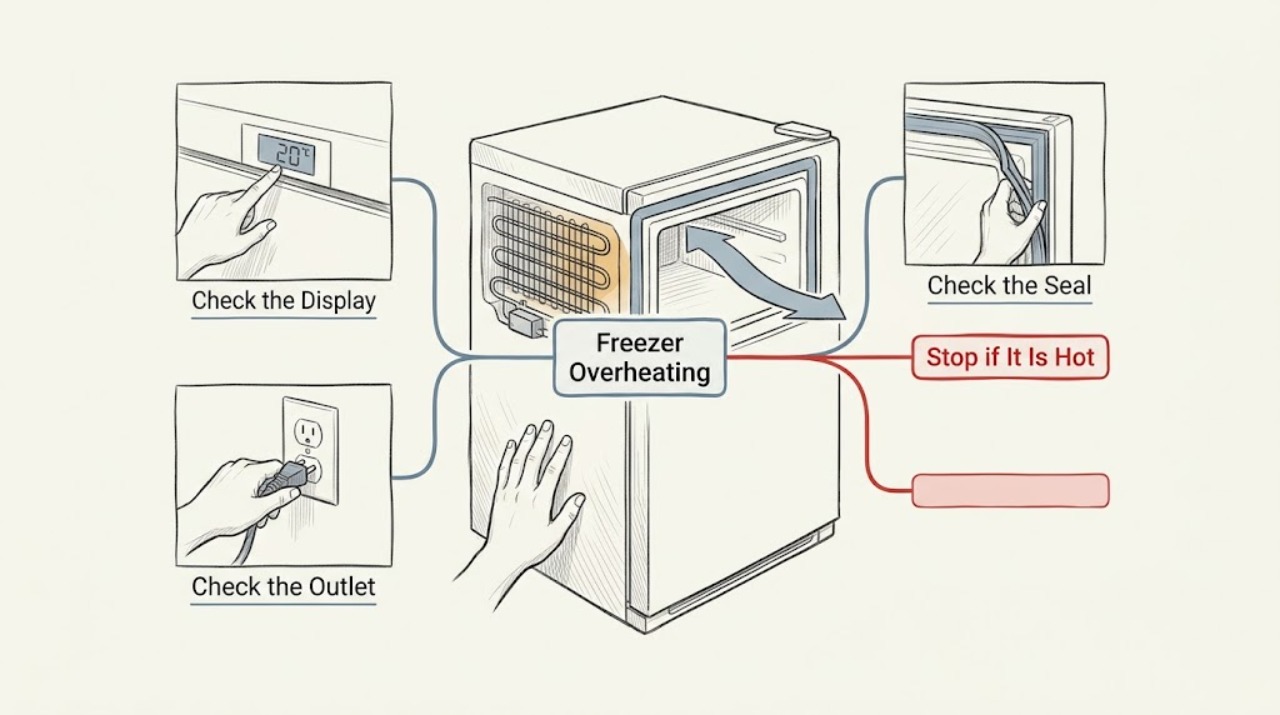
First decide whether the Frigidaire freezer feels warm inside or whether the cabinet and compressor are simply working harder. A freezer may run longer after installation, a power interruption, a large warm load, frequent door openings, or hot room conditions. If the inside is actually warm, check the selected setting, power, door closure and gasket seal, interior vents, frost buildup, and space around stored food. If the freezer cannot reach a stable cold temperature after the model's stabilization period, or you find a damaged gasket, heavy frost, abnormal noise, or a compressor that runs without cooling, stop relying on it for temperature-sensitive food and arrange qualified service.
Work through in order
Diagnostic checks
Use only checks that match the exact appliance or system and its official guide.
-
Check 1
Check the inside temperature using the freezer's display or a suitable appliance thermometer, and compare it with the setting recommended in the exact Frigidaire Use and Care manual.
Expected result: The interior is at or near the model's target, or it is clearly warmer and the temperature continues to rise.
Next step: If the interior is stable, continue monitoring without repeatedly opening the door. If it is warm, keep the door closed and continue with power, door-seal, vent, and frost checks while protecting the food.
Why this matters
Why: A warm exterior with a stable cold interior points more toward normal heat rejection; a warm or rising interior confirms a cooling or air-sealing problem rather than an exterior-temperature impression.
-
Check 2
Verify that the freezer has power by checking its interior or control-panel light, confirming the plug is seated, and checking the appropriate household outlet or reset device without opening the appliance cabinet.
Expected result: The lights and controls work normally, or the unit has no power or the outlet/reset device has tripped.
Next step: If power was interrupted, restore it safely and allow the model's stabilization period. If the outlet or reset device will not hold, stop using the appliance and have the electrical issue assessed rather than repeatedly resetting it.
Why this matters
Why: Working lights show that the appliance is receiving at least some power but do not prove that the cooling system is operating; a power interruption can explain a warm compartment and extended recovery run time.
-
Check 3
Inspect the door or lid from the front and check the gasket for dirt, gaps, cracks, distortion, or anything inside the cabinet that prevents full closure; clean only the accessible gasket with the method allowed by the model manual.
Expected result: The door closes evenly and the gasket grips all around, or a gap, dirty section, damaged gasket, or obstructing package is visible.
Next step: Remove an internal obstruction or clean the accessible gasket, then close the door and allow stabilization. If the gasket is damaged or still leaves a gap, arrange service or model-specific replacement guidance instead of forcing the door shut.
Why this matters
Why: A door that does not seal lets warm air enter and can make the compressor run longer while the freezer temperature remains unstable; a clear continuous seal makes air leakage less likely.
-
Check 4
Look inside the freezer for packages covering the air vents, packed food pressed against the rear wall, or frost that blocks vents or prevents the door from closing; do not chip ice with a sharp tool.
Expected result: Air paths are blocked or frost is obstructing circulation, or the vents and interior are clear.
Next step: Rearrange only accessible food to leave the vents open. If frost is extensive, follow the exact model's defrost instructions or arrange service; if the interior is clear, continue to the environment and run-time check.
Why this matters
Why: Frigidaire identifies blocked airflow and excess frost as causes of uneven cooling, impaired circulation, or a door that cannot seal; clear vents make that cause less likely but do not prove the cooling system is sound.
-
Check 5
Review recent conditions: installation or reconnection, a power outage, a large amount of warm food, frequent door openings, a hot room, or a freezer positioned without the clearance and environment specified in the manual.
Expected result: One of those conditions occurred recently, or none applies and the freezer has been operating under ordinary conditions.
Next step: If a temporary condition occurred, keep the door closed and allow the manufacturer's stabilization interval. If no temporary condition explains the symptom, record the interior temperature and arrange service if it does not recover.
Why this matters
Why: Recent heat load, warm ambient conditions, or recovery from power loss can extend compressor run time; a persistent warm interior under ordinary conditions is more concerning for a seal, airflow, fan, control, or sealed-system fault.
-
Check 6
Listen from outside the cabinet for the compressor hum, fan movement, unusual clicking, repeated cycling, or a completely silent unit while comparing the interior temperature over time.
Expected result: The unit runs and the interior cools, it runs continuously without lowering the interior temperature, it makes abnormal noises, or it has no cooling sound at all.
Next step: Stop using the freezer for temperature-sensitive food if the interior stays warm. Arrange qualified service if the unit cannot cool after stabilization, makes abnormal noises, or repeatedly stops and restarts.
Why this matters
Why: Normal operating sounds can show that the freezer is attempting to cool, but sound alone cannot identify the failed component. Continuous operation without temperature recovery or abnormal cycling after the simple checks needs professional diagnosis.
Use your observations
Decision map
Find the observation that best matches what you see, then follow the next safe action.
-
PATH 01Next step
What you see
The cabinet feels warm but the interior temperature is stable at the model's target.
Do this next
Treat the symptom as possible normal heat rejection, keep the ventilation clearance specified by the manual, and monitor the interior rather than judging by the exterior alone.
-
PATH 02Next step
What you see
The freezer recently lost power, was installed, received a large warm load, or has been opened frequently.
Do this next
Keep the door closed, avoid adding more warm food, and allow the exact model's stabilization interval before deciding that the cooling system has failed.
-
PATH 03Next step
What you see
The gasket has a gap, the door is obstructed, vents are covered, or frost blocks airflow.
Do this next
Correct only the accessible obstruction or cleaning issue, then allow stabilization. Arrange model-specific service if the seal or frost condition cannot be corrected safely.
-
PATH 04Next step
What you see
The interior remains warm after the simple checks and the model's stabilization period, or the compressor runs without cooling.
Do this next
Stop storing temperature-sensitive food in the freezer and arrange qualified appliance service; do not open sealed-system panels or handle refrigerant.
-
PATH 05Next step
What you see
There is smoke, a burning odor, damaged wiring, repeated breaker or reset trips, severe frost around an abnormal noise, or a damaged cabinet or door.
Do this next
Stop using the appliance, keep clear of the hazard, and obtain qualified appliance or electrical service before using it again.
Helpful context
Understand the symptom
Warm cabinet versus a warm freezer interior
Heat leaving the refrigeration system can make an exterior panel feel warm while the food compartment remains cold. The more useful symptom is the condition inside: food softening, a high-temperature alarm, or a measured temperature that is above the setting. A compressor or fan that runs for a long time can also be normal while the unit recovers from a power interruption or a large warm load.
Protect food while you troubleshoot
Keep the door closed as much as possible while checking the cause. Move temperature-sensitive food to a known-safe cold appliance if the interior is warming, and follow local food-safety guidance for anything that may have spent too long above its safe storage range. Do not open sealed refrigeration panels, handle refrigerant, or perform electrical measurements as a household check.
Allow time after a correction
A freezer does not become stable immediately after reconnection, a setting change, loading, or a door-seal correction. Use the stabilization interval specified for the exact Frigidaire model. If the temperature still does not recover after that interval, the observation is more useful for service than repeatedly changing the control.
Only after diagnosis
Potential parts
- freezer door gasket
Only consider a gasket after inspection shows a persistent gap, damage, or failure to seal and the exact model's documentation or a technician confirms that the gasket is the cause.
Confirm the exact Frigidaire model and manufacturer's fit information before ordering any component. - evaporator or condenser fan component
Only consider a fan component when airflow is absent or abnormal and a qualified technician confirms the fan fault after excluding blocked vents and frost.
Do not infer compatibility from appearance; use the exact model documentation and technician diagnosis. - temperature control or sensor component
Only consider a control or sensor after a technician confirms that the freezer is receiving power but is not regulating temperature correctly with a sound seal and clear airflow.
Confirm the exact Frigidaire model and the manufacturer's service or fit information before any replacement.
When checks do not resolve it
Need a professional?
A qualified technician should diagnose a persistent warm interior after power, setting, seal, airflow, frost, and environment checks, especially when the compressor or fan runs without cooling or the unit makes abnormal sounds.
Common questions
FAQ
Why does my Frigidaire freezer feel hot on the outside?
An exterior panel can feel warm while the freezer is rejecting heat normally. Check the interior temperature first. If the inside is also warm or continues to rise, use the door, airflow, frost, power, and stabilization checks and arrange service if it does not recover.
Is it normal for a Frigidaire freezer to run for a long time?
It can run longer after installation, reconnection after an outage, loading warm food, frequent door openings, or hot room conditions. Persistent run time without a cold interior after stabilization is not something to ignore.
Can a bad freezer door seal make a Frigidaire freezer overheat?
A door that does not seal lets warm air enter and can make the freezer run longer while the interior remains unstable. Check for gaps, dirt, damage, or an item preventing closure, then follow model-specific gasket guidance.
What should I do if frost is blocking the Frigidaire freezer vents?
Do not chip the frost with a sharp tool. Keep food clear of the vents and follow the exact model's defrost instructions; arrange service if the frost is extensive, returns quickly, or prevents the door from sealing.
Read the exact guide
Official sources
- Freezer Runs Too MuchFrigidaire · Frigidaire's official guidance for extended freezer run time and common temporary causes.
- Freezers - How can I set my freezer to run less frequently, or for shorter intervals?Frigidaire · Frigidaire's official guidance on run frequency, gasket sealing, door openings, temperature stabilization, and ambient conditions.
- Refrigerators / Freezer - Frost Build UpFrigidaire · Frigidaire's official frost guidance for door seals, blocked vents, and airflow around stored items.
- Freezer - Not Freezing or Not CoolingFrigidaire · Frigidaire's official troubleshooting guidance for a freezer that is too warm, not cooling, or showing a high-temperature condition.
- Why is moisture forming on the outside of my freezer?Frigidaire · Frigidaire's official explanation of exterior moisture from a slightly open door or humid conditions.
Community feedback
Share a repair observation
Share a plain-text repair observation. Accepted observations are published automatically; this page may take a moment to update.