
On this page
Start here
Quick answer
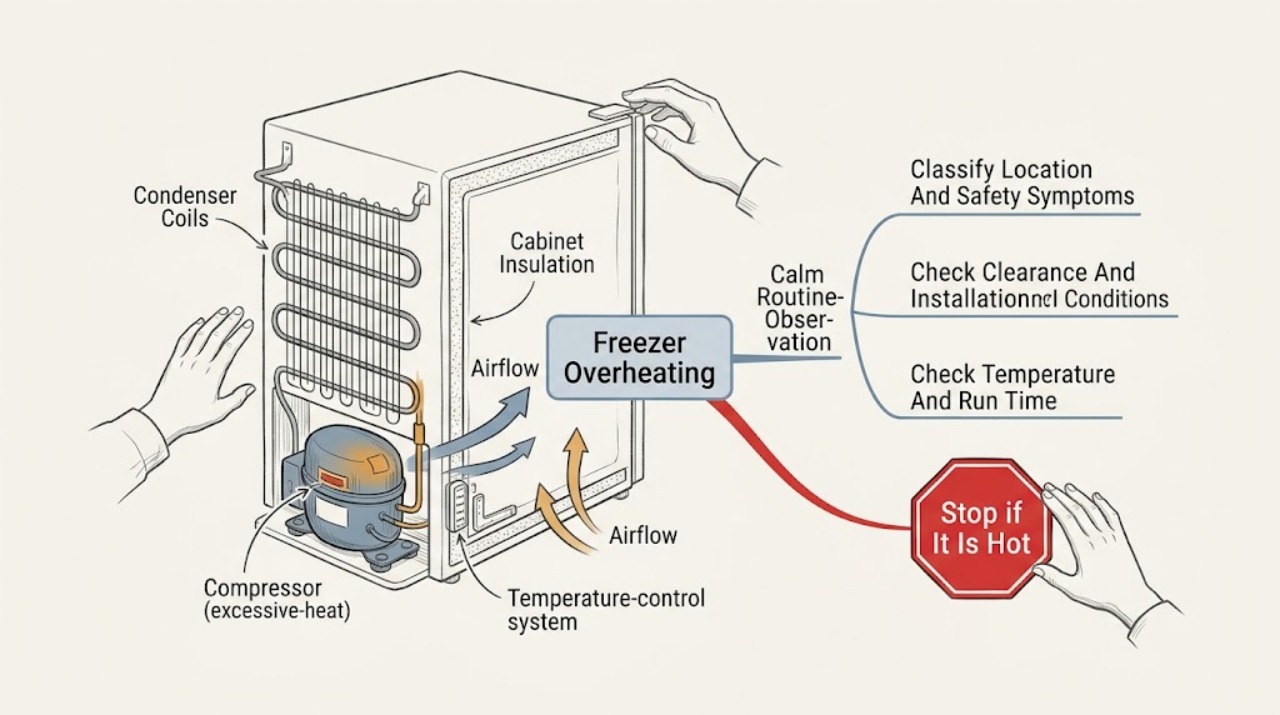
A GE freezer's outside case can normally feel warm or even hot because the case or a built-in heater helps reject heat and prevent condensation. GE says upright and chest freezer walls can be up to 30°F warmer than the surrounding room, but the model still needs the clearances in its owner's manual. Treat heat with a burning smell, smoke, melted material, a hot or damaged cord, repeated breaker trips, unusual clicking, or a freezer that is not holding temperature as a fault: stop using it, keep people away, and arrange qualified appliance or electrical service. From a safe, dry position, identify where the heat is located, check the model-specific clearance and installation conditions, and confirm the food temperature and compressor behavior without touching the compressor, wiring, refrigerant tubing, or access panels.
Before you begin
Safety first
- This article covers safe external heat classification, model identification, clearance and installation observations, temperature and run-time recording, visible door and vent checks, and model-approved external cleaning only. Do not touch hot mechanical or electrical parts, open panels, test live circuits, move a heavy appliance, or open sealed refrigeration components.
Work through in order
Diagnostic checks
Use only checks that match the exact appliance or system and its official guide.
-
Check 1
From a dry, stable position, note whether warmth is spread across the side walls, concentrated at the front edge or divider, limited to the lower rear area, or accompanied by smoke, odor, melting, water, a damaged cord, or a breaker trip. Do not touch hot components or reach behind the freezer.
Expected result: Only the exterior case is warm and the freezer is holding temperature, or the heat is new, localized, rapidly increasing, or paired with a safety symptom or loss of cooling.
Next step: For normal case warmth with stable cooling, continue to the clearance and operating-condition checks. For smoke, burning odor, melting, a hot cord, water near wiring, or cooling loss, stop using the freezer and arrange prompt qualified service.
Stop if: Stop immediately for smoke, sparks, a burning smell, melted material, active flooding, a hot or damaged cord, or any need to stand in water or touch an electrical part.
Why this matters
Why: GE says warm or hot exterior sides can be normal heat rejection, especially on chest and upright models. A new concentrated hot spot, an abnormal smell or visible damage, or heat together with a warm cabinet is not explained by normal case warmth alone.
-
Check 2
Read the GE model and installation instructions, then compare the visible top, side, and rear clearance with that model's requirements. Note direct sun, a nearby heat source, a hot garage, blocked room airflow, or anything stored against the freezer; do not pull out a heavy or built-in unit.
Expected result: Clearance is below the model requirement, the freezer is in an unusually hot or humid location, the room airflow is blocked, or installation conditions are within the manual's limits.
Next step: Remove only a plainly accessible object that blocks ventilation and restore the model-approved surrounding space without moving the appliance. If correcting clearance requires lifting, disconnection, or moving a built-in unit, request service instead.
Stop if: Do not move a heavy freezer, remove rear panels, place a fan against internal parts, or work near a hot cord, wet outlet, or exposed wiring.
Why this matters
Why: Restricted air circulation or excessive ambient heat can make the case feel hotter and lengthen compressor run time. GE publishes different general clearances for chest and upright freezers, so another model's spacing cannot be assumed to fit this one.
-
Check 3
Use an appliance thermometer if available and record the freezer temperature, whether food remains frozen, how long the compressor has been running, and whether a large warm load or recent installation preceded the heat. Keep the door closed between observations.
Expected result: The freezer is near its normal temperature, warmer than normal while the compressor runs for a long time, or warming while the compressor is silent, clicking, or repeatedly starting and stopping.
Next step: If temperature is stable and no safety symptom exists, continue the visible door, load, and vent check. If food is warming or the sound pattern is abnormal, keep the door closed as practical, protect food, and arrange qualified service rather than forcing a longer run.
Stop if: Stop using the freezer for smoke, odor, electrical symptoms, or a temperature that is rising despite safe settings and clearance; do not touch the compressor or live parts to confirm heat.
Why this matters
Why: GE explains that compressors can run 80% to 90% of the time and longer after a warm load or in hot weather, so run time alone does not prove overheating. A rising food temperature, repeated clicking, or no cooling with normal power is more consistent with a control, relay, wiring, compressor, airflow, or sealed-system concern.
-
Check 4
With the door open only briefly, check that packages are not blocking interior vents, the lid or door closes fully, the gasket is clean and contacting evenly, and the freezer is not packed in a way that prevents the model's air path. Look for an interior light that remains on when closed if the model has one.
Expected result: A package blocks a vent or lid, the gasket is folded or damaged, the door remains ajar, the interior light stays on, or the load and door appear normal.
Next step: Remove only an accessible obstruction, restore the gasket's position without tools, close the door, and monitor temperature without repeated openings. Request service for a damaged gasket, misaligned door, returning frost, or persistent heat and cooling loss.
Stop if: Do not force the door, cut or glue a gasket, remove panels, scrape frost with a sharp object, or continue operation when food is warming and the exterior heat is abnormal.
Why this matters
Why: GE lists blocked freezer vents, damaged or dirty gaskets, frequent door opening, and an interior light that stays on as factors that increase run time or reduce cooling. These conditions can make the exterior work harder but do not explain smoke, melting, or electrical damage.
-
Check 5
Use the model owner's manual to determine whether the freezer has a user-cleanable condenser or other external maintenance point. If it does, disconnect power only from a dry, safe position, allow the unit to cool, and clean only the accessible area and method the manual permits; if it has a self-cleaning condenser, do not add an improvised cleaning step.
Expected result: The manual identifies a cleanable condenser with visible dust, the model has a self-cleaning or inaccessible condenser, or cleaning would require a cover, appliance movement, or contact with hot or wet parts.
Next step: Perform only the exact manual-approved external cleaning, restore all covers and dry conditions, and monitor temperature. If heat or cooling loss persists, arrange qualified diagnosis of the condenser, fan, compressor, controls, or sealed system.
Stop if: Do not open sealed refrigeration parts, spray liquid into the cabinet, use compressed air into unknown openings, touch live wiring, or clean while the appliance is energized.
Why this matters
Why: GE says dirty condenser coils can reduce efficiency on models that require cleaning, but many newer refrigerators have a condenser that does not need user cleaning. Incorrect access can create an electrical, refrigerant, or mechanical hazard.
Use your observations
Decision map
Find the observation that best matches what you see, then follow the next safe action.
-
PATH 01Safety boundary
What you see
The side or front case is warm or hot in a stable, even way, the freezer holds temperature, and there is no odor, smoke, damage, or electrical symptom.
Do this next
Confirm the model's air clearance and continue normal operation while monitoring temperature and any change in the heat pattern.
Why this path and its safety boundary
Why it matters: GE identifies this exterior warmth as a normal heat-rejection or anti-condensation behavior for upright and chest freezers.
Safety stop: Arrange service if the heat becomes localized or rapidly increases, cooling changes, or any odor, smoke, melting, or electrical symptom appears.
-
PATH 02Safety boundary
What you see
The freezer has inadequate model clearance, blocked ventilation, direct heat, an unusually hot room, or a recent large warm load, but no electrical danger is visible.
Do this next
Restore only the model-approved clearance and loading conditions without moving a heavy unit, then monitor temperature with the door closed.
Why this path and its safety boundary
Why it matters: The installation or load can lengthen compressor operation and increase case warmth without proving an internal failure.
Safety stop: Request service if the freezer cannot maintain temperature after safe conditions are restored or if correcting the location requires lifting or disconnection.
-
PATH 03Safety boundary
What you see
A vent, door, gasket, interior light, or model-approved condenser-cleaning condition is visibly contributing to long run time.
Do this next
Correct only the accessible obstruction, door or gasket position, or manual-approved cleaning step, then monitor temperature without repeated door openings.
Why this path and its safety boundary
Why it matters: GE lists these as factors that can increase run time or reduce cooling efficiency; they are separate from a compressor or electrical diagnosis.
Safety stop: Arrange service for a damaged gasket, inaccessible condenser, returning frost, persistent heat, or any condition requiring panel removal.
-
PATH 04Safety boundary
What you see
The freezer is warming, the compressor clicks or stops repeatedly, it runs continuously without reaching temperature, or it has normal power but no effective cooling.
Do this next
Keep the door closed as practical, protect food, preserve the temperature and sound history, and arrange qualified GE appliance diagnosis.
Why this path and its safety boundary
Why it matters: A relay, defrost or temperature control, wiring, compressor, fan, condenser, or sealed-system fault is plausible; exterior heat alone cannot identify the part.
Safety stop: Do not touch the compressor, test live circuits, remove panels, open the sealed system, or keep forcing the unit to run.
-
PATH 05Safety boundary
What you see
There is smoke, sparking, a burning smell, melted material, a hot damaged cord, a repeated breaker trip, flooding, or water near an outlet or electrical component.
Do this next
Keep away from the hazard, use a safe accessible shutoff only if it can be reached without contact with water or damaged parts, and arrange urgent qualified service or emergency help as appropriate.
Why this path and its safety boundary
Why it matters: This is an immediate electrical, fire, or physical safety boundary, not normal freezer case warmth.
Safety stop: Do not step into water, touch wet electrical parts, unplug through a puddle, move the freezer, or restore power to reproduce the symptom.
-
PATH 06Safety boundary
What you see
The freezer cannot hold its normal temperature and food is soft or thawing, even if the outside heat could otherwise be normal.
Do this next
Keep the door closed as much as possible, assess food according to official food-safety guidance, and arrange qualified service for the freezer fault.
Why this path and its safety boundary
Why it matters: Food protection now takes priority; warm case walls do not make a failed cooling cycle safe to ignore.
Safety stop: Do not keep perishable food in a freezer that cannot maintain temperature or use repeated resets to delay service.
Helpful context
Understand the symptom
Warm sides are not automatically overheating
On GE upright and chest freezers, heat on the outside can be part of normal heat rejection. GE says chest-freezer condensers can be wrapped around the case, upright models can use case heaters to reduce sweating, and the exterior may be up to 30°F warmer than the installation environment. The useful question is whether the freezer is maintaining temperature and whether the heat is accompanied by an odor, smoke, damage, electrical symptom, or a sudden change from the appliance's normal behavior.
Heat, run time, and cooling must be read together
A compressor may run much of the time; GE describes a design range of about 80% to 90% for refrigerators and freezers, with longer operation during hot weather or after a large warm load. That does not make a freezer that is getting hotter while food warms normal. Blocked vents, a damaged door gasket, poor clearance, a dirty condenser on models that require cleaning, or an internal control, relay, wiring, or compressor fault can change the decision from observation to service.
Use a strict electrical and fire boundary
Do not diagnose overheating by touching the compressor, opening a cover, moving a heavy freezer, or testing energized wiring. If there is smoke, sparking, a burning smell, a melted cord, active water near electrical parts, or a breaker that trips again, stop immediately and use a safe accessible power shutoff only if it can be reached without contact with the hazard. Keep the freezer door closed as practical while food safety and service are handled.
Safety boundary
Stop conditions
- Stop immediately for smoke, sparks, a burning smell, melting, a hot or damaged cord, repeated breaker trips, active flooding, or water near electrical parts.
- Do not touch the compressor, condenser, wiring, refrigerant tubing, or access panels to measure heat; do not test live circuits or open the sealed system.
- Do not move a heavy or built-in freezer, force a door, cut or glue a gasket, or use a clearance requirement from another model.
- Disconnect power before any model-approved cleaning only when the plug, outlet, and floor are dry and safely accessible; do not spray liquid into openings.
- Arrange qualified GE service when the freezer is warming, food is thawing, abnormal clicking or continuous running persists, the heat pattern changes, or safe clearance and loading checks do not restore normal operation.
Only after diagnosis
Potential parts
- GE-compatible condenser or evaporator fan assembly
Consider this category only after qualified diagnosis confirms a fan or motor fault associated with abnormal heat, long run time, or reduced cooling.
Confirm the exact GE model, fan location, connector, blade, and manufacturer fit information; access may require panel removal. - GE-compatible temperature or defrost control
Consider this category only when diagnosis links abnormal temperature regulation, frost, or run time to a failed control rather than clearance, load, or door sealing.
Confirm the exact GE model and control design; do not bypass a thermostat, sensor, or defrost safety device. - GE-compatible start relay or compressor component
Consider this category only when qualified testing confirms a starting or compressor fault; case heat or clicking alone does not identify a specific part.
Confirm the exact GE model and electrical diagnosis; compressor and start-device work belongs to qualified service.
When checks do not resolve it
Need a professional?
Arrange qualified GE appliance service when a freezer is warming despite safe clearance and loading, runs continuously without maintaining temperature, clicks or stops repeatedly, has a returning abnormal heat pattern, or needs condenser, fan, control, compressor, or sealed-system diagnosis. Stop immediately for smoke, sparks, burning odor, melting, a hot cord, repeated breaker trips, flooding, or water near electrical parts, and use qualified electrical service for a circuit or wiring concern.
Safety scope: This article covers safe external heat classification, model identification, clearance and installation observations, temperature and run-time recording, visible door and vent checks, and model-approved external cleaning only. Do not touch hot mechanical or electrical parts, open panels, test live circuits, move a heavy appliance, or open sealed refrigeration components.
Common questions
FAQ
Is it normal for the outside of a GE freezer to feel hot?
Often, yes. GE says chest and upright freezer exteriors can feel warm or even hot as they reject heat or prevent condensation, and case walls can be up to 30°F warmer than the room. It is not normal when the heat is accompanied by smoke, odor, melting, electrical symptoms, or loss of cooling.
Why is my GE freezer running all the time and getting hot?
GE says compressors may run about 80% to 90% of the time, with longer operation after a warm load or in hot weather. Check model clearance, blocked vents, door sealing, loading, and any model-approved condenser maintenance. If food is warming or clicking occurs, arrange service.
Can poor clearance make a GE freezer overheat?
Restricted air circulation can increase case warmth and run time. Compare the freezer with the exact GE installation instructions because chest and upright models have different general clearance ranges. Remove only accessible obstructions; do not move a heavy or built-in unit as a user test.
What does a burning smell from a GE freezer mean?
A burning smell is not normal case warmth. Stop using the freezer, keep away from smoke or sparking, use a safe accessible power shutoff only if it can be reached without contact with the hazard, and arrange qualified appliance or electrical service. Do not restart it to reproduce the smell.
Should I clean the condenser when my GE freezer feels hot?
Only if the exact owner's manual identifies an accessible, user-cleanable condenser and gives a procedure. GE notes that some models do not require coil cleaning. Disconnect power only from a dry, safe position, and never remove panels or spray liquid into openings.
When should I call for GE freezer overheating service?
Arrange service when the freezer warms, food thaws, abnormal clicking or continuous running persists, safe clearance and loading checks do not help, or diagnosis requires a fan, control, relay, compressor, wiring, or sealed-system check. Stop immediately for smoke, sparks, burning odor, melting, a hot cord, or a repeat breaker trip.
Read the exact guide
Official sources
- Upright & Chest Freezer - Not WorkingGE Appliances · Applies when a GE upright or chest freezer has normal control lights but does not cool, especially when heat or long run time accompanies the symptom.
- Refrigerator or Freezer - Normal Run TimeGE Appliances · Applies to evaluating a GE freezer that feels hot or runs for long periods, while the model manual controls exact installation and maintenance requirements.
- Upright & Chest Freezer - Exterior Case WarmGE Appliances · Directly applies to interpreting warm or hot exterior sides on GE upright and chest freezers; the owner's manual controls the model-specific clearance.
- GE Appliance - General List of Minimum Air Clearance RequirementsGE Appliances · Applies to comparing visible chest or upright freezer clearance with GE's general ranges; the exact owner's manual and installation instructions control.
Community feedback
Share a repair observation
Share a plain-text repair observation. Accepted observations are published automatically; this page may take a moment to update.