
On this page
Start here
Quick answer
Start by separating a dead refrigerator from one that has power but is warm. Record the exact Danby model, check that the plug is seated and the unit is turned on, and use the model-matched manual before changing settings or moving the cabinet. Danby's current DFF116 refrigerator manual lists a tripped breaker or poorly inserted plug under no power, and lists a warm setting, a door that is not shut, recent warm food, heat or sunlight, and high ambient conditions under an internal temperature that is not cold enough. If the display or interior light works but cooling does not return after the external checks, do not open the rear panel: fan, defrost, compressor, controls, and the sealed refrigerant circuit need qualified service. Stop immediately for smoke, burning odor, a damaged cord, water near electrical parts, repeated breaker trips, or refrigerant-tube damage.
Before you begin
Safety first
- The owner may observe the model label, safe power connection, control state, door closure, external clearance, visible frost or water, and normal user-accessible care in the matching manual. Electrical diagnosis, fan and defrost work, control-board work, compressor work, refrigerant handling, and sealed-system repair are for qualified service personnel.
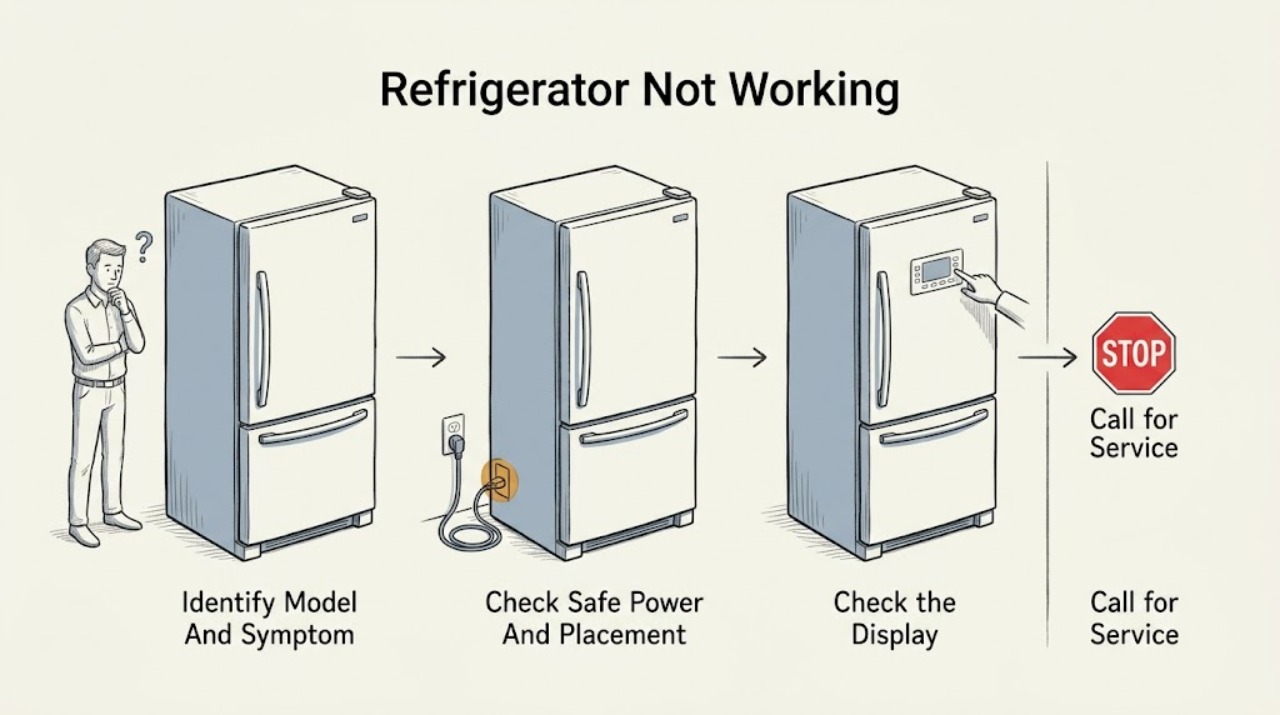
Work through in order
Diagnostic checks
Use only checks that match the exact appliance or system and its official guide.
-
Check 1
Read the rating label and record the full Danby model and serial information. Then note whether the interior light, display, and controls respond; whether the unit makes its normal operating sound; whether the freezer, refrigerator compartment, or both are warm; and whether the problem began after moving the unit, a power interruption, or adding warm food.
Expected result: The unit is completely dark and unresponsive, or it has power but one or more compartments are not cold enough.
Next step: Use the recorded model in Danby's manual lookup, then follow the branch below that matches the observed symptom. Keep the door closed as much as practical while the food is being protected.
Stop if: Do not remove a rear, control, or interior fixed panel to identify the system layout.
Why this matters
Why: A dark unit sends the diagnosis toward power and control state. A lit or responsive unit sends it toward settings, door and airflow conditions, recent load, ambient conditions, or a cooling subsystem; the exact model determines which features exist.
-
Check 2
For a dark or recently moved refrigerator, confirm from a dry, safe position that the plug is fully seated, the receptacle switch is on if one exists, and the unit has not been connected through an extension cord or altered plug. Check that the cabinet is upright and not visibly crushed or tipped; if it was transported on its side or back, use the upright waiting period in the matching manual before connection.
Expected result: The plug or receptacle state was wrong, the unit was recently moved, or the power connection and placement are already correct.
Next step: Correct only the external connection or placement issue once. If the unit remains dark, a breaker trips again, or the cord/plug is damaged, leave it off and arrange qualified service or an electrician as appropriate.
Stop if: Do not replace a fuse, alter a receptacle, bypass grounding, splice a cord, or repeatedly reset a tripped protection device.
Why this matters
Why: A loose connection or post-transport delay can explain a no-start condition. If the connection and model-approved waiting period are correct but the refrigerator remains dark, the cause may be a protection device, cord, control, or internal electrical fault.
-
Check 3
If the light or display works, read the exact model manual for the temperature control, vacation or demo state, lock, and any alarm indication. Confirm that the refrigerator is not intentionally set warm or in a mode that pauses cooling, and make only the manual's normal user adjustment. Do not infer a control sequence from a different Danby model.
Expected result: A warm setting or documented non-cooling mode was selected, the setting is appropriate, or the model has no such control or mode.
Next step: Allow the exact manual's normal recovery time after a setting change without repeatedly changing controls. If temperature does not improve, continue with the external-load and airflow check, then service if the symptom persists.
Why this matters
Why: A control state can make a working refrigerator appear failed. If the setting is appropriate and the unit remains warm, the cause is less likely to be a simple user setting and more likely to involve airflow, door sealing, defrost, fan, compressor, or sealed-system operation.
-
Check 4
Inspect the door from the outside: confirm it closes fully, the gasket is not visibly folded or obstructed, and shelves or food are not holding it open. Note recent large additions of warm food, frequent door opening, direct sun or a nearby heat source, and blocked external ventilation. Do not rearrange internal air channels unless the matching manual identifies them as user-accessible.
Expected result: The door does not seal normally, the cabinet is overfilled or exposed to unusual heat, or the door and surrounding conditions are normal.
Next step: Correct an obvious external obstruction, close the door, restore the manual's required clearance, and give the refrigerator time to recover. If it remains warm or the gasket/hinge cannot close normally, arrange service.
Stop if: Do not force the door, reshape a gasket with heat, or remove trim or hinges to improve closure.
Why this matters
Why: Danby's refrigerator guidance associates a warm cabinet with a door that is not shut, frequent opening, warm contents, heat or sunlight, and high ambient conditions. If those conditions are normal but cooling is still absent, an internal cooling subsystem becomes more likely.
-
Check 5
Without removing panels, look for heavy frost on visible interior surfaces, water on the floor or inside the cabinet, a blocked visible vent, or an unusual change in airflow. If the exact manual describes an automatic-defrost model, do not chip, scrape, or accelerate defrosting with a heat source; document the pattern instead.
Expected result: There is heavy frost, standing water, or a visibly blocked airflow path, or there is no such external symptom.
Next step: Clear only an obvious external obstruction and follow the exact manual for any user-accessible cleaning. For recurring frost, water, or restricted airflow, keep food safe and arrange service rather than opening the cooling compartment.
Stop if: Do not puncture tubing, use sharp tools on ice, remove a defrost cover, or pour hot water into the cabinet to force a repair.
Why this matters
Why: Frost or water can be a clue to a door-seal, drain, airflow, or defrost problem, but it does not identify which internal component failed. The cited DFF116 manual uses automatic defrost and routes defrost water to a drip tray, so a recurring pattern needs model-specific diagnosis.
-
Check 6
From outside the closed cabinet, note whether the compressor or fan seems absent, runs continuously without cooling, clicks and stops, or produces a new scraping or electrical sound. Compare only with the model manual's normal-operation guidance; do not touch or access the compressor, fan, wiring, defrost parts, control board, or refrigerant tubing.
Expected result: Cooling returns after external checks, or the refrigerator stays warm with an abnormal operating pattern or no meaningful cooling response.
Next step: Stop troubleshooting at the cabinet boundary and give the technician the model, compartment temperatures or symptoms, sound pattern, and the time the issue began. Do not continue running a unit that is overheating, leaking, or making an electrical sound.
Stop if: Do not open the rear panel, test live voltage, jump a control, replace a relay, work on the compressor, or open the sealed refrigerant circuit.
Why this matters
Why: A persistent abnormal sound or run pattern makes an internal fan, defrost, control, compressor, or sealed-system issue more likely than a simple setting or door problem. The observation narrows the service request but cannot safely identify a replaceable part.
-
Check 7
Stop immediately for smoke, burning odor, arcing, a damaged cord or plug, water near electrical parts, repeated breaker or ground-fault trips, a tipped or crushed cabinet, unusual heat, or visible damage to refrigerant tubing. From a safe, dry position, isolate power and keep people away until qualified help is arranged.
Expected result: No safety symptom is present and the refrigerator has a model-documented external condition, or a safety symptom is present.
Next step: For any safety symptom, do not restart the refrigerator. Contact an authorized appliance service provider or qualified electrician for the relevant hazard and preserve food using a safe alternative.
Stop if: Do not puncture refrigerant tubing, remove fixed covers, perform live electrical tests, bypass protection, or attempt internal cooling-system repair.
Why this matters
Why: A refrigerator that is merely warm can be observed through low-risk external checks; a fire, shock, moisture, mechanical, or refrigerant hazard overrides further testing.
Use your observations
Decision map
Find the observation that best matches what you see, then follow the next safe action.
-
PATH 01Next step
What you see
The light, display, and controls are all dark, and the refrigerator does not respond after the plug, receptacle state, model-approved transport wait, and safe placement are correct.
Do this next
Leave the refrigerator off if the protection device trips again or the cord is damaged. Otherwise provide the model and the external power observations to Danby or qualified service; do not open the cabinet.
Why this path and its safety boundary
Why it matters: The problem is more consistent with power delivery, a protection device, cord, control, or another electrical fault than with a temperature setting or door seal.
-
PATH 02Next step
What you see
The light or display works, but the cabinet is warm and the setting, door closure, recent load, ambient heat, sunlight, and external ventilation reveal a correctable condition.
Do this next
Correct the specific external condition once, keep the door closed, and monitor recovery according to the matching manual. If there is no improvement, move to professional diagnosis.
Why this path and its safety boundary
Why it matters: A user or installation condition is more likely than an immediate internal part failure, although the refrigerator still needs time to recover after the condition is corrected.
-
PATH 03Next step
What you see
The controls and door appear normal, external clearance is adequate, and the refrigerator remains warm or runs continuously without recovering.
Do this next
Stop at external observation and arrange model-matched service. Record whether one compartment or the whole cabinet is affected and whether there is frost, water, clicking, scraping, or an absent operating sound.
Why this path and its safety boundary
Why it matters: A fan, defrost, control, compressor, or sealed-system fault becomes more likely than a simple setting or loading issue. A part cannot be selected from this symptom alone.
-
PATH 04Next step
What you see
The refrigerator has power and cooling changes when the exact manual's temperature, vacation, demo, lock, or alarm state is corrected, or the manual does not document that state for the model.
Do this next
Use only the model's documented controls and allow normal recovery time. If the state is unclear or the refrigerator stays warm, contact Danby or qualified service.
Why this path and its safety boundary
Why it matters: A documented control state can explain the symptom. If the control state is not documented or the symptom returns, the controls cannot be assumed to be the fault or the cure.
-
PATH 05Next step
What you see
Heavy visible frost, recurring water, or a blocked visible airflow path accompanies poor cooling.
Do this next
Follow only accessible care in the matching manual and do not force defrosting. If the pattern recurs or the unit remains warm, arrange service.
Why this path and its safety boundary
Why it matters: A door-seal, drain, airflow, or defrost issue is more plausible, but the visible pattern does not distinguish the internal cause. For the cited DFF116 family, defrost is automatic and the water route is part of the appliance design.
-
PATH 06Next step
What you see
Smoke, burning odor, arcing, damaged power hardware, water near electrics, repeated protection trips, unusual heat, a tip-over, or refrigerant-tube damage is present.
Do this next
Isolate power only if safe, do not restart, and arrange qualified service or electrical help. Do not puncture tubing or attempt internal repair.
Why this path and its safety boundary
Why it matters: The hazard is more urgent than identifying why the refrigerator stopped. Continued operation or cabinet access could add fire, shock, mechanical, or refrigerant risk.
Helpful context
Understand the symptom
First decide whether the refrigerator is dead or merely warm
A dark display or interior light, no response from controls, and no operating sound point first to power delivery or a control state. If the light or display works, the refrigerator is not electrically dead; the next decision is whether the cabinet is warming because of settings, door and airflow conditions, a recent load, or an internal cooling fault. This distinction prevents repeated outlet checks from obscuring a cooling diagnosis.
Use the exact Danby model, not a generic refrigerator recipe
Danby sells compact, mid-size, outdoor, specialty, and full-size refrigerators with different controls and airflow arrangements. Its manual lookup asks for a model number, and the cited DFF116 guide is specific to a listed group of DFF116 models. Use that guide only when the rating label matches; otherwise obtain the manual for the actual unit before interpreting a mode, alarm, defrost behavior, or service access.
External checks are the owner boundary
A user can observe the plug, control setting, door closure, external clearance, food load, and visible frost or water without removing panels. Danby's current DFF116 guide describes automatic defrost and warns against damaging the refrigerant circuit; the compressor, fans, defrost system, wiring, controls, and sealed circuit are not interchangeable owner checks. If those systems are suspected, preserve the observations and arrange model-matched service.
Safety boundary
Stop conditions
- Do not infer a repair procedure, mode, temperature setting, or component fit from another Danby refrigerator model.
- Do not open fixed covers, perform live electrical tests, bypass a protection device, splice a cord, or alter grounding.
- Do not remove or replace fans, defrost components, relays, controls, or compressor parts without qualified model-specific service.
- Do not puncture or open the refrigerant circuit, scrape frost with sharp tools, or use an improvised heat source to force defrosting.
- Do not keep operating or repeatedly restarting a refrigerator with smoke, burning odor, arcing, water near electrics, repeated trips, unusual heat, or visible tubing damage.
When checks do not resolve it
Need a professional?
Arrange Danby or authorized appliance service when the refrigerator remains warm after the model-matched external checks, one or both compartments are not cooling, the unit runs continuously or clicks and stops, frost or water recurs, a control state is unclear, or the unit is dark after a correct safe power connection. Seek immediate qualified help for smoke, burning odor, arcing, a damaged cord, water near electrical parts, repeated breaker or ground-fault trips, unusual heat, a tip-over, or refrigerant-tube damage.
Safety scope: The owner may observe the model label, safe power connection, control state, door closure, external clearance, visible frost or water, and normal user-accessible care in the matching manual. Electrical diagnosis, fan and defrost work, control-board work, compressor work, refrigerant handling, and sealed-system repair are for qualified service personnel.
Common questions
FAQ
What should I check first when my Danby refrigerator is not working?
First decide whether the interior light and display are dead or whether the refrigerator has power but is warm. Record the exact model, confirm the plug is seated and the unit is turned on, and use the matching Danby manual before changing controls or moving the cabinet.
Why is my Danby refrigerator running but not getting cold?
Check the model's temperature state, door closure, recent warm food, direct heat or sunlight, and external ventilation. If those are normal and the cabinet remains warm or runs continuously, a fan, defrost, control, compressor, or sealed-system fault is more likely and needs qualified service.
Should I unplug my Danby refrigerator after it was moved on its side?
Follow the upright waiting period in the exact model manual before connecting it. Danby's refrigerator FAQ and the cited DFF116 manual both emphasize allowing a transported unit to stand upright before plugging it in.
Can I repair a Danby refrigerator fan, defrost system, or compressor myself?
No. You may document visible frost, water, airflow, or sound from outside the cabinet, but fan, defrost, controls, compressor, wiring, and sealed refrigerant work require qualified model-specific service. Do not remove covers or puncture tubing.
When is a Danby refrigerator not-working problem an emergency?
Stop using it for smoke, burning odor, arcing, a damaged cord or plug, water near electrical parts, repeated breaker or ground-fault trips, unusual heat, a tip-over, or visible refrigerant-tube damage. Isolate power only from a safe dry position and arrange qualified help; do not restart to test it.
Read the exact guide
Official sources
- DFF116B1WDBL / DFF116B1WDBR / DFF116B2WDBL / DFF116B2WDBR / DFF116B2SSDBL / DFF116B2SSDBR Refrigerator Owner’s ManualDanby · DFF116B1WDBL, DFF116B1WDBR, DFF116B2WDBL, DFF116B2WDBR, DFF116B2SSDBL, and DFF116B2SSDBR; other Danby refrigerators may differ.
- The fridge is not cooling properly. What should I do?Danby USA · Brand-level refrigerator guidance for plug, power state, and post-transport upright waiting; the exact owner manual controls model-specific details.
- Faqs Category: RefrigerationDanby USA · Brand-level symptom guidance; model manuals control exact installation, temperature, defrost, airflow, and service details.
- Product ManualsDanby Appliances - USA · Brand-level lookup; type the exact refrigerator SKU/model to obtain its owner manual.
Community feedback
Share a repair observation
Share a plain-text repair observation. Accepted observations are published automatically; this page may take a moment to update.