
On this page
Start here
Quick answer
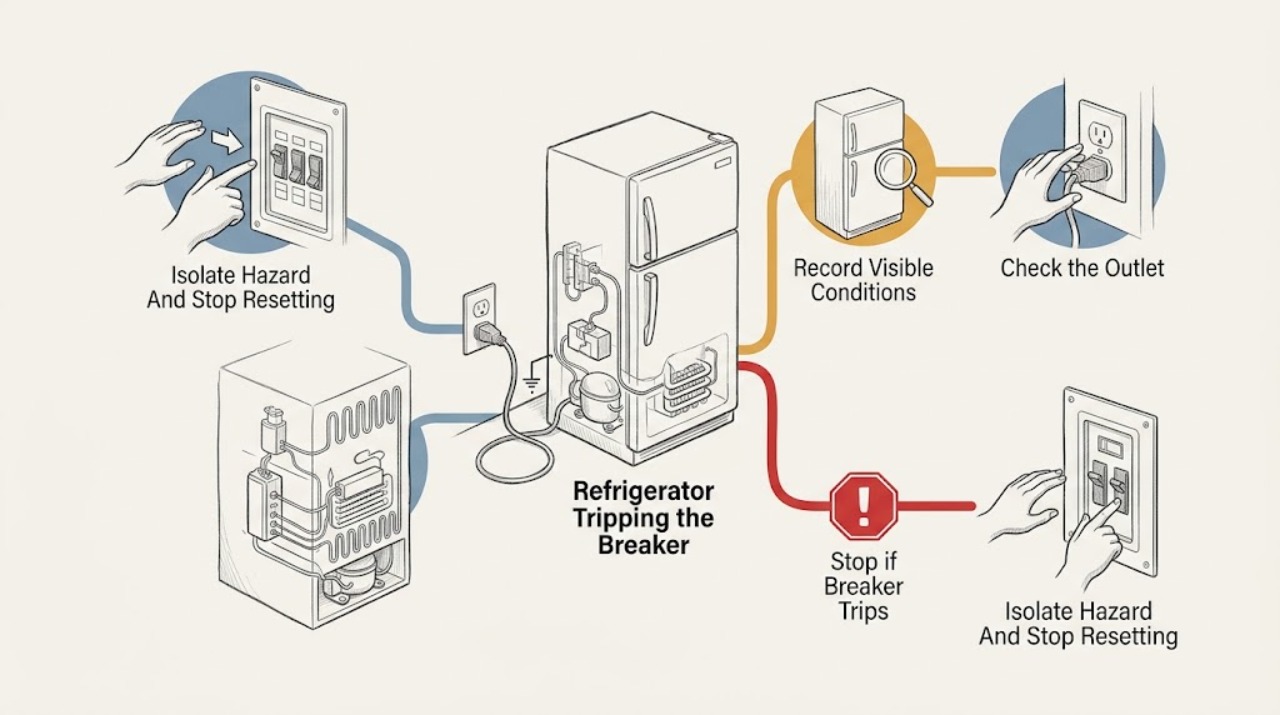
Do not keep resetting a breaker to make a Danby refrigerator run. If the plug, outlet, breaker/RCD, cord, or nearby floor is wet, hot, scorched, sparking, or smells burnt, leave the refrigerator disconnected and arrange qualified electrical/appliance service. If the area is dry and safe, note whether the trip occurs immediately at plug-in, only when the compressor starts, after the refrigerator has run, or only when other appliances share the circuit. Danby's official manuals list a tripped breaker, loose plug, improper power supply, and defective house wiring among no-power causes; they also require a properly grounded wall outlet and prohibit extension cords or splicing. Check only the external plug/cord, outlet condition, and visible moisture, and use the exact model manual for installation requirements. A repeatable trip can involve the compressor starting components, defrost system, control, wiring, or another internal fault. Do not open the cabinet, test live voltage, replace a breaker or fuse with a different rating, or work on the compressor, refrigerant circuit, defrost parts, or control board.
Before you begin
Safety first
- The user may disconnect the appliance from a safe dry position, record the trip, inspect the external cord/plug/outlet for visible damage, read the rating label, and check the installation against the exact manual. House wiring, breakers, compressor starting components, defrost system, controls, harnesses, insulation, refrigerant tubing, and all energized testing are for qualified personnel.
Work through in order
Diagnostic checks
Use only checks that match the exact appliance or system and its official guide.
-
Check 1
At the first trip, stop the refrigerator and check from a dry position for a hot plug, scorch marks, smoke, spark, burnt/electrical odor, water near the cord or outlet, or a damaged cord. Do not touch wet electrical parts; isolate power only if it can be done without contact with a hazard.
Expected result: Any heat, odor, visible damage, water, smoke, spark, or repeated immediate trip is present, or the area is dry with no visible hazard.
Next step: For any hazard or repeated trip, leave the refrigerator disconnected and arrange qualified electrical/appliance service. If dry and undamaged, continue without resetting the breaker repeatedly.
Stop if: Do not reclose a tripped breaker with the refrigerator still connected when there is smoke, burning odor, heat, water, or sparking.
Why this matters
Why: A hazard symptom makes further energizing unsafe. The absence of visible damage does not prove the appliance is safe, but it allows a limited external supply review without opening the unit.
-
Check 2
Without opening or repeatedly restarting the appliance, record when the trip occurred: immediately at plug-in, at an attempted compressor start, after running for a while, during a defrost period if known, or only while other appliances were operating on the same circuit. Note whether the refrigerator display or interior light went out.
Expected result: The trip is immediate, tied to a start/run event, occurs with other loads, or the timing is unknown because the breaker has been reset repeatedly.
Next step: Keep the unit disconnected and give this timing to an electrician or technician. Do not use repeated breaker resets as a test and do not substitute another appliance's behavior for a refrigerator diagnosis.
Stop if: Do not hold the breaker on, bypass protection, or run the refrigerator unattended after a trip.
Why this matters
Why: Immediate or repeatable trips with only the refrigerator connected make a supply or appliance fault more likely. A trip only with several loads suggests circuit loading, while an unknown pattern cannot safely distinguish the causes.
-
Check 3
With the refrigerator unplugged, inspect the plug and cord for looseness, cuts, crushing, or heat damage. Confirm the plug was fully inserted into the model-required grounded wall outlet and was not connected through an extension cord, power strip, spliced cord, or shared outlet. Check only the accessible outlet face and surrounding area for moisture or damage; leave house-wiring work to an electrician.
Expected result: The plug was loose, an extension/shared outlet was used, the outlet or cord is damaged/wet, or the installation already matches the manual.
Next step: Correct only an obvious, safe external connection issue and have an electrician assess a damaged outlet, grounding concern, or circuit capacity. If the installation is correct and the trip recurs, arrange appliance service.
Stop if: Do not replace the outlet, change breaker ratings, remove the ground pin, splice the cord, or perform live-voltage tests yourself.
Why this matters
Why: An incorrect connection, loose plug, damaged cord, or defective house wiring can explain a no-power event. A correct dry installation with a repeatable trip shifts suspicion toward a protection or appliance fault, not a reason to open the refrigerator.
-
Check 4
Read the model and rating plate and compare the refrigerator's voltage/frequency and installation instructions with the supply. Confirm the appliance is in the intended environment with ventilation clearances described by that model manual, and that it was not recently moved or transported on its side without the manual's required upright period.
Expected result: The rating information or installation is mismatched, ventilation is blocked, the unit was recently moved, or the installation matches the manual.
Next step: Do not energize a mismatched installation; have the supply or placement corrected by the appropriate professional. If the setup matches and the breaker still trips, keep the refrigerator disconnected and escalate.
Stop if: Do not modify house wiring, bypass a grounding requirement, place the unit in a wet/unsuitable area, or repeatedly power it after transport-related concerns.
Why this matters
Why: Wrong supply, improper installation, or restricted ventilation can create abnormal operation or protection events. A correct installation does not rule out an internal electrical or compressor-start fault.
-
Check 5
If a qualified person has confirmed the external circuit and installation are suitable, provide the technician with the model, trip timing, load conditions, display state, cord/outlet observations, and whether the refrigerator had been moved or exposed to water. Do not reconnect the appliance solely to reproduce the trip unless the professional directs a safe controlled test.
Expected result: The refrigerator remains isolated with an appliance-only or repeatable trip pattern, or an electrician identifies a house-supply issue.
Next step: Follow the electrician's or appliance technician's repair recommendation and keep food in a safe alternate cold-storage location. Do not order internal parts until the exact model and failed component are professionally confirmed.
Stop if: Do not open the cabinet, test live circuits, replace a compressor start device or defrost part, or puncture refrigerant tubing.
Why this matters
Why: A verified appliance-only trip can involve compressor starting components, defrost parts, controls, wiring, or insulation; a house-supply finding belongs to electrical service. Neither result can be resolved by a generic Danby reset.
Use your observations
Decision map
Find the observation that best matches what you see, then follow the next safe action.
-
PATH 01Safety boundary
What you see
The breaker trips with heat, a burnt/electrical odor, smoke, spark, water near the plug/outlet, or a damaged cord.
Do this next
Leave the refrigerator and circuit isolated as safely possible and arrange qualified electrical/appliance service; do not reset to continue cooling.
Why this path and its safety boundary
Why it matters: An immediate electrical or moisture hazard is more likely than a normal compressor cycle.
Safety stop: Do not touch wet parts, hold the breaker on, or use the cord again after visible damage.
-
PATH 02Safety boundary
What you see
The breaker trips only when other appliances operate, or the refrigerator uses an extension, shared outlet, incorrect grounding, or a mismatched supply.
Do this next
Keep the refrigerator disconnected until an electrician confirms the correct grounded supply and circuit arrangement. Do not create a workaround with a power strip or extension.
Why this path and its safety boundary
Why it matters: Circuit loading or installation is more likely than an isolated refrigerator component fault.
Safety stop: Do not change breaker size, remove the ground pin, splice the cord, or make house-wiring changes without a qualified electrician.
-
PATH 03Safety boundary
What you see
The correct dry outlet and circuit are verified, but the breaker trips immediately when only the refrigerator is connected.
Do this next
Leave it unplugged and arrange appliance service; provide the exact model and the immediate-trip pattern.
Why this path and its safety boundary
Why it matters: A refrigerator cord, input filter, control, wiring, or another internal electrical fault is more likely.
Safety stop: Do not bypass protection, open the control area, or make live measurements.
-
PATH 04Safety boundary
What you see
The refrigerator powers on but the breaker trips when the compressor starts, after a run period, or during a suspected defrost event.
Do this next
Stop further tests and have a qualified appliance technician diagnose the appliance with the model manual and rating data.
Why this path and its safety boundary
Why it matters: A compressor starting component, motor, defrost part, control, wiring, or thermal/protection fault is possible; timing alone does not identify the failed part.
Safety stop: Do not replace a start relay, capacitor, defrost heater, thermostat, fuse, or board based only on the timing.
-
PATH 05Safety boundary
What you see
The trip pattern is unknown, the breaker has been reset repeatedly, or the breaker continues to trip after an apparently correct external installation.
Do this next
Keep the refrigerator disconnected, protect the food elsewhere, and arrange both electrical and appliance evaluation as appropriate.
Why this path and its safety boundary
Why it matters: The available observations cannot safely separate supply, overload, and appliance faults; recurrence is not a normal operating condition.
Safety stop: Do not continue reset-and-retry cycles or leave the appliance connected unattended.
Helpful context
Understand the symptom
Make the first trip the stopping point
A breaker trip is a protection event, not a reset challenge. Leave the refrigerator disconnected when there is heat, a burnt or electrical odor, a damaged cord, water near the plug or outlet, smoke, or a spark. Do not repeatedly reclose the breaker while the refrigerator is connected; preserve the trip pattern for a qualified electrician or appliance technician.
The timing of the trip changes the safe next step
Record whether the breaker trips as soon as the plug is inserted, when the compressor or defrost cycle starts, after the unit has been running, or only when other loads operate on the same circuit. That pattern helps service distinguish a supply/overload event from an appliance fault, but it does not prove a failed component. Danby manuals consistently require the exact model's rated, grounded supply and prohibit extension-cord workarounds.
Stop before internal refrigeration or electrical work
Danby manuals warn that the refrigerator uses refrigerant and that servicing should be performed by qualified or authorized personnel. A compressor start device, defrost heater, control board, harness, or insulation fault may require energized or sealed-system diagnosis. The owner boundary is external inspection and model-specific installation checks; the repair boundary begins at the cabinet, wiring, protection device, and sealed system.
Safety boundary
Stop conditions
- Do not repeatedly reset a breaker or reconnect the refrigerator after a trip. Stop immediately for a burnt/electrical odor, hot plug, smoke, spark, water near electrical parts, damaged cord, or repeated immediate trips.
- Do not use an extension cord, power strip, spliced cord, shared outlet, altered breaker rating, removed ground pin, or improvised grounding arrangement.
- Do not open the cabinet, control panel, rear cover, or compressor area; do not perform live-voltage, continuity, insulation, or component tests.
- Do not replace compressor starting parts, defrost components, fuses, sensors, thermostats, control boards, wiring, or refrigerant-system parts without qualified diagnosis and exact-model confirmation.
- Do not puncture refrigerant tubing, use electrical appliances for defrosting, or continue operation after a water leak, overheating, or abnormal electrical event.
When checks do not resolve it
Need a professional?
Contact a qualified electrician or Danby-authorized appliance service provider when the breaker trips more than once, trips with only the refrigerator connected, the supply/grounding is uncertain, the trip follows compressor or defrost operation, or any heat, odor, smoke, spark, water, damaged cord, or abnormal cooling is present. Provide the full model and exact trip timing.
Safety scope: The user may disconnect the appliance from a safe dry position, record the trip, inspect the external cord/plug/outlet for visible damage, read the rating label, and check the installation against the exact manual. House wiring, breakers, compressor starting components, defrost system, controls, harnesses, insulation, refrigerant tubing, and all energized testing are for qualified personnel.
Common questions
FAQ
Why does my Danby refrigerator keep tripping the breaker?
Possible external causes include a tripped protection device, loose plug, improper supply, shared/extension-cord installation, or house wiring. If the supply is correct and the trip repeats, an internal refrigerator fault such as compressor starting, defrost, control, or wiring trouble is possible and needs qualified diagnosis. Do not keep resetting the breaker.
Can I plug a Danby refrigerator into an extension cord?
Danby refrigerator manuals cited here prohibit extension cords and shared-outlet workarounds and require a properly grounded wall outlet. Follow the exact model manual and have any outlet or grounding change handled by a qualified electrician.
What if the breaker trips when the compressor starts?
That timing can make a compressor starting component, motor, control, wiring, or supply problem more likely, but it does not identify the failed part. Leave the refrigerator disconnected and arrange qualified appliance/electrical service; do not replace a relay or capacitor based only on timing.
Is it safe to reset the breaker once?
Do not reset it while there is smoke, sparking, heat, a burnt/electrical odor, water near electrics, cord damage, or an immediate repeat trip. Even without visible damage, a repeatable refrigerator trip should be evaluated rather than handled through reset-and-retry cycles.
Read the exact guide
Official sources
- Customer SupportDanby Appliances · Support route; service options depend on model and market.
- DFF180E1WDB / DFF180E2SSDB Frost Free Refrigerator Owner's ManualDanby · DFF180E1WDB/DFF180E2SSDB model family; power and safety details must not be generalized beyond the exact rating-label model.
- The outdoor fridge is not turning on. What could be the issue?Danby Appliances · General external power guidance; the owner's manual and qualified service route govern the exact model.
- DAR125SLDD Owner's ManualDanby · DAR125SLDD model family; its outlet, grounding, transport, and service instructions are examples, not universal ratings.
- Refrigeration FAQsDanby Appliances · General refrigeration guidance; model manuals control electrical ratings and placement requirements.
Community feedback
Share a repair observation
Share a plain-text repair observation. Accepted observations are published automatically; this page may take a moment to update.