
On this page
Start here
Quick answer
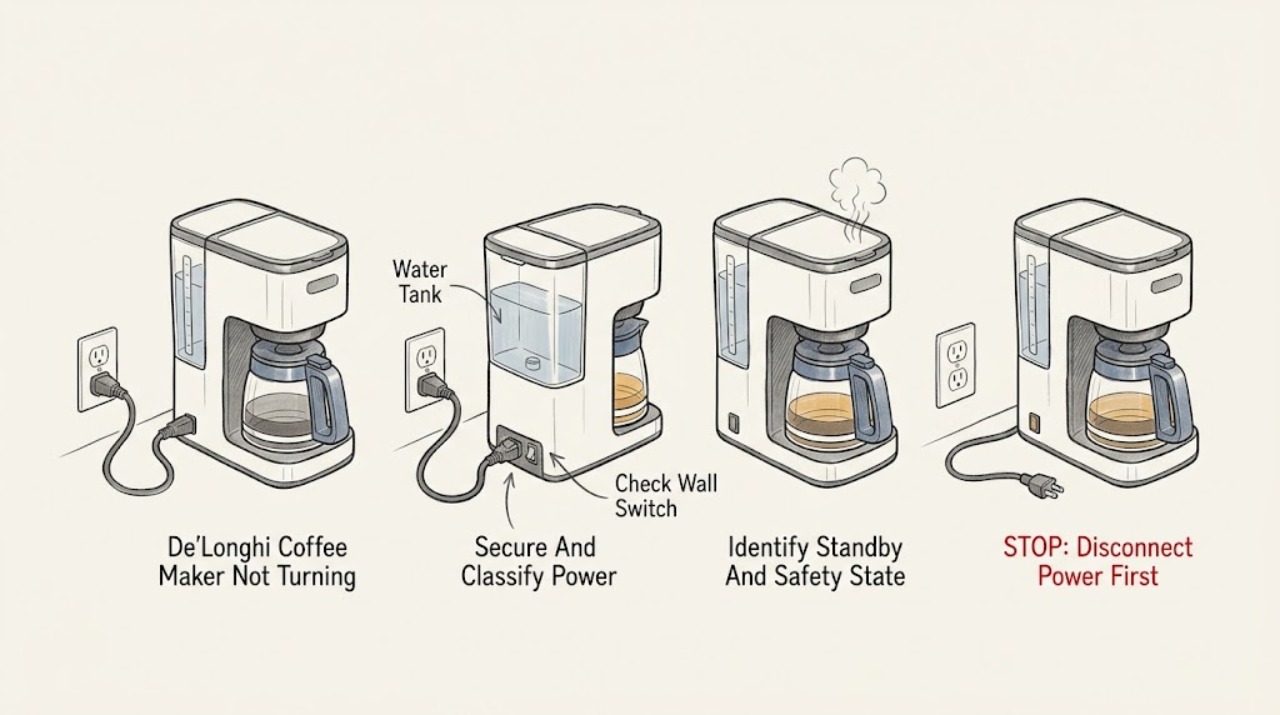
First separate a completely dead machine from one that has power but is asleep or refusing a start condition. Check the outlet and plug from the outside, then the model's rear or main switch, and wake an auto-off or standby machine with the button named in its manual. If the panel lights but the machine will not operate, make sure the water tank and any removable brew or filter assembly are seated, the steam control is fully off where the model requires it, and no visible lock, alarm, or setup state is active. De'Longhi's support pages show that these controls differ by family: a pump espresso machine can enter a safety state when the steam button is depressed, a La Specialista may wake with OK after Auto Off, and some bean-to-cup machines have a rear switch. Do not pour water near the energized appliance, run it with missing parts, defeat a safety device, open the housing, or test the power circuit. A hot or damaged cord, burning odor, smoke, arcing, repeated breaker trip, or a machine that dies again after a safe check means stop using it and arrange qualified service; internal power, thermal-fuse, control, and heating faults are not user repairs.
Before you begin
Safety first
- The user may read the model label, inspect the external plug and cord, use a known-good outlet without an extension, operate the model's normal main or wake-up control, and reseat only accessible documented removable parts while the machine is off, cool, unplugged, and dry. Housing removal, internal power, thermal-fuse, control, pump, heater, wiring, interlock bypass, and all energized testing belong to qualified service.
Work through in order
Diagnostic checks
Use only checks that match the exact appliance or system and its official guide.
-
Check 1
Stop brewing and let the machine cool if it was recently hot. Without opening it, look and smell for smoke, a burning or melting odor, arcing, a hot or damaged cord or plug, water at the outlet, or a breaker that has tripped. If none is present, observe whether the display or any indicator is completely dark, briefly lights, or remains responsive.
Expected result: There is smoke, burning odor, arcing, a hot or damaged cord/plug, water at the outlet, or repeated breaker operation; the machine is completely dark; or the panel lights or responds.
Next step: For any hazard, stop using the coffee maker and isolate power only from a safe, dry location; arrange qualified appliance or electrical service. Otherwise continue with the external power and model-control checks.
Stop if: Do not touch a hot plug, reset a breaker repeatedly, use the machine near standing water, or remove a cover to find an internal fuse.
Why this matters
Why: A fire, shock, or water hazard is an immediate stop condition. A completely dark panel makes the supply, cord, main switch, internal fuse or power circuit more likely. A lit or responsive panel means the machine is not completely without power and may instead be in standby, safety, setup, or a component fault state.
-
Check 2
Read the full model label and inspect the plug and cord from the outside. Confirm the plug is fully inserted into a suitable known-good outlet without using an extension or adapter, and check whether the exact model has a rear or separate main switch. Turn that switch on only in the normal way described for the model; do not repeatedly cycle a protection device.
Expected result: The outlet or plug is loose or dead; a rear/main switch was off; the machine powers after the connection or switch is corrected; or the outlet and switch are normal but the machine remains dark.
Next step: Correct only a loose external connection or an off model switch and make one normal start attempt. If the outlet is dead, use a qualified electrician for the household circuit; if the machine stays dark or protection operates again, leave it unplugged and arrange service.
Stop if: Do not use a damaged cord, bypass grounding, open the plug, substitute a fuse, or perform voltage measurements on an energized coffee maker.
Why this matters
Why: An external supply or off main switch can explain a no-start without an appliance failure. If a known-good connection and the model's switch do not restore any light, the problem is more likely inside the power path and is not safely narrowed by guessing at a fuse.
-
Check 3
If the panel has power, compare the controls with the exact model help page or manual. For a pump espresso family, make sure the steam control is fully off before pressing the normal on/off control. For a La Specialista, try the documented OK wake-up action after Auto Off. For a bean-to-cup model, confirm the rear switch if provided is on. Do not guess a button combination for another family.
Expected result: The machine wakes and remains on; it wakes briefly then shuts off; the steam control is depressed or a standby/Auto Off state is indicated; or the correct model-specific wake-up action has no effect.
Next step: Use the machine only if it wakes and stays stable without a hazard. If it shuts off again, the control is unresponsive, or the model is uncertain, stop and arrange model-matched service rather than trying random controls.
Stop if: Do not hold a steam control, door, tank switch, or other interlock in an artificial position, and do not dismantle the control panel.
Why this matters
Why: A standby or model-specific safety state can look like a no-start. De'Longhi specifically says a depressed steam button can make a pump espresso machine power off almost instantly when restarted. If the documented wake-up action fails or the unit immediately drops out again, an internal fault or an unrecognized model condition is more likely.
-
Check 4
With the machine switched off, unplugged, cool, and dry, inspect only the accessible water tank, drip tray, brew unit or filter holder, and steam control for an obvious mis-seated part, blockage, or position the exact manual identifies as required. Refit a part with normal hand pressure, fill water only as the model instructions require, and note any visible lock, alarm, flashing pattern, or setup message after one normal start attempt.
Expected result: A documented removable part was out of position and the machine starts after correction; the panel shows a model-specific warning; the machine remains lit but silent; or the same no-start returns.
Next step: Follow only the exact model's documented response to the indicator. If the warning or no-start persists, stop using the machine and provide the model and display behavior to qualified service.
Stop if: Do not pour water into electrical openings, run without the required tank or filter assembly, bypass a sensor, remove internal covers, or probe the brew, pump, or heater circuit.
Why this matters
Why: A removable assembly or user-facing safety state can prevent operation on some models, but a visible indicator must be interpreted for that exact model. A powered machine that remains silent after accessible checks makes an internal switch, control, pump, heater, or protection fault more likely.
-
Check 5
Only when there is no odor, smoke, heat damage, leak, or tripped protection, perform at most one model-documented power reset: switch off normally, unplug from a safe dry location, let the machine cool, and reconnect only as the manual directs. Record the model, power state, switch position, standby or safety indication, removable-part result, and what happened after the single attempt.
Expected result: The machine returns to normal and stays on; it remains dark; it starts and then shuts off; or a breaker, burning odor, abnormal heat, leak, or other hazard appears.
Next step: Use the machine only if it completes a stable normal operation without a hazard. Otherwise keep it unplugged and arrange qualified De'Longhi or appliance service with the recorded observations.
Stop if: Do not keep resetting, leave the machine unattended after a fault, run it dry, or continue after smoke, arcing, burning odor, abnormal heat, leakage, or repeated breaker operation.
Why this matters
Why: A one-time recovery may clear a transient standby or control state, but it does not prove an internal repair. A repeatable failure after external checks points toward the model's power, thermal protection, control, pump, or heating circuit, while any physical hazard overrides further diagnosis.
Use your observations
Decision map
Find the observation that best matches what you see, then follow the next safe action.
-
PATH 01Safety boundary
What you see
All indicators are dark, the outlet or plug is not supplying power, the model's rear/main switch is off, or the breaker trips again after one safe check.
Do this next
Correct only the external connection or switch. Use qualified electrical service for a household outlet issue and qualified appliance service if the machine remains dark or protection operates again.
Why this path and its safety boundary
Why it matters: An external supply, main switch, cord, protection, or internal power-path issue is more likely than standby or a removable brew assembly.
Safety stop: Do not open the plug or machine, replace an internal fuse, bypass grounding, or repeatedly reset the breaker.
-
PATH 02Safety boundary
What you see
The panel is lit or briefly lights, the machine recently entered Auto Off, the rear switch was off, or a pump espresso model shuts off when the steam control is depressed.
Do this next
Use the exact model's wake-up action: normal on/off with the steam control off for the documented pump-espresso case, OK for the documented La Specialista wake-up case, or the rear switch where provided. Escalate if it will not stay on.
Why this path and its safety boundary
Why it matters: A model-specific standby, main-switch, or safety state is more likely than a completely dead appliance.
Safety stop: Do not force or hold an interlock, guess another model's sequence, or repeatedly cycle the machine.
-
PATH 03Safety boundary
What you see
The display is powered and shows a documented warning, the tank or removable brew/filter assembly was not seated, or operation returns after the accessible part is correctly refitted.
Do this next
Refit or fill only the accessible item described by the exact manual and make one normal start attempt. If the warning or no-start returns, arrange service.
Why this path and its safety boundary
Why it matters: A model-specific user-facing interlock or setup condition is more likely than a failed internal power circuit, but the same symptom cannot identify a compatible part.
Safety stop: Do not run without required parts or water, pour water into the housing, defeat a switch, or remove the casing.
-
PATH 04Safety boundary
What you see
The outlet, plug, main switch, documented standby action, and accessible assemblies are normal, but the machine stays silent, shuts off immediately, or fails again after one safe reset.
Do this next
Leave the machine unplugged and arrange qualified De'Longhi or appliance service. Give the technician the exact model, panel behavior, switch and standby observations, removable-part result, and reset result.
Why this path and its safety boundary
Why it matters: An internal switch, thermal protection device, power supply, control board, pump, heater, or wiring fault is more likely; the exact failed component cannot be inferred from no-start alone.
Safety stop: Do not open the housing, test a thermal fuse or heater live, bridge an interlock, or replace internal parts by brand or symptom alone.
-
PATH 05Safety boundary
What you see
Smoke, burning or melting odor, a hot plug or cord, arcing, water at electrical parts, abnormal heat, a leak into the base, or repeated breaker operation is present.
Do this next
Stop using the coffee maker, isolate power only from a safe, dry location if possible without touching the hazard, and arrange urgent qualified appliance or electrical service.
Why this path and its safety boundary
Why it matters: Shock, fire, scald, or short-circuit risk takes priority; the user troubleshooting boundary has been reached.
Safety stop: Do not restore power, touch a hot cord, wipe inside an energized machine, run it to reproduce the fault, or remove a cover.
Helpful context
Understand the symptom
The first split is dead power versus a powered machine
Pressing a button is not the same as proving that the machine has no power. Note whether every light and display is dark, whether a rear or main switch is present, whether the outlet and plug are secure, and whether the machine wakes and then shuts down. A dark machine points first to the external supply or an internal electrical path. A lit panel moves the diagnosis toward auto-off, a model-specific safety or setup condition, removable parts, or an internal fault.
De'Longhi families do not share one wake-up sequence
The official help pages are product-specific. One pump espresso FAQ says the steam button must be off when waking from standby, while a La Specialista FAQ says to press OK after Auto Off. A bean-to-cup FAQ says to check the rear switch if provided. Use the control labels and instructions for the identified model; do not apply an ECAM, La Specialista, manual espresso, or drip-coffee sequence to another family.
Keep water and heat checks outside the housing
A tank, filter holder, brew unit, drip tray, or steam control may have to be in its normal position before a model allows operation, but the exact interlock is model-dependent. Inspect and reseat only accessible parts with the machine switched off and cool. Never pour water over the machine, immerse it, bypass a microswitch, remove a cover, or probe wiring. Internal power supplies, thermal fuses, thermostats, control boards, pumps, and heaters require qualified service.
Safety boundary
Stop conditions
- Stop using the coffee maker for smoke, burning or melting odor, a hot or damaged cord/plug, arcing, water at electrical parts, abnormal heat, a base leak, or repeated breaker operation; isolate power only from a safe, dry location.
- Do not pour water into or immerse the appliance, operate it with missing required assemblies, or handle a wet plug or outlet.
- Do not open the housing, replace or bypass an internal thermal fuse, bridge a tank/brew/steam interlock, or perform energized electrical tests.
- Do not repeatedly reset the breaker or coffee maker, hold a safety control artificially, or run it unattended to reproduce a no-start or shutoff.
- Do not generalize the ECAM, pump espresso, La Specialista, manual espresso, or drip-coffee wake-up and indicator behavior to another De'Longhi model.
Only after diagnosis
Potential parts
- power cord or external power connection
Consider this only when the exact model is identified and qualified diagnosis finds a damaged cord or model-specific external power connection; a dark display alone is not enough.
Confirm the rating-label model and manufacturer fit and safety information; do not substitute a cord by appearance alone. - main power switch
Consider this only when the exact model has a failed rear or main switch confirmed by qualified diagnosis after the external outlet and cord are verified.
Switch layout and electrical ratings vary by model; do not open or bypass the switch as a user test. - thermal protection or thermal fuse
Consider this only if qualified service confirms an open thermal-protection device and determines why it operated; the no-start symptom cannot identify the fuse or root cause.
Verify exact model, rating, and safety documentation. Thermal protection is an internal safety component and is not a user bypass or generic replacement. - control or heating circuit component
Consider this category only after qualified diagnosis confirms a persistent powered no-start or immediate shutoff is caused by the control, heater, wiring, or related internal circuit.
Control and heating components are model-specific; do not infer fit from the DeLonghi brand or install without qualified electrical and appliance service.
When checks do not resolve it
Need a professional?
Arrange qualified service when the machine remains dark after the outlet, plug, cord, and model switch are checked; when it powers but will not stay on after the exact standby or safety state is cleared; when a documented warning persists after accessible parts are correctly seated; or when the machine fails again after one safe reset. Stop immediately for smoke, burning or melting odor, a hot plug or cord, arcing, water at electrical parts, abnormal heat, leakage into the base, or repeated breaker operation.
Safety scope: The user may read the model label, inspect the external plug and cord, use a known-good outlet without an extension, operate the model's normal main or wake-up control, and reseat only accessible documented removable parts while the machine is off, cool, unplugged, and dry. Housing removal, internal power, thermal-fuse, control, pump, heater, wiring, interlock bypass, and all energized testing belong to qualified service.
Common questions
FAQ
Why is my De'Longhi coffee maker completely dark?
Check the plug, outlet, cord, and the model's rear or main switch from the outside. If the connection and switch are normal but no indicator appears, leave the machine unplugged and arrange qualified service; do not open it to replace an internal fuse.
Could Auto Off make a De'Longhi machine seem not to turn on?
Yes, on some families. De'Longhi says a pump espresso machine can be in standby and should be woken with its normal control while the steam button is off; its La Specialista help says to press OK after Auto Off. Use the exact model instructions.
Should I check the water tank or brew unit when the panel lights but the machine will not start?
You may inspect and reseat only accessible parts that the exact model manual identifies, with the machine off, cool, unplugged, and dry. A persistent warning or no-start can involve an internal interlock or control and should be serviced rather than bypassed.
Can I replace the thermal fuse if my De'Longhi coffee maker has no power?
No. A dark machine does not prove that the thermal fuse is the failed component, and an opened thermal protector may reflect an underlying overheating or electrical problem. Diagnosis, replacement, and any root-cause check belong to qualified service.
When should I stop trying to turn the machine on?
Stop for smoke, burning or melting odor, a hot plug or cord, arcing, water near electrical parts, abnormal heat, leakage into the base, or repeated breaker operation. Isolate power only from a safe, dry location and arrange qualified appliance or electrical service.
Read the exact guide
Official sources
- My pump espresso machine went into standby mode and now will not switch on. What can I do?De'Longhi US · The Auto Off and steam-button behavior is specific to the pump espresso family covered by this FAQ.
- Why my La Specialista does not turn on?De'Longhi US · The OK-button wake-up instruction applies to La Specialista units covered by the FAQ, not all De'Longhi coffee makers.
- Product manuals | De'Longhi USDe'Longhi · The manual lookup is used to match controls, indicators, removable assemblies, and safety instructions to the exact model.
- De'Longhi Customer Service | De'LonghiDe'Longhi · Supports model identification, manuals, product-specific self-service, and escalation; it does not diagnose an unspecified internal component.
- My bean to cup machine will not switch on. What can I try?De'Longhi US · The rear-switch instruction applies only if the identified bean-to-cup model provides that switch.
- The machine will not switch on | Manual Espresso maker EC860De'Longhi Coffee Machines Help Center · The power-cable and mains-plug steps apply to EC860; they are a model-specific example, not a universal De'Longhi sequence.
Community feedback
Share a repair observation
Share a plain-text repair observation. Accepted observations are published automatically; this page may take a moment to update.