
On this page
Start here
Quick answer
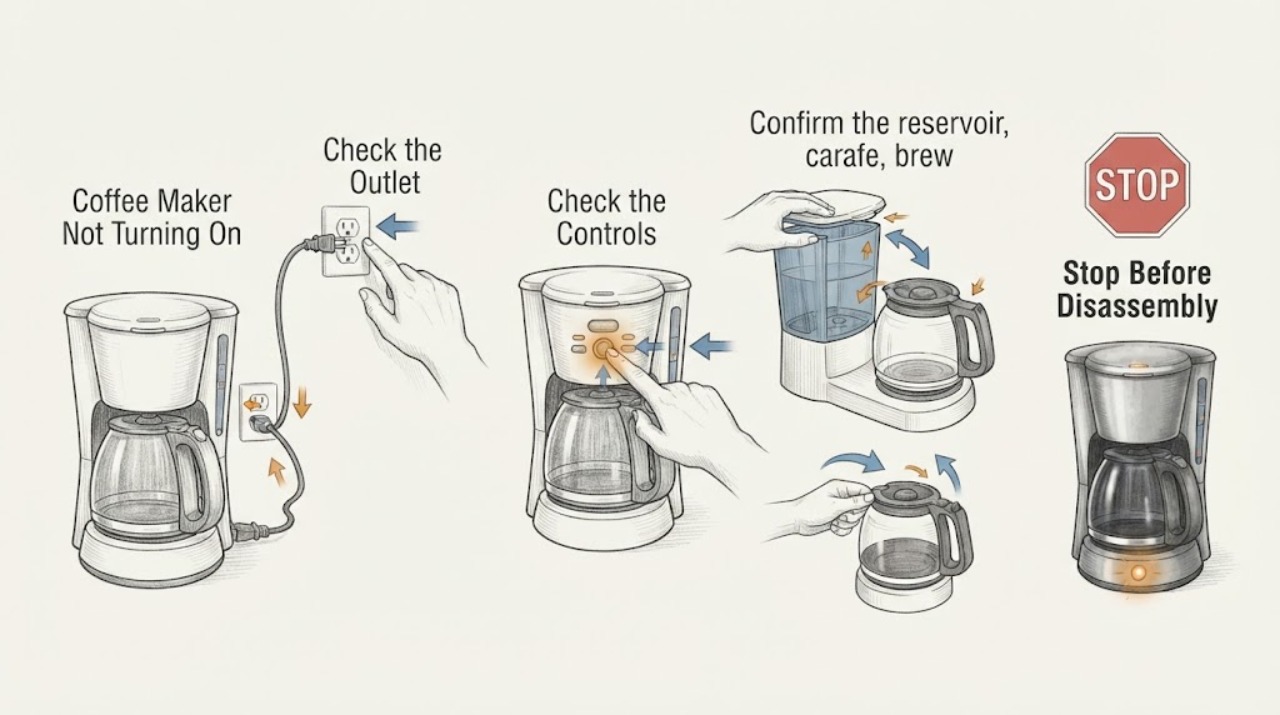
If a coffee maker will not turn on, check the dry outlet, plug, power button, and any correctly seated reservoir or brew part required by the model. Try one known-good outlet or safe breaker reset; do not keep cycling a machine with a hot smell, damaged cord, liquid, or repeated tripping. If the outlet works but the coffee maker stays dark, use manufacturer service because internal wiring, a fuse, or a control fault needs qualified diagnosis.
Work through in order
Diagnostic checks
Use only checks that match the exact appliance or system and its official guide.
-
Check 1
Check for a power light or display and inspect the plug, cord, and outlet from a dry position.
Expected result: The outlet is dead, the cord or plug is damaged, or supply looks normal.
Next step: Do not use a damaged cord. Test the outlet with another suitable device or have an electrician check it.
Why this matters
Why: A dead outlet or damaged supply explains no power before the machine is diagnosed; visible power does not prove internal safety.
-
Check 2
Press the appliance’s power button once and try one separate grounded outlet without an overloaded power strip.
Expected result: The machine lights, remains dark, or the new outlet trips.
Next step: Stop after one controlled test. Do not repeatedly reset a tripping circuit.
Why this matters
Why: Starting elsewhere points to the original supply; persistent darkness or tripping points to appliance or circuit service.
-
Check 3
Confirm the reservoir, carafe, brew basket, or removable brew unit is seated as the exact model requires, without adding water to electrical openings.
Expected result: A required part was mis-seated, or all parts are correctly positioned.
Next step: Reseat only accessible parts, then try the power button once. If still dark, arrange service.
Why this matters
Why: Some machines use interlocks that prevent operation when a part is absent; correct seating can restore normal controls.
-
Check 4
Ask whether the machine stopped after heavy use, showed a thermal message, or has a hot or burning smell.
Expected result: The unit may be thermally protected, or there is no heat or smell.
Next step: Allow only the cooling interval in the manual, and do not power it again if smell, smoke, or heat remains.
Why this matters
Why: A thermal cutout can stop operation after overheating; burning smell or repeated shutdown is a service boundary.
Use your observations
Decision map
Find the observation that best matches what you see, then follow the next safe action.
-
PATH 01Next step
What you see
The outlet is dead but the coffee maker works elsewhere.
Do this next
Use a safe grounded outlet and arrange electrical service for the original outlet if needed.
Why this path and its safety boundary
Why it matters: The symptom is in the household supply or circuit, not proven inside the machine.
-
PATH 02Next step
What you see
The outlet is live but the coffee maker remains dark after one power-button and seating check.
Do this next
Keep it disconnected and contact the manufacturer or qualified appliance service.
Why this path and its safety boundary
Why it matters: An internal fuse, wiring, thermal, or control fault is more likely.
Helpful context
Understand the symptom
Breville’s official guidance separates external power checks from internal wiring or fuse faults and also calls out reservoir seating and thermal shutdown.
When checks do not resolve it
Need a professional?
Arrange qualified service when a known-good outlet is live but the machine stays dark, a cord is damaged, the circuit trips again, liquid entered the base, or there is smoke, burning smell, or abnormal heat.
Common questions
FAQ
Should I keep resetting the breaker when a coffee maker will not turn on?
No. A single safe reset can distinguish a tripped circuit, but repeated trips indicate a circuit or appliance fault.
Can a mis-seated reservoir prevent startup?
Yes, some models use reservoir or brew-part seating checks. Confirm the exact manual’s normal seating step without spilling water into the machine.
Read the exact guide
Official sources
- Espresso machine problems and fixesBreville · Coffee machine power, outlet, reservoir seating, overheating, and support
Community feedback
Share a repair observation
Share a plain-text repair observation. Accepted observations are published automatically; this page may take a moment to update.