
On this page
Start here
Quick answer
First decide whether the dryer never starts or whether it starts and you can hear a motor or blower while the drum remains still. With the dryer empty, cool, and disconnected from power, check only the outside door, load, and accessible controls; a drum that turns unusually freely can point to a loose or broken belt, while a drum that is hard to turn can point to a drive or support problem. Electric, gas, and ventless designs share the same basic door and drive checks but differ in power, heat, and condensation systems. Stop immediately for gas odor, smoke, burning smell, overheating, metal-on-metal noise, sparks, water near electricity, or repeated breaker trips. Internal belt, motor, roller, wiring, and heater work belongs to qualified service.
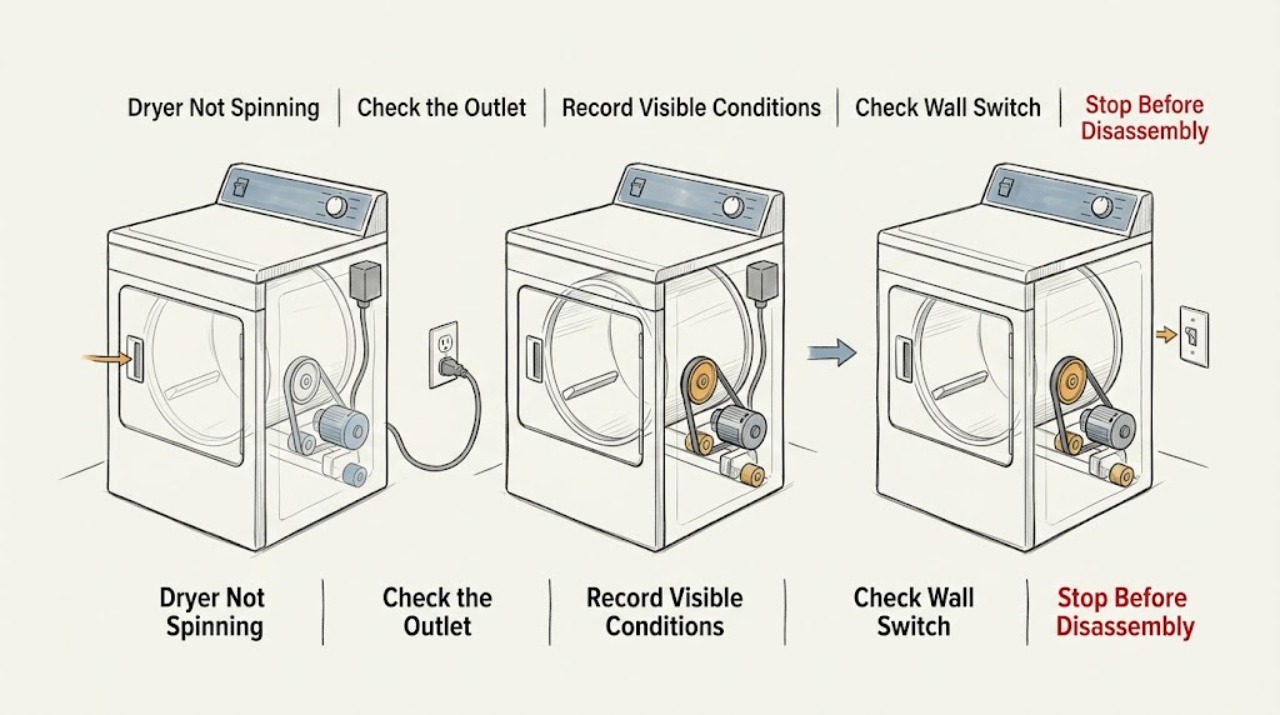
Work through in order
Diagnostic checks
Use only checks that match the exact appliance or system and its official guide.
-
Check 1
Stop the dryer and inspect from a dry position for a gas odor, smoke, burning or melted smell, scorching, visible sparks or arcing, a hot or damaged plug, water near the outlet or controls, repeated breaker trips, or loud metal-on-metal impact.
Expected result: No hazard is present and the dryer is stable, or one of the danger signs is present.
Next step: If any danger sign is present, stop using the dryer, leave a gas-smell area without operating switches or flames, disconnect power only when it is safe and dry, and arrange qualified help. Otherwise continue.
Why this matters
Why: A stable, dry appliance permits low-risk observations. Fire, gas, electrical, water-contact, and severe mechanical signs make continued spinning tests unsafe.
-
Check 2
Record the model, whether it is electric, gas, condenser, or heat-pump, the selected cycle and option, whether the controls or drum light respond, and what you hear when Start is pressed. Note whether the timer counts down, whether the blower or motor hums, and whether the drum moves at all.
Expected result: The controls are dead, the dryer does not begin a cycle, the timer counts down with a humming or running sound, or the timer never starts.
Next step: Use the no-start branch when there is no cycle activity. Use the drum-drive branch when a cycle is active but the drum is stationary.
Why this matters
Why: Dead controls point toward power or control supply. A timer that counts down while the drum stays still separates a started-cycle drive fault from a button or door-state problem.
-
Check 3
For a no-start symptom, with hands and the control panel dry, close the door fully, make sure the cycle selector is at a valid cycle, clear only the labeled control lock or delay, and hold Start for the time specified in the owner's manual. Do not press or bypass the door switch with an object.
Expected result: The dryer starts and the drum turns, or it remains idle with a door, lock, or start indication.
Next step: Retry once after correcting only the accessible control state. If the door will not latch or the dryer remains idle, stop and request service.
Why this matters
Why: A door that is not latched, a control lock, an invalid selector position, or a required press-and-hold can prevent spinning without a drive failure. A damaged or scorched switch is not a user adjustment.
-
Check 4
For an electric dryer with no display or drum response, check the home's dryer circuit from the panel without opening the dryer or touching wiring. For a gas dryer, check only that the normal outlet connection is secure. Do not reset a breaker repeatedly, use an extension cord, or inspect a damaged cord while energized.
Expected result: A breaker is tripped, power returns once, the plug or outlet shows damage, or the supply appears normal but the dryer still will not spin.
Next step: If the breaker trips again or any cord/outlet damage is visible, stop and use a licensed electrician. If supply is normal and the dryer remains inactive, request appliance service.
Why this matters
Why: Electric dryers can have a multi-part supply, and a power fault can look like a motor or control failure. Burn marks, loose connections, or a breaker that trips again indicate an electrical fault.
-
Check 5
If the dryer starts but the drum does not turn, stop it, remove the load, switch it off, unplug or isolate power, and let the drum cool fully. Only then turn the empty drum gently by hand from the opening, keeping fingers clear of edges and never forcing it.
Expected result: The empty drum turns with normal resistance, turns unusually freely, or is hard to turn or catches at one point.
Next step: Do not run the dryer to confirm a suspected belt or drive fault. Record the resistance and sound and arrange qualified service for any abnormal result.
Why this matters
Why: A drum that turns unusually freely can indicate that the belt is loose or broken; hard or uneven movement can indicate a seized roller, bearing, idler, foreign object, or another drive restriction. This observation cannot identify a part by itself.
-
Check 6
If the dryer turns with a light load but stops or hums with heavy, wet, or bulky items, remove the load and use a smaller load that can tumble freely. Do not keep restarting a motor that has become hot or is only humming.
Expected result: The drum turns after reducing the load, or it remains stationary or noisy with an empty drum.
Next step: Use only a suitable load after the dryer has cooled and the empty drum moved normally. If the symptom returns or the motor overheats, stop and request service.
Why this matters
Why: A heavy wet load can overload the drive and cause belt slip or motor overheating. An empty-drum failure is more consistent with a drive, motor, support, or control problem.
-
Check 7
Check the selected programme and option without opening the cabinet. Confirm that it is not paused, in a wrinkle-care or cool-down phase, or set to a mode whose behavior the manual describes as intermittent or heat-free. Observe whether the drum turns periodically or is completely stationary while the timer runs.
Expected result: The drum turns intermittently without heat as an option feature, or the dryer is active but the drum never turns.
Next step: End the option with its labeled control or open the door as the manual permits. If the drum remains still during a normal active phase, stop testing and request service.
Why this matters
Why: Wrinkle-care and cool-down can be normal after the heated cycle. Complete lack of drum movement while a cycle runs points away from a normal option and toward a drive or safety fault.
-
Check 8
Inspect only accessible lint and airflow areas after the dryer is off and cool. Clean and reseat the lint filter, keep the front and intake clear, and check a vented dryer's accessible hose for crushing or blockage. Do not use a dryer without its lint filter or treat a vent warning as permission to open the cabinet.
Expected result: Lint or a crushed vent is visible, airflow is weak, a vent warning appears, or the airflow path is clear.
Next step: Correct only an accessible obstruction and arrange full vent cleaning when the run is uncertain. If the drum still will not spin, stop and request drive service.
Why this matters
Why: Restricted airflow primarily lengthens drying and raises heat, but some dryers can reduce heat or shut down as a safety response. A clean vent does not rule out a mechanical no-spin fault.
-
Check 9
If the dryer is condenser or heat-pump type, check only the model's user-accessible water container, filter, and airflow indicators after it is cool and off. Empty and reseat a full container if the manual permits it; do not open refrigeration, heater, pump, or electrical compartments.
Expected result: A full container or user-cleanable restriction is indicated, or the ventless dryer is clear but the drum remains stationary.
Next step: Run one supervised test only when the dryer is dry and stable. If water leaks, the container refills abnormally, or the drum still does not move, stop and request service.
Why this matters
Why: Condensation management can interrupt a programme, but it does not justify assuming a full tank caused a no-spin symptom. A persistent stationary drum after the permitted check needs service.
-
Check 10
After the dryer is cool, dry, stable, and hazard-free, perform no more than one reset exactly as the model manual directs, then run a short supervised test with an empty or suitable light load. Do not repeatedly reset a breaker or continue a test with a hum, burning smell, overheating, or metal noise.
Expected result: The drum turns normally once, or the same no-spin symptom returns.
Next step: If it fails again, stop using the dryer and give service the model, dryer type, cycle, power state, timer behavior, sound, empty-drum resistance, load, and any code or hazard notes.
Why this matters
Why: A reset may clear a transient control state, but recurrence indicates an unresolved door, power, belt, motor, roller, support, airflow, or control fault.
Use your observations
Decision map
Find the observation that best matches what you see, then follow the next safe action.
-
PATH 01Safety boundary
What you see
Controls are dark or the dryer never starts a cycle
Do this next
Check only the normal plug and breaker state; a repeat trip, damaged cord, or damaged outlet requires an electrician, while normal supply with no start requires appliance service.
Why this path and its safety boundary
Safety stop: Continue to the active-cycle drum branch.
-
PATH 02Safety boundary
What you see
The timer counts down or the motor/blower runs but the drum remains still
Do this next
Stop, isolate power, cool the dryer, and perform only the gentle empty-drum resistance observation; abnormal freedom, stiffness, or catching requires service.
Why this path and its safety boundary
Safety stop: Verify that the cycle is not paused, reversing, cooling, or in wrinkle care.
-
PATH 03Safety boundary
What you see
The drum turns with no load but stops with a heavy or bulky load
Do this next
Reduce the load and allow the motor to cool; if it repeats, arrange service for drive or motor diagnosis.
Why this path and its safety boundary
Safety stop: Continue to the empty-drum and drive branch.
-
PATH 04Safety boundary
What you see
The drum turns intermittently without heat after the end indication
Do this next
Treat wrinkle-care or cool-down as a possible normal feature and use the labeled option control or door behavior in the manual.
Why this path and its safety boundary
Safety stop: A stationary drum during an active normal phase needs service.
-
PATH 05Safety boundary
What you see
The dryer is ventless and a full container or filter indicator appears
Do this next
Empty and reseat the user-accessible container or clean the permitted filter, then test once when dry and cool.
Why this path and its safety boundary
Safety stop: Do not apply water-container steps to a vented dryer; continue with the drive diagnosis.
-
PATH 06Safety boundary
What you see
Gas odor, smoke, scorching, arcing, repeated breaker trip, overheating, severe impact, or water near electricity is present
Do this next
Stop immediately, leave a gas-smell area without operating switches or flames, keep clear of damaged or wet equipment, and arrange qualified emergency, electrical, or appliance help.
Why this path and its safety boundary
Safety stop: Continue only with the low-risk checks above.
Helpful context
Understand the symptom
A dryer that does not spin can have two very different symptoms. If the controls, timer, and motor are all quiet, begin with power, door closure, cycle selection, and Start. If the motor or blower runs but the drum is still, the control has probably started the cycle and the drive system needs attention. Do not remove a panel just to confirm a belt; the same symptom can involve the motor, idler, rollers, drum support, or a safety device.
A short pause during a reversing or cool-down phase is not automatically a failure. A dryer may also continue intermittent, heat-free tumbling after drying when a wrinkle-care option is selected. Diagnose the drum only after observing whether the cycle is actually active and whether the drum turns during a safe, supervised check.
Safety boundary
Stop conditions
- Stop immediately for a gas smell, smoke, burning or melted smell, scorching, visible sparks or arcing, or a hot or damaged plug.
- Stop if a breaker trips again, the cord or outlet is damaged, or water reaches an electrical connection; do not touch wet plugged-in equipment.
- Stop for overheating, a motor that only hums, violent movement, persistent metal-on-metal scraping, or a drum that catches or will not turn gently after cooling.
- Do not bypass the door switch, open the cabinet, handle a gas path, test live wiring, or replace a belt, motor, roller, heater, or thermal device as a user check.
Only after diagnosis
Potential parts
- drive belt or idler
Consider only if a qualified diagnosis finds that the drum turns unusually freely or the belt path is broken or loose.
Confirm the exact dryer model and fit information; do not open the cabinet as a user check. - drum support roller or bearing
Consider only if a cool, isolated drum catches, scrapes, or has abnormal resistance and service confirms a support fault.
Match the model and design; abnormal noise or binding should be professionally diagnosed. - drive motor
Consider only if power and door checks pass but the motor hums, overheats, or fails a qualified drive test.
Electric, gas, and ventless platforms differ; confirm model fit and electrical requirements through qualified service. - door switch or control component
Consider only if the door is correctly closed but the cycle cannot start or stay active and a model-specific test confirms the switch or control fault.
Never bypass the door interlock; verify exact model compatibility.
When checks do not resolve it
Need a professional?
Arrange qualified appliance service when the timer runs but the drum does not, the drum turns freely or catches, a smaller load does not resolve the symptom, the dryer overheats, or the no-spin condition returns after one safe model-documented reset. Use a licensed electrician for a damaged supply or repeated breaker trip, and a vent or appliance professional for persistent airflow restrictions.
Common questions
FAQ
How can I tell whether a dryer has not started or the drum drive has failed?
If the controls are dark or the timer never starts, check only the normal door, cycle, Start, and power states. If the timer counts down or the motor runs while the drum stays still, the cycle has started and a belt, motor, support, or control fault needs service.
Can an overloaded dryer stop the drum from turning?
Yes. Heavy wet or bulky loads can overload the drive or motor. Remove part of the load and let the dryer cool before one supervised test. If it repeats with a small load or the empty drum is abnormal, stop and request service.
Why does the dryer tumble after it says the cycle is done?
A Wrinkle Prevent, Wrinkle Shield, anti-crease, or cool-down feature may intermittently tumble without heat after drying. If it continues heating, runs continuously, or will not stop when the option is canceled, treat it as a fault.
Is it safe to turn the dryer drum by hand?
Only after switching the dryer off, isolating power, removing the load, and letting the drum cool. Turn it gently from the opening; do not force it or open the cabinet. Unusually free, stiff, catching, or scraping movement needs service.
Does a ventless dryer have a different no-spin diagnosis?
The door and drive checks are similar, but a condenser or heat-pump dryer may stop a programme for a full water container or a model-specific filter condition. Empty or clean only user-accessible parts described in the manual; a stationary drum still needs drive service.
Read the exact guide
Official sources
- CPSC Urges Flood Victims to Take Steps to Prevent CO Poisoning, Electrocution, Explosion and FiresU.S. Consumer Product Safety Commission · Electrical safety around wet appliances and emergency response to suspected gas leaks
- What should I do if my dryer stops operating?Electrolux · Electrolux dryer motor overheating, load reduction, thermal limiter, and service guidance
- Dryer - Drum Does Not TurnGE Appliances · GE dryer drum movement, heavy-load belt symptoms, and service boundary
- Not Tumbling or Spinning - Dryer - Product Help | WhirlpoolWhirlpool Product Help · Whirlpool dryer no-tumble start, power, door/control, and supply guidance
- Wrinkled Clothing - DryerWhirlpool Product Help · Whirlpool dryer post-cycle Wrinkle Prevent and Wrinkle Shield intermittent tumbling
- Samsung dryer turns on but will not start or spinSamsung · Samsung dryer error, control lock, Time Dry start confirmation, timer, and no-spin service guidance
- What should I do if my dryer does not start?Electrolux · Electrolux dryer start control, selector, door, plug, and breaker checks
- Samsung dryer loses power or won't turn onSamsung · Samsung dryer power, breaker, cord damage, mid-cycle shutdown, and vent safety guidance
- How to clean your tumble dryerBosch Home Appliances · Bosch condenser and heat-pump dryer water container, filter, heat exchanger, and humidity sensor guidance
Community feedback
Share a repair observation
Share a plain-text repair observation. Accepted observations are published automatically; this page may take a moment to update.