
On this page
Start here
Quick answer
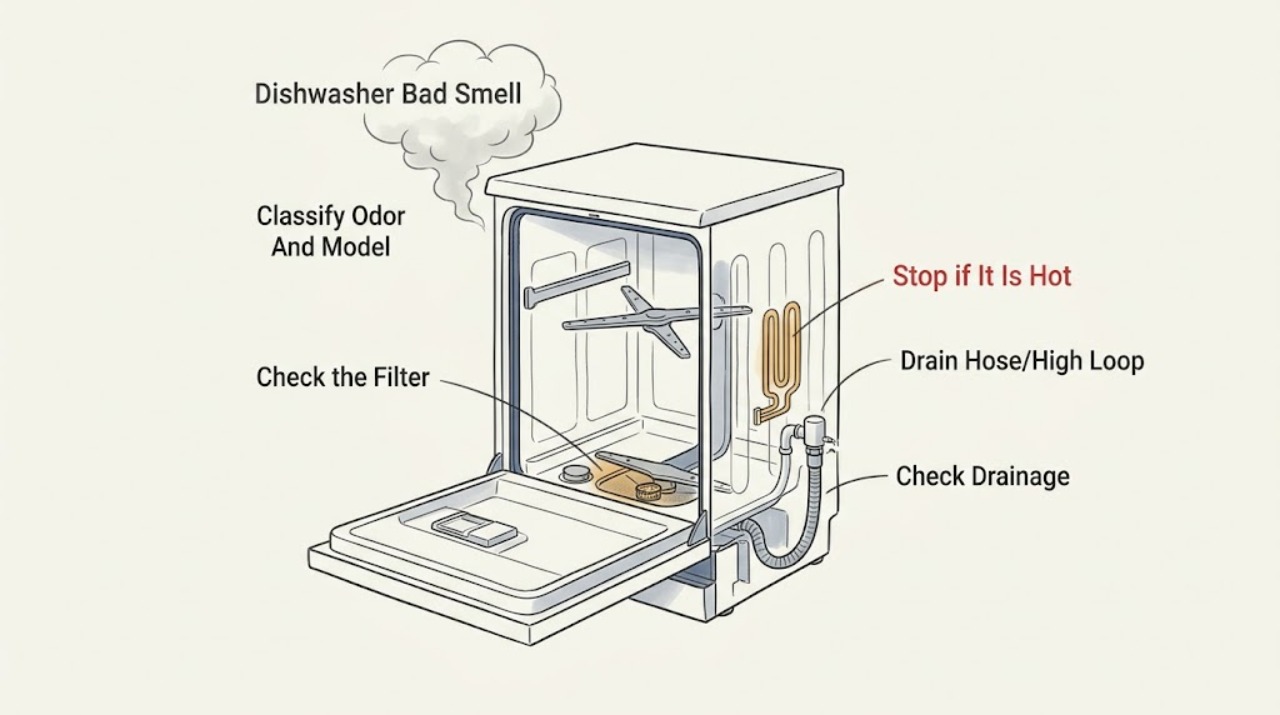
Start by identifying whether the Electrolux dishwasher smell is food or sewage-like, a new-installation odor, a chemical/foam odor, or a hot electrical/burning smell. Remove standing food soils from the tub and clean the user-accessible filter and glass trap exactly as the model manual shows; Electrolux says food residue in the filter/sump and poor draining can produce odors. Check visible standing water, the drain hose for kinks or an incorrect high loop, the air gap if fitted, and the garbage-disposal knockout plug where applicable; do not dismantle plumbing. Inspect and wipe the accessible door gasket and tub edge with a mild, nonabrasive method from the manual, and make sure the door closes fully. Use one approved empty cleaning or rinse method at a time: Electrolux's odor guidance says a vinegar cycle must not include detergent, so never mix vinegar, bleach, dishwasher cleaner, detergent, or other chemicals. If sewage returns from the drain, water leaks, the smell is electrical/burning, the dishwasher has repeated drain errors, or odor remains after the safe filter/drain/cleaning checks, stop using it and arrange qualified service.
Before you begin
Safety first
- The user may turn the dishwasher off, allow it to cool, clean accessible filters/glass trap and gasket as the exact manual permits, inspect visible drainage, and use one approved cleaning method. Internal sump, drain-pump, plumbing disconnection, wiring, control, heater, leak, and electrical work are for qualified personnel.
Work through in order
Diagnostic checks
Use only checks that match the exact appliance or system and its official guide.
-
Check 1
Record the full Electrolux dishwasher model and when the odor appears. With the machine off and cool enough to open safely, note whether the smell is food/sour, sewer-like, chemical/foamy, a new-installation smell, or hot/burning/electrical. Note whether it follows a cycle, standing water, a leak, or an idle period.
Expected result: The odor is food-like or sour, sewer-like with standing water, chemical/foamy, new-plastic-like after installation, or hot/burning/electrical; the model is known or cannot be identified.
Next step: Use the appropriate external-cleaning or drainage branch and the model manual. For electrical/burning odor, stop using the dishwasher immediately and arrange service.
Stop if: Do not start a cycle to reproduce a chemical or electrical smell.
Why this matters
Why: Food/sour odor supports a residue or filter/sump path. Sewer odor with water supports drainage or backflow. Chemical/foam odor points to product or dosage contamination. Hot/burning odor is an electrical or overheating boundary, not a cleaning problem. An unknown model limits safe cleaning and cycle assumptions.
-
Check 2
Switch the dishwasher off and let the tub cool. Follow the exact manual to remove only the accessible filter and glass trap; empty food residue, rinse the parts, and replace them securely. Wipe the accessible door gasket, tub edge, and lower-door area with a mild nonabrasive method approved by the manual. Use gloves for broken glass or sharp debris and do not reach blindly into the sump.
Expected result: Food, grease, glass, bones, or residue is present in the filter/glass trap or gasket area; the filter is incorrectly seated; the gasket is dirty or damaged; or these areas are clean and intact.
Next step: Clean and reseat the user-accessible parts once, then use a normal rinse or cleaning cycle as the manual permits. If a filter will not release, the gasket is damaged, or debris remains in an inaccessible sump, stop and arrange service.
Stop if: Do not force the filter, remove a pump cover, reach into hidden blades/debris, or use abrasive tools or caustic chemicals on the gasket.
Why this matters
Why: Residue in the filter, glass trap, sump entrance, spray area, or gasket can support odor and poor drainage. A damaged gasket can also allow leaks or soil retention. A clean, correctly seated filter and intact gasket make drain routing, standing water, detergent misuse, or an internal fault more relevant.
-
Check 3
After the cycle is complete and the tub is safe to inspect, distinguish a small amount of water below the filter from water covering the filter screen or returning into the tub. Check only visible drain routing: a kinked or moved hose, the required high loop, a dirty counter air gap if fitted, and the garbage-disposal knockout plug if the dishwasher drains there. Do not disconnect a water or drain line.
Expected result: Water covers the filter, returns after draining, smells sewer-like, the hose is kinked/low/moved, the air gap is dirty, the disposer connection is newly installed, or the tub drains clear with no return.
Next step: Correct only an obvious external hose kink or accessible air-gap/disposer condition as the installation instructions permit, then perform one normal drain/rinse check. If wastewater returns, the hose must be disconnected, the unit leaks, or drainage remains poor, stop and arrange plumbing/appliance service.
Stop if: Do not pull out a built-in dishwasher, disconnect hoses, reach into the sump, or repeatedly run cycles with wastewater standing.
Why this matters
Why: Electrolux says some water at the bottom can be normal, but water covering the filter or returning with odor supports incomplete drainage or backflow. Hose routing, air-gap blockage, disposer installation, and filter debris can each contribute; the observation does not identify a failed drain pump.
-
Check 4
Review what was added to the dishwasher and dispenser: correct automatic-dishwasher detergent, rinse aid, detergent amount, and any cleaner used for the odor. Choose one model-approved empty rinse/cleaning method. If using the Electrolux odor article's vinegar option, use vinegar alone in the empty tub and do not add detergent or another cleaner; otherwise follow the manual's specified cycle/sanitize option.
Expected result: Hand/dish soap, too much detergent, spilled rinse aid, mixed cleaners, old residue, or no chemical misuse is found; foam or chemical odor is present or absent.
Next step: Stop adding products, wipe accessible spills, and allow the exact manual-approved rinse/cleaning procedure to complete only when there is no leak or electrical hazard. If foam, chemical odor, or leakage persists, stop and arrange service.
Stop if: Do not mix vinegar, bleach, dishwasher cleaner, detergent, rinse aid, or other chemicals; do not pour detergent directly into the tub unless the exact manual says so.
Why this matters
Why: Electrolux identifies non-dishwasher soap, excessive detergent, and spilled rinse aid as causes of oversudsing and leaks; its odor option expressly excludes detergent when vinegar is used. Foam or chemical odor makes product contamination more likely than ordinary food residue.
-
Check 5
Once the filter is seated, visible drainage is clear, the door closes, and no chemical or electrical hazard is present, run one model-approved rinse or empty cleaning cycle. Keep the area observed for a returning odor, standing water, foam, door-edge leak, or abnormal sound. Do not use repeated cycles to mask wastewater or a leak.
Expected result: The odor clears, it returns only with standing water, it returns despite a clean filter and clear drain, foam or leakage appears, or a hot/burning smell develops.
Next step: Monitor only a normal, dry, odor-free result. For recurring odor, standing water, leak, abnormal sound, or any electrical smell, stop operation and contact qualified Electrolux/appliance service.
Stop if: Do not continue cycles with wastewater, foam, leakage, or a burning odor, and do not add another cleaner to counteract the first one.
Why this matters
Why: A cleared odor supports removable soil or a transient new-installation condition. Odor that tracks standing water supports drainage/backflow. Recurrence with clean filters and clear routing, or any foam/leak/electrical smell, needs a broader diagnosis.
-
Check 6
Record the model, odor description and timing, filter/glass-trap condition, gasket condition, standing-water level, drain-hose/air-gap/disposer observations, detergent or cleaner used, cycle result, and any leak, foam, error light, unusual sound, heat, smoke, or electrical smell. Keep the dishwasher off if the hazard or drainage problem persists.
Expected result: The smell resolved after safe filter/drain/cleaning corrections, or it persists with correct external checks, wastewater returns, the door/tub leaks, an error repeats, or an electrical odor is present.
Next step: Provide the record and exact model to Electrolux service or a qualified appliance/plumbing professional. Protect floors and avoid using the dishwasher until wastewater, leak, or electrical symptoms are assessed.
Stop if: Do not remove panels, test a pump or wiring live, reset protection repeatedly, or continue operation after smoke, burning smell, or a leak near electrical parts.
Why this matters
Why: Resolution after an external correction supports residue, drainage, or cleaning-product causes. Persistent odor, wastewater backflow, leak, repeated drain error, or electrical smell can involve the drain system, sump, pump, seal, wiring, or control and cannot be identified safely from outside.
Use your observations
Decision map
Find the observation that best matches what you see, then follow the next safe action.
-
PATH 01Safety boundary
What you see
The smell is sour or food-like, appears when the door opens, and food/grease is found in the filter, glass trap, sump entrance, spray area, or door gasket with no standing-water or electrical hazard.
Do this next
Cool the dishwasher, clean and reseat the accessible filter/glass trap and wipe the gasket as the exact manual permits, then run one approved rinse or empty cleaning cycle.
Why this path and its safety boundary
Why it matters: Removable soil and trapped residue are more likely than drain backflow or an electrical fault.
Safety stop: Do not reach into hidden sump areas, force the filter, or use mixed chemicals.
-
PATH 02Safety boundary
What you see
The odor is sewer-like and returns with water covering the filter, water left after a cycle, a kinked/low drain hose, a dirty air gap, or a disposer connection issue.
Do this next
Correct only an obvious external hose/air-gap/disposer condition as permitted by the installation guidance and perform one drain check. If water returns or the line must be disconnected, stop and arrange service.
Why this path and its safety boundary
Why it matters: Incomplete drainage or wastewater backflow is more likely. A small amount below the filter can be normal, but returning or excessive water is not a smell-only cleaning issue.
Safety stop: Do not disconnect plumbing, pull out a built-in unit, or run repeated cycles with wastewater standing.
-
PATH 03Safety boundary
What you see
The smell is chemical/foamy after a cleaner, hand soap, excess detergent, or rinse-aid spill, or it is a mild new-installation smell without standing water or a hazard.
Do this next
Stop adding products, wipe accessible spills, and use only one model-approved rinse/cleaning method at a time. If foam, chemical odor, or leakage persists, arrange service.
Why this path and its safety boundary
Why it matters: Product residue/oversudsing or a transient new-installation odor is more likely than food trapped in the sump. Mixed chemicals can create a separate safety and material-damage concern.
Safety stop: Never mix vinegar, bleach, detergent, dishwasher cleaner, rinse aid, or other chemicals.
-
PATH 04Safety boundary
What you see
The smell is hot/burning/electrical, smoke or arcing is visible, water leaks toward electrical parts, the door or tub cannot seal, or a protection device trips.
Do this next
Stop using the dishwasher and isolate power only from a safe, dry position. Arrange qualified electrical/appliance service; isolate water only if a safe accessible shutoff is provided and no contact with wet electrics is needed.
Why this path and its safety boundary
Why it matters: This is a safety boundary, not a filter or deodorizing problem. Continued operation can worsen shock, fire, water, or appliance damage.
Safety stop: Do not run another cycle, wipe wet electrical parts while energized, remove panels, or reset protection repeatedly.
Helpful context
Understand the symptom
Classify the smell before cleaning
A food or sour smell after dirty dishes points toward residue and drainage. A sewer-like smell that returns with water in the tub points toward drain routing or backflow. A new-installation smell may fade with use, while a chemical, burning, or electrical odor is a stop condition. Note when the smell appears—after a cycle, when the door opens, or when the dishwasher is idle—and keep the model manual nearby.
Clean the user-accessible soil traps safely
Food debris can remain in the filter, glass trap, sump area, and spray arms. Turn the dishwasher off, let hot water and steam cool, and follow the exact manual before lifting out accessible filters. Electrolux's filter guide describes rinsing the glass trap and filters under running water and using a sponge or bottle brush for residue. Broken glass, bones, and sharp debris require gloves and careful handling; do not reach blindly into the sump.
Use only one cleaning method at a time
Electrolux publishes more than one odor-cleaning option, including an empty hot/sanitize cycle or an empty cycle with white vinegar and no detergent. Treat these as alternatives, not a recipe to combine. Never mix vinegar with bleach, dishwasher cleaner, detergent, rinse aid, or another chemical; follow the exact model manual and product label. If foam, a chemical odor, or a leak appears, stop rather than adding another product to counteract it.
Safety boundary
Stop conditions
- Stop using the dishwasher for a hot/burning or electrical odor, smoke, arcing, a damaged cord/plug, repeated protection trips, or water near electrical parts; isolate power only from a safe, dry position.
- Stop for wastewater returning into the tub, a persistent drain error, an active leak, or water that covers the filter; do not keep running cycles to clear the smell.
- Do not mix vinegar, bleach, dishwasher cleaner, detergent, rinse aid, or other cleaning products; use one model-approved method at a time and follow the exact manual.
- Do not remove pump covers or internal panels, disconnect plumbing, perform live electrical tests, or reach blindly into the sump; use gloves and care around broken glass or sharp debris.
- Do not force a filter, gasket, door, drain connection, or air-gap part, and do not mask a recurring odor with fragrance or repeated chemical cycles.
When checks do not resolve it
Need a professional?
Arrange qualified Electrolux/appliance or plumbing service when odor persists after the exact model's safe filter, gasket, drainage, and one-method cleaning checks; wastewater returns, standing water remains, the drain hose/connection must be disconnected, the door or tub leaks, a filter or sump cannot be safely cleared, or an error repeats. Stop immediately for a burning/electrical smell, smoke, arcing, a hot/damaged cord or plug, repeated protection trips, or water near electrical parts.
Safety scope: The user may turn the dishwasher off, allow it to cool, clean accessible filters/glass trap and gasket as the exact manual permits, inspect visible drainage, and use one approved cleaning method. Internal sump, drain-pump, plumbing disconnection, wiring, control, heater, leak, and electrical work are for qualified personnel.
Common questions
FAQ
Why does my Electrolux dishwasher smell bad?
Food soils left in the tub, a dirty filter or glass trap, incomplete drainage, standing water, and a new-installation smell are common evidence-backed starting points. Clean the accessible filter and gasket as the manual permits and check visible drainage. A sewer-like recurring odor, leak, or electrical smell needs service.
How do I clean the filter and glass trap on an Electrolux dishwasher?
Turn the dishwasher off and let it cool, then follow the exact model manual. Electrolux's guide describes lifting out the accessible glass trap and coarse/fine filters, emptying them, rinsing under running water, and replacing them securely. Use gloves and care around broken glass, bones, or pits.
Is water at the bottom of an Electrolux dishwasher normal?
A small amount below the filter can be normal on some models, but water covering the filter screen or returning after draining supports a drainage problem. Check only visible hose, air-gap, disposer, and filter conditions; do not disconnect plumbing if service is needed.
Can I use vinegar and detergent together to remove a dishwasher odor?
No. Electrolux's published vinegar option is an empty cycle with white vinegar and no detergent. Treat cleaning products as alternatives, never mix vinegar with detergent, bleach, dishwasher cleaner, rinse aid, or another chemical, and follow the exact manual.
Can a drain-hose problem cause an Electrolux dishwasher odor?
Yes. Electrolux says incorrect drain-hose installation, kinks, and incomplete draining can leave food soils in the sump and contribute to odor. Inspect only visible routing and any accessible air gap; if wastewater returns or the hose must be disconnected, arrange service.
When should I stop using an Electrolux dishwasher because of smell?
Stop for a burning/electrical smell, smoke, arcing, water near electrical parts, an active leak, wastewater returning, repeated drain errors, or persistent foam after a product mistake. Isolate power only from a safe, dry position and arrange qualified service.
Read the exact guide
Official sources
- Book Electrolux Appliance RepairElectrolux · Electrolux USA service route; regional service eligibility may vary.
- Dishwasher - Water LeakingElectrolux · General Electrolux dishwasher leak guidance; exact hoses, gaskets, detergent limits, and access vary by model.
- Why is water in the dishwasher after it runs?Electrolux · General Electrolux dishwasher guidance; a small amount of water and filter geometry vary by model.
- Dishwasher - Why does my dishwasher have an odor and how do I fix it?Electrolux · General Electrolux dishwasher odor guidance; exact cycle and cleaning steps remain model-specific.
- User manualsElectrolux · Manual lookup route; applicable instructions depend on model/PNC and market.
- Dishwasher - Drain Hose GuideElectrolux · Installation guidance for applicable Electrolux dishwasher drain systems; exact high-loop and connection requirements must be matched to the installation manual.
- Dishwashers - Not DrainingElectrolux · General Electrolux drainage guidance; hose routing, controls, and reset behavior vary by model and installation.
- Dishwasher Glass Trap and Filter GuideElectrolux · Models with the described removable glass trap/coarse/fine filter arrangement; other models may differ.
- Dishwasher - OdorsElectrolux · General Electrolux dishwasher odor guidance; cleaning cycle names and model features vary.
- Dishwasher - Dispenser and Detergents GuideElectrolux · General Electrolux detergent guidance; dispenser and dosage depend on model and water hardness.
Community feedback
Share a repair observation
Share a plain-text repair observation. Accepted observations are published automatically; this page may take a moment to update.