
On this page
Start here
Quick answer
If an Electrolux dishwasher stops with an antiflood indication and water has reached the base, stop the cycle, close the water tap, and isolate power only from a safe, dry location. Do not fully dismantle the machine, bypass the flood protection, or run repeated cycles to find the leak. Electrolux says its i30 guidance can indicate water collecting in the base and recommends checking safe external conditions such as the load, spray-arm movement, filters, door seal and levelling; an internal leak or a returning alarm needs an authorised service visit.
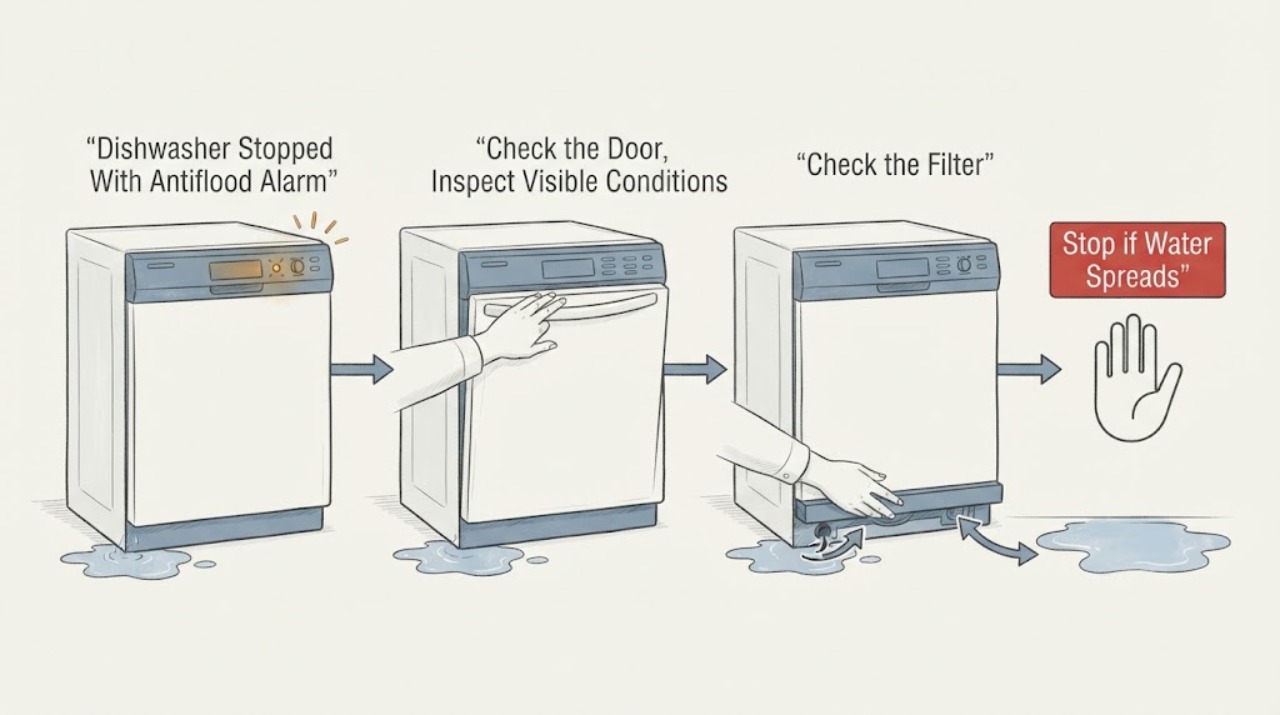
Work through in order
Diagnostic checks
Use only checks that match the exact appliance or system and its official guide.
-
Check 1
Stop the dishwasher, close its water tap, and isolate the electrical supply from a safe, dry location. Keep the door closed if water is actively entering and do not run another cycle to reproduce the leak.
Expected result: The machine is still filling, water is spreading outside the base, the pump runs continuously, or the antiflood indication remains after the supply is closed.
Next step: Leave the appliance off and arrange an authorised Electrolux service visit. Do not bypass the protection or work inside the base.
Stop if: Stop immediately if there is water near electrical connections, a damaged cord, a burning smell, or a breaker trip; do not touch wet electrical parts.
Why this matters
Why: The protection response is still active or there is an unresolved water/electrical hazard; this is not a normal reset condition.
-
Check 2
With the appliance off and cool, inspect only the visible door seal around the tub opening. Look for dirt, food residue, limescale, a cut, a loose section or a seal that no longer contacts the cabinet; wipe accessible residue with a soft cloth and no sharp or abrasive tool.
Expected result: The seal is visibly damaged or displaced, or it is clean and continuous with no visible gap.
Next step: If damaged or displaced, keep the dishwasher off and give the exact model to authorised service; if it looks sound, continue only with the other external checks.
Why this matters
Why: A damaged or poorly contacting gasket can allow water out at the door, but a sound visible seal does not rule out an internal base leak.
-
Check 3
Check the visible load and spray arms without removing panels: confirm no large item blocks either arm, the arms can turn freely by hand with power isolated, and filters are seated and visibly free of debris.
Expected result: A dish blocks an arm, an arm is damaged or cannot turn, or the load and accessible filters look normal.
Next step: Correct only the load or clean accessible filters/arms as the model manual permits, leave the water supply off overnight if the official guidance calls for drying, and stop if the alarm or leak returns.
Why this matters
Why: Electrolux says an obstructed spray arm can direct water continuously at one door area and contribute to flooding; normal visible loading does not identify an internal leak.
-
Check 4
Check the appliance position from outside with a spirit level if it is safe to reach, and look at the visible front door alignment. Do not pull out an integrated dishwasher or remove the furniture panel merely to investigate the base.
Expected result: The unit leans forward, the door is not centred, or the appliance appears level and the door closes evenly.
Next step: Have installation corrected only by a qualified person if needed, then use the exact owner manual. If the antiflood condition has occurred or returns, use authorised service rather than repeated tests.
Why this matters
Why: Electrolux lists levelling and door alignment as causes of water escaping at the door; a level, aligned unit still may have an internal leak.
-
Check 5
Record the model, PNC/product number and serial number from the rating plate at the side of the dishwasher door, along with when the alarm appeared, where water was visible, whether it was foamy, and which external checks were made.
Expected result: The alarm or leak returns after the accessible checks, the source is not visible from the front, or the machine needs to be opened or moved to inspect it.
Next step: Keep the water tap closed and appliance isolated until an authorised technician inspects it. Provide the recorded identity and do not order parts or perform live electrical tests.
Why this matters
Why: The remaining possibilities are model-specific or internal, and Electrolux directs unresolved internal leaks to authorised service; the symptom alone cannot identify a hose, pump, sump, valve or sensor.
Use your observations
Decision map
Find the observation that best matches what you see, then follow the next safe action.
-
PATH 01Next step
What you see
Water is still entering, the pump will not stop, the alarm returns immediately, or water is near electrical connections.
Do this next
Close the tap, isolate power from a safe dry location, and call authorised service; do not bypass the float or run the appliance with panels removed.
Why this path and its safety boundary
Why it matters: The anti-flood response has not resolved the underlying condition and continued operation can increase water or electrical risk.
-
PATH 02Next step
What you see
A dirty/damaged gasket, forward lean, misaligned door, blocked spray arm or excessive foam is visible from the outside.
Do this next
Correct only the accessible condition supported by the owner manual, keep the water off while the base dries, and stop if the alarm or leak returns.
Why this path and its safety boundary
Why it matters: Electrolux documents these as possible door or wash-path leak contributors, but they do not prove that the base itself is the leak source.
-
PATH 03Next step
What you see
The accessible seal, load, spray arms, filters and levelling look normal, or water is visible only under the machine.
Do this next
Keep the appliance off with the water tap closed and book authorised Electrolux service with the model/PNC/serial details.
Why this path and its safety boundary
Why it matters: The remaining fault is outside the safe external scope and may be an internal leak; the anti-flood signal is not evidence of one particular failed component.
Helpful context
Understand the symptom
What the antiflood indication tells you
An antiflood indication is a protection response, not a diagnosis of a particular pump, hose, seal or sensor. Electrolux describes i30 as water collecting in the base and says the protection can be triggered by an internal leak; the supplied lead has no model or readable original post, so the exact code and failed part remain unconfirmed.
Keep inspection outside the machine
Use only the accessible checks below after the appliance is stopped and isolated. Do not remove the base, reach under the machine, defeat the float or anti-flood device, or energise the dishwasher with panels removed. If water is still entering or the alarm returns, close the tap and arrange authorised service.
Common questions
FAQ
Can I open the dishwasher fully to find the leak?
Do not fully dismantle it or run it with panels removed. Close the water tap, isolate power safely, and limit yourself to the visible seal, load, spray-arm, filter and levelling checks. Electrolux directs suspected internal base leaks to authorised service.
Does the antiflood alarm prove that the pump is bad?
No. Electrolux describes the protection as responding to water in the base; that does not identify a pump, hose, sump, valve, sensor or seal. The exact model and leak location are needed for a diagnosis.
Could loading or foam cause water at the bottom?
Electrolux lists an obstructed spray arm, a large item deflecting water, and excess foam as possible contributors to flooding or leakage. Correct only accessible loading or cleaning issues, keep the water off while the base dries, and use service if the alarm returns.
Read the exact guide
Official sources
- Dishwasher Leaking – Causes and SolutionsElectrolux UK · Opened official Electrolux support article. Used for external checks involving levelling, installation, door seal, spray-arm obstruction, foam and internal-leak escalation.
- Protection against floodingElectrolux Australia · Opened the manufacturer-hosted PDF and verified the dishwasher manual section before use. Used for unplugging/turning off water before moving, anti-flood device meaning, authorised-service boundary, and rating-plate identity.
- Water leaking from dishwasher doorElectrolux Ireland · Opened official Electrolux support result. Used only for checking rinse-aid spillage, levelling, door alignment, loading and door-seal condition; it is not used to diagnose an internal component.
- Dishwasher displays error message i30, drains constantlyElectrolux Ireland · Opened official Electrolux support article. Used for closing the water tap, checking loading/filters/spray arms, allowing drying with supply off, and authorised service for a continuing internal leak.
Community feedback
Share a repair observation
Share a plain-text repair observation. Accepted observations are published automatically; this page may take a moment to update.