
On this page
Start here
Quick answer
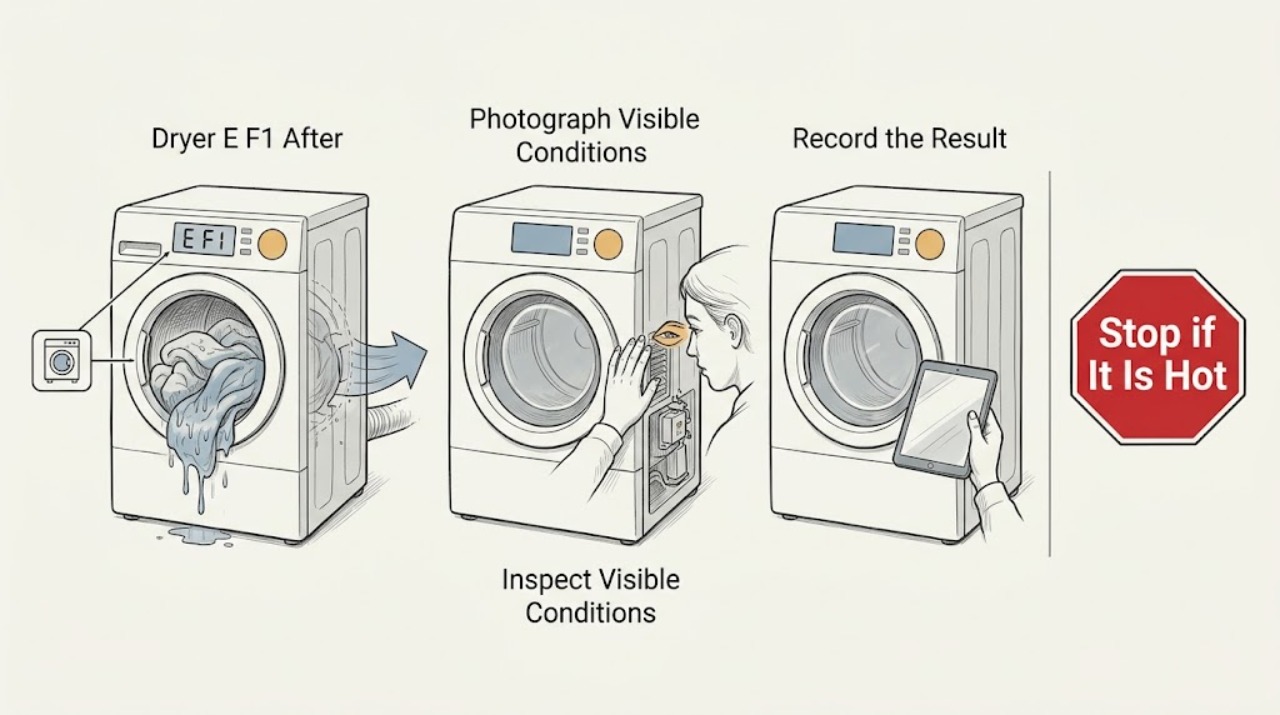
Do not keep restarting the Electrolux gas dryer with a waterlogged blanket. Record the display exactly, including whether it is shown as “E F1” or “EF1,” and photograph the model label. Electrolux’s opened laundry-dryer guide defines EF1 as a ventilation blockage and directs the user to the lint filter, exhaust tube, and vent exit; its drying guidance also warns that an oversized load takes longer and that a gas dryer must have an exhaust duct venting outdoors. Remove or reduce the wet bulky load only if it can be handled safely, clean or inspect only the accessible lint and vent path with power off, and stop for burning odor, smoke, scorching, unusual heat, gas odor, or a damaged cord or plug. A code that returns after the load and accessible vent checks needs model-specific service rather than repeated cycles or a guessed code meaning.
Before you begin
Safety first
- The user boundary is exact-display/model identification, safe load removal, lint-screen care, and visual inspection of accessible airflow and outdoor termination. Internal burner, motor, sensor, control, wiring, gas, cabinet, and hidden-duct work belongs to qualified service.
Work through in order
Diagnostic checks
Use only checks that match the exact appliance or system and its official guide.
-
Check 1
Stop the cycle and wait for the drum to stop. Record the display character-for-character, including spaces, and photograph the rating label at the top of the door opening if it is accessible. Note that the dryer is gas-fired and whether the message appeared immediately after the soaking-wet blanket was loaded.
Expected result: The screen reads E F1, EF1, or another message; the model number is known or missing; and the message appeared after a single wet bulky load or during a prior normal load.
Next step: Use the exact Electrolux manual or support record for the model and display. Do not substitute an E1/F1 explanation, open the control area, or repeatedly start the dryer to see whether the message changes.
Stop if: Stop and arrange service if the code returns immediately, the model cannot be identified, or the display is accompanied by smoke, burning odor, gas odor, scorching, abnormal heat, a damaged cord or plug, or a tripped circuit.
Why this matters
Why: Electrolux’s opened dryer guide identifies EF1 as ventilation blockage, but it does not prove that every model or display spacing uses the same code. An incomplete model or misread character makes cross-model decoding unsafe.
-
Check 2
With the dryer off and cool, remove the soaking-wet blanket from the drum only if it can be handled without strain or slipping. Look at the remaining load size and whether the blanket was packed tightly enough to prevent free tumbling; do not add water or run another cycle to reproduce the message.
Expected result: The blanket is waterlogged and fills much of the drum, the load is tightly packed, the motor stopped from heat, or the load was not unusually large.
Next step: Keep the dryer off while the motor cools. Plan at most one supervised test with a smaller, balanced load only after the accessible ventilation and gas-exhaust checks below are satisfactory; if the motor overheated or the message returns, arrange service.
Stop if: Do not lift a waterlogged blanket alone, force it through the door, continue with a hot cabinet or drum, or run another load if there is scorching, burning odor, smoke, unusual heat, or a repeated shutdown.
Why this matters
Why: Electrolux says an overloaded dryer takes longer and separately notes that overloading can overheat the motor. A wet bulky load can therefore explain poor tumbling or an overheat symptom, but it does not by itself prove that EF1 has a load-specific meaning or that the vent is clear.
-
Check 3
After power is disconnected safely and the dryer is cool, clean the lint screen and visually inspect the accessible exhaust tube for crushing, sharp bends, or blockage. Look at the outdoor vent exit for visible lint or debris that can be cleared without dismantling the wall or duct.
Expected result: The lint screen is loaded, the tube is bent or crushed, the vent exit is blocked, or the accessible path is clear but the message remains.
Next step: Clear only accessible lint or debris and restore the lint screen and duct connection. If the duct inside a wall or ceiling needs cleaning, use qualified vent service; do not remove panels or probe the airflow system.
Stop if: Stop if the duct is disconnected, crushed inside the wall, hot to the touch, heavily linted beyond safe access, or if the code returns after the accessible correction.
Why this matters
Why: The Electrolux error guide maps EF1 to a ventilation blockage and specifically directs these three checks. A clear visible section does not prove that the hidden duct, sensor, or internal airflow path is healthy.
-
Check 4
For the newer gas-dryer context, verify from a safe visual position that the exhaust duct terminates outdoors and that laundry, rugs, and other items are not pressed against the front or back of the dryer. Do not alter the gas connection, burner, exhaust wall, or building wiring.
Expected result: The outdoor termination is missing or blocked, the dryer is crowded by laundry or rugs, the gas installation appears damaged, or the surrounding air space and outdoor duct are intact.
Next step: Leave the dryer unused and arrange qualified vent or appliance service when outdoor exhaust, clearances, or the gas installation cannot be verified. Do not make a temporary indoor exhaust arrangement or keep testing while a safety condition is unresolved.
Stop if: Stop immediately for gas odor, smoke, burning odor, scorching, a hot cabinet or plug, damaged gas tubing or cord, or any sign of combustion or carbon-monoxide danger; leave the area and contact the appropriate emergency or gas-safety service if needed.
Why this matters
Why: Electrolux warns never to operate a gas dryer without an exhaust duct venting outdoors because of carbon-monoxide risk, and says a gas dryer needs air around it for burner ventilation. These are safety prerequisites, not optional ways to bypass EF1.
-
Check 5
Only after the dryer has cooled, the wet bulky load has been removed or reduced, the lint screen is installed, and the outdoor exhaust path is verified, run one supervised normal test. Stay nearby and stop if the display returns or the cabinet, plug, airflow, or odor seems abnormal.
Expected result: The test completes without EF1, EF1 returns, drying remains weak, the motor stops again, or any heat, odor, smoke, or gas symptom appears.
Next step: If EF1 or abnormal heat returns, stop using the dryer and provide service with the exact display, model label, load description, vent observations, and photographs. Do not order a sensor, board, motor, or vent component from the code alone.
Stop if: Do not run another test after EF1 returns, after a motor overheat, or after smoke, burning odor, gas odor, scorching, unusual heat, a damaged cord or plug, or a circuit trip.
Why this matters
Why: A single clean test can show whether the immediate load and accessible ventilation conditions changed, but it cannot certify a hidden duct, airflow sensor, burner, control, motor, or other internal part. Repeated testing increases exposure to a possible ventilation or gas-safety fault.
Use your observations
Decision map
Find the observation that best matches what you see, then follow the next safe action.
-
PATH 01Next step
What you see
The display is confirmed as EF1 on the exact manual, it appeared after one waterlogged blanket load, the load was too large to tumble freely, and there is no heat, odor, smoke, or gas concern.
Do this next
Remove or reduce the load safely, verify the lint and accessible exhaust path, and allow the dryer to cool before at most one supervised test. Escalate if EF1 returns.
Why this path and its safety boundary
Why it matters: The heavy wet load can explain slow drying or motor stress, but Electrolux still defines EF1 as a ventilation-blockage indication; the load alone is not a safe code reset or a reason to ignore the vent.
-
PATH 02Next step
What you see
EF1 is accompanied by a loaded lint screen, crushed or bent exhaust tube, or a blocked outdoor vent exit.
Do this next
Keep the dryer off, clear only the accessible obstruction with power safely disconnected, and use qualified vent service for hidden or damaged ductwork.
Why this path and its safety boundary
Why it matters: A ventilation restriction is more likely than a confirmed failed part, and continued gas-dryer operation can increase heat and carbon-monoxide risk if exhaust is not outdoors.
-
PATH 03Next step
What you see
The exact display remains EF1 after a safe load reduction and the accessible lint, tube, and outdoor-exit checks are clear, or the model manual does not list the spaced E F1 display.
Do this next
Stop owner troubleshooting and arrange model-specific Electrolux appliance or vent service with the display photo and model label. Do not repeat cycles or replace a part by code similarity.
Why this path and its safety boundary
Why it matters: A hidden vent restriction, airflow sensing, or dryer fault remains possible, but the opened general guide cannot identify the component or authorize internal testing for an unknown model.
-
PATH 04Next step
What you see
There is a burning or gas odor, smoke, scorching, unusual heat, a hot or damaged plug, damaged gas hardware, a circuit trip, or the dryer cannot safely exhaust outdoors.
Do this next
Stop using the dryer immediately. Leave the area for a gas or combustion emergency and contact the appropriate emergency, gas-safety, electrician, or qualified appliance service provider; do not restart it to confirm the code.
Why this path and its safety boundary
Why it matters: This is a fire, electrical, combustion, or carbon-monoxide safety condition rather than a normal wet-load troubleshooting branch.
Helpful context
Understand the symptom
The display spacing matters. The opened Electrolux laundry-dryer guide prints the ventilation warning as EF1, but a screen that appears as E F1 must still be checked against the exact owner's guide for the appliance and market. Do not borrow an E1, F1, or another brand's code explanation. The model number is normally found at the top of the dryer door opening; record it before asking for service or selecting a manual.
A soaking-wet blanket can be an oversized, poorly tumbling load and can make drying take longer; Electrolux also warns that overloading can overheat a dryer's motor. That context does not by itself change EF1's documented ventilation meaning. For a gas dryer, the outdoor exhaust path and surrounding air supply are safety conditions: do not run without an exhaust duct venting outdoors, and do not continue after a burning smell, smoke, scorching, unusual heat, or gas odor.
When checks do not resolve it
Need a professional?
Call for service if EF1 returns after one safe correction and one supervised test, if the code is not defined for the exact model, if the motor overheats, or if the exhaust or gas installation cannot be verified.
Safety scope: The user boundary is exact-display/model identification, safe load removal, lint-screen care, and visual inspection of accessible airflow and outdoor termination. Internal burner, motor, sensor, control, wiring, gas, cabinet, and hidden-duct work belongs to qualified service.
Have this ready
- Provide the exact display text and spacing, model and serial label, market, blanket/load description, whether the lint screen and accessible duct were clear, outdoor vent observations, and any heat, odor, smoke, or shutdown history.
Common questions
FAQ
Does a soaking-wet blanket itself mean E F1 is a load error?
Not from the opened Electrolux material. A waterlogged or oversized load can take longer to dry and can stress or overheat the motor, while the Electrolux dryer code guide defines EF1 as a ventilation blockage. Treat the load as a reason to stop, unload safely, and verify the vent—not as a substitute code meaning.
Can I keep running a gas dryer to clear the code?
No. Electrolux says a gas dryer must have an exhaust duct venting outdoors, and it needs adequate air around the unit for the gas burner. After one safe load and accessible-vent check, a returning EF1 belongs with qualified service; never keep testing through smoke, burning or gas odor, unusual heat, or a missing or blocked outdoor exhaust.
Is E F1 the same as EF1 on every Electrolux dryer?
Do not assume that. The opened general Electrolux guide prints EF1 as ventilation blockage, but the exact model manual and market control determine how a display is formatted and interpreted. Photograph the screen and rating label before using a code-specific procedure.
Read the exact guide
Official sources
- Dryer - Not Drying and Extended Drying TimeElectrolux · The page applies to dryers and states that oversized loads take longer, the exhaust duct should be checked, and a gas dryer must not operate without an exhaust duct venting outdoors.
- Where can I find my model and serial number?Electrolux · The page applies to all appliances and states that a dryer model number can be found along the top of the door opening.
- My dryer is running, but does not seem to be heating. What should I do?Electrolux · The page applies to dryers and directs gas-dryer users to the gas supply and adequate air around the unit, while warning not to place laundry or rugs against the dryer.
- What should I do if my dryer stops operating?Electrolux · The page applies to dryers and states that overloading can overheat the motor, recommends reducing load size, and directs service if the condition persists.
- Laundry Dryer Error Code GuideElectrolux · The page applies to laundry dryers and lists EF1, also written as E F1 in the task display, as Ventilation Blockage, with checks for the lint filter, exhaust tube, and vent exit; it is not a substitute for an exact model manual.
Community feedback
Share a repair observation
Share a plain-text repair observation. Accepted observations are published automatically; this page may take a moment to update.