
On this page
Start here
Quick answer
First determine whether the intermittent fan is the ELFE773CAW's own airflow or a separate apartment booster fan connected to the building exhaust. Electrolux identifies the ELFE773CAW as an electric front-load dryer and requires an approved outdoor exhaust hood and a clear, lint-free duct; its public support also says restricted ventilation can affect drying. A dryer that continues tumbling, heating, and completing the cycle while only the wall or building booster cycles does not by itself prove a dryer failure or a failed part—the building fan control, sensing arrangement, or shared exhaust needs the installer or property manager. If the dryer itself stops, overheats, loses airflow, smells hot, smokes, or trips protection, stop using it and arrange qualified appliance or electrical/vent service. Do not open the dryer, alter booster wiring, or test live terminals.
Work through in order
Diagnostic checks
Use only checks that match the exact appliance or system and its official guide.
-
Check 1
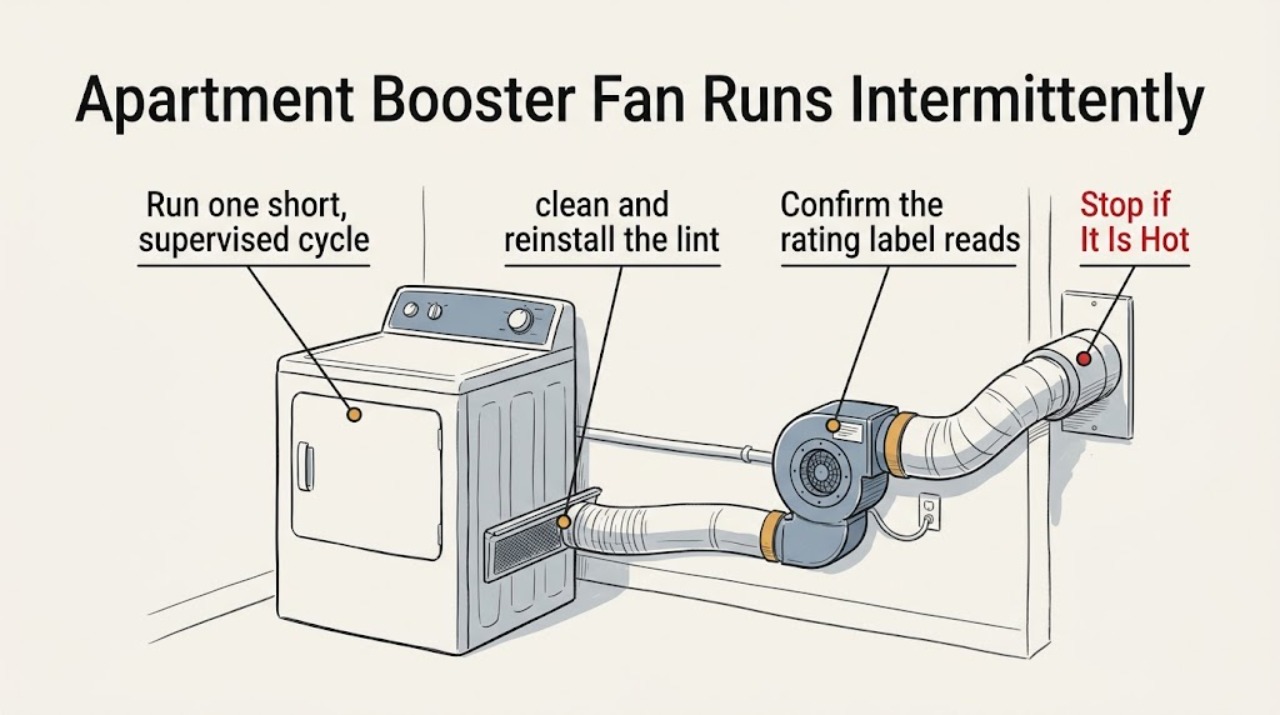
Confirm the rating label reads ELFE773CAW and identify which fan is cycling: listen at the dryer cabinet, the visible wall or ceiling grille, and the accessible exterior exhaust hood without removing covers. At the same time note whether the drum tumbles, warm air exits, the cycle timer progresses, and clothes dry normally.
Expected result: Only the separate apartment fan stops and restarts while the dryer continues normally, or the dryer itself stops tumbling, loses heat or airflow, or fails to complete the cycle.
Next step: Record the fan location, cycle, time from start, and whether the dryer is heating and finishing. Treat a separate booster as an apartment exhaust-control issue and give the record to the installer or property manager; use the appliance-service branch if the dryer itself fails.
Stop if: Stop immediately for smoke, burning odor, scorching, sparking, a hot cord or outlet, abnormal vibration, a blocked exhaust, or a breaker or safety device that trips.
Why this matters
Why: The exact model is an electric front-load dryer. If the dryer remains operational, the intermittent external fan is not enough to identify a dryer motor, heater, or control failure; if the dryer itself stops or overheats, the appliance has a separate service symptom.
-
Check 2
With the dryer off and cool, clean and reinstall the lint screen as the owner's guidance directs, then inspect only the accessible duct connection and exterior hood for lint, a crushed transition, a closed damper, or a screen or grate obstructing the exhaust. Do not pull the dryer out or open a shared apartment duct.
Expected result: The lint screen or visible hood is blocked, the duct is visibly crushed or disconnected, the hood damper does not open freely, or the accessible exhaust path looks clear.
Next step: Correct only a loose lint screen or an obvious accessible obstruction. For a shared duct, fixed grille, building booster, damaged duct, or inaccessible hood, stop altering the system and have the building's qualified installer or vent contractor inspect it.
Stop if: Do not operate without the lint screen, tape over a vent opening, add a screen, use flexible plastic or foil ducting, reach into a duct, or remove a building fan cover.
Why this matters
Why: Electrolux says lint, restricted ventilation, and a blocked exhaust hood can affect drying, and its installation instructions require a clear outdoor exhaust without a screen or grate. A clear visible path does not prove that a concealed building duct or booster is correctly controlled.
-
Check 3
Run one short, supervised cycle only if the dryer has no safety symptom. Note the selected temperature and cycle, whether the intermittent fan starts during warm-up, pauses when the heater cycles, and resumes later, and whether the dryer completes without excessive heat or extended drying.
Expected result: The dryer tumbles and dries normally while the external fan cycles with the load or heat pattern, or the dryer develops weak airflow, unusually long drying, excessive heat, stopping, or a burning smell.
Next step: For normal dryer performance, stop cycle experiments and report the fan timing and model to the installer or property manager. For poor airflow, heat, or stopping, leave the dryer off and arrange qualified Electrolux and vent service.
Stop if: Do not continue a test through overheating, scorching, smoke, a burning odor, repeated stopping, or a blocked exhaust.
Why this matters
Why: A normal appliance cycle with only an external fan pattern keeps the apartment booster control or shared exhaust interface in consideration; it does not establish that the Electrolux dryer is commanding that fan. Poor airflow, overheating, or stopping makes the appliance or exhaust system a safety/service problem.
-
Check 4
Compare the apartment fan behavior with the dryer's operating result across one normal load: record load size, cycle, start and stop times for the external fan, whether the dryer's heater and drum remain active, and whether the building fan is shared with another appliance. Do not change the fan's sensor, relay, breaker, or wiring.
Expected result: The booster cycles only with this dryer but the dryer finishes normally, the booster never starts, or the dryer and booster both lose operation or trip protection.
Next step: Give the property manager or installer the exact model, vent route, fan location, timing record, and dryer-performance result. Request inspection of the booster control and shared duct by a qualified professional rather than modifying it yourself.
Stop if: Keep the dryer out of use for a hot or damaged outlet, electrical odor, smoke, exposed wiring, repeated breaker trips, or any exhaust condition that cannot be safely assessed externally.
Why this matters
Why: An external fan that cycles while the dryer remains normal is a building-control or installation question, not proof of a replaceable Electrolux part. A fan that never starts, a shared system that affects multiple appliances, or a simultaneous trip needs the property-side installer or an electrician to diagnose the interface.
Use your observations
Decision map
Find the observation that best matches what you see, then follow the next safe action.
-
PATH 01Next step
What you see
The ELFE773CAW tumbles, heats, moves air, and completes the cycle normally, while only a separate apartment wall, ceiling, or building fan starts and stops.
Do this next
Stop changing dryer settings and report the exact model, fan location, cycle, and timing to the property manager or installation contractor for a building-side inspection.
Why this path and its safety boundary
Why it matters: The dryer has not demonstrated an appliance failure. The intermittent behavior is more consistent with the building booster control, sensing arrangement, or shared exhaust installation, which Electrolux's public model documents do not define.
-
PATH 02Next step
What you see
The external fan cycles and the dryer also has weak airflow, extended drying, unusual heat, or a visibly obstructed lint or exhaust path.
Do this next
Turn the dryer off, correct only an accessible lint-screen or hood obstruction, and have the complete duct and shared exhaust inspected by a qualified vent professional if the restriction is not fully visible.
Why this path and its safety boundary
Why it matters: A lint or exhaust restriction is more important than the fan timing because Electrolux warns that restricted ventilation affects drying and increases fire risk.
-
PATH 03Next step
What you see
The dryer itself stops, will not restart until it cools, or the motor becomes unusually hot, while the apartment fan behavior is secondary.
Do this next
Leave the dryer off, allow no repeated load tests, and arrange qualified Electrolux service. Include the load size, cycle, stopping time, and external fan behavior.
Why this path and its safety boundary
Why it matters: Electrolux identifies motor overheating and thermal-limiter operation as possible reasons a dryer stops; this is an appliance service boundary rather than proof of a booster-fan fault.
-
PATH 04Next step
What you see
There is smoke, burning odor, scorching, sparking, a hot or damaged outlet or cord, exposed wiring, a blocked exhaust, or repeated breaker operation.
Do this next
Stop using the dryer and keep clear. Isolate power only from a dry, safe position if possible, and arrange qualified appliance, electrical, or vent service; use local emergency procedures for active smoke or fire.
Why this path and its safety boundary
Why it matters: This is an immediate fire or electrical safety stop, not a fan-timing adjustment.
Helpful context
Understand the symptom
A replacement dryer can expose a building exhaust-control mismatch without the dryer itself being defective. The useful observation is whether the ELFE773CAW continues to tumble, heat, move air, and finish the selected cycle while a separate fan at the wall, roof, or utility-room duct starts and stops. Electrolux's public material identifies the dryer and the exhaust requirements, but does not publish a control map for an apartment booster fan or its sensor.
Keep all checks external. A dryer exhaust system is a fire-safety system, and the apartment fan may be building-owned equipment. Do not bypass a fan, add a jumper, change a relay, remove duct panels, or open the dryer's cabinet to make the fan run continuously.
When checks do not resolve it
Need a professional?
Contact the apartment's installer or property manager when only the separate booster fan cycles while the ELFE773CAW completes normally. Request Electrolux appliance and qualified vent service when the dryer itself stops, overheats, loses airflow, takes unusually long to dry, or repeats the symptom with a clear external duct path.
Have this ready
- Provide the exact model, whether the fan is inside or outside the dryer, apartment vent and booster location, selected cycle and temperature, load size, timing of fan starts and stops, dryer drum and heat behavior, visible hood condition, and any odor, heat, smoke, noise, or breaker event.
Common questions
FAQ
Why does my apartment booster fan turn on and off with an Electrolux ELFE773CAW dryer?
First confirm that the cycling fan is separate from the dryer. If the dryer tumbles, heats, moves air, and completes normally while only the building fan cycles, the external fan control or shared exhaust interface needs the installer or property manager; Electrolux's public model material does not document that building control.
Could a blocked vent cause intermittent fan operation?
A restriction can affect airflow and drying performance, so check the lint screen and only the accessible exterior hood or duct connection with the dryer off and cool. Do not open a shared apartment duct; have a qualified vent professional inspect hidden restrictions.
Should I rewire the booster fan so it stays on continuously?
No. The apartment booster and its sensor or relay may be building equipment, and Electrolux does not publish a model-specific wiring change for this symptom. Report the external-only pattern to the responsible installer or property manager and do not bypass the control.
When is intermittent fan behavior an Electrolux dryer problem?
Treat it as an appliance-side service issue when the dryer itself stops, overheats, loses airflow, takes unusually long to dry, smells hot, or trips a protective device. Electrolux identifies motor overheating and thermal-limiter operation as possible reasons a dryer stops.
Read the exact guide
Official sources
- Installation for Electrolux Front Load DryerElectrolux · Official installation PDF reached from the exact ELFE773CAW model-support page; used for external exhaust and fire-safety boundaries, not for apartment booster control logic.
- Front Load Perfect Steam™ Electric Dryer with Balanced Dry™ and Instant Refresh – 8.0 Cu. Ft. ELFE773CAW Model Support PageElectrolux Canada · Official Electrolux Canada model-support page opened for the exact assigned model.
- What should I do if my dryer stops operating?Electrolux · Official Electrolux dryer support article opened during research; used only when the dryer itself stops or overheats.
- Dryer - Not Drying and Extended Drying TimeElectrolux · Official Electrolux dryer support article opened during research; used for safe external lint and exhaust observations and the shared-vent boundary.
Community feedback
Share a repair observation
Share a plain-text repair observation. Accepted observations are published automatically; this page may take a moment to update.