
On this page
Start here
Quick answer
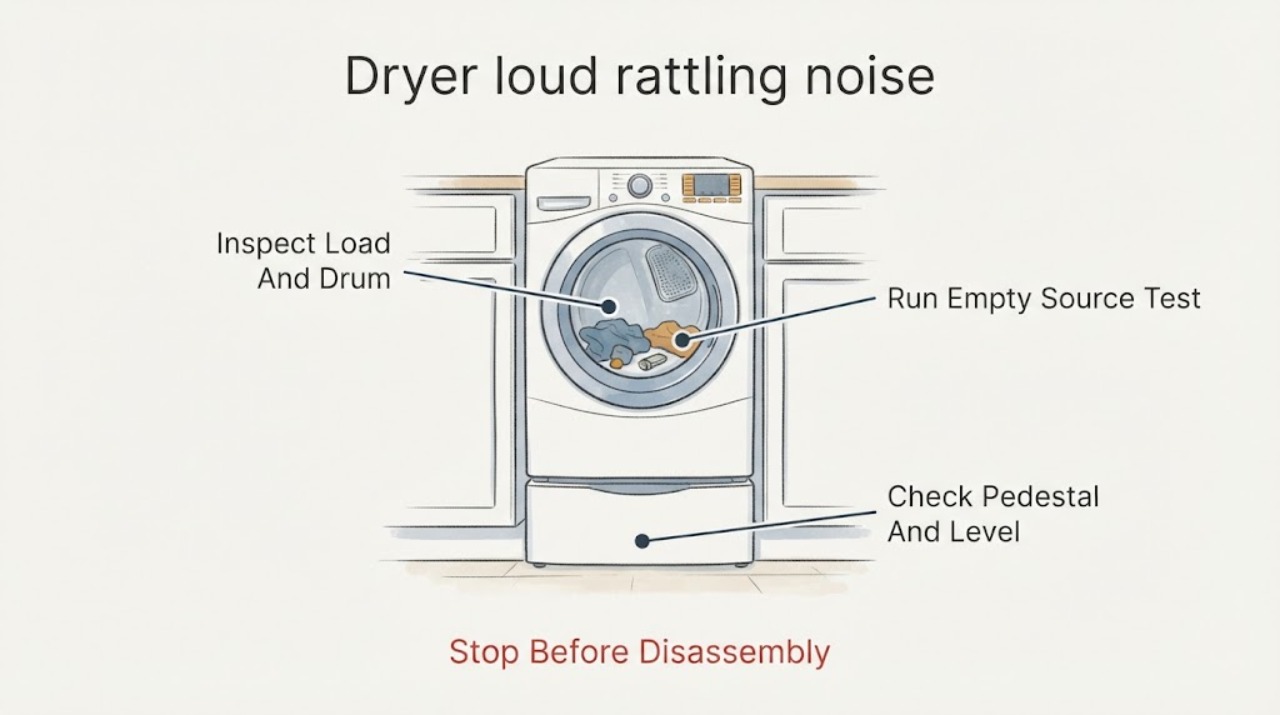
First separate a loose item in the load from a noise produced by the dryer. Electrolux says coins or other foreign objects in the drum and belt buckles or metal fasteners on clothing can rattle; stop the dryer, check pockets and fasteners, then use an empty cycle only if the dryer is otherwise safe to run. If the sound remains with the drum empty, Electrolux directs service. A loose pedestal, missing shipping bolts or an unlevel installation can also create clanking or vibration, especially after installation. Do not assume a roller, belt, motor or drum bearing from sound alone, and stop using the dryer for scraping, burning, electrical or severe impact symptoms rather than opening the cabinet.
Work through in order
Diagnostic checks
Use only checks that match the exact appliance or system and its official guide.
-
Check 1
Stop the dryer, let the drum stop completely, remove the load and check pockets, the drum and visible door area for coins or other loose objects. Turn garments inside out or secure metal fasteners before another normal load.
Expected result: A coin/foreign object or loose fastener is found; the drum is clear; or the object cannot be removed safely.
Next step: Remove only an accessible object with the dryer off. If it is trapped, the drum is damaged or the noise is severe, leave the dryer off and arrange service.
Why this matters
Why: Electrolux identifies foreign objects and metal fasteners as load-related rattling sources. A clear drum does not yet prove an internal part fault.
-
Check 2
Only if the dryer has no burning smell, exposed damage, severe scraping or unsafe movement, run the shortest model-appropriate empty cycle while remaining nearby. Stop immediately if the loud rattle or impact returns.
Expected result: The noise disappears empty; it continues empty; or a new scraping/impact or burning symptom appears.
Next step: If quiet empty, reload with pockets and fasteners secured and monitor. If noisy empty or hazardous, stop using the dryer and request service.
Why this matters
Why: Electrolux uses an empty cycle to distinguish a clothing/foreign-object noise from a noise produced by the dryer. A persistent empty-drum noise needs service rather than a guessed component.
-
Check 3
With the dryer off, inspect the accessible floor and installation: the unit is level and stable, the pedestal or stacking hardware is not visibly loose, and any shipping materials/bolts were removed according to the exact installation manual.
Expected result: The dryer rocks, the pedestal/stacking area is loose, the unit was recently installed or moved, or the installation appears stable.
Next step: Correct only an obvious external installation issue permitted by the manual or call the installer. Do not open the cabinet or continue operating a visibly unstable dryer.
Why this matters
Why: Electrolux lists a loose pedestal as a clanking/squeaking source and recommends checking shipping bolts and leveling for a newly installed dryer.
-
Check 4
Record whether the sound begins at start, drum rotation, heat, or shutdown, and whether it changes with a small versus normal load. Do not repeatedly cycle the dryer or operate it unattended to reproduce the sound.
Expected result: The sound is load-dependent, persists empty, changes with heat/rotation, or is accompanied by stopping or overheating.
Next step: Provide the model and timing to qualified service. If the dryer stops or shows overheating symptoms, leave it off; Electrolux directs service when cooling/reducing load does not resolve operation problems.
Why this matters
Why: Timing and load dependence help service distinguish a clothing/installation issue from an appliance-sourced noise, but do not diagnose a belt, motor, roller or bearing.
-
Check 5
Stop using the dryer immediately for a burning smell, smoke, exposed wire, severe metal scraping, cabinet movement or repeated impact. Disconnect power only by the normal accessible plug/breaker procedure if safe; gas dryers should not be opened or disconnected at the gas line by the user.
Expected result: The hazard clears after shutdown, remains, or the source is uncertain.
Next step: Keep clear of the appliance and arrange qualified Electrolux service; use appropriate emergency/fire or gas support if smoke or a gas odor is present. Do not remove panels or guess a replacement part.
Why this matters
Why: A loud rattle with a heat, electrical or mechanical hazard is outside the supported empty-load and installation checks.
Use your observations
Decision map
Find the observation that best matches what you see, then follow the next safe action.
-
PATH 01Next step
What you see
The rattle disappears when the drum is empty and returns only with particular clothing.
Do this next
Secure or remove the offending items and monitor a normal load. If the sound later occurs empty, switch to the appliance-service branch.
Why this path and its safety boundary
Why it matters: Electrolux identifies pockets, coins, belt buckles and other metal fasteners as likely load-related sources.
-
PATH 02Next step
What you see
The rattle or clank remains during an empty cycle.
Do this next
Stop using the dryer and arrange qualified service. Do not identify or replace a roller, belt, motor or bearing from sound alone.
Why this path and its safety boundary
Why it matters: Electrolux says this points to a noise from the dryer rather than the load and recommends contacting service.
-
PATH 03Next step
What you see
The dryer is newly installed, moved, stacked or on a pedestal and also rocks, vibrates or clanks.
Do this next
With the dryer off, use the exact installation manual or installer to correct visible stability issues. Do not run a visibly unstable unit.
Why this path and its safety boundary
Why it matters: Electrolux lists shipping materials/bolts, leveling and a loose pedestal as installation-related possibilities.
-
PATH 04Next step
What you see
The noise includes burning smell, smoke, exposed wiring, severe scraping, repeated impact or overheating/stopping.
Do this next
Leave the dryer off, disconnect normal power only if safe, and arrange qualified service or emergency support as appropriate. Do not open the cabinet.
Why this path and its safety boundary
Why it matters: The symptom is beyond a safe user-level noise check and may pose fire, electrical or mechanical risk; no internal cause is confirmed.
Helpful context
Understand the symptom
Start with the load, not a guessed part
Stop the dryer and empty the drum. Check every pocket and visible drum area for coins or other loose objects, and check clothing for belt buckles or metal fasteners. Electrolux lists these as common sources of rattling or clanking. Do not reach into a moving drum or keep running a load to see whether a loose object damages the cabinet.
Use an empty cycle as a source test
If the drum, door and power connection are normal and there is no burning smell, exposed damage or severe scraping, Electrolux recommends an empty cycle to distinguish a noise from clothing from a noise produced by the unit. If the rattle remains with the drum empty, stop treating it as a load issue and arrange service.
Check installation and pedestal conditions
Electrolux says clanking or squeaking can occur when a dryer on a pedestal has become loose. For a newly installed unit, check only the accessible installation conditions: shipping bolts removed as directed by the manual, a solid level floor and a secure pedestal/stacking installation. Do not remove cabinet panels or reach under a running dryer.
Escalate persistent or hazardous noise
A rattle that persists empty, becomes a scraping or impact noise, accompanies a burning smell, or appears with cabinet movement is outside a model-free user check. Keep the dryer off and arrange qualified Electrolux service. Do not infer or replace a roller, belt, motor, blower or bearing from the sound alone.
Record details for the technician
Note the complete model, electric or gas type, whether the sound starts with the drum or heat, whether it changes with load size, whether it remains empty, whether the unit is stacked/on a pedestal, and any recent move or installation. These observations define the service boundary without asserting an internal failure.
When checks do not resolve it
Need a professional?
Arrange qualified Electrolux service when the rattling remains in an empty cycle, the drum/cabinet is damaged, the pedestal or installation cannot be made stable, the noise is scraping/impacting, the dryer stops or overheats, or any burning smell, smoke, exposed wiring or gas odor is present. Provide the full model, dryer type, load/empty result, installation status and when the sound occurs.
Common questions
FAQ
How do I tell whether the rattling comes from clothes or the Electrolux dryer?
Stop and empty the drum, inspect pockets and fasteners, then run an empty cycle only if the dryer is otherwise safe. If the sound continues empty, Electrolux directs service.
Could a pedestal cause a loud dryer rattle?
Yes, Electrolux says clanking or squeaking can occur when a dryer on a pedestal has become loose. With the dryer off, check visible stability and the model installation guidance; do not assume a loose pedestal is the cause if the noise persists empty.
Should I replace a belt or drum roller for a rattling sound?
Not from sound alone. Electrolux’s public guidance supports load and installation checks and service when noise persists; the model and technician diagnosis are needed before any internal part decision.
Read the exact guide
Official sources
- Laundry Dryer NoisesElectrolux · General dryer noise guide; load, pedestal, shipping-bolt and leveling branches.
- Is it normal for my dryer to make sounds or noises?Electrolux · General Electrolux dryer noise page; load/foreign-object and empty-cycle distinction.
- What should I do if my dryer does not start?Electrolux · General external start/door/power checks; no internal diagnosis.
- What should I do if my dryer stops operating?Electrolux · General service boundary for stopping/overheating; used only for escalation, not component diagnosis.
Community feedback
Share a repair observation
Share a plain-text repair observation. Accepted observations are published automatically; this page may take a moment to update.