
On this page
Start here
Quick answer
Start with the load and airflow before suspecting an internal heater. Electrolux says an Air Fluff or no-heat setting can tumble without heat, an overloaded or nearly empty drum dries poorly, lint or residue can restrict airflow, and a blocked exhaust duct or hood extends drying time. With the dryer off and cool, clean the lint screen, use a correctly sized and sorted load, confirm the model-appropriate heated cycle, and inspect the visible vent path. If the dryer remains cold, the vent cannot be safely cleared, a gas dryer lacks safe outdoor exhaust, or the problem persists after these checks, stop and arrange authorised service rather than opening the cabinet or guessing at a heating part.
Before you begin
Safety first
- Do not operate a gas dryer without an exhaust duct venting outdoors, remove the lint screen during operation, disconnect internal wiring, open the cabinet, perform live voltage tests, bypass thermal protection or replace an internal heating part based only on incomplete drying.
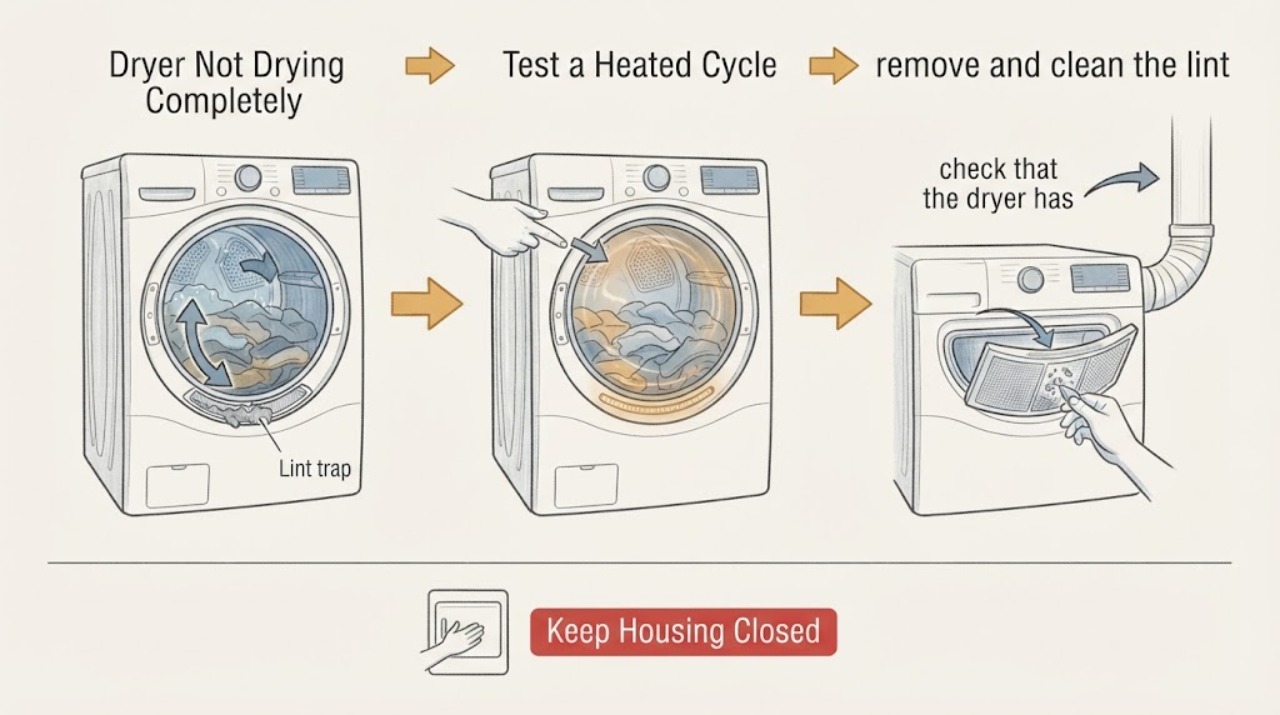
Work through in order
Diagnostic checks
Use only checks that match the exact appliance or system and its official guide.
-
Check 1
With the dryer off, compare the load with the fabric labels and select the model-appropriate heated cycle and dryness level; do not use Air Fluff or a no-heat temperature when the goal is fully dry clothes.
Expected result: The load is overloaded, nearly empty, mixed with heavy and light fabrics, or on a no-heat/low-heat setting; or the load and selected cycle are appropriate.
Next step: Correct only the visible load or setting and compare the result on a similar load. If the setting is appropriate and clothes remain damp, continue with the cool, external checks below.
Why this matters
Why: Electrolux says load size, free tumbling, fabric sorting and cycle/temperature affect drying time. A no-heat selection explains tumbling without heat, while a correct load and cycle move the check toward airflow or service.
-
Check 2
After the dryer is off and cool, remove and clean the lint screen; if it has residue, wash it in warm soapy water, dry it fully and reinstall it before operating.
Expected result: The screen is coated with lint or residue, airflow through it is visibly restricted, or it is already clean and correctly installed.
Next step: Run the dryer only with the clean screen installed, then inspect the accessible exhaust path; do not remove the screen or reach into the cabinet.
Why this matters
Why: Electrolux says lint buildup can block airflow and hinder drying, and warns not to operate the dryer without the lint screen. A clean screen does not prove the external exhaust is clear.
-
Check 3
From outside the appliance, check that the dryer has the model-required clearance and that the visible exhaust duct and exterior hood are not blocked, crushed or obviously restricted; do not disconnect the duct or dismantle the dryer.
Expected result: The duct or hood is blocked/restricted, the dryer is enclosed without adequate ventilation, or the visible path appears clear.
Next step: Stop using a gas dryer if it lacks a safe outdoor exhaust path. Arrange professional vent cleaning or authorised service for a restricted or inaccessible path; otherwise continue to the sensor/model check.
Why this matters
Why: Electrolux identifies restricted exhaust, blocked hood and inadequate closet ventilation as causes of longer drying. A clear visible path still does not establish that the internal airflow or heater is healthy.
-
Check 4
With the dryer cool, locate the moisture-sensor bars using the exact owner guide and look for visible residue; consider whether unusually humid room conditions or fabric-softener-sheet residue could be affecting automatic dryness detection.
Expected result: Residue is visible, the room is unusually humid, the model does not use the described sensor arrangement, or no such condition is found.
Next step: Clean only as the model manual permits and use a matching load/cycle. If the dryer still leaves clothes damp, record the model and arrange service rather than replacing a sensor or heater based on this observation.
Why this matters
Why: Electrolux says residue can inhibit sensor accuracy and high humidity can lengthen drying. These are performance factors, not proof of a failed sensor or heating component.
-
Check 5
Confirm whether the drum warms at all during a normal model-supported heated cycle, without opening the cabinet or performing live measurements, and record the complete model number and fuel type.
Expected result: The dryer tumbles but stays cold, it heats yet leaves clothes damp after load/filter/vent checks, it is a gas model with a supply or exhaust concern, or it heats normally on an appropriate cycle.
Next step: Keep the cabinet closed and contact authorised service for persistent cold operation, abnormal heat, fuel/exhaust concerns or unresolved damp loads. Provide the model, cycle, load, vent findings and whether the drum warmed.
Why this matters
Why: A cold drum after the visible setting and airflow checks indicates a service-level heating or supply problem; damp clothes with normal heat may still reflect sensing, airflow, load or model-specific cycle behavior. The symptom alone does not identify an element, igniter, thermostat or control board.
Use your observations
Decision map
Find the observation that best matches what you see, then follow the next safe action.
-
PATH 01Next step
What you see
The dryer was on Air Fluff/no heat, overloaded or nearly empty, or filled with mixed heavy and light fabrics, and it has not yet been tried with a suitable heated cycle and freely tumbling load.
Do this next
Correct the load and visible settings according to the care labels and model guide, then compare with a similar load.
Why this path and its safety boundary
Why it matters: The incomplete drying can be explained by the selected cycle or load conditions rather than a confirmed appliance failure.
-
PATH 02Next step
What you see
The lint screen is dirty, the accessible exhaust/hood is restricted, or the dryer lacks adequate ventilation around a closet or under-counter installation.
Do this next
Stop using a gas dryer without a safe outdoor exhaust; clean only accessible lint/hood areas and arrange professional vent cleaning or service for the duct or installation.
Why this path and its safety boundary
Why it matters: Restricted airflow is a supported reason for extended drying and can create a safety concern, especially for gas models.
-
PATH 03Next step
What you see
The load, filter, visible vent path and model-appropriate cycle are correct, but the drum stays cold or clothes remain damp across comparable loads.
Do this next
Keep the cabinet closed and arrange authorised service with the exact model, fuel type, cycle, load and observed heat/airflow.
Why this path and its safety boundary
Why it matters: The external checks have not resolved the symptom; the manufacturer guidance does not support naming an internal heater, thermostat, sensor or control part from this result.
-
PATH 04Next step
What you see
The dryer heats normally but automatic cycles stop early or leave damp items, and the model uses moisture-sensor bars or a heat-pump/feature-specific system.
Do this next
Use the exact owner guide for the sensor location and cycle behavior, clean only as directed, and call service if the result persists.
Why this path and its safety boundary
Why it matters: Sensor residue, humidity and model-specific drying behavior can affect the result; the page does not establish a failed sensor or a universal timing expectation.
Helpful context
Understand the symptom
Rule out the load and cycle first
A drum that is too full cannot tumble freely, while a very small load may not tumble or contact the sensing system as intended. Electrolux also warns that Air Fluff or a no-heat temperature will tumble without heat. Sort similar fabrics and weights, use the cycle and dryness level that match the care labels, and do not treat a longer time on a delicate or low-heat setting as proof of a failed heater.
Airflow affects drying and safety
Lint buildup, a restricted exhaust duct, a blocked outside hood or inadequate closet ventilation can leave clothes damp. Clean only accessible lint-screen and vent/hood areas as described by Electrolux. A gas dryer must have an exhaust duct that vents outdoors; do not run it without that duct or remove safety/vent components to improve airflow.
Use the model manual for sensors and features
Electrolux says residue on moisture-sensor bars can affect automatic sensing and directs owners to the Complete Owner’s Guide for their location. Some dryers have features such as heat-pump systems or model-specific dryness options, so the absence of a model number limits this page to common external checks. Persistent cold operation, abnormal heat or a safety concern belongs with authorised service.
When checks do not resolve it
Need a professional?
Arrange authorised service when the dryer remains cold after the visible cycle, filter and vent checks, repeatedly leaves clothes damp with a correct load and airflow path, has inaccessible or restricted ducting, or presents abnormal heat, smoke, burning smell, gas concern or repeated electrical trips. Do not open the cabinet or select an internal part from the symptom alone.
Safety scope: Do not operate a gas dryer without an exhaust duct venting outdoors, remove the lint screen during operation, disconnect internal wiring, open the cabinet, perform live voltage tests, bypass thermal protection or replace an internal heating part based only on incomplete drying.
Have this ready
- Provide the full model number, electric or gas fuel type, selected cycle and temperature, load size/fabric mix, lint-screen condition, visible vent/hood findings, whether the drum warms, room humidity, sensor-bar condition and any safety symptoms.
Common questions
FAQ
Can an Electrolux dryer leave clothes damp because the load is too small?
Yes. Electrolux says both an overloaded and an overly empty load can take longer, because items need room to tumble and enough items for proper tumbling. Sort similar fabrics and compare with a correctly sized load before assuming an internal failure.
Can I use Air Fluff when I want clothes fully dry?
Air Fluff or a no-heat temperature tumbles without heat. Select the model-appropriate heated cycle and temperature for the fabric labels, then use the exact owner guide for dryness options.
How often should I clean the lint screen and vent?
Electrolux says to clean the lint screen before or after every load and periodically wash off residue. It also recommends regular inspection and cleaning of the outdoor exhaust and venting; an inaccessible or restricted duct should go to a qualified service provider.
Does a warm dryer prove the heating system is working correctly?
No. A dryer can warm while still having a load, airflow, moisture-sensing or model-specific cycle issue. If a suitable load remains damp after the external checks, provide the exact model and arrange service rather than diagnosing an internal heater.
What should I do if the dryer stays cold?
Confirm the visible cycle and temperature are not Air Fluff/no heat, and use only safe external checks. If it remains cold, keep the cabinet closed and contact authorised service; gas supply, electrical supply and internal heating parts require model-appropriate or qualified assessment.
Read the exact guide
Official sources
- Dryers - How often do I need to clean my dryer or the lint screen/filter to optimize my drying performance?Electrolux Owner Support · Opened Electrolux official maintenance guidance. It says to clean the lint screen before or after every load, explains that lint can restrict airflow, and recommends periodic outdoor exhaust/vent inspection and cleaning.
- My clothes seem to be over-dried. How can I prevent this?Electrolux Owner Support · Opened Electrolux official dryer guidance. It supports choosing the appropriate cycle and temperature and using Auto Dry versus Timed Dry as a model-appropriate drying decision; it does not define a universal setting sequence.
- Dryer - Not Drying and Extended Drying TimeElectrolux Owner Support · Opened Electrolux official dryer guidance. It covers cycle/temperature, load size and tumbling, humidity, moisture-sensor bars, ventilation, exhaust duct/hood, gas-dryer outdoor exhaust and model-specific heat-pump timing.
- My dryer is running, but does not seem to be heating. What should I do?Electrolux Owner Support · Opened Electrolux official no-heat guidance. It distinguishes a no-heat cycle from a running dryer, covers electric/gas supply conditions and directs unresolved issues to support; it is not used to diagnose a particular internal part.
Community feedback
Share a repair observation
Share a plain-text repair observation. Accepted observations are published automatically; this page may take a moment to update.