
On this page
Start here
Quick answer
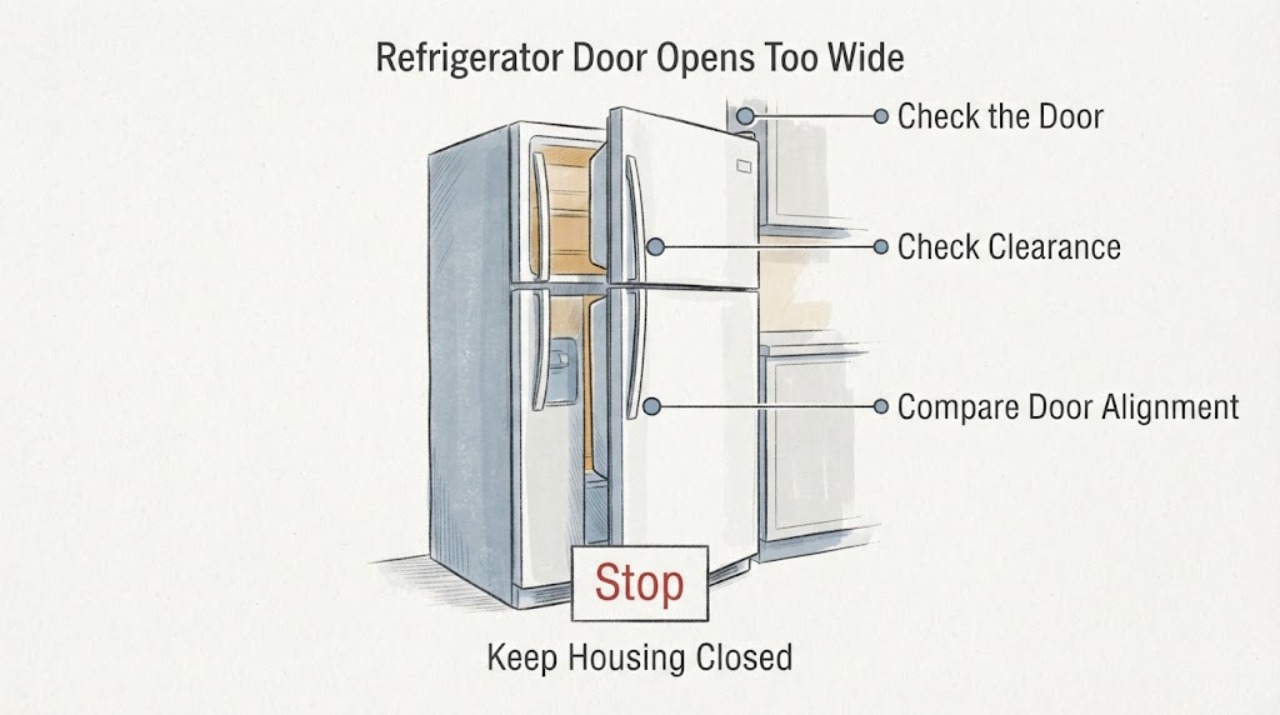
An Electrolux refrigerator door that opens too wide usually needs its door type, stop/hinge relationship and surrounding clearance identified before any adjustment. Electrolux says adjacent walls or cabinets may need 3–4 inches of extra width depending on the model so doors can open fully, and its door-alignment guidance says the door stop should contact the lower hinge without the door contacting the upper hinge through its full travel. Do not bend a hinge, remove a stop, reverse the swing or order a part from the symptom alone. Record the refrigerator format and model, check for an obstruction or damaged hinge/stop from the outside, and use the matching installation or Use & Care guide. If the door hits cabinetry, has no effective stop, sags, or cannot be aligned without removing hardware, stop forcing it and arrange Electrolux service or an installer inspection.
Work through in order
Diagnostic checks
Use only checks that match the exact appliance or system and its official guide.
-
Check 1
With the refrigerator stationary, open the affected door slowly and identify the format—top-freezer, side-by-side, French door or four-door—and the first point of contact or the point where the door keeps traveling: cabinet/wall, upper hinge, lower hinge/stop, gasket, shelf or no visible contact.
Expected result: The door hits the surrounding cabinet/wall, contacts a hinge area, catches an obstruction/gasket, or reaches a wide angle with no visible stop contact.
Next step: Keep the door movement gentle, record the contact point and continue to the matching clearance or stop observation. Do not force the door past the contact or remove hardware based on appearance.
Why this matters
Why: The observation separates installation clearance, obstruction/seal and hinge-stop branches. Electrolux publishes different guidance for different refrigerator formats, so a wide angle alone does not identify a failed hinge or a missing part.
-
Check 2
Measure the free width beside the refrigerator on the hinge and opening sides, and note any wall, cabinet, trim or handle contact while the door is moved through its normal travel.
Expected result: The cabinet or wall contacts the door/handle before the intended open position, or there is the model-dependent clearance described in the installation guide.
Next step: Compare the measurement with the exact installation guide and have the installer assess any required repositioning. Do not cut cabinetry, move the refrigerator under load, or add a universal stop without model instructions.
Why this matters
Why: Electrolux says adjacent walls or cabinets may need 3–4 inches of extra width depending on model for full door opening. A clearance shortage is an installation constraint, not proof of a bad door stop.
-
Check 3
From the outside, watch the lower hinge/stop and upper hinge as the door moves from fully closed toward fully open; do not remove a set screw or turn an adjustment screw unless the exact Electrolux guide identifies that procedure for the model.
Expected result: The door stop contacts the lower hinge and the door clears the upper hinge, or the stop does not contact, the door touches the upper hinge, the hinge is visibly bent, or the door is sagging.
Next step: If the stop/hinge relationship is wrong or hardware looks damaged, stop forcing the door and use the model guide or qualified service. If it is correct, continue to the obstruction and seal check rather than changing the hinge.
Why this matters
Why: Electrolux's alignment check expects stop-to-lower-hinge contact and no upper-hinge contact through full movement. A failed visual relationship is evidence for an alignment/hinge service branch, not a reason to bend or replace a part generically.
-
Check 4
Inspect the shelves, door bins, food packages, gasket and frame for an obstruction; clean the gasket and remove only items that are visibly blocking the door, without pulling or reshaping the seal.
Expected result: An item blocks the door, the gasket is dirty or displaced, or the door path is clear but the door still opens too far or will not close properly.
Next step: Correct the visible obstruction or clean the gasket, then close the door gently and re-observe the path. If the door still has excessive travel, catches, sags or fails to seal, arrange service/installer inspection.
Why this matters
Why: Electrolux says door obstructions and a dirty gasket can prevent complete closing. Clearing those conditions can solve a closing symptom, but it does not establish that a wide-opening hinge or stop is sound.
-
Check 5
Record the model number and serial information before considering door-swing reversal, leveling or hinge adjustment; Electrolux places refrigerator model labels in different locations by format and points top-freezer owners to the installation guide for swing changes.
Expected result: The model and refrigerator format are confirmed, or the model cannot be read and the door configuration is uncertain.
Next step: Use only the matching installation/Use & Care guide. If the model or hinge configuration remains uncertain, stop at external observation and request an installer or Electrolux service assessment.
Why this matters
Why: Electrolux's published instructions are model/format dependent. A top-freezer reversal option does not prove that a French-door or side-by-side unit has the same stop or adjustment arrangement.
-
Check 6
Arrange qualified service or an installer inspection if the door hits the cabinet, lacks effective stop contact, has a bent/loose hinge, remains wide-opening after visible obstructions are cleared, or cannot be adjusted without removing hardware.
Expected result: The problem persists, the door cannot seal or align, the installation clearance is wrong, or hardware damage is visible.
Next step: Keep the door from being forced, protect the contents from temperature loss if it cannot close, and provide the model, format, contact point and clearance measurements to the installer/service provider. Do not order an unverified hinge, stop or gasket.
Why this matters
Why: Electrolux directs unresolved refrigerator door problems to service and does not provide one universal stop/hinge procedure for all refrigerator families.
Use your observations
Decision map
Find the observation that best matches what you see, then follow the next safe action.
-
PATH 01Next step
What you see
The door or handle contacts a wall, cabinet or trim before the position expected by the model's installation guide.
Do this next
Measure and compare the opening with the exact Electrolux installation guide, then have the installer assess repositioning. Do not force the door or cut/alter cabinetry from a generic measurement.
Why this path and its safety boundary
Why it matters: The primary issue is available installation clearance, not a proven failed hinge or door stop.
-
PATH 02Next step
What you see
The door stop does not contact the lower hinge, the door touches the upper hinge, or the door/hinge is visibly bent or sagging through its travel.
Do this next
Stop forcing the door and use the model-specific alignment procedure or qualified service; do not bend the hinge, remove the stop or substitute a part without fitment evidence.
Why this path and its safety boundary
Why it matters: The stop/hinge alignment is outside the relationship Electrolux describes for a correctly aligned door.
-
PATH 03Next step
What you see
A shelf, bin, food package or dirty gasket is the only visible obstruction and the hinge/stop path appears intact.
Do this next
Remove the obstruction or clean the gasket as Electrolux describes, then close the door gently. Escalate if the door still does not close or opens too far.
Why this path and its safety boundary
Why it matters: The door issue may be caused by an accessible obstruction or seal condition rather than excessive hinge travel.
-
PATH 04Next step
What you see
The door reaches a wide angle with no visible contact, or the model/door configuration is unknown.
Do this next
Read the model label and matching installation guide before changing the swing or adjusting hardware; if the configuration remains uncertain, request an installer/service assessment.
Why this path and its safety boundary
Why it matters: The public general guidance does not establish whether that travel is normal for this Electrolux family or whether a stop/hinge part is missing.
Helpful context
Understand the symptom
Define what too wide means
A door can open farther than expected because the refrigerator has no accessible stop for that model, the stop is not contacting the lower hinge, the door is contacting the upper hinge or cabinet, the cabinet is installed too close to a wall, or the hinge/door has been disturbed. Those are different decisions. Electrolux's published guidance covers several refrigerator formats, so the model and door configuration matter before any hardware is moved.
Use clearance and stop checks before adjustment
Start with an unobstructed, external observation: identify the cabinet/wall contact, watch the hinge and stop through the door's travel, and check whether the gasket and shelves are being caught. Electrolux's alignment article includes adjustment procedures for specific formats, but it also requires a final stop/hinge check; do not assume its tool sizes or set-screw steps apply to an unknown model.
Do not force the door or improvise a stop
A stop that is missing, a hinge that is bent, or a door that contacts a cabinet can affect sealing and alignment. Electrolux directs unresolved door issues to service and directs owners to the installation guide for swing changes. A generic spacer, bent hinge, glued limiter or guessed replacement part can create a new closing or sealing problem.
When checks do not resolve it
Need a professional?
Request Electrolux service or installer inspection when the door contacts cabinetry, the stop/hinge relationship is wrong, hardware is bent or loose, the gasket cannot seal, or the door remains too wide-opening after visible obstructions and model-specific clearance checks. Do not choose a hinge, stop, gasket or limiter from the symptom alone.
Common questions
FAQ
How much side clearance does an Electrolux refrigerator need for the door to open?
Electrolux says adjacent walls or cabinets may require 3–4 inches of extra width depending on the model. Use the exact installation guide because door format, handle and hinge arrangement change the required clearance.
Is an Electrolux refrigerator door supposed to have a stop?
Electrolux's alignment guidance tells owners to verify that the door stop contacts the lower hinge and that the door does not contact the upper hinge through its full movement for the formats covered by that article. A wide-opening door with no visible stop contact needs model-specific documentation or service.
Can I reverse the door swing to stop it opening too wide?
Some Electrolux top-freezer refrigerators can be set to open from either side, but Electrolux says the installation guide contains the swing-change instructions. Do not assume that option or procedure applies to a French-door or side-by-side model.
What information should I give service for a door that opens too far?
Provide the model and refrigerator format, the first contact point, side clearance, whether the stop touches the lower hinge, whether the door seals, and any visible hinge or gasket damage. Electrolux identifies the model-label location by refrigerator type, so record the label before arranging service.
Read the exact guide
Official sources
- Refrigerator Door IssuesElectrolux Owner Support · Official Electrolux refrigerator door guidance for accessible obstruction and gasket checks; unresolved cases are directed to service.
- Refrigerators - Are the doors on my Top-Freezer refrigerator reversible?Electrolux Owner Support · Official Electrolux guidance limited to the top-freezer question; it is not generalized to French-door or side-by-side models.
- Refrigerators - How to align doorsElectrolux Owner Support · Official Electrolux guidance for side-by-side, French-door and four-door refrigerators; exact model instructions still control.
- Where can I find my model and serial number?Electrolux Owner Support · Official Electrolux model-identification guidance used to obtain the exact installation/manual scope.
- Delivery and Installation Guide - RefrigeratorElectrolux Owner Support · Official Electrolux installation guidance; the 3–4 inch statement is explicitly model-dependent and is not treated as a universal measurement.
Community feedback
Share a repair observation
Share a plain-text repair observation. Accepted observations are published automatically; this page may take a moment to update.