
On this page
Start here
Quick answer
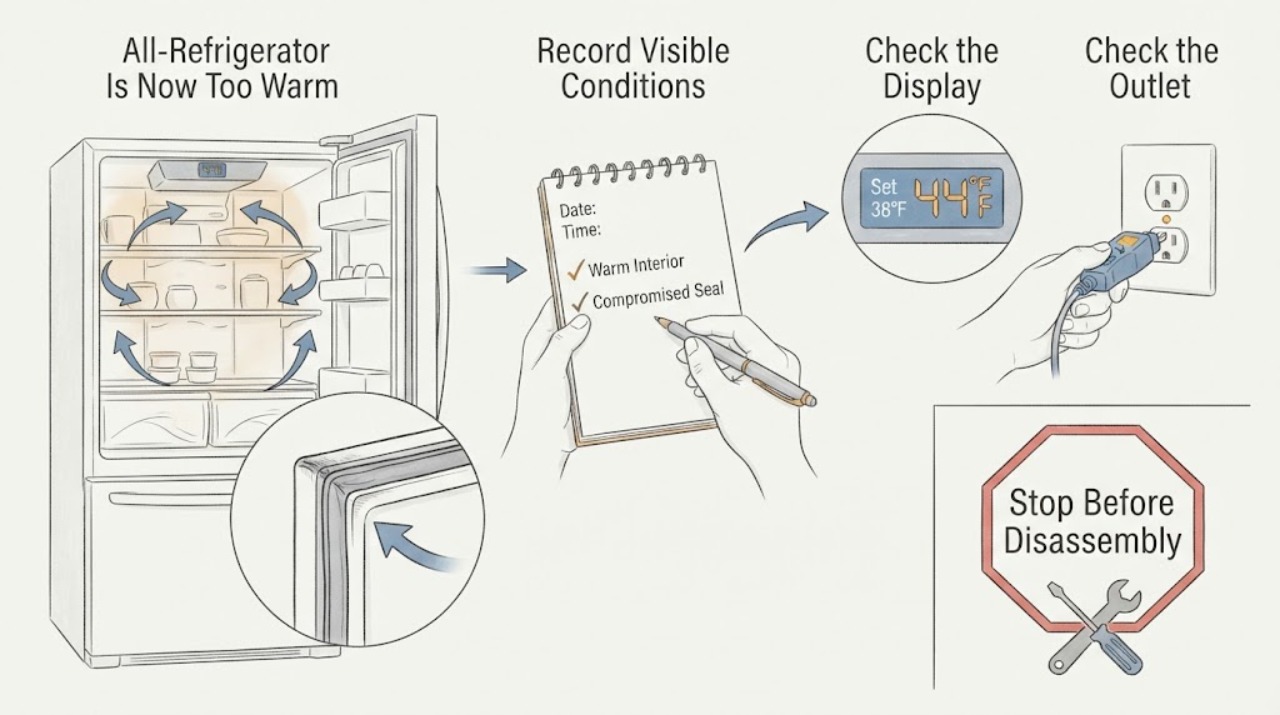
The EI32AR80QSF is an Electrolux built-in all-refrigerator, so use the refrigerator control and do not look for a freezer setting. Because it was too cold and is now too warm, verify the actual cabinet temperature with a separate thermometer, return the control to the model's documented refrigerator setting, keep vents and the door seal clear, and allow the cabinet to stabilize before judging the result. Electrolux's general refrigerator guidance uses 37°F as a suggested setting and 33–47°F as an acceptable range; if the measured temperature remains outside that range after the setting, airflow, door, power and installation checks, stop repeated adjustments and arrange service.
Work through in order
Diagnostic checks
Use only checks that match the exact appliance or system and its official guide.
-
Check 1
Place a separate refrigerator thermometer in the cabinet, away from the door and away from a cold-air outlet, and record the reading after the door has stayed closed for a meaningful stabilization period. Note whether the reading is within Electrolux's general refrigerator range of 33–47°F, above it, or below it.
Expected result: The measured temperature is within 33–47°F, remains above 47°F, or is still below 33°F while food is freezing.
Next step: If the cabinet is in range, move food away from vents and monitor. If it remains above range or below range after the control and external checks, stop repeated adjustment and arrange service with the measured readings and timeline.
Why this matters
Why: A thermometer separates a cabinet-wide temperature problem from a warm or frozen item caused by placement. Electrolux lists 37°F as the suggested refrigerator setting and 33–47°F as the acceptable refrigerator range; the measurement is more useful than the feel of one item.
-
Check 2
Confirm the refrigerator control is set to the model-documented refrigerator target, then make only one small adjustment toward warmer when the measured cabinet temperature is below range. Do not search for or use a freezer setting on this all-refrigerator model, and do not keep changing the setting before stabilization.
Expected result: The control returns to its documented target and the cabinet moves into range, or the temperature remains too warm or too cold after the stabilization interval.
Next step: Keep the setting that produces a measured in-range cabinet temperature. If it cannot hold the range, document the setting and readings and request model-specific service rather than trying internal controls.
Why this matters
Why: A setpoint change can correct an adjustment-related temperature problem, but it does not prove that the control or cooling system is healthy. Electrolux's general guidance treats the refrigerator setting separately from the food's subjective temperature.
-
Check 3
Inspect the interior from the front for packages pressed against air vents or a heavily loaded shelf blocking circulation. Move items clear of the vents without removing panels, and note whether the cold or frozen spots are concentrated next to an outlet.
Expected result: Cold or frozen items are directly against a vent, or the cabinet has no obvious blockage but remains uniformly warm.
Next step: Rearrange the load and recheck the thermometer after stabilization. If the cabinet remains out of range, continue to the door and installation checks and then service; do not remove an interior cover to inspect a fan or evaporator.
Why this matters
Why: Electrolux warns that food against vents can disrupt airflow and freeze, while a uniformly warm cabinet after the blockage is removed is not explained by that placement alone.
-
Check 4
Close the door slowly and check for a package, shelf or drawer preventing full closure. Inspect the gasket all the way around for a visible gap or dirt; where the gasket is dry and intact, use Electrolux's dollar-bill style resistance check without pulling the gasket out of its channel.
Expected result: The door does not close evenly, the gasket has a gap or will not grip the paper, or the door and gasket appear to seal normally.
Next step: Remove only the external obstruction and clean the gasket with warm soapy water as directed. If the gasket or alignment remains defective, request service; if the seal is good and the measured temperature remains out of range, proceed to service rather than forcing an adjustment.
Why this matters
Why: A door that leaks room air can warm the cabinet and create localized frost or temperature swings. A good external seal makes a persistent cabinet-wide temperature problem less likely to be a simple door obstruction, but it does not identify a particular internal part.
-
Check 5
Check the external installation conditions: the unit should have stable power, should not be exposed to direct heat or sunlight, and should not be installed below 55°F or above 110°F. Do not pull the built-in cabinet out or remove covers just to inspect the rear.
Expected result: The room or cabinet is outside the stated ambient limits, the unit is beside a heat source, power is interrupted, or the installation is within the documented conditions.
Next step: Correct a safe external heat or power condition and allow the cabinet to stabilize. If the installation is suitable and measured temperature is still out of range, keep the appliance closed and arrange qualified service; do not adjust refrigerant or open the sealed system.
Why this matters
Why: Electrolux says ambient conditions and installation location affect operation. A suitable installation with a stable power supply does not rule in a compressor or sealed-system failure, but it removes common external causes from the next service discussion.
Use your observations
Decision map
Find the observation that best matches what you see, then follow the next safe action.
-
PATH 01Next step
What you see
The thermometer shows 33–47°F, but one item near a vent is frozen or another item near the door feels warm.
Do this next
Rearrange food away from vents and the door, close the door fully, and monitor the independent thermometer before requesting a component diagnosis.
Why this path and its safety boundary
Why it matters: The cabinet average is within Electrolux's general refrigerator range, so placement and airflow can explain the item difference more plausibly than a proven cabinet-wide cooling failure.
-
PATH 02Next step
What you see
The measured cabinet temperature stays above 47°F after the documented setting, clear vents, good door seal, suitable ambient conditions and stabilization.
Do this next
Keep perishable food in safe cold storage, keep the refrigerator closed, and contact Electrolux or a qualified appliance technician with the model, readings and sequence from too cold to too warm. Do not open panels or add refrigerant.
Why this path and its safety boundary
Why it matters: The common external checks did not restore the refrigerator range. The result supports a service evaluation, but it does not identify a compressor, fan, sensor or sealed-system part from user observations alone.
-
PATH 03Next step
What you see
The cabinet remains below 33°F or repeatedly freezes food after the setting is returned to target, even though vents and the door seal are clear.
Do this next
Stop chasing the setpoint, protect food from freezing, and request service for unstable temperature control; do not bypass a control or transfer a freezer procedure to this all-refrigerator.
Why this path and its safety boundary
Why it matters: The problem is still a temperature-control or airflow symptom, not proof that a particular control or sensor should be replaced. Electrolux's too-cold guidance calls for service when the external checks do not resolve it.
-
PATH 04Next step
What you see
There is burning odor, arcing, a hot or damaged plug/receptacle, repeated breaker tripping, refrigerant/oil evidence, or a need to remove panels to continue.
Do this next
Stop using the appliance, isolate power only if that can be done without touching a wet or damaged connection, keep food in safe cold storage, and arrange qualified service. Do not perform live tests, bypass controls or open the sealed system.
Why this path and its safety boundary
Why it matters: The condition is outside safe external troubleshooting and may involve electrical or sealed-system hazards.
Helpful context
Understand the symptom
This model identity matters: Electrolux's product specification calls the EI32AR80QS line a built-in all-refrigerator, and its support page describes the same line as an all refrigerator with IQ-Touch controls. The EI32AR80QSF should therefore be assessed as one refrigerated cabinet; there is no freezer compartment or freezer control to use as a comparison.
A change from over-cooling to under-cooling is a reason to measure rather than keep moving the control. A warm spot in food can come from placement or blocked airflow, while a cabinet-wide temperature that remains high after stabilization needs service evaluation. The checks below stay outside the sealed system and do not assume that a compressor, fan or control has failed.
When checks do not resolve it
Need a professional?
Call Electrolux support or a qualified appliance technician when the EI32AR80QSF cannot hold the documented refrigerator range after the external checks and stabilization, when the door or gasket will not seal, when temperature repeatedly swings from too cold to too warm, or when any electrical, frost, refrigerant or sealed-system concern would require opening the cabinet. Give the technician the exact model, independent temperature readings, control setting, ambient conditions and the sequence of symptoms.
Common questions
FAQ
Is the Electrolux EI32AR80QSF a refrigerator/freezer combination?
The official EI32AR80QS product specification and support page identify this line as a built-in all-refrigerator with IQ-Touch controls. Treat the EI32AR80QSF as one refrigerated cabinet and do not apply a freezer-setting procedure.
What temperature should I use while checking whether it is cooling enough?
Electrolux's general refrigerator guidance lists 37°F as the suggested refrigerator setting and 33–47°F as an acceptable range. Verify the actual cabinet temperature with a separate thermometer and allow the appliance to stabilize before deciding that a change fixed the problem.
Should I replace a compressor or thermostat because it was too cold and then became too warm?
No component can be identified from that sequence alone. First document the measured temperature, control setting, airflow, door seal, power and installation conditions. If the cabinet remains out of range after those checks, use Electrolux support or qualified service instead of guessing at a part.
Read the exact guide
Official sources
- Refrigerators - Too ColdElectrolux · Use the refrigerator portions for the EI32AR80QSF all-refrigerator; omit the article's freezer-specific branches because this exact model is an all-refrigerator.
- Refrigerator Runs Too MuchElectrolux · General Electrolux refrigerator operating guidance used only for stabilization, ambient conditions, door opening and setpoint context; it is not used to diagnose a specific EI32AR80QSF component.
- EI32AR80Q Built-In All Refrigerator Product SpecificationsElectrolux · The opened specification identifies model family EI32AR80QS as BUILT-IN ALL REFRIGERATOR; use the identity and installation statements for the EI32AR80QSF family, not for a refrigerator/freezer variant.
- All Refrigerator with IQ-Touch™ Controls EI32AR80QS Model SupportElectrolux · Opened Electrolux model support page labels EI32AR80QS an All Refrigerator with IQ-Touch Controls and provides model support/service routing; it does not establish an internal repair procedure.
- Refrigerators - Not CoolingElectrolux · Electrolux support article applies to refrigerators; use its external refrigerator checks and service boundary for the EI32AR80QSF, while treating the exact model's all-refrigerator identity from the model sources as controlling.
Community feedback
Share a repair observation
Share a plain-text repair observation. Accepted observations are published automatically; this page may take a moment to update.