
On this page
Start here
Quick answer
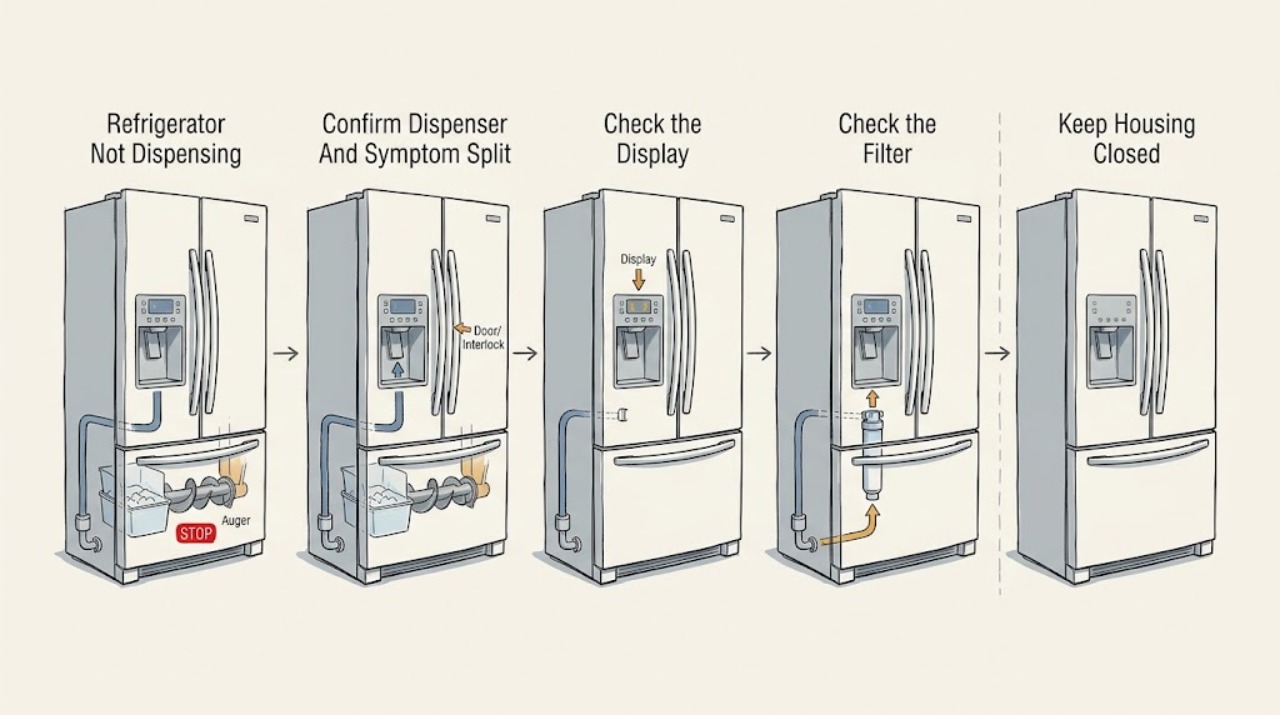
First confirm that the Electrolux refrigerator actually has the dispenser feature and identify the full model. Separate the symptom into water not dispensing, ice not dispensing, or both. If the display is locked, Electrolux says the refrigerator will not dispense water or ice; unlock it only with the exact model control. Confirm the door is fully closed and the selected dispenser mode is the one you intend to use. For a water problem, check that the water supply is connected, the filter is installed securely and is not frozen or cracked, and that a recently installed filter or water line has been primed and purged as the model instructions require. A slow or absent flow with an old filter makes the filter path more likely, but does not prove the filter is the only fault. For an ice-only problem, inspect the accessible chute and ice bucket for visible frost or a jam; Electrolux's auger guidance uses model-specific crushed/cube selection and a controlled paddle sequence, so do not force or reach into the auger. If both water and ice fail, the display remains locked or dead, the water supply is absent, the filter path is normal but flow does not return, or the dispenser motor, valve, wiring, or door sensing would need access, stop and arrange qualified Electrolux service. Do not bypass a door or dispenser interlock, disconnect pressurized lines, probe live wiring, or order a valve, motor, auger, or filter without the exact model.
Before you begin
Safety first
- The user may identify the model, verify a normal door-closed and unlocked state, inspect a filter and accessible chute/bucket, and follow the exact model's filter, purge, or auger instructions. Qualified personnel must handle water-line disconnection, internal valve/tubing, dispenser housing, door sensing, auger motor, controls, wiring, leaks near electrics, and energized testing.
Work through in order
Diagnostic checks
Use only checks that match the exact appliance or system and its official guide.
-
Check 1
Read the rating label and record the full Electrolux model. Confirm that the refrigerator has a water dispenser, ice dispenser, or both, then separate the complaint into water only, ice only, both, or no response from the display/paddle. Check that the dispenser is being used with the door fully closed as the model requires.
Expected result: The model has a dispenser and only water, only ice, or both fail; the display is unresponsive; the door is open or not closing fully; or the model has no dispenser feature.
Next step: Continue only for a confirmed dispenser-equipped model. If the door does not close or the display is unresponsive, correct only an obvious external obstruction and use the exact model support route; if there is no dispenser, stop and use the appropriate refrigerator page.
Stop if: Do not bypass the door sensor, hold an interlock closed, or test the dispenser with the door or covers defeated.
Why this matters
Why: Water-only, ice-only, and combined failures point to different paths. A locked or nonresponsive control and an open door can prevent dispensing without proving a filter or valve fault. A model without a dispenser is outside this article's evidence.
-
Check 2
Observe the control panel and selected dispenser mode without opening the appliance. If the display is locked, use only the exact model's documented unlock control; Electrolux's general water-dispenser page describes holding the lock key for 3 seconds, but another model may use a different interface. Select the intended water, cube, or crushed-ice mode only when the manual supports it.
Expected result: The display is locked and dispensing returns after the documented unlock; the mode is wrong; the display is active but the dispenser remains silent; or the display is dark or shows an unexplained fault.
Next step: Use the model-matched control instructions and make one normal dispensing observation. If the panel stays dark, shows a fault, or does not respond after the documented unlock, stop and arrange service rather than opening the panel.
Stop if: Do not repeatedly press undocumented combinations, bridge the lock, or bypass the door/interlock circuit.
Why this matters
Why: Electrolux says a locked display prevents water or ice dispensing, so recovery after a model-documented unlock points to control state rather than a failed filter. A responsive panel with no output shifts attention to the water/filter or ice-bucket path. A dark or faulting panel may indicate a wider power or control issue.
-
Check 3
For a water-only or combined failure, inspect only the accessible shutoff/supply indication and the filter housing. Confirm the water supply is connected, the filter is installed securely, and the filter is not visibly cracked or frozen. If a filter was recently installed, follow the exact model instructions to prime and purge the water system; do not loosen a water line.
Expected result: The supply is absent or newly installed, the filter is loose, cracked, frozen, clogged, or overdue, the filter path is normal, or water flow is slow rather than absent.
Next step: Restore only an obvious supply state or reseat/replace the filter when the exact model supports it and the filter is confirmed compatible. Follow the model's purge instructions for a new filter. If flow remains absent or the filter housing leaks, stop and arrange service.
Stop if: Do not disconnect tubing, force a filter, use a cracked filter, run the dispenser with water leaking near electrics, or order a filter by brand alone.
Why this matters
Why: Electrolux identifies missing supply, incorrect filter installation, filter damage/freezing, and an overdue or clogged filter as possible reasons for slow or absent dispenser water. A recently replaced filter can also need priming/purging. A normal filter and supply do not rule out an internal valve, tubing, control, or door-sensing fault.
-
Check 4
For an ice-only failure, inspect the accessible ice chute, bucket, and visible frost or clumped ice without putting fingers or tools into the auger. If the exact model's Electrolux instructions match the auger procedure, use the documented crushed/cube selection and bucket removal sequence; otherwise leave the bucket and motor path in place.
Expected result: Ice or frost visibly blocks the chute, the bucket is not seated, cubes are clumped around the auger, the bucket/auger path is clear, or the motor is silent/only hums with no ice movement.
Next step: Follow only the exact model's safe bucket/auger instructions and stop if the bucket will not release, the ice is embedded, or the motor path remains abnormal. Arrange service for a clear path with no dispensing or for a damaged chute.
Stop if: Do not reach into the auger, use a knife or sharp tool, force the bucket, pour hot water into the chute, or run the dispenser with a removed guard or door interlock.
Why this matters
Why: Electrolux identifies ice around the auger motor shaft and an improperly seated or frozen bucket path as an ice-dispensing issue that can sometimes be addressed by the model's documented procedure. A clear bucket with no movement makes the motor, drive, control, or wiring more likely, but sound alone cannot select a part.
-
Check 5
After the model-specific lock, door, water/filter, and accessible ice checks, document whether water, ice, or both recovered, the display state, filter age and fit, supply status, bucket/chute condition, and any leak or unusual sound. Do not open the dispenser housing, rear water valve area, or control panel.
Expected result: One function recovers after a documented external correction; water and ice remain unavailable; the filter/supply path is normal; the auger is silent or only humming; or there is a leak, damaged tubing, wet electrical area, or recurring fault.
Next step: Monitor only a dry, normally operating dispenser. For persistent no-dispense, a leak, wet electrical area, damaged line, or abnormal motor/valve behavior, stop using the affected function and arrange qualified Electrolux service with the model and record.
Stop if: Do not repeatedly actuate the paddle, probe live wiring, bypass a door/interlock, disconnect a water line, or order a valve, motor, auger, or control from the symptom alone.
Why this matters
Why: Recovery after a lock, filter, purge, or visible ice correction supports that condition as the immediate cause. Persistent combined failure makes a shared supply, control, door-sensing, or internal valve path more likely; persistent ice-only failure makes the auger drive or ice-control path more likely. Neither pattern proves a replacement part.
Use your observations
Decision map
Find the observation that best matches what you see, then follow the next safe action.
-
PATH 01Safety boundary
What you see
The Electrolux refrigerator has no water or ice dispenser, or the model cannot be confirmed as a dispenser-equipped design.
Do this next
Stop this path and use the exact model's support material for the actual symptom, such as ice production, cooling, or a water leak.
Why this path and its safety boundary
Why it matters: The official evidence used here concerns dispenser controls, water filters, water supply, and ice-bucket/auger paths. It does not establish a diagnosis for a refrigerator without that feature.
Safety stop: Do not add an external dispenser, open the cabinet, or infer a dispenser valve fault from a refrigerator that was not designed with one.
-
PATH 02Safety boundary
What you see
The panel is locked, the door is not fully closed, or the selected mode does not match the intended water/cube/crushed-ice function, and dispensing recovers after the model-documented control or door correction.
Do this next
Use the documented control state and make one normal dispense observation. Arrange service if the lock returns without user input or the door/display remains abnormal.
Why this path and its safety boundary
Why it matters: A control state or door/interlock condition is more likely than a failed filter or motor; Electrolux says a locked display prevents water and ice dispensing.
Safety stop: Do not defeat the lock or door sensor, hold the paddle continuously, or use undocumented reset combinations.
-
PATH 03Safety boundary
What you see
Water is unavailable or slow, the ice maker may also be affected, and the supply is absent/new or the filter is loose, cracked, frozen, clogged, overdue, or not primed after replacement.
Do this next
Restore only the model-documented supply/filter state, prime and purge a new filter as instructed, and stop for leakage or a filter that will not seat. If flow remains absent, arrange service.
Why this path and its safety boundary
Why it matters: The water-supply or filter path is more likely than an ice-auger fault. Electrolux identifies those filter and supply conditions as causes of slow or absent dispenser water and ice.
Safety stop: Do not disconnect a water line, use a damaged filter, or keep dispensing when water is reaching electrical parts.
-
PATH 04Safety boundary
What you see
Water dispenses normally but ice does not, and visible frost, clumped cubes, an unseated bucket, or a chute obstruction is present; the exact model supports an auger procedure.
Do this next
Follow only the exact model's ice-bucket/auger instructions. Stop and arrange service if ice is embedded, the bucket will not seat, or the path remains clear but the auger does not move.
Why this path and its safety boundary
Why it matters: The ice bucket, chute, or auger path is more likely than the water filter. Electrolux's auger guidance addresses ice around the auger shaft with a model-specific crushed/cube and paddle sequence.
Safety stop: Do not reach into or force the auger, use sharp tools or hot water, or defeat a dispenser guard/interlock.
-
PATH 05Safety boundary
What you see
Both water and ice fail with a responsive, unlocked panel and normal filter/supply checks, or a clear ice path has no auger movement; the problem persists or a leak/electrical warning appears.
Do this next
Stop using the affected dispenser function and arrange qualified Electrolux service. Isolate power and water only from a safe position for a leak or wet electrical area, and provide the model and recorded checks.
Why this path and its safety boundary
Why it matters: A shared water supply, door sensing, control, internal valve, tubing, auger motor, or wiring fault is possible. User-visible symptoms cannot safely identify which internal part failed.
Safety stop: Do not open the rear valve area, dispenser housing, control panel, or wiring, and do not order an internal part from a no-flow or humming symptom alone.
Helpful context
Understand the symptom
Limit the diagnosis to a refrigerator with a dispenser
The assigned topic is not a generic refrigerator water leak or an ice-maker production problem. Use this path only when the exact Electrolux model has a water or ice dispenser. Record whether water, ice, or both fail, whether the display responds, and whether the door is fully closed. Electrolux's dispenser guidance covers several refrigerator layouts, but controls and service procedures remain model-specific.
Treat the lock and filter as control-path checks, not proof of a failed part
A locked refrigerator display can disable both water and ice dispensing. A correctly seated, unfrozen, undamaged filter and a properly primed new water system are separate checks from the dispenser paddle or ice auger. An old or clogged filter can make water slow or stop, but a normal filter does not prove that an internal valve, tubing section, door switch, or control is healthy.
Keep the ice-bucket path separate from the water path
When water works but ice does not, inspect the accessible chute and bucket rather than replacing a water filter. Electrolux's auger guidance uses a specific crushed/cube selection and bucket procedure to address ice around the auger shaft, but it is not a universal reset for every Electrolux design. If both functions fail, or if the bucket, chute, valve, or motor would require internal access, stop at the model information and arrange service.
Use model-matched service for persistent dispensing faults
Electrolux directs unresolved water-dispenser problems to service and recommends using the exact owner manual. A dispenser valve, tubing, paddle switch, door-sensing path, auger motor, wiring, and control board are not identified safely by a no-flow symptom. Record the model, whether water or ice is affected, filter history, display-lock state, door state, and any visible frost or jam for the technician.
Safety boundary
Stop conditions
- Stop dispensing and arrange service for water near electrical parts, an active leak, damaged tubing, a cracked filter, smoke, burning odor, sparking, abnormal heat, or a damaged cord; isolate power or water only from a safe position if possible.
- Do not bypass a door, display-lock, paddle, chute, or other dispenser interlock, and do not hold the paddle continuously to force operation.
- Do not disconnect water lines, open the rear valve or dispenser housing, probe live wiring, or perform energized tests.
- Do not reach into the ice auger or chute, use sharp tools or hot water to clear ice, or force an ice bucket or filter into place.
- Do not order a filter, valve, auger, motor, tubing, or control from the Electrolux name or symptom alone; confirm the exact model and obtain qualified diagnosis.
Only after diagnosis
Potential parts
- Electrolux refrigerator water filter
Consider only when the exact model has a dispenser, the filter is confirmed overdue, clogged, frozen, cracked, or unable to seat, and the model instructions support replacement after the supply and lock checks.
Confirm the full model and manufacturer fit information before ordering; a slow or absent dispenser alone does not prove filter failure. - Electrolux ice auger or dispenser drive
Consider only after qualified diagnosis confirms a clear, correctly seated ice bucket and chute but no auger movement, with the exact model's drive arrangement identified.
Ice buckets, augers, motors, and drives vary by refrigerator layout and model; do not select a part from a humming or silent dispenser alone.
When checks do not resolve it
Need a professional?
Arrange qualified Electrolux service when the exact model's lock, door, filter, water-supply, priming, and accessible ice-bucket checks do not restore dispensing; when both water and ice fail; when the display or door sensing is abnormal; when the auger is silent or only humming with a clear path; or when a leak, damaged line, wet electrical area, or internal valve, motor, control, tubing, or wiring access is involved.
Safety scope: The user may identify the model, verify a normal door-closed and unlocked state, inspect a filter and accessible chute/bucket, and follow the exact model's filter, purge, or auger instructions. Qualified personnel must handle water-line disconnection, internal valve/tubing, dispenser housing, door sensing, auger motor, controls, wiring, leaks near electrics, and energized testing.
Common questions
FAQ
Why is my Electrolux refrigerator not dispensing water or ice?
First confirm the model has a dispenser and separate water from ice. Check the door and display-lock state, then check water supply and filter fit/condition. If water and ice both fail with those checks normal, a shared valve, control, door-sensing, tubing, or wiring problem needs service.
Can a locked Electrolux refrigerator display stop the dispenser?
Yes. Electrolux says a locked display prevents water or ice dispensing. Use only the exact model's documented unlock control; do not bypass the lock or door interlock.
What should I check when the Electrolux water dispenser is slow or stops?
Check that the water supply is present, the filter is securely installed and not cracked or frozen, and that a recently installed filter has been primed and purged. Electrolux identifies a clogged or overdue filter as a possible reason for slow or absent flow. Persistent no-flow needs service.
What can stop an Electrolux refrigerator from dispensing ice?
If water works but ice does not, inspect the accessible chute and ice bucket for frost, clumped cubes, or an unseated bucket. Electrolux provides an auger procedure using CRUSHED and CUBE modes for compatible designs. Do not reach into or force the auger, and use service if the path is clear but the drive does not move.
When should I call for Electrolux refrigerator dispenser service?
Call when the model-specific lock, door, filter, supply, priming, and accessible ice checks do not restore water or ice; when both functions fail; when the display or door sensing is abnormal; when the auger is silent or only humming; or when there is a leak, damaged water line, wet electrical area, or internal valve, motor, control, tubing, or wiring issue.
Read the exact guide
Official sources
- Refrigerators - Auger FixElectrolux · Applies to refrigerator ice-dispenser designs with a compatible ice bucket/auger path; supports the crushed/cube selection and controlled bucket/auger procedure but is not universal to every model.
- What should I do if the dispenser on my refrigerator is not dispensing water?Electrolux · Applies to Electrolux refrigerators, including French-door, side-by-side, and top-freezer layouts with dispenser systems; supports lock state, filter positioning, and clogged/overdue filter checks.
- Refrigerators - No WaterElectrolux · Supports the water supply, display-lock, filter fit/damage/freezing, filter replacement, priming/purging, and service branches for dispenser-equipped refrigerators; exact model controls the local procedure.
Community feedback
Share a repair observation
Share a plain-text repair observation. Accepted observations are published automatically; this page may take a moment to update.