
On this page
Start here
Quick answer
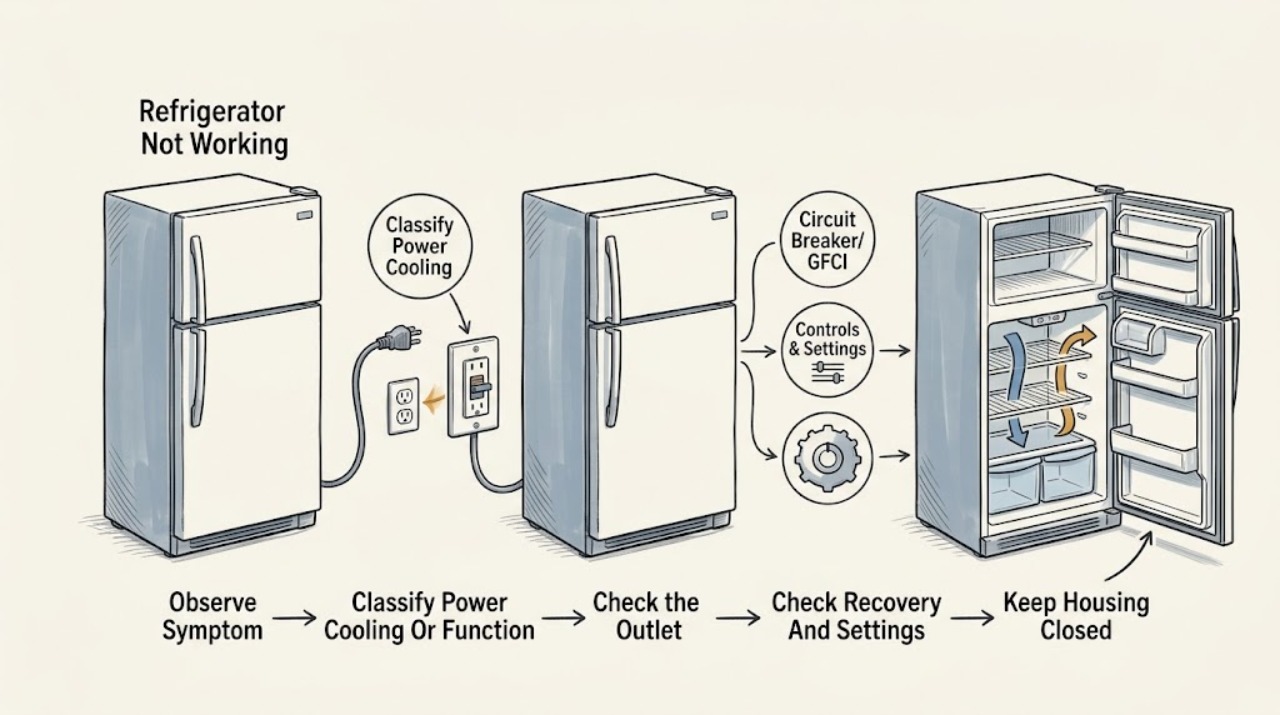
First separate an Electrolux refrigerator with no display or interior light from one that has power but is warm, and from one whose controls or dispenser are the only functions not working. For a completely dark unit, make sure the plug is secure, check the dedicated outlet and breaker/fuse from a dry position, and do not keep resetting a circuit that trips. For a powered but warm refrigerator, confirm the temperature setting and operating mode in the exact Use & Care guide, clear food from the vents, make sure the doors close, and inspect the gasket for a gap; a newly installed or recently power-interrupted unit may need the model's stabilization period. Electrolux says a non-sealing door causes unstable temperature and blocked vents prevent proper cooling. Do not pull out a built-in refrigerator, remove panels, probe live wiring, or work on the compressor, refrigerant circuit, fan, defrost heater, control, or sealed system. Stop for smoke, sparks, burning/electrical odor, a hot or damaged cord or outlet, water near electrical parts, a leaking or bulging cabinet, or a breaker that trips again. If power is stable and the refrigerator remains nonfunctional or warm after the visible checks, arrange qualified appliance service.
Before you begin
Safety first
- The user may check power indications, a secure plug and safe outlet/circuit state, model settings, recovery time, accessible vents, door closure, and gasket condition. Moving built-in units, removing panels, working on fans, compressors, defrost components, sensors, controls, wiring, water lines, or sealed refrigeration circuits is for qualified personnel.
Work through in order
Diagnostic checks
Use only checks that match the exact appliance or system and its official guide.
-
Check 1
From a dry position, note whether the control panel lights, the interior light turns on, the refrigerator and freezer are cold, and which function is affected. Record whether the unit is completely dark, powered but warm, running continuously, recently installed or moved, or affected only at the dispenser/ice-maker/control. Look for smoke, sparks, burning/electrical odor, a hot or damaged cord/outlet, water near electrical parts, or a cabinet leak.
Expected result: No display and no interior light; display/lights on but one or both compartments are warm; only a dispenser, ice maker, or control function is affected; or a safety hazard is present.
Next step: For a hazard, stop using the affected functions and isolate power or water only from a dry safe position without touching damaged parts. Otherwise take the no-power or powered-but-warm path and do not repeatedly reset the appliance.
Stop if: Stop for smoke, sparks, burning/electrical odor, a hot/damaged cord or outlet, water near electrical parts, a leaking/bulging cabinet, exposed wiring, or a breaker that trips again.
Why this matters
Why: No lights make the household supply, outlet, breaker/fuse, or appliance power path more likely. Lights with warm compartments point toward settings, recovery time, airflow, door sealing, or a cooling-system fault. A single-function symptom may have a separate control, lock, water, or ice path. A hazard overrides further checks.
-
Check 2
For a completely dark refrigerator, confirm the plug is seated and inspect the dedicated outlet, breaker, or fuse from a dry position. If safe, test the outlet with another appliance without moving the refrigerator. Reset a tripped breaker only once; do not use an extension cord, bypass grounding, or access internal wiring.
Expected result: The outlet is dead, the breaker/fuse is tripped or blown, the outlet is warm/loose/damaged, the circuit trips again, or the refrigerator remains dark on a stable supply.
Next step: Have a qualified electrician address a damaged outlet, recurring trip, or wiring concern. If the supply is stable but the refrigerator remains dark, arrange qualified appliance service and do not remove panels.
Stop if: Do not repeatedly reset a breaker, touch a wet/hot/loose outlet, replace a fuse with an incorrect type, pull out a built-in unit, or probe live wiring.
Why this matters
Why: A household supply or installation problem is more likely when the outlet is dead or the breaker is tripped. Electrolux specifies a dedicated properly grounded refrigerator outlet and says a recurring or unresolved no-power problem requires service. Power at the outlet with no refrigerator lights makes an appliance-side power or control fault more likely.
-
Check 3
For a powered but warm refrigerator, note whether it was newly installed, recently transported, or affected by a power outage. Use the exact model's Use & Care guide to verify that the refrigerator and freezer settings are active and appropriate and that no user-selected inactive or special mode is preventing normal operation. Keep the doors closed while the unit recovers.
Expected result: The unit is newly installed or recovering from an outage; a setting is off, unusually warm, or not confirmed; the controls are normal but the unit has had enough recovery time; or the display is unresponsive despite interior power.
Next step: Correct only a clearly documented setting and allow the model's stated stabilization time. If the refrigerator remains warm, the display is unresponsive, or food safety is at risk, arrange service; do not keep power-cycling to force recovery.
Stop if: Do not change hidden service settings, remove panels, move a built-in refrigerator, or keep perishable food in an appliance that has not returned to a safe temperature.
Why this matters
Why: Electrolux says a newly installed unit may need up to 24 hours for temperature to stabilize and that the exact recommended settings should be taken from the model guidance. A normal setting after the recovery period makes an airflow, door, fan, defrost, control, compressor, or sealed-system problem more likely.
-
Check 4
Without moving a built-in unit, inspect the visible interior vents and make sure containers are not pressed against them. Note whether the refrigerator is in an unusually cold location, has restricted clearance, or has recently been heavily loaded. Do not remove rear covers or reach near a fan, condenser, or wiring.
Expected result: An interior vent is blocked, the unit is in an unsuitable cold environment, the cabinet has restricted airflow, or visible airflow and location are normal but compartments remain warm.
Next step: Move only loose food away from vents and use the model's installation guidance for clearance and ambient conditions. If the unit is built in, do not pull it out; arrange service when normal airflow and location do not restore cooling.
Stop if: Do not remove condenser covers, touch moving/hot components, pull out a built-in refrigerator, or clean near energized parts.
Why this matters
Why: Electrolux states that blocked vents prevent airflow and that it does not recommend installation where ambient temperature drops below 55°F. A visible obstruction or unsuitable location can explain poor cooling; normal visible conditions make internal airflow, defrost, fan, compressor, sensor, or sealed-system faults more likely.
-
Check 5
Close each refrigerator and freezer door normally and check that no package, shelf, drawer, or ice buildup holds it open. Inspect the gasket around the accessible perimeter for dirt, tears, warping, detachment, or a visible gap. If the gasket is intact, use the manual-permitted clean-and-dry method; do not bend, heat, glue, or remove the seal.
Expected result: A door is obstructed or misaligned, the gasket is dirty or damaged, a bill slides out with little/no resistance at a test location, or the seal appears continuous but the temperature remains unstable.
Next step: Remove only a visible obstruction and clean the accessible gasket as the exact manual permits. Arrange service for a damaged gasket, door, hinge, alignment, or persistent temperature problem; do not force the door closed.
Stop if: Do not operate with a door that cannot close, a torn seal, a cracked liner, uncontrolled condensation/water, or a gasket that requires heating, gluing, or removal.
Why this matters
Why: Electrolux says a door that does not seal causes unstable temperature and recommends checking gasket resistance with a bill. A gap or damaged seal makes warm-air entry more likely; a good visible seal after proper closure makes settings, airflow, recovery, or internal cooling faults more likely.
-
Check 6
If power is stable, settings and recovery time are appropriate, vents are clear, doors seal, and the Electrolux refrigerator remains dark, unresponsive, warm, or limited to a persistent single-function failure, stop user-level testing. Record the model, control/interior-light status, refrigerator and freezer temperatures, settings, outage/installation history, door/gasket condition, airflow observations, sounds, leaks, odors, and any displayed alert.
Expected result: The refrigerator remains nonfunctional or warm, runs continuously without cooling, has abnormal fan/compressor behavior, shows a persistent alert, leaks, or has any electrical/water hazard.
Next step: Stop using affected functions and arrange qualified Electrolux/appliance service. Isolate power or water only from a dry safe position when necessary and provide the diagnostic record; do not restart repeatedly to test.
Stop if: Do not remove panels, probe live circuits, handle refrigerant, access the compressor or defrost heater, bypass controls, or perform energized tests.
Why this matters
Why: The issue has moved beyond outlet, setting, recovery, airflow, and door-seal checks. The remaining scope may include a fan, sensor, control, defrost system, compressor, start device, water/ice subsystem, or sealed refrigeration circuit, but the symptom cannot select a safe part.
Use your observations
Decision map
Find the observation that best matches what you see, then follow the next safe action.
-
PATH 01Next step
What you see
The Electrolux refrigerator has no control-panel indication and no interior light.
Do this next
Check the plug, outlet, and breaker/fuse once from a dry safe position. A dead or damaged outlet needs electrical attention; a stable outlet with a dark refrigerator needs appliance service.
Why this path and its safety boundary
Why it matters: The outlet, dedicated circuit, breaker/fuse, plug, appliance power input, or control path is more likely than a cooling-only fault.
-
PATH 02Next step
What you see
The display or interior light works, but the refrigerator or freezer remains warm.
Do this next
Confirm model settings, allow the documented stabilization period, clear vents, and verify door/gasket sealing. If temperatures do not recover, arrange service and protect perishable food.
Why this path and its safety boundary
Why it matters: Settings, post-installation or outage recovery, blocked vents, door sealing, ambient location, or an internal cooling fault are more likely than a total power failure.
-
PATH 03Next step
What you see
The unit cools inconsistently, has condensation or frost near a door, a gasket gap, a package blocking closure, or food pressed against vents.
Do this next
Remove only visible obstructions, clean the accessible gasket as directed, and confirm the door closes. Service is needed for a damaged seal, door, hinge, liner, or persistent temperature problem.
Why this path and its safety boundary
Why it matters: Warm-air entry or restricted internal airflow is more likely. Electrolux identifies non-sealing doors and blocked vents as causes of unstable or poor cooling.
-
PATH 04Next step
What you see
The refrigerator still lights and cools, but the dispenser, ice maker, display input, or one compartment is the only failed function.
Do this next
Record which functions still work and follow only the exact model's documented user controls. Do not remove a dispenser panel, disturb a water line, or open control wiring; persistent failure needs qualified service.
Why this path and its safety boundary
Why it matters: The failure may be in that function's control, lock, water/ice path, sensor, fan, or compartment-specific system rather than the refrigerator's main power. The exact model manual is required to interpret alerts and controls.
-
PATH 05Safety boundary
What you see
Power, settings, recovery time, airflow, and door sealing are normal, but the refrigerator remains dark, warm, unresponsive, leaking, unusually noisy/hot, or repeatedly trips power.
Do this next
Stop using the affected appliance function and arrange qualified Electrolux/appliance diagnosis. Provide the model and symptom record; do not select a part or restart to test.
Why this path and its safety boundary
Why it matters: This is beyond visible user checks and may involve the compressor, fan, defrost system, sensor, control, water path, or sealed refrigeration circuit. A repeated electrical or water hazard requires immediate stop-use handling.
Safety stop: Do not remove panels, handle refrigerant, touch wet electrics, bypass controls, or perform live tests.
Helpful context
Understand the symptom
Define “not working” before changing anything
A refrigerator with no display and no interior light has a different first path from a refrigerator that lights up but is warm. If only the ice maker, water dispenser, display, or one compartment is affected, the rest of the appliance may still have power and cooling. Note the exact symptom, any visible alert, recent outage or installation, interior temperature, compressor/fan sounds, and whether both doors close before attempting a reset.
Check power at the refrigerator and the home circuit
Electrolux recommends a dedicated, properly grounded outlet for its refrigerators. From a dry position, make sure the plug is seated and check the breaker or fuse after an outage. An outlet can be tested with another appliance only if doing so is safe and does not require moving a built-in refrigerator. Do not repeatedly reset a breaker, use an extension cord as a workaround, or touch a hot, wet, loose, or damaged outlet.
Allow for installation and temperature recovery
A newly installed refrigerator or one that has just been without power may need the stabilization period specified by its manual; Electrolux's cooling guidance notes that temperature can need up to 24 hours to stabilize. Keep doors closed while it recovers and protect food according to local food-safety guidance. If the unit remains dark, warm, or repeatedly alarms after the model's recovery period, do not keep cycling power as a substitute for diagnosis.
Check settings, airflow, doors, and gasket
Use the exact model's Use & Care guide to confirm the refrigerator and freezer settings and that the appliance is not in a user-selected inactive or special mode. Keep food from blocking interior vents, make sure the doors close without a package in the way, and inspect the gasket for dirt, tears, gaps, or detachment. Electrolux says blocked vents impair cooling and a non-sealing door causes unstable temperature. Clean only the accessible gasket surface with the method the manual permits; do not bend or replace the door yourself.
Escalate a powered refrigerator that stays warm
If the panel and interior lights work, settings and airflow are normal, both doors seal, and the refrigerator remains warm, the likely scope is no longer a simple user adjustment. A fan, condenser, defrost system, sensor, control, compressor, or sealed refrigeration fault cannot be selected safely from sound or frost pattern alone. Record the model, temperatures, settings, light status, door/gasket observations, recent outage or installation, and any leak, code, odor, or unusual sound for qualified service.
Safety boundary
Stop conditions
- Stop immediately for smoke, sparks, burning/electrical odor, a hot or damaged cord/outlet, water near electrical parts, a leaking or bulging cabinet, exposed wiring, or a breaker/fuse that trips again.
- Do not repeatedly reset a breaker, bypass grounding or controls, use an extension cord as a workaround, or touch a wet/hot/loose outlet.
- Do not pull out a built-in refrigerator, remove rear or control panels, touch a moving fan or hot compressor, probe live wiring, or perform energized tests.
- Do not handle refrigerant, open a sealed cooling circuit, access a defrost heater, or replace internal electrical or cooling parts from temperature or sound alone.
- Do not operate with a door that cannot close, a damaged gasket/liner, uncontrolled condensation or water, or food that may have been held at an unsafe temperature.
- Arrange qualified service when stable power and model-directed settings, recovery, airflow, door, and gasket checks do not restore operation or cooling.
When checks do not resolve it
Need a professional?
Arrange qualified Electrolux or appliance service when the refrigerator remains dark on a stable dedicated supply, remains warm after the model-directed settings and stabilization period, or has a persistent dispenser, ice-maker, display, or compartment failure after visible checks. Stop immediately for smoke, sparks, burning/electrical odor, a hot/damaged cord or outlet, water near electrical parts, a leaking/bulging cabinet, exposed wiring, or repeated breaker trips. Do not remove panels, handle refrigerant, bypass controls, or perform live tests.
Safety scope: The user may check power indications, a secure plug and safe outlet/circuit state, model settings, recovery time, accessible vents, door closure, and gasket condition. Moving built-in units, removing panels, working on fans, compressors, defrost components, sensors, controls, wiring, water lines, or sealed refrigeration circuits is for qualified personnel.
Common questions
FAQ
What should I check first when my Electrolux refrigerator is not working?
First check whether the control panel and interior light work. If both are off, check the secure plug, dedicated outlet, breaker/fuse, and outlet condition from a dry position. If the lights work but the refrigerator is warm, check model settings, installation or outage recovery, vents, door closure, and gasket sealing. Persistent failure after those checks needs qualified service.
Why is my Electrolux refrigerator warm even though the lights are on?
Confirm the exact model's temperature settings and allow the documented stabilization period after installation or a power outage. Then make sure food is not blocking vents, the doors close fully, and the gasket seals around the cabinet. Electrolux says blocked vents and a non-sealing door can prevent stable cooling; if those checks are normal and the refrigerator remains warm, arrange service.
How long should an Electrolux refrigerator take to cool after installation or an outage?
Electrolux's general no-cooling guidance notes that temperature may need up to 24 hours to stabilize, while the exact model's installation and Use & Care instructions control the final expectation. Keep the doors closed during recovery and monitor temperatures. If the appliance remains warm or dark after the documented period, do not keep cycling power; arrange service.
Can blocked vents or a bad door gasket make an Electrolux refrigerator stop working?
They can make a powered refrigerator cool poorly or have unstable temperatures. Electrolux says blocked vents prevent airflow and a door that does not seal causes unstable temperature. Move only loose items away from vents, ensure the door closes, and clean an accessible gasket as the manual permits. A torn gasket, misaligned door, or persistent warm condition needs service.
What does it mean if my Electrolux refrigerator has no display or interior light?
That pattern points first to the outlet, dedicated circuit, breaker/fuse, plug, or appliance power path rather than a cooling-only issue. Check the plug and circuit once from a dry safe position and test the outlet only if safe. A recurring trip, damaged outlet, or refrigerator that stays dark on a stable supply requires qualified electrical or appliance service.
When should I stop troubleshooting an Electrolux refrigerator?
Stop for smoke, sparks, burning/electrical odor, a hot or damaged cord/outlet, water near electrical parts, a leaking or bulging cabinet, exposed wiring, or a breaker that trips again. Also stop when the refrigerator remains dark or warm after safe power, model-setting, recovery, airflow, door, and gasket checks. Do not remove panels, handle refrigerant, bypass controls, or perform live tests; arrange qualified service.
Read the exact guide
Official sources
- Refrigerators - Not CoolingElectrolux · General Electrolux guidance for power indications, installation recovery, settings, ambient location, vents, door closure, gasket sealing, and service; exact refrigerator models differ.
- Refrigerator No PowerElectrolux · General Electrolux refrigerator guidance for dedicated outlet, breaker/fuse, plug, outlet testing, and service escalation; exact model and local electrical requirements differ.
Community feedback
Share a repair observation
Share a plain-text repair observation. Accepted observations are published automatically; this page may take a moment to update.