
On this page
Start here
Quick answer
First confirm that the temperature is actually moving outside the Electrolux operating ranges rather than changing normally during cooling or defrost. Electrolux lists 37°F for the refrigerator and 0°F for the freezer as suggested settings, with acceptable ranges of 33–47°F and −6–6°F. Check the setting, recent power or installation changes, blocked vents, door closure, and the gasket. If temperatures remain unstable after those external checks, or a high-temperature alarm returns, arrange service with the exact model; do not infer a sensor, damper, compressor, or sealed-system failure from temperature variation alone.
Before you begin
Safety first
- Keep diagnosis to temperature observation, controls, visible vents, clearance, door closure, and gasket inspection. Do not open the cabinet, perform live electrical tests, handle the sealed refrigeration system, or replace an internal part without model-specific service instructions.
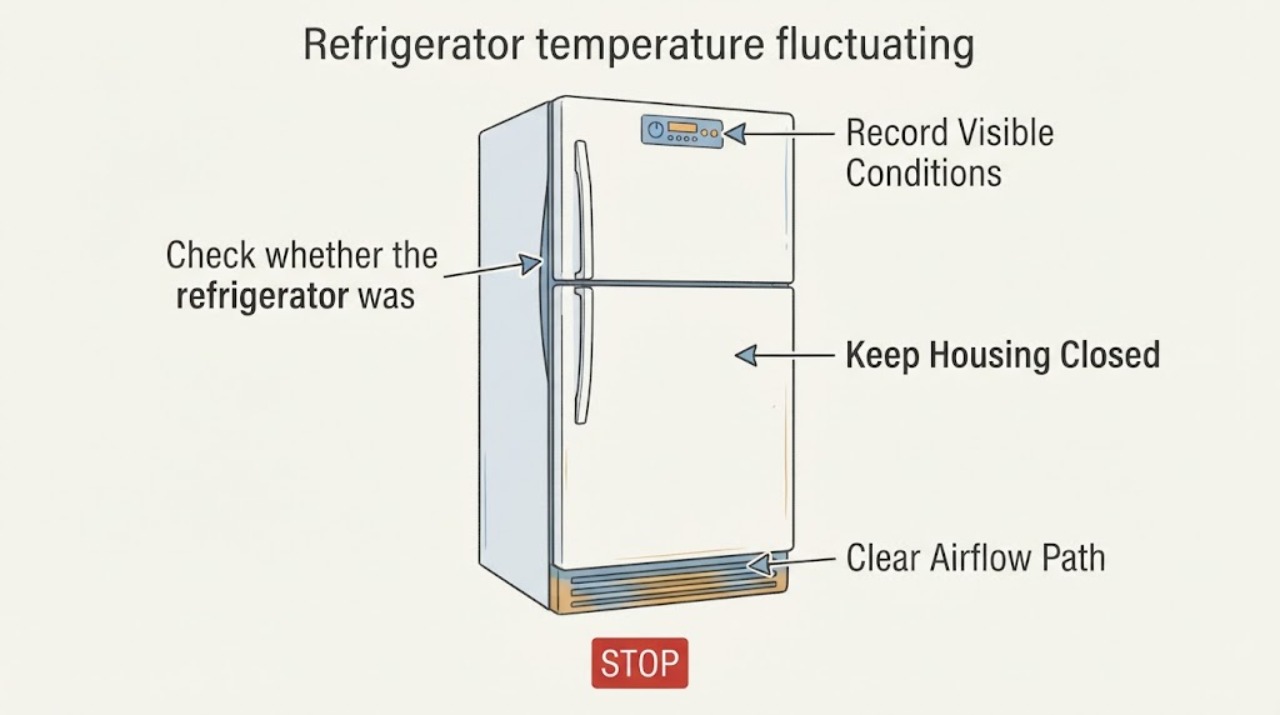
Work through in order
Diagnostic checks
Use only checks that match the exact appliance or system and its official guide.
-
Check 1
Record the refrigerator and freezer temperatures at the same time, along with each displayed setpoint, after the doors have remained closed for a consistent interval.
Expected result: The readings stay within Electrolux’s 33–47°F refrigerator and −6–6°F freezer ranges, or one compartment repeatedly moves outside its range.
Next step: If both compartments remain in range, monitor the pattern and avoid changing settings repeatedly. If one remains outside range, continue with the recovery, airflow, and seal checks.
Stop if: If the readings are inconsistent or the appliance has not had a stable closed-door period, repeat the measurement with a consistent method before drawing a fault conclusion.
Why this matters
Why: Readings within the documented ranges may reflect normal control and defrost variation; repeated readings outside a range establish a cooling symptom that needs further checks.
-
Check 2
Check whether the refrigerator was installed recently or lost power, and allow the documented stabilization period before judging the final temperature.
Expected result: Installation or power loss was recent, and the unit has had less than 8–12 hours to cool or less than 24 hours to stabilize; alternatively, the unit has had a full recovery period.
Next step: Keep the doors closed as much as practical and recheck after the recovery period. Do not repeatedly change controls during stabilization.
Stop if: If the readings still move outside range after stabilization, continue with external airflow and door-seal checks and prepare the exact model for service.
Why this matters
Why: Electrolux says recovery takes time after installation or power interruption, so early swings do not prove a failed cooling component.
-
Check 3
Inspect the interior vents and the rear clearance from outside, moving food away from vents and allowing the airflow clearance specified by the exact owner manual.
Expected result: Packages block an interior vent, dust restricts the rear vent area, or the refrigerator is pushed tightly against the wall; alternatively, vents and clearance are unobstructed.
Next step: Rearrange items and correct only visible clearance or cleaning issues allowed by the owner manual, then allow the refrigerator to stabilize and measure again.
Stop if: If airflow is clear but the readings remain unstable, continue to the door and gasket check rather than guessing a fan or control-board fault.
Why this matters
Why: Electrolux says blocked vents prevent proper airflow and that restricted rear airflow makes the unit work harder, which can affect temperature control.
-
Check 4
Check that every refrigerator and freezer door or drawer closes fully, then inspect the gasket for gaps using the paper-resistance check described by Electrolux.
Expected result: A door is obstructed or not closing, or the paper slides out without resistance at part of the gasket; alternatively, the doors close and the seal has consistent resistance.
Next step: Remove the obstruction and clean the gasket with warm soapy water as Electrolux describes, then recheck temperature after stabilization. Do not force or reshape a damaged gasket.
Stop if: If the seal and closure are normal but the temperature still fluctuates outside range, arrange service with the model and the recorded readings.
Why this matters
Why: Electrolux identifies an open or poorly sealing door as a cause of unstable temperature because warm air enters the cabinet.
-
Check 5
If the display shows a high-temperature alarm or HI indication, note the alarm, the highest displayed temperature, and whether a door was left open before acknowledging it.
Expected result: The high-temperature indication follows an open door, a power event, or a measured temperature above the normal range; alternatively, it returns with closed doors and stable settings.
Next step: Close and seal the doors, allow recovery, and use only the model manual’s alarm-clear procedure. If the alarm returns, arrange service rather than repeatedly resetting it.
Stop if: If no high-temperature alarm is present, use the measured readings and external checks above to decide whether service is needed.
Why this matters
Why: Electrolux describes HI/high-temperature alarms as an elevated refrigerator or freezer temperature condition and says the alarm-clearing method varies by model.
Use your observations
Decision map
Find the observation that best matches what you see, then follow the next safe action.
-
PATH 01Next step
What you see
The temperature moves briefly after a recent installation, power interruption, door-open event, or defrost period and returns to the documented range after recovery.
Do this next
Keep the doors closed as practical, keep vents clear, and monitor with consistent readings through the stabilization period.
Why this path and its safety boundary
Why it matters: Electrolux documents a recovery period and says longer or faster compressor operation can be normal after defrost or warm-room conditions.
-
PATH 02Next step
What you see
One or both compartments repeatedly measure outside the Electrolux range after the recovery period, with blocked vents or a leaking door seal.
Do this next
Correct the visible obstruction or closure issue, clean the gasket as directed, and measure again after stabilization.
Why this path and its safety boundary
Why it matters: The external airflow or warm-air entry can account for the unstable readings without proving an internal component failure.
-
PATH 03Next step
What you see
The doors seal, vents are clear, settings are appropriate, and temperature remains outside range or the high-temperature alarm returns.
Do this next
Arrange qualified Electrolux service and provide the exact model, measured readings, alarm text, timing, and recent power or installation history. Do not open panels or replace a sensor, damper, fan, compressor, or sealed-system part based on fluctuation alone.
Why this path and its safety boundary
Why it matters: The symptom persists after the documented external checks; the opened Electrolux pages do not identify a specific internal part for an unmodelled refrigerator.
Helpful context
Understand the symptom
Temperature variation is meaningful only when it is measured over time. Record the refrigerator and freezer readings, the setpoints, and whether the doors were opened or a defrost cycle may have occurred. Electrolux lists 37°F and 0°F as suggested settings and gives 33–47°F for the refrigerator and −6–6°F for the freezer as acceptable operating ranges.
Recent installation or a power interruption can make the readings look unstable while the appliance recovers. Electrolux says a unit can need 8–12 hours to cool completely and up to 24 hours to stabilize. Once the recovery period has passed, inspect the vents, door closure, gasket, settings, and clearance before assuming an internal fault.
An Electrolux refrigerator may run more after a defrost cycle, in a hot room, or when airflow is restricted. That operating sound alone does not identify a failed compressor or fan. If the measured temperature remains outside the documented range, a high-temperature alarm returns, or food cannot be kept safely cold, stop relying on resets and arrange qualified service with the model and the readings.
When checks do not resolve it
Need a professional?
Use the exact Electrolux owner manual for model-specific controls and alarm clearing. Request qualified service for persistent out-of-range temperatures, repeated high-temperature alarms, a door that cannot seal, or symptoms requiring internal access.
Safety scope: Keep diagnosis to temperature observation, controls, visible vents, clearance, door closure, and gasket inspection. Do not open the cabinet, perform live electrical tests, handle the sealed refrigeration system, or replace an internal part without model-specific service instructions.
Common questions
FAQ
What temperature should an Electrolux refrigerator reach?
Electrolux lists 37°F for the refrigerator and 0°F for the freezer as suggested settings. Its support page gives acceptable operating ranges of 33–47°F for the refrigerator and −6–6°F for the freezer.
How long should I wait after a power outage or installation?
Electrolux says a unit normally takes 8–12 hours to cool completely and can need up to 24 hours to stabilize. Check the readings again after that period before treating the recovery as a fault.
Can a bad door seal make the temperature fluctuate?
Yes. Electrolux says a door that does not seal can cause unstable temperature. Check for obstructions and use the paper-resistance check; arrange service if the gasket or door still cannot seal.
Should I reset the refrigerator when the temperature changes?
Do not rely on a generic reset. Electrolux says alarm-clearing and reset methods vary by model. First record the temperature and check recovery, airflow, doors, and settings; use only the exact owner manual for a model-specific alarm procedure.
Read the exact guide
Official sources
- Refrigerator Error Codes and Alarms GuideElectrolux · Opened Electrolux alarm guide; it states reset methods depend on model and distinguishes power failure, high temperature, door-ajar, and other alarm states.
- Refrigerator Error Code H or HI - High TemperatureElectrolux · Opened Electrolux support page for all refrigerators; it covers a high-temperature indication, door/settings checks, model-dependent clearing, and service escalation.
- Refrigerators - Not CoolingElectrolux · Opened Electrolux owner support page; it applies to all refrigerators and directly covers too-warm or unstable-temperature checks.
- What should I do if my refrigerator or freezer temperature is too cold?Electrolux · Opened Electrolux support page covering both refrigerators and freezers; it confirms that changing the refrigerator control can affect both compartments.
- Refrigerator Runs Too MuchElectrolux · Opened Electrolux owner support page for refrigerators; it explains normal longer runtime and external conditions that make cooling work harder.
Community feedback
Share a repair observation
Share a plain-text repair observation. Accepted observations are published automatically; this page may take a moment to update.