
On this page
Start here
Quick answer
If an Electrolux refrigerator trips the circuit breaker, do not keep resetting it or use an extension cord. First note whether the breaker trips immediately when the refrigerator is plugged in, when the compressor starts, after a power outage, or only when other appliances are running. From a dry, safe position, check the plug, accessible cord, receptacle, and floor for heat, scorching, water, or damage; a water leak near electricity, burning smell, smoke, sparking, a hot plug, or another immediate trip means leave the refrigerator disconnected and obtain qualified electrical/appliance service. Electrolux identifies an overloaded circuit, ground leakage/short circuit, incorrect connection, or an internal appliance fault as possibilities, but an external check cannot identify a failed compressor, start device, defrost component, control, or wiring. Use a dedicated correctly grounded outlet as specified by the exact model, protect food if cooling is lost, and have a professional diagnose any recurring trip.
Before you begin
Safety first
- The user may switch off/isolate power from a safe dry location, check the breaker once, observe the accessible plug/cord/outlet/floor, close a visible water shutoff, and record timing and alarms. Circuit testing, internal electrical/cooling/water components, live measurements, breaker changes, and repairs are for qualified professionals.
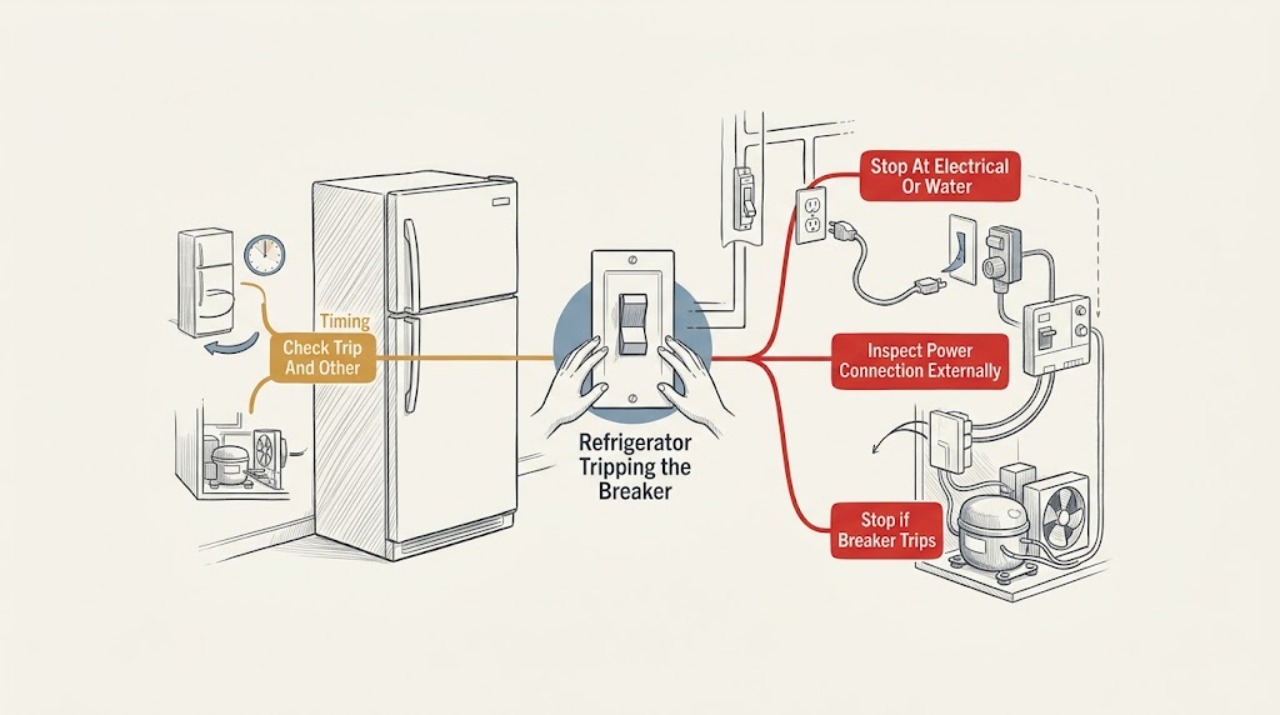
Work through in order
Diagnostic checks
Use only checks that match the exact appliance or system and its official guide.
-
Check 1
If the breaker has tripped, leave the refrigerator off while you look from a dry position for smoke, flames, burning odor, sparks, melted or discolored plastic, a hot plug/cord/receptacle, standing water, or a leaking water line near the appliance or outlet. If any sign is present, isolate power only from a safe dry location and close the water shutoff if a supply leak is visible.
Expected result: There is an electrical or water hazard; the breaker tripped with no visible damage; or the refrigerator is simply without power after a normal trip.
Next step: For any hazard, keep the refrigerator disconnected and call a qualified electrician or authorized appliance service. If no hazard is visible, continue with one controlled external circuit check only; do not repeatedly reset.
Stop if: Do not touch wet or hot electrical parts, unplug through standing water, open the rear cover, or reconnect a smoking, sparking, wet, or heat-damaged refrigerator.
Why this matters
Why: Smoke, heat damage, arcing, or water near electricity is a stop-use event. A clean visual inspection does not prove that the circuit or refrigerator is safe to re-energize, especially after a repeat trip.
-
Check 2
Record when the trip occurs: immediately on plug-in, when the compressor or fan starts, during a defrost/cooling period, after an ice-maker or water event, or only when other appliances are operating. Note whether the refrigerator shares the circuit, whether it was recently installed or moved, and whether the breaker trips again after one reset performed only from a safe dry position.
Expected result: The breaker trips with several appliances together; trips with the refrigerator alone; trips at a repeatable start-up/operation moment; or does not trip again after other loads are removed.
Next step: Turn off or unplug other loads only if safe, never use an extension or adapter, and have a qualified electrician verify the circuit and receptacle. If the refrigerator alone trips, leave it disconnected and arrange appliance/electrical service.
Stop if: Do not increase the breaker rating, change wiring, bypass grounding, share a temporary outlet, or reset the breaker repeatedly to locate the moment of failure.
Why this matters
Why: Several simultaneous loads support a circuit-capacity problem, while a repeat trip with the refrigerator alone raises concern for ground leakage, short circuit, incorrect connection, or an appliance fault. The timing narrows the handoff but does not prove a compressor or control failure.
-
Check 3
With the refrigerator disconnected, confirm that the plug is fully seated in the correct, grounded outlet and that the accessible cord is not pinched, cut, crushed, wet, or hot. Check the receptacle face for discoloration or looseness without removing its cover. Do not pull a built-in refrigerator out or substitute an extension cable; leave electrical measurements to a qualified electrician and follow the exact installation guide for outlet and clearance requirements.
Expected result: The outlet/plug/cord is damaged or loose; the connection appears normal; or the refrigerator was recently installed, relocated, or connected to a different circuit.
Next step: Keep the appliance off and have a qualified electrician repair or verify a damaged outlet/cord/ground. For a recent installation or relocation, have the installer verify the dedicated circuit and connection before reuse.
Stop if: Do not repair a cord, replace a plug, remove the receptacle cover, use a cheater plug, or run the refrigerator from an extension or multi-plug adapter.
Why this matters
Why: A damaged connection or incorrect installation can cause a trip independently of a refrigerator component. A normal-looking external connection does not rule out a hidden fault or ground leakage.
-
Check 4
If power is safely isolated, look only at accessible signs that help the service handoff: interior light/display state, whether food is warming, a high-temperature or power-failure indication, a visible water leak, and whether the ice-maker/dispenser water line is connected without a kink. Keep doors closed and do not remove panels or energize the unit just to listen for the compressor.
Expected result: The refrigerator is warm or not cooling; a PF/high-temperature alarm appears; water is leaking; or cooling and water connections look normal but the breaker still trips.
Next step: Protect food and arrange prompt service if temperature is rising, a leak is present, or an alarm persists. Give the technician the exact code, timing, temperature observation, and water-line history; keep the refrigerator disconnected if the breaker trips with it alone.
Stop if: Do not remove the compressor cover, defrost heater cover, control panel, water valve, or wiring; do not use heat to defrost or reconnect a leaking appliance.
Why this matters
Why: A power interruption can create a power-failure or high-temperature alarm, while a leak or loss of cooling may indicate a broader fault. None of these observations identifies a safe user-replaceable electrical part.
-
Check 5
If the refrigerator alone trips the breaker again, or if the breaker will not hold with the refrigerator connected, stop testing. Record the model/PNC and serial number, trip timing, circuit loads, outlet/cord observations, any PF or high-temperature alarm, cooling loss, leak, odor, heat, or visible damage. Provide this record to a qualified electrician and Electrolux-authorized appliance technician.
Expected result: The trip recurs with the refrigerator alone; the trip was isolated to an overloaded shared circuit; or the breaker and refrigerator both operate normally after professional verification.
Next step: Leave a repeatedly tripping refrigerator disconnected, protect food, and arrange diagnosis. Resume operation only after the circuit and appliance have been verified safe by the appropriate professional.
Stop if: Do not perform resistance/voltage tests, bypass a ground, replace the breaker with a higher rating, repeatedly reset, or order a compressor, relay, control, defrost, or wiring part from the symptom alone.
Why this matters
Why: A recurring appliance-only trip is consistent with a possible internal electrical or component fault and is not a normal operating condition. A circuit-only overload still needs electrical correction, not a larger fuse or breaker.
Use your observations
Decision map
Find the observation that best matches what you see, then follow the next safe action.
-
PATH 01Safety boundary
What you see
The breaker trips only when the refrigerator and other high-load appliances run together, and no heat, odor, water, or damage is visible.
Do this next
Remove other loads if safe and have a qualified electrician verify the circuit, receptacle, grounding, and permitted load. Keep the refrigerator on its correctly specified circuit without an extension cable.
Why this path and its safety boundary
Why it matters: Circuit capacity or multiple-appliance loading is more likely than a confirmed refrigerator fault, but the circuit still needs proper assessment.
Safety stop: Do not install a larger fuse/breaker, use a multi-plug adapter, or treat a temporary non-trip as proof the appliance is safe.
-
PATH 02Safety boundary
What you see
The refrigerator trips the breaker when connected or when it starts, even with other appliances removed.
Do this next
Leave it disconnected and arrange qualified electrical and Electrolux appliance diagnosis. Provide the trip timing and whether the display/cooling changed.
Why this path and its safety boundary
Why it matters: Ground leakage, short circuit, incorrect connection, or an internal refrigerator fault is more likely; external observation cannot identify the component.
Safety stop: Do not reset repeatedly, use another outlet as a workaround, open panels, or test the compressor, start device, wiring, or control live.
-
PATH 03Safety boundary
What you see
The issue followed an outage or surge and the display shows a power-failure/high-temperature indication, without visible electrical damage.
Do this next
Follow the exact manual for acknowledging a power-failure indication, keep the doors closed, monitor cooling, and stop using the unit if the breaker trips again or temperature does not recover.
Why this path and its safety boundary
Why it matters: The alarm may reflect the interruption and warming while the refrigerator recovers, but a breaker that trips again is not explained by the alarm alone.
Safety stop: Do not keep reconnecting after a surge-related trip or assume a reset cleared internal damage.
-
PATH 04Safety boundary
What you see
The trip is accompanied by water at the floor, around the plug, behind the refrigerator, or at an accessible ice-maker/water connection.
Do this next
Keep the refrigerator disconnected from a safe dry position, close the household water shutoff if the supply line is leaking, and arrange qualified appliance/electrical service.
Why this path and its safety boundary
Why it matters: Water near electricity creates shock and equipment risk and takes priority over diagnosing the breaker or ice maker.
Safety stop: Do not touch wet plugs or wiring, pull the refrigerator through standing water, reconnect to test, or disconnect a pressurized line yourself.
-
PATH 05Safety boundary
What you see
The circuit is appropriate, the refrigerator trips alone, or the breaker trips at a repeatable operating moment with no safe external explanation.
Do this next
Leave the refrigerator off, protect food, and have an authorized technician and qualified electrician diagnose the appliance and supply safely.
Why this path and its safety boundary
Why it matters: An internal compressor-start, fan, defrost, control, wiring, or other electrical fault is possible, but the trip does not identify a replaceable part.
Safety stop: Do not remove covers, make live measurements, bypass protection/grounding, or replace an internal component based on the symptom alone.
Helpful context
Understand the symptom
The timing of the trip is the useful clue
A breaker that trips as soon as the plug is connected is a different pattern from one that trips only when the compressor starts or after another high-load appliance is switched on. A recent outage or surge can leave a power-failure indication, but it does not make a repeated trip safe to ignore. Record the timing, what else was on the circuit, whether the refrigerator display/lights changed, and whether cooling or water connections were affected. Do not infer a specific internal part from timing alone.
Only dry external checks are user-level checks
Electrolux support allows checking the breaker, plug, and outlet, but electrical faults, ground leakage, and appliance wiring require qualified help. With the refrigerator disconnected, inspect the accessible plug, cord, receptacle face, floor, and visible water line without moving a built-in unit or removing a cover. Do not use an extension cable, adapter, improvised ground, or a different circuit as a workaround. If a technician needs the appliance energized, that is their controlled test—not a reason to keep resetting the breaker at home.
Cooling and food safety may become the next risk
If the breaker remains off, the refrigerator and freezer will warm. Keep doors closed, check the temperature with a suitable thermometer if safe, and move or discard food according to local food-safety guidance when temperatures are uncertain. A compressor that runs often can be normal on some variable-speed models, but a refrigerator that is not cooling, repeatedly trips, leaks, or shows a recurring alarm needs prompt service. The sealed cooling system, compressor-start parts, defrost components, controls, and internal wiring are not DIY electrical checks.
Safety boundary
Stop conditions
- Do not repeatedly reset a breaker that trips with the refrigerator; stop immediately for smoke, burning odor, sparks, melted plastic, a hot plug/cord, or water near electricity.
- Do not use an extension cable, multi-plug adapter, cheater plug, improvised ground, or higher-rated breaker/fuse as a workaround.
- Do not open the rear cover, compressor/start assembly, defrost system, control, water valve, or wiring, and do not perform live voltage/resistance tests.
- Keep a leaking or electrically damaged refrigerator disconnected and close the water shutoff if a visible supply leak is present.
- If cooling is lost or a high-temperature/power-failure alarm persists, keep doors closed, protect food, and arrange prompt professional service.
When checks do not resolve it
Need a professional?
Arrange qualified electrical and Electrolux-authorized appliance service when the breaker trips with the refrigerator alone, trips again after one safe external check, the outlet/cord/plug is damaged or hot, a PF/high-temperature alarm persists, cooling is lost, or water is near electrical parts. Provide the model/PNC and serial number, trip timing, other circuit loads, outlet observations, cooling/temperature symptoms, alarm text, and any leak, odor, heat, or visible damage.
Safety scope: The user may switch off/isolate power from a safe dry location, check the breaker once, observe the accessible plug/cord/outlet/floor, close a visible water shutoff, and record timing and alarms. Circuit testing, internal electrical/cooling/water components, live measurements, breaker changes, and repairs are for qualified professionals.
Common questions
FAQ
Why does my Electrolux refrigerator keep tripping the breaker?
Possible categories include an overloaded shared circuit, a supply/grounding problem, ground leakage or short circuit, or an internal refrigerator fault. The trip timing helps the electrician and technician, but it does not identify a safe replacement part. Do not keep resetting the breaker.
Can I plug my Electrolux refrigerator into an extension cord?
No. Electrolux electrical guidance warns against extension cables for appliances. Use the correctly installed, grounded outlet and circuit specified by the exact refrigerator installation guide, and have a qualified electrician correct any supply problem.
Should I reset the breaker for my refrigerator?
If there is no smoke, heat, water, or other hazard, you may check the breaker once from a safe dry position as part of an external power check. If it trips again—especially with the refrigerator alone—leave it disconnected and arrange electrical/appliance service instead of repeating resets.
What if the breaker trips after a power outage?
A power outage or surge can produce a PF/power-failure indication and a temporary high-temperature alarm, but a breaker that trips again is not normal recovery. Keep the doors closed, monitor cooling if safe, and have the circuit and refrigerator checked if the trip recurs.
When is a tripping refrigerator an emergency?
Treat smoke, burning smell, sparks, a hot or damaged plug/cord, scorching, water near electrical parts, a visible supply leak, or repeated immediate trips as stop-use conditions. Isolate power only from a safe dry location, close the water shutoff for a visible water leak, and obtain qualified help.
Read the exact guide
Official sources
- Fridge repair serviceElectrolux UK · Electrolux refrigerator repair support; service eligibility and procedures vary by market and model.
- Too much load on the circuitElectrolux UK · General Electrolux appliance power-supply guidance; local circuit rules and the refrigerator installation guide still apply.
- Refrigerator Error Code PF or Power Failure LightElectrolux · Electrolux refrigerators that display PF or a power-failure light; exact alerts vary by model.
- EHE6899 Refrigerator User ManualElectrolux Australia · EHE6899 manual for exact model details; used for manufacturer-documented patterns and to avoid treating every refrigerator design as identical.
- Refrigerator No PowerElectrolux · All refrigerators covered by the support article; internal electrical repairs are not user DIY work.
- Refrigerator Error Codes and Alarms GuideElectrolux · Electrolux refrigerator models covered by the error guide; exact code meanings are model-specific.
Community feedback
Share a repair observation
Share a plain-text repair observation. Accepted observations are published automatically; this page may take a moment to update.