
On this page
Start here
Quick answer
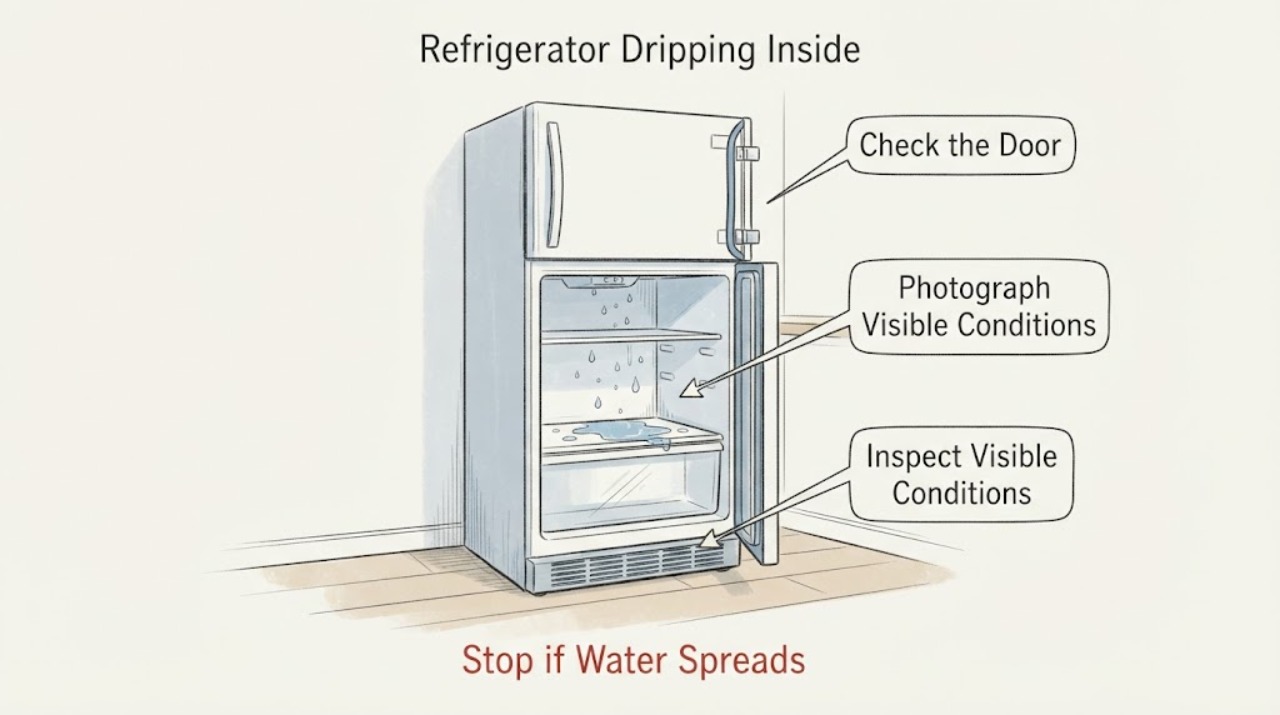
For an Electrolux top-freezer/bottom-refrigerator layout that is dripping inside, protect food and the floor first, then make only visible checks of the door closure, accessible water filter and accessible supply connections. Electrolux says that a recently changed or cracked filter can leak inside, and that a door left open for a long time can cause air leakage, evaporator icing and water leakage; its guidance does not prove that the drain is clear or identify a hidden drain, diffuser or internal part. Keep the refrigerator closed and cold if it is safe to do so, document where and when the water appears, and ask the landlord or property manager to arrange model-matched service rather than removing panels or pulling out a rented appliance.
Work through in order
Diagnostic checks
Use only checks that match the exact appliance or system and its official guide.
-
Check 1
Move exposed food away from the drip, wipe standing water from shelves and the floor, and keep the refrigerator and freezer doors closed except for necessary access. If water has contacted uncovered food, treat that food as potentially contaminated rather than tasting it.
Expected result: The refrigerator remains at or below 40°F, food packaging is intact, and the water is limited to a clean shelf or liner; or food is wet/uncovered, the temperature is above 40°F, or the source is dirty or unknown.
Next step: Keep safe food covered and cold. Discard food that is contaminated or whose temperature history is uncertain, and use an appliance thermometer to monitor the refrigerator and freezer. Do not unplug a normally cooling refrigerator merely to test the leak; isolate power only if water reaches electrical parts or there is another immediate hazard.
Why this matters
Why: Cold storage and prompt spill cleanup reduce food-safety and cross-contamination risk, but a wet package, unknown contamination or unsafe temperature changes the decision from appliance troubleshooting to food protection.
-
Check 2
Dry the visible area, place an absorbent towel where it can be monitored, and record whether new water appears after the refrigerator door is opened, after an ice-maker or dispenser event, or without either event. Photograph the exact highest wet point and any nearby frost without removing panels.
Expected result: Water appears near the dispenser or filter area, at a shelf or diffuser, after a door has been left open, or only during a suspected defrost/ice event; or no repeat drip is seen during safe observation.
Next step: Give the photos, timing and model/serial label to the landlord or property manager. Do not run extra ice or water cycles, pour test water into an inaccessible drain, or open the freezer liner to reproduce the drip.
Why this matters
Why: The timing and highest visible wet point help a technician separate an accessible water connection/filter issue from a condensation, ice or hidden drainage path. They do not prove the source or validate the claim that the drain is clear.
-
Check 3
If this refrigerator has an accessible water filter, inspect only the filter and its housing from the normal user access point. Confirm that the filter is seated as the model manual shows and look for a visible crack or wetness; do not force it, remove hidden tubing, or use a filter part whose model fit is unknown.
Expected result: The filter was recently changed, is visibly cracked, is wet at the housing, or is not seated; or the filter and housing are dry and correctly seated.
Next step: If the filter is cracked or leaking, stop using the water/ice feature and show the model label and filter condition to the property manager for a model-matched replacement or service. If it is dry and seated, leave it alone and proceed to the service request instead of diagnosing an internal part.
Why this matters
Why: Electrolux states that an incorrectly installed or cracked water filter can cause leaking inside the cabinet, sometimes with slow or absent dispenser flow. A dry, correctly seated filter does not clear the drain, diffuser or other internal paths.
-
Check 4
From the front, check that both doors close fully and that the visible gasket is not folded, dirty or visibly pulled away. If the appliance has an accessible external water line and it is safe to view without moving the refrigerator, look for fresh moisture at the connection; do not pull a rental appliance away from the wall or reach behind it.
Expected result: A door remains ajar, the gasket has a visible gap, the door was left open for a long time, or an accessible connection is wet; or the doors close and no accessible connection is wet.
Next step: Remove only an obvious obstruction from the door seal, close the doors, and report any gap or accessible leak. Leave rear connections and hidden tubing to the landlord's authorized technician, especially in a rental or built-in installation.
Why this matters
Why: Electrolux says prolonged door opening can create air leaks, evaporator icing and water leakage, and says loose rear connections can leak to the floor. These observations can guide service but do not prove that a gasket, drain, valve or other component is defective.
-
Check 5
Send the landlord or property manager the model/serial label, photos, the highest visible wet point, the timing log, filter/door observations and any food-temperature concern. State that the user has not independently verified the drain condition and request a model-matched refrigerator service assessment.
Expected result: The leak recurs, frost returns, water reaches electrical areas or the floor, the refrigerator warms, the filter/connection is wet, or the cause would require a cover or panel to be removed.
Next step: Keep the appliance in its safe cooling state while awaiting authorized service, unless water reaches electrical parts, cooling fails, or there is an immediate hazard; in those cases isolate power only if it can be done safely and follow the property manager's emergency procedure. Do not order parts or authorize structural disassembly yourself.
Why this matters
Why: A recurring internal leak or any hidden-path inspection exceeds a tenant's safe external check. Electrolux directs unresolved refrigerator leaks toward service, while the assigned case has no verified model-specific diagnosis or repair outcome.
Use your observations
Decision map
Find the observation that best matches what you see, then follow the next safe action.
-
PATH 01Next step
What you see
Uncovered food was contacted by unknown water, or the refrigerator has been above 40°F and the time is uncertain.
Do this next
Separate and discard questionable food according to FDA food-safety guidance, wipe and clean the affected surface, keep the doors closed, and monitor the appliance temperature while arranging service.
Why this path and its safety boundary
Why it matters: The immediate risk is food contamination or unsafe temperature, not identifying the refrigerator component.
-
PATH 02Next step
What you see
The accessible filter is cracked/not seated, or a visible accessible water connection is wet.
Do this next
Stop using the affected water/ice feature if needed, photograph the condition, and have the landlord or authorized technician handle the model-matched filter or connection service.
Why this path and its safety boundary
Why it matters: Electrolux identifies filter installation/cracks and loose water connections as possible leak sources, but the exact component and repair still depend on the model.
-
PATH 03Next step
What you see
A door was left open for a long period, the gasket visibly fails to seal, or frost returns near the upper transfer/diffuser area.
Do this next
Close the door, remove only an obvious seal obstruction, document the frost and leak timing, and request model-specific service if the drip or frost returns. Do not remove panels or apply heat.
Why this path and its safety boundary
Why it matters: Electrolux says prolonged door opening can create air leaks, evaporator icing and water leakage; this is a supported possibility, not proof of a failed gasket or defrost part.
-
PATH 04Next step
What you see
The filter and visible connections are dry, the doors seal, but water keeps appearing inside or the source is behind a liner, diffuser or other cover.
Do this next
Leave the refrigerator assembled, preserve the photos and timing log, and have the landlord or an authorized technician identify the model-specific internal path. Do not pour more water into the drain or install an unverified part.
Why this path and its safety boundary
Why it matters: The remaining possibilities are not distinguishable safely from the available identity and general Electrolux guidance; the user's statement that the drain is clear is not independently verified.
Helpful context
Understand the symptom
Treat the reported drain check as unverified
The assigned case says an Electrolux top/bottom refrigerator is dripping near the upper-rear area and that the poster believes the drains are clear. The supplied Reddit lead could not be opened as a durable page in this research run, so that statement is not independently verified and does not rule out a drain, air-leak, defrost or water-path problem. Electrolux's own guidance narrows the safe first checks to visible connections, the water filter and prolonged door opening; it does not authorize opening the freezer liner or choosing a replacement part without the model.
Protect food and the rental before diagnosing
Move uncovered food away from the drip, wipe pooled water from shelves and the floor, and keep doors closed as much as possible. Check the refrigerator temperature with an appliance thermometer; FDA guidance uses 40°F or below for the refrigerator and says to discard food when its temperature history is uncertain or contamination cannot be ruled out. Photograph the wet area, frost pattern and timing before cleaning them away so the property manager can see whether the water appears after door opening, ice production, dispensing or a defrost period.
Use model identity before any internal repair decision
Find the model and serial label without removing covers, and tell the landlord or property manager that the refrigerator is leaking inside. A tenant should not pull out a built-in unit, remove an evaporator or diffuser cover, pour more water into an inaccessible drain, apply heat to ice, or install a drain clip or other part based on a generic diagnosis. The exact owner manual and model-matched service call are needed before hidden drainage or internal refrigeration work is considered.
When checks do not resolve it
Need a professional?
Ask the landlord or property manager to arrange service for any recurring internal leak, returning frost, wet filter or connection, warming refrigerator, or leak whose source is behind a cover. Treat water near electrical parts, loss of cooling, a rapidly spreading leak or another immediate hazard as an urgent safety issue; do not investigate inside the appliance.
Common questions
FAQ
Does the report that the drain is clear prove that the drain is not the problem?
No. The supplied Reddit lead was not accessible as a durable opened page in this research run, so the reported drain check cannot be independently verified. Even if a visible opening appears clear, that does not identify a hidden tube, defrost path or diffuser issue. Preserve the observation for the authorized technician rather than repeating water or heat tests.
What can I check without taking apart the Electrolux refrigerator?
Protect food and the floor, observe the highest wet point and timing, check the accessible filter for correct seating or a crack, check that doors close and the visible gasket is not obstructed, and look for moisture at an accessible connection without moving the appliance. Electrolux does not provide a model-specific internal drain diagnosis on the general leak page.
Should a tenant unplug the refrigerator while waiting for service?
Do not unplug a normally cooling refrigerator just to reproduce or stop a drip, because food temperature can become unsafe. Keep doors closed and monitor temperature when it is safe. If water reaches electrical parts, cooling fails, or there is another immediate hazard, isolate power only from a dry, safe location and follow the landlord or property manager's emergency procedure.
Could an Electrolux water filter cause water inside the cabinet?
Yes, conditionally: Electrolux says an incorrectly installed or cracked filter can cause leaking in the cabinet, sometimes with slow or no dispenser flow. Check only the user-accessible filter and housing; if it is wet or damaged, document it and ask the property manager for the model-matched service decision.
Read the exact guide
Official sources
- Refrigerator Water LeaksElectrolux · Opened official Electrolux refrigerator support page. It applies generally to refrigerators and does not identify a model-specific hidden drain, diffuser, defrost component or replacement part for this no-model task.
- Refrigerator Thermometers - Cold Facts about Food SafetyU.S. Food and Drug Administration · Opened FDA consumer food-safety guidance. It supports keeping the refrigerator at or below 40°F, wiping spills promptly, keeping doors closed to preserve cold, and discarding food when temperature history is uncertain; it does not diagnose the appliance leak.
Community feedback
Share a repair observation
Share a plain-text repair observation. Accepted observations are published automatically; this page may take a moment to update.