
On this page
Start here
Quick answer
First separate a musty or sour laundry smell from a burning or electrical smell. For a musty smell, wipe the rubber seal dry, leave the door and detergent drawer open between washes, clean the drawer and applicable filters, use the correct detergent amount, and run the model's maintenance programme as described in its manual. If the smell is burning, unplug the washer dryer immediately if safe and arrange service. If a sour smell remains after the model-appropriate cleaning, or the smell appears only during drying, stop repeated cycles and have the appliance inspected.
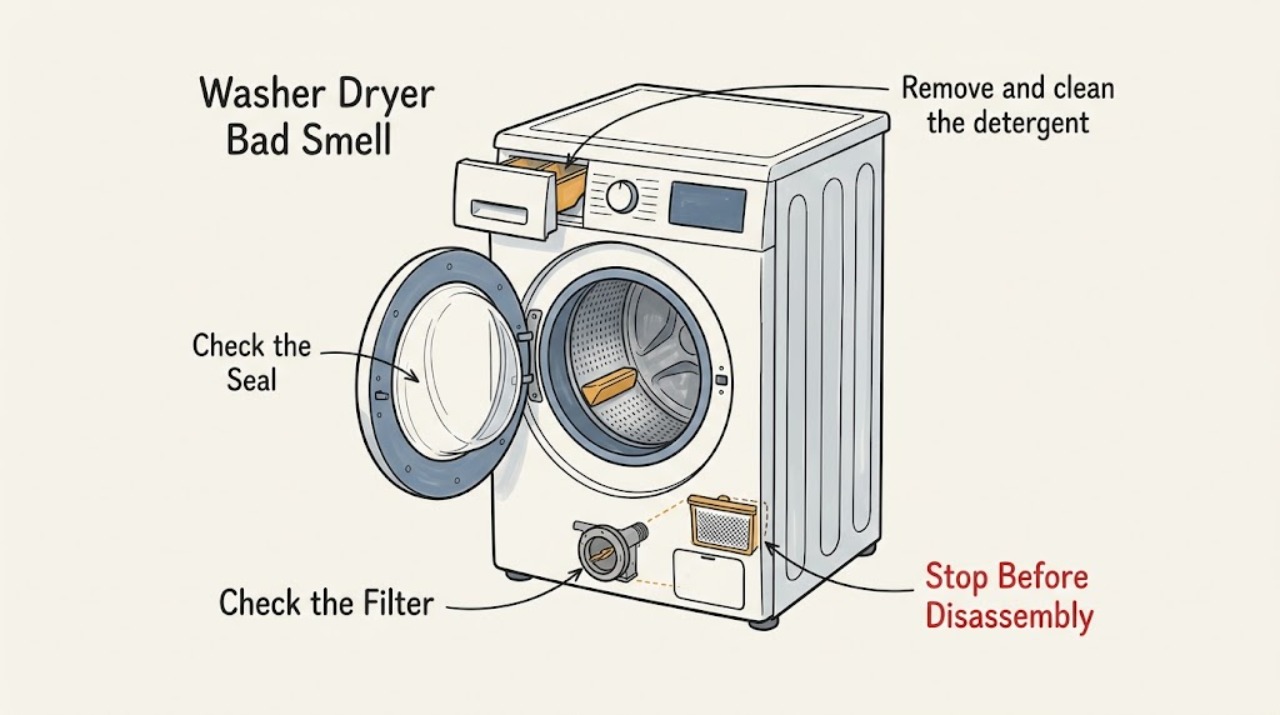
Work through in order
Diagnostic checks
Use only checks that match the exact appliance or system and its official guide.
-
Check 1
Identify whether the smell is musty or sour after washing, detergent-like from the drawer or seal, lint-like after drying, or sharp and burning; stop the appliance immediately for the last category.
Expected result: The odor is damp or sour, occurs only during drying, or resembles burning, melting insulation, or an electrical fault.
Next step: For a non-burning odor, continue with the seal, drawer, drum, and filter checks; for a burning odor, disconnect power if safe and arrange qualified service.
Stop if: Stop immediately for burning smell, smoke, sparks, melting, a hot cord, or a repeated breaker trip.
Why this matters
Why: Odor timing changes the path: residue and moisture can be cleaned externally, while a burning smell can signal a hazardous fault that should not be tested with another cycle.
-
Check 2
With the washer dryer empty and cool, inspect the inner and outer door seal for lint, coins, residue, or dark mould spots, wipe it with a soft damp cloth, dry it, and leave the door ajar after the cycle.
Expected result: Residue, trapped objects, mould spots, or standing moisture are present, or the seal is clean but the smell continues.
Next step: Remove only accessible debris, dry the seal, and continue with drawer and maintenance-cycle checks; do not pull the seal out of its channel.
Stop if: Stop if the seal is torn, detached, sharply contaminated, or cleaning would require dismantling the door or cabinet.
Why this matters
Why: Dirt and moisture at the seal can retain odor and transfer it to laundry; a clean seal with persistent odor points toward the drawer, drum, filter, drain path, or drying path.
-
Check 3
Remove and clean the detergent drawer only as the model manual shows, rinse residue from each compartment, clean the drawer socket with a small soft brush, and measure detergent and conditioner according to the product and appliance instructions.
Expected result: Dried detergent, conditioner, mildew, or standing water is present in the drawer or socket, or the drawer is clean but odor returns.
Next step: Refit the drawer correctly, leave it slightly open after use, and run the manual's empty rinse or maintenance programme if specified.
Stop if: Stop if the drawer cannot be removed safely, the socket is damaged, or cleaning would expose wiring or require tools.
Why this matters
Why: Residue and excess detergent can feed stale odor and block the drawer; recurrence after a clean drawer shifts attention to the seal, drum, drain filter, or drying system.
-
Check 4
With no laundry in the drum, run the washer dryer's named Machine Clean or high-temperature maintenance programme only as described in the exact user manual; use only the approved amount and type of cleaner if the manual calls for one.
Expected result: The odor decreases after the maintenance cycle, returns quickly, or the washer dryer cannot heat or complete the cycle normally.
Next step: Keep the door and drawer open to dry between uses and repeat maintenance only at the manual's stated interval; arrange service if the smell persists or the cycle is abnormal.
Stop if: Stop for burning odor, smoke, abnormal heat, leaking water, repeated electrical trips, or a cycle that cannot be controlled.
Why this matters
Why: A reduction supports a residue or moisture cause; quick recurrence or a failed heating or cleaning cycle indicates that external cleaning is not enough and may involve a drain, sensor, heater, or control issue.
-
Check 5
Turn the appliance off and use the exact manual to clean the drain pump or fluff filter and, where the model has them, the primary or secondary drying lint filters and accessible heat exchanger; place a tray under any filter opening that the manual identifies.
Expected result: Lint, stagnant water, detergent residue, or blockage is found in an applicable filter, or the filters are clean while the smell appears only after drying.
Next step: Refit every filter and cover correctly, run only the manual's verification or rinse cycle, and arrange service if odor, poor drying, or abnormal heat continues.
Stop if: Stop if water cannot be controlled, a filter is broken, the heat exchanger is inaccessible, or cleaning requires opening the cabinet.
Why this matters
Why: Filters can retain damp residue and lint, but washer-dryer filter layouts are model-specific; a clean filter with drying-only odor requires a technician to assess the internal air and heating path.
-
Check 6
Arrange Electrolux or qualified appliance service when odor persists after model-appropriate cleaning, appears during drying with abnormal heat, comes with a burning smell, or is associated with leaks, poor drainage, or repeated faults; provide the model, cycle, odor timing, and checks completed.
Expected result: The service provider has the model, odor description, cycle timing, seal and drawer condition, filter result, maintenance-cycle result, and any heat, leak, or electrical symptom.
Next step: Keep the appliance out of use when the odor is hazardous or the cycle is abnormal, and follow the model-specific service recommendation.
Stop if: Stop use for burning smell, smoke, scorching, abnormal heat, water near electrical parts, or repeated breaker trips.
Why this matters
Why: A complete odor history helps separate residue and moisture from a drain, heater, fan, sensor, or control fault without unsafe disassembly.
Use your observations
Decision map
Find the observation that best matches what you see, then follow the next safe action.
-
PATH 01Next step
What you see
The washer dryer emits a burning or electrical smell, smoke, scorching, or melting odor.
Do this next
Arrange qualified service and follow the exact model guidance.
Why this path and its safety boundary
Why it matters: Unplug or disconnect the appliance immediately if safe, stop using it, and arrange qualified Electrolux service.
-
PATH 02Next step
What you see
The odor is sour, damp, or stale and is strongest after washing.
Do this next
Arrange qualified service and follow the exact model guidance.
Why this path and its safety boundary
Why it matters: Dry the seal, leave the door and drawer open, clean residue, measure detergent correctly, and run the manual's maintenance programme.
-
PATH 03Next step
What you see
Mould, lint, detergent, conditioner, or standing moisture is visible at the seal or dispenser.
Do this next
Arrange qualified service and follow the exact model guidance.
Why this path and its safety boundary
Why it matters: Clean the accessible area using the model instructions and dry it between uses; arrange service if mould or seal damage persists.
-
PATH 04Next step
What you see
The smell appears only during or after the drying portion of a washer-dryer cycle.
Do this next
Arrange qualified service and follow the exact model guidance.
Why this path and its safety boundary
Why it matters: Clean the applicable lint filters and accessible heat exchanger only as the model manual permits; stop for burning odor or abnormal heat and arrange service.
-
PATH 05Next step
What you see
A mild plastic-like odor occurs only during the first few drying cycles of a new appliance and is fading.
Do this next
Arrange qualified service and follow the exact model guidance.
Why this path and its safety boundary
Why it matters: Ventilate the room and follow the model manual; if the odor is strong, worsening, or burning, stop using the appliance and arrange service.
-
PATH 06Next step
What you see
The odor returns after the seal, drawer, applicable filters, dosing, and maintenance-cycle checks.
Do this next
Arrange qualified service and follow the exact model guidance.
Why this path and its safety boundary
Why it matters: Stop repeated cleaning cycles and arrange qualified service for drain, heating, airflow, sensor, or control diagnosis.
Helpful context
Understand the symptom
Classify the smell before cleaning
A damp, sour, or stale smell after washing usually calls for a hygiene and residue check. A sharp burning or electrical smell is different: stop the appliance, disconnect it if safe, and arrange service. If the smell is noticeable only after drying, inspect the drying filters and use the exact washer-dryer manual because filter layouts and cleaning routines vary by model.
Dry the machine between cycles
Electrolux points to humidity, detergent residue, the door seal, drawer, drum, and filters as maintenance areas. Wipe the accessible seal, leave the door and drawer ajar after use, measure detergent as directed, and run the model's maintenance programme with no laundry. Do not mix cleaning chemicals or improvise a hot cycle when the manual specifies a particular cleaner or programme.
Safety boundary
Stop conditions
- A burning, electrical, melting, or scorched smell, smoke, sparking, or abnormal heat is present.
- Water leaks near electrical parts, the appliance trips a breaker, or the cord or plug becomes hot or damaged.
- A cycle cannot be stopped normally, the drum or dryer path overheats, or the appliance makes a new severe noise.
- The door seal, filter, drawer, heat exchanger, or cover is damaged and cleaning would require dismantling the appliance.
- The smell persists after the model-appropriate external cleaning and maintenance checks.
- Cleaning would require mixing chemicals, using an unapproved cleaner, or working inside the cabinet.
Only after diagnosis
Potential parts
Only when cleaning does not remove mould or residue and a qualified technician confirms the seal is damaged or requires replacement for the exact model.
Only when the exact model manual and qualified diagnosis show that a damaged or ineffective filter assembly is contributing to retained water or odor.
Only after qualified diagnosis confirms an internal drying-path fault; a drying-only smell does not identify one compatible component.
When checks do not resolve it
Need a professional?
The smell is burning, electrical, or accompanied by smoke, scorching, abnormal heat, or repeated breaker trips., A musty or sour smell returns after cleaning the seal and drawer and running the model maintenance programme., The odor occurs only during drying, especially with poor drying, excessive heat, or a filter that is clean but ineffective., The seal, pump filter, lint filter, drawer, or heat exchanger is damaged or cannot be safely accessed., The washer dryer leaks, drains poorly, displays a fault, or needs internal heater, fan, sensor, or control testing.
Common questions
FAQ
Why does my Electrolux washer dryer smell musty?
Humidity, residue, and mould at the seal, drawer, drum, or filters can retain a sour or stale odor. Dry the seal, leave the door and drawer open, dose detergent correctly, clean applicable filters, and run the model's maintenance programme.
What should I do if my Electrolux washer dryer smells like burning?
Stop the appliance, disconnect it immediately if safe, and arrange service. Do not run another wash or drying cycle to see whether the smell goes away.
Can a dirty detergent drawer cause a bad smell?
Yes. Electrolux identifies dried detergent, conditioner, and mildew build-up as maintenance concerns. Remove and clean the drawer according to the exact model manual, then leave it slightly open between uses.
Why does the smell appear only when drying?
Inspect the applicable lint filters and accessible drying path using the model manual. If the smell is burning, the dryer overheats, or the odor persists with clean filters, stop using it and arrange qualified service.
Read the exact guide
Official sources
- Tumble dryer emits unpleasant smellsElectrolux · Supports the drying portion of a washer-dryer odor diagnosis; the article applies to tumble-dryer models and the washer-dryer's exact filter layout must be confirmed in its manual.
- How to clean and maintain your Electrolux washer dryerElectrolux · Supports routine washer-dryer maintenance and model-specific filter boundaries; exact programmes and filter locations vary by model.
- Cleaning the washing machine's rubber seal if it's dirtyElectrolux · Supports seal moisture, mould, residue, ventilation, and professional replacement guidance relevant to the washer section of a washer dryer; exact cleaner and seal design remain model-specific.
- How to fix Smell Issues of Electrolux Washer DryersElectrolux Singapore · Supports odor classification, seal and drawer ventilation, detergent dosing, maintenance-wash, filter, drain, and service guidance for the model families listed on the regional page; exact model instructions take precedence.
Community feedback
Share a repair observation
Share a plain-text repair observation. Accepted observations are published automatically; this page may take a moment to update.