
On this page
Start here
Quick answer
A musty or sour smell from a Miele washer-dryer usually calls for a cleaning and drying routine, not a fragrance that masks the source. Remove wet laundry promptly, leave the door and detergent drawer slightly open after use, check the accessible door seal and drawer for residue, and use the model's Clean Machine or other approved cleaning programme with an empty drum. During drying, fluff and lint can collect in the drum and filters, so use the model-specific rinse-out-fluff or filter and heat-exchanger care instructions; do not run a laundry load in a maintenance programme. Use the detergent amount specified for the load, water hardness, and dosing system. Stop using the appliance for a burning, electrical, solvent, or strong chemical smell, smoke, leaks near power, damaged wiring, or any condition that requires opening the cabinet, and arrange qualified Miele service.
Work through in order
Diagnostic checks
Use only checks that match the exact appliance or system and its official guide.
-
Classify the odor and stop for a hazardous smell
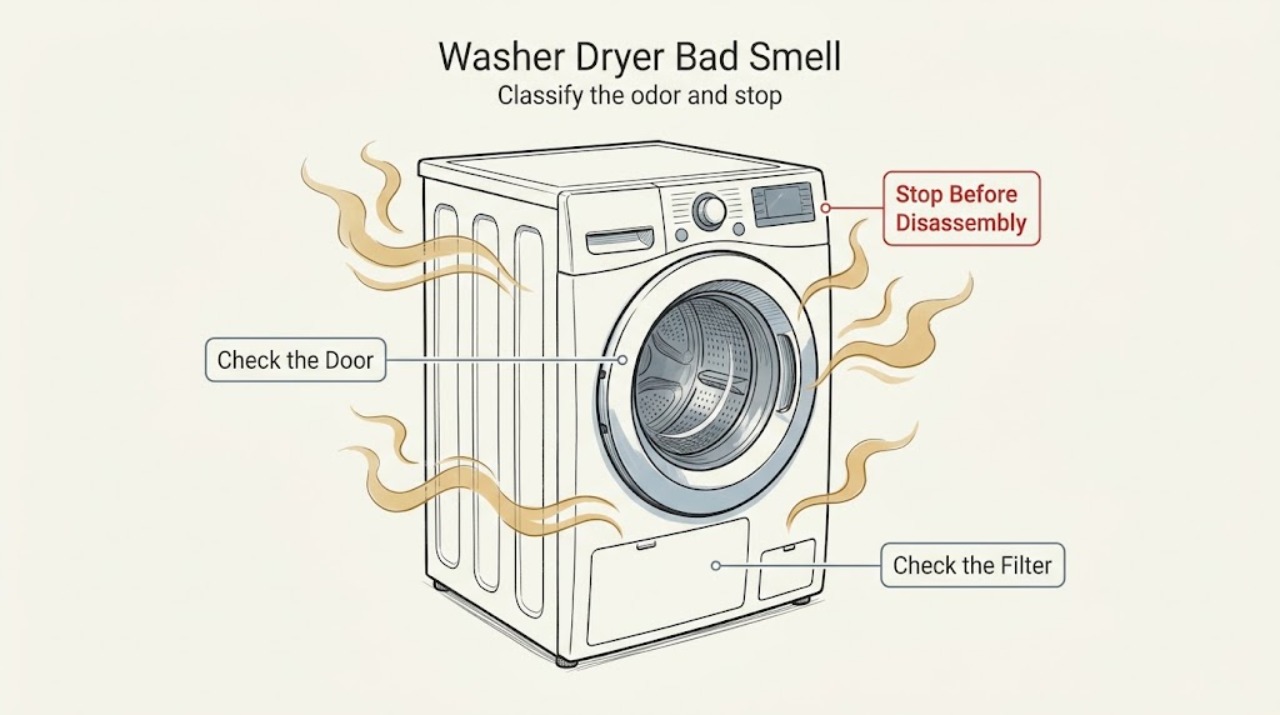
Stop the washer-dryer and note where the smell is strongest: the drum, door seal, detergent drawer, drain area, or drying outlet. Distinguish musty or sour, detergent or mildew-like, rubber on a new dryer, solvent or chemical, electrical burning, or smoke. Keep the door closed if smoke or a strong chemical odor is present and do not run another cycle to test it.
Expected result: The smell is a mild musty or sour odor around damp laundry or washable surfaces, a short-lived rubber odor from a new dryer, or a burning, electrical, solvent, chemical, or smoke odor.
Next step: For smoke, burning, electrical, solvent, or strong chemical odor, stop immediately, disconnect power only if safe, ventilate without operating switches, and arrange qualified service. For a mild laundry odor, remove wet laundry and continue with the external cleaning checks after the drum is stationary.
Why this matters
Why: Miele documents retained wet laundry, machine residue, and closed wet surfaces as causes of ordinary laundry odors and notes that a new tumble dryer can have a temporary rubber odor. Burning, smoke, solvent, or strong chemical odor can indicate a safety or product-compatibility problem rather than organic residue.
-
Remove moisture from laundry, door, and drawer
Remove laundry as soon as the programme ends and check whether the door, porthole, seal, and detergent drawer were left closed while wet. With the machine off, stationary, and safe to access, wipe visible moisture and residue from accessible surfaces and leave the door and drawer slightly open so they can dry. Do not leave children or pets able to enter the open drum.
Expected result: Wet laundry was left in the drum, the door or drawer stayed closed, moisture is visible on the seal or glass, or the surfaces are dry and the odor returns from another area.
Next step: Change the unloading and ventilation routine and monitor the next load. If residue or odor remains, inspect the drawer, seal, drum, and accessible filters; do not force a door or reach into a moving drum.
Why this matters
Why: Miele identifies long periods with wet laundry and closed door or drawer as odor contributors. Drying the accessible surfaces can prevent recurrence, but a smell that remains with the drum, seal, and drawer clean needs a deeper cleaning or service branch.
-
Clean the accessible drawer, seal, drum, and filters
With the appliance switched off and power safely disconnected for cleaning, inspect the detergent drawer, its channels, the door seal folds, porthole glass, and any filter the manual identifies as user-accessible. Remove visible lint, hair, detergent, or softener residue using the manual's mild cleaning method, and dry the cleaned surfaces. If a drain filter may contain water, follow the exact controlled-drain procedure rather than opening it casually.
Expected result: Residue, mold-like film, lint, or standing dampness is present, or the accessible areas are clean while the odor persists.
Next step: Clean and dry only the accessible components named by the manual; do not use solvents, abrasive cleaners, a water jet, or mixed chemicals. If the odor remains or the filter cannot be safely accessed, proceed to the model-specific maintenance programme or arrange service.
Why this matters
Why: Miele explains that detergent and fabric-softener buildup, lint, hair, and damp surfaces can contribute to unpleasant odors. Clean accessible surfaces can remove a local source; persistent odor with those areas clean shifts attention to the maintenance programme, dosing, drain, or drying path.
-
Run the correct empty-drum cleaning programme
Find the exact model manual and select its Clean Machine or approved high-temperature cleaning programme with no laundry in the drum. Add only the machine cleaner or other detergent and amount the manual specifies; never combine cleaners. If there is no Clean Machine programme, follow Miele's model-specific cleaning instructions rather than inventing a cycle or temperature.
Expected result: The empty maintenance programme completes and the odor is gone, the odor is reduced but returns, or the programme cannot start, stops, leaks, or displays a fault.
Next step: If the odor is gone, let the door and drawer dry after future use and repeat maintenance at the interval specified by the model. If the smell returns or the programme fails, stop using cleaning chemicals and arrange qualified service for the drain, dosing system, or internal areas.
Why this matters
Why: Miele states that cleaning the washer-dryer reduces bacteria, mold, biofilm, and unpleasant odors, and its manual requires an empty drum for the Clean Machine programme. A returning odor suggests continued residue, dosing, drainage, or drying-path contamination; a failed or leaking programme needs service.
-
Clean the drying and fluff path when the smell follows drying
If the odor appears after a drying programme, check whether the model has a Rinse out fluff or equivalent maintenance programme and whether it is a condenser design with user-cleanable filters or a heat exchanger. Run only the empty maintenance programme described by the manual, use no detergent where the manual says not to, and clean filters or the heat exchanger only as instructed.
Expected result: Fluff or lint is visible in the drum, door seal, filter, or drying path, the smell appears only after drying, or the drying path is clean and the odor also occurs after washing.
Next step: Complete the model-specific empty fluff or filter-care procedure and wipe remaining accessible fluff from the seal and glass. If the odor remains, the dryer overheats, airflow is weak, or the heat exchanger cannot be safely accessed, stop and arrange service.
Why this matters
Why: Miele's washer-dryer manual says fluff develops during drying and can collect in the drum and suds container, and its dryer support requires condenser filters and heat exchangers to be cleaned according to the operating instructions. A washing-only odor points back to moisture, residue, or dosing rather than the drying path.
-
Correct detergent dosing and perform one controlled retest
Check the detergent amount against the load size, soil level, water hardness, and the machine's automatic dosing setting. Use only the detergent type and quantity allowed by the exact manual. After the cleaning routine is complete and all accessible surfaces are dry, run one normal small load and remove it promptly; stop if the smell becomes burning, chemical, or unusually hot.
Expected result: The dose was excessive or insufficient, the machine has automatic dosing that was set incorrectly, the test load no longer smells, or the odor returns despite correct dosing and cleaning.
Next step: Keep the corrected dosing and ventilation routine if the retest is normal. If odor returns, the appliance leaks, the drum fails to drain, or the source cannot be located without opening the cabinet, leave it off and arrange qualified Miele service.
Why this matters
Why: Miele identifies incorrect manual or automatic detergent dosing as an odor contributor. A normal-smelling test load after cleaning and corrected dosing supports a maintenance cause; recurrence despite those corrections suggests a hidden drain, dosing, seal, or drying-system issue.
Use your observations
Decision map
Find the observation that best matches what you see, then follow the next safe action.
-
PATH 01Next step
What you see
The odor is musty or sour, wet laundry was left inside, or the door and detergent drawer stayed closed while damp.
Do this next
Remove laundry promptly, dry accessible surfaces, and leave the door and drawer slightly open after use. Run the model's empty cleaning programme if odor remains.
-
PATH 02Next step
What you see
Detergent, softener, lint, hair, or damp residue is visible in the drawer, seal, drum, or accessible filter.
Do this next
Clean only the accessible parts using the exact manual's mild method and avoid solvents, abrasive cleaners, water jets, and mixed chemicals. Arrange service if the source persists.
-
PATH 03Next step
What you see
The smell appears only after drying and fluff or filter residue is present.
Do this next
Use the model's empty Rinse out fluff or filter and heat-exchanger care procedure; do not add detergent to a maintenance programme. Arrange service for weak airflow, overheating, or persistent odor.
-
PATH 04Next step
What you see
The odor follows a new dryer and is a mild rubber smell that fades after the initial cycles.
Do this next
Ventilate the room and monitor according to the operating instructions. Stop immediately if the odor is burning, electrical, smoky, or intensifying rather than fading.
-
PATH 05Next step
What you see
The odor returns after accessible cleaning, an empty maintenance programme, correct dosing, and prompt unloading, or the programme leaks or displays a fault.
Do this next
Leave the appliance off and arrange qualified Miele service for the drain, dosing, seal, blower, filter, or internal system. Do not open the cabinet.
-
PATH 06Next step
What you see
Smoke, electrical burning odor, strong chemical or solvent odor, visible wiring damage, a leak near electrical parts, or unsafe heat is present.
Do this next
Stop immediately, disconnect power only if safe, keep clear, and seek qualified emergency or appliance service from a safe location.
Helpful context
Understand the symptom
The smell's character and location help separate routine residue from a fault. A musty or sour odor in the drum, seal, or drawer commonly follows retained moisture, detergent buildup, or infrequent high-temperature cleaning. An odor that appears only after drying may come from damp textiles, filters, or a new-dryer rubber smell. Burning, solvent, electrical, or strong chemical odors are not cleaning problems: stop the machine and obtain qualified help.
Use only the programme and cleaning product named in the exact Miele operating instructions. The washer-dryer manual warns against solvent-based or abrasive cleaners, says to disconnect the plug before cleaning or maintenance, and warns that the drum must be stationary before reaching in. Never spray the cabinet with a water jet or dismantle the appliance to chase an odor.
When checks do not resolve it
Need a professional?
Arrange qualified Miele service when an odor returns after the model-specific empty cleaning and drying-path routines, when the washer-dryer leaks, cannot drain, overheats, displays a fault, or the smell requires access behind a panel. Stop immediately for smoke, burning or electrical odor, strong solvent or chemical odor, visible wiring damage, leaks near power, or unsafe heat.
Common questions
FAQ
Why does my Miele washer-dryer smell musty?
Wet laundry left inside, a closed damp door or detergent drawer, residue in the drawer or seal, infrequent machine cleaning, and incorrect detergent dosing can contribute. Remove laundry promptly, ventilate, clean accessible areas, and run the model's empty cleaning programme.
How do I clean a Miele washer-dryer that smells?
Follow the exact model manual: clean accessible drawer, seal, glass, and filters, then run the Clean Machine programme with an empty drum and only the approved cleaner or detergent. If the model has Rinse out fluff, run it empty and without detergent.
When is a Miele washer-dryer odor unsafe?
Stop immediately for smoke, burning or electrical odor, strong chemical or solvent odor, visible damage, unsafe heat, or a leak near electrical parts. Disconnect power only if safe and arrange qualified service; do not mask the smell with fragrance or open the cabinet.
Read the exact guide
Official sources
- How to Eliminate Bad Odors from Your Washing MachineMiele USA · Miele washing-machine odor sources, drawer, drum, filter, cleaning, and ventilation tips
- Laundry/washing machine smells unpleasantMiele USA · Miele washer odor, cleaning programme, wet laundry, ventilation, and detergent-dosing guidance
- Laundry/tumble dryer smells unpleasantMiele USA · Miele tumble-dryer odor, damp fabrics, condenser filter and heat-exchanger care
- Tumble dryer smells of rubberMiele USA · Miele new tumble-dryer rubber odor guidance
- WTR 860 WPM ZAMiele · Miele washer-dryer Clean Machine, Rinse out fluff, filter care, and cleaning safety; confirm details against the exact model manual
Community feedback
Share a repair observation
Share a plain-text repair observation. Accepted observations are published automatically; this page may take a moment to update.