
On this page
Start here
Quick answer
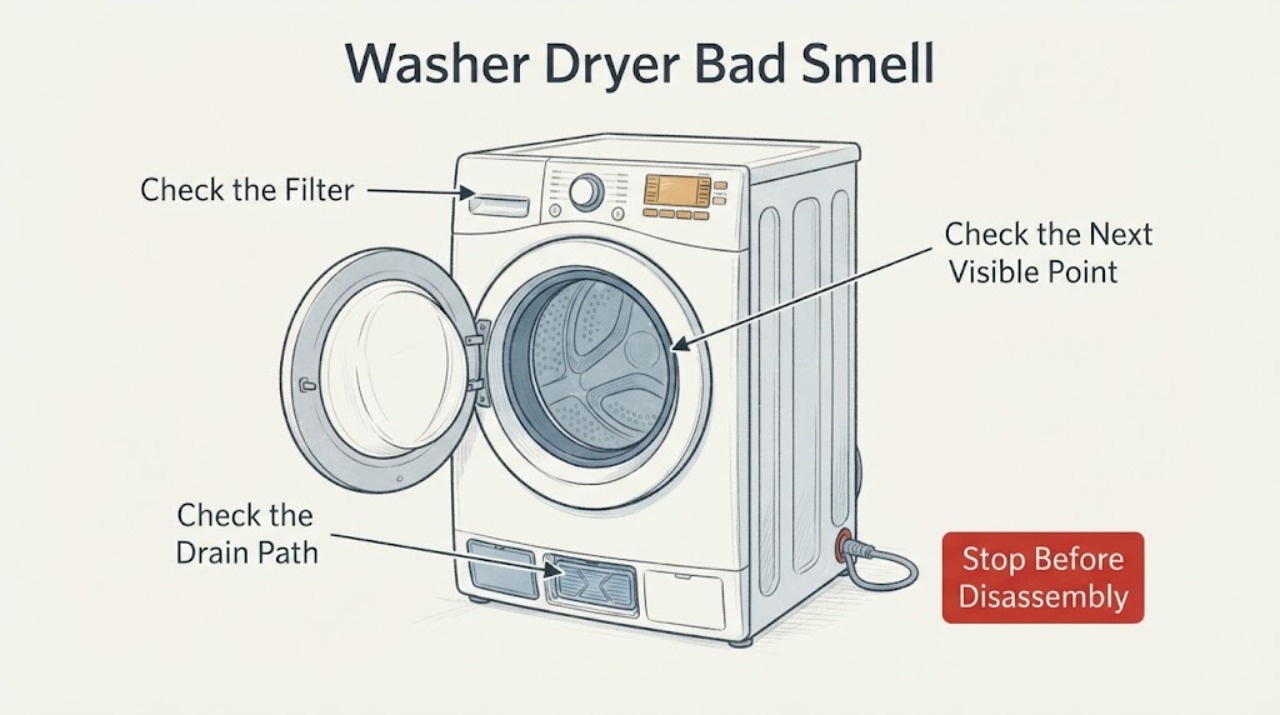
A bad smell from a Hoover washer dryer most often comes from moisture and residue in the drum, door seal, detergent drawer, filter, or drain path. First identify whether it is musty, sour, sewage-like, metallic, or burning, then disconnect the appliance before inspecting accessible areas. Clean the seal, drawer, filter, and lint or residue as the model guide permits, and run the model's approved empty maintenance cycle. A burning or electrical smell, gas smell, smoke, scorched hose, leakage, or a smell that remains after safe cleaning is a reason to stop using the machine and arrange qualified service.
Work through in order
Diagnostic checks
Use only checks that match the exact appliance or system and its official guide.
-
Check 1
Notice when the smell is strongest and describe it without running another cycle: musty or damp, sour or detergent-like, sewage or rotten-egg, metallic, burning, or electrical. Note whether it comes from the drum, drawer, door seal, filter area, drain connection, or the rear of the appliance.
Expected result: The odour has a damp/residue character, becomes stronger during draining, or smells hot, burnt, metallic, or electrical.
Next step: For a safety smell, follow the stop conditions now. Otherwise disconnect the appliance and continue to Action 2.
Why this matters
Why: Damp and sour smells support a cleaning and moisture branch. Drain-linked odour supports a waste-path branch. Burning, metallic, or electrical odour can indicate overheating, friction, wiring, or a trapped object and should not be treated as ordinary residue.
-
Check 2
Switch the washer dryer off, unplug it, and wait for it to cool. Remove laundry, then inspect the accessible folds of the door seal, the door glass, the drum opening, and the detergent or conditioner drawer for mould, standing water, hair, fluff, coins, or greasy residue. Wipe removable surfaces with a soft cloth and the model-approved mild cleaner.
Expected result: Residue, mould, trapped debris, or retained water is visible, or these accessible areas are clean and dry.
Next step: Clean and dry the accessible areas, leave the door and drawer ajar, and continue to Action 3. Do not remove the seal or cabinet panels to search deeper.
Why this matters
Why: Visible residue or trapped moisture can directly cause a musty or sour odour. A clean seal and drawer make a drain-path, filter, or internal source more likely.
-
Check 3
With the appliance disconnected and the model guide in hand, inspect the accessible drain pump filter and hose or standpipe connection. Use a shallow container and cloth for expected residual water, and stop if the filter will not release, the hose is damaged, or water is leaking. Never work on a powered appliance.
Expected result: The filter contains stagnant water or debris, the drain hose is kinked or incorrectly routed, the waste pipe smells, or the accessible drain path is clear.
Next step: Clean only the accessible filter as the manual directs and correct an obvious external routing issue. If the smell intensifies during draining, persists, or the pipe is blocked, stop and contact a plumber or appliance technician.
Why this matters
Why: Trapped water, debris, a kink, or sink or standpipe backflow can create sewage-like odour. A clear accessible path does not rule out a concealed plumbing blockage or internal pump issue.
-
Check 4
After the accessible cleaning is complete and the appliance is reassembled exactly as the manual requires, run an empty maintenance or drum-clean programme approved for the model. Use only the manual-approved cleaner or descaler and never combine cleaning products. Keep the room ventilated and remain nearby for an abnormal smell or leak.
Expected result: The odour is substantially reduced after the empty cycle, or it remains unchanged or becomes hot, burnt, chemical, or electrical.
Next step: If improved, dry the interior after each use and repeat maintenance only at the model's recommended interval. If unchanged or unsafe, stop using the appliance and use the service path.
Why this matters
Why: Improvement supports residue or moisture build-up as the source. No improvement points toward drainage, a seal that retains contamination, or an internal fault; a safety smell requires immediate stop.
-
Check 5
After washing and drying, remove damp laundry promptly, wipe moisture from the seal and glass, and leave the door and detergent drawer slightly open when the location is safe. Check whether the machine is repeatedly run on low-temperature cycles or left closed while damp.
Expected result: Moisture is trapped between cycles, the drawer or seal stays wet, or the interior dries and the odour does not return.
Next step: Adopt the drying routine if the odour resolves. If it returns quickly despite a clean, dry interior, continue to Action 6 rather than escalating chemical use.
Why this matters
Why: Trapped moisture and low-temperature residue support recurring biological or detergent odour. A dry machine with a returning smell suggests a hidden drain, seal, filter, or internal source.
-
Check 6
Before another wash or dry cycle, check whether any burning or electrical smell, smoke, scorched hose, unusual heat, water leak, damaged cord, gas smell, or persistent sewage odour remains. Do not sniff inside a running machine or touch a hot or damaged area.
Expected result: A safety symptom or persistent odour remains, or the smell has resolved after cleaning and drying.
Next step: For any safety symptom, leave the appliance disconnected and arrange qualified service; use a plumber for a confirmed household waste-pipe problem. If resolved, monitor the routine and model-specific maintenance cycle.
Why this matters
Why: A safety symptom can indicate overheating, friction, wiring, a leak, or another condition that ordinary cleaning cannot safely diagnose. A resolved odour supports maintenance rather than a parts replacement.
Use your observations
Decision map
Find the observation that best matches what you see, then follow the next safe action.
-
PATH 01Safety boundary
What you see
Is the smell musty, damp, sour, or strongest around the seal, drawer, or drum?
Do this next
Clean and dry the accessible seal, drawer, and drum area, then run the model-approved empty maintenance cycle.
Why this path and its safety boundary
Safety stop: Use the drain, metallic, burning, or electrical branches according to the smell and timing.
-
PATH 02Safety boundary
What you see
Does the smell become stronger while water drains, or does the sink, standpipe, or waste connection also smell?
Do this next
Stop and check only the accessible filter, hose routing, and waste connection with the appliance disconnected. A blocked or incorrectly routed waste pipe needs plumbing help.
Why this path and its safety boundary
Safety stop: Continue with seal, drawer, maintenance-wash, and moisture-control checks.
-
PATH 03Safety boundary
What you see
Is the smell burning, hot-metal, electrical, or accompanied by smoke, heat, sparks, or a scorched hose?
Do this next
Stop the cycle, disconnect the appliance if safe, do not use it again, and arrange qualified inspection. Do not remove panels or restart it to see whether the smell returns.
Why this path and its safety boundary
Safety stop: Proceed with the low-risk cleaning and drainage branches.
-
PATH 04Safety boundary
What you see
Does the odour substantially improve after cleaning, drying, and the model-approved maintenance wash?
Do this next
Keep the seal, drawer, and filter clean, remove laundry promptly, ventilate the interior, and repeat maintenance only as the manual recommends.
Why this path and its safety boundary
Safety stop: Treat the remaining odour as a possible drain, seal, filter, or internal fault and arrange service instead of adding stronger chemicals.
-
PATH 05Safety boundary
What you see
Does the odour return quickly, or is there a leak, standing water, a damaged seal or hose, or a filter that cannot be safely cleared?
Do this next
Leave the appliance disconnected and arrange a qualified appliance technician; use a plumber when the evidence points to the household waste pipe.
Why this path and its safety boundary
Safety stop: Monitor the machine after each use and keep the door and drawer dry and ventilated.
Helpful context
Understand the symptom
The smell type changes the next check
A musty or damp smell usually points to trapped moisture or residue around the drum, seal, drawer, or low-temperature wash path. A sour smell can indicate detergent or conditioner build-up. A sewage or rotten-egg smell that intensifies when the machine drains points toward the waste pipe, standpipe, or drain routing rather than the drum alone. A burning or hot-metal smell is a safety symptom, not a cleaning problem.
Clean only after disconnecting and cooling
Hoover's Advice Centre says to disconnect the appliance from the mains before examining it. Remove laundry, wipe the door glass and seal, clean the detergent drawer, and check the accessible filter only as the exact model instructions describe. Do not remove panels, reach near moving parts, or use a chemical mixture that is not approved by the owner's guide.
A maintenance wash prevents a recurring odour
Hoover recommends a regular empty maintenance wash to clear residue and limescale, with the exact programme and cleaner controlled by the model manual. Afterward, remove wet laundry promptly, wipe standing moisture, and leave the door and drawer ajar when safe so the interior can dry. If the smell returns quickly, treat that as evidence of a drainage, seal, filter, or internal problem rather than repeating stronger cleaning chemicals.
Safety boundary
Stop conditions
- Stop immediately for burning, electrical, hot-metal, or gas smell, smoke, sparks, scorching, unusual heat, a damaged cord, or a leaking appliance.
- Disconnect the appliance before examining the seal, drawer, filter, hose, or drain connection; do not work near moving or powered parts.
- Do not mix cleaning products, remove cabinet panels, bypass a safety device, or continue testing when the smell suggests overheating or wiring damage.
- If a sewage-like odour persists after the accessible drain checks, or a filter, hose, seal, or waste pipe cannot be safely cleared, arrange qualified service or plumbing help.
When checks do not resolve it
Need a professional?
Arrange qualified appliance service for a burning, electrical, hot-metal, gas, or persistent chemical smell; smoke, heat, leaks, damaged wiring, a damaged seal or hose, standing water, or an odour that returns after safe cleaning. Contact a plumber when the smell is clearly linked to a blocked or backed-up household waste pipe.
Common questions
FAQ
Why does my Hoover washer dryer smell musty?
Moisture and residue can build up in the drum, door seal, detergent drawer, filter, or drain path, especially when damp laundry remains inside or low-temperature cycles are used repeatedly. Clean accessible areas with the appliance disconnected and run the model-approved maintenance cycle.
Why does the smell get worse when my Hoover washer dryer drains?
A drain hose, sink waste, standpipe, or filter may be holding stagnant water or allowing backflow. Check only the accessible filter and hose routing with the appliance disconnected; a blocked household waste pipe needs plumbing help.
How do I clean a smelly Hoover washer dryer?
Disconnect and cool the appliance, remove laundry, clean the accessible seal, door glass, detergent drawer, and filter as the model guide permits, then run its approved empty maintenance or drum-clean cycle. Never mix cleaning products or open the cabinet.
Is a burning smell from a Hoover washer dryer safe?
No. A burning, electrical, hot-metal, or gas smell, smoke, sparks, scorching, unusual heat, or a damaged cord is a stop condition. Disconnect the appliance if safe and arrange qualified inspection rather than running another test.
Read the exact guide
Official sources
- Keeping your washing machine smelling fresh and hygenicaly cleanHoover Advice Centre · Hoover washer-dryer maintenance-wash and residue-control guidance
- Keep door seal clean and dryHoover Advice Centre · Hoover washer-dryer door-seal cleaning, moisture control, and maintenance wash guidance
- Smelly machineHoover Advice Centre · Hoover washer and washer-dryer drain routing, maintenance wash, and odour guidance
- How do i get rid of the smell in my washing machine?Hoover Home · Hoover washing-machine and washer-dryer odour types, cleaning, drainage, ventilation, and safety escalation
Community feedback
Share a repair observation
Share a plain-text repair observation. Accepted observations are published automatically; this page may take a moment to update.