
On this page
Start here
Quick answer
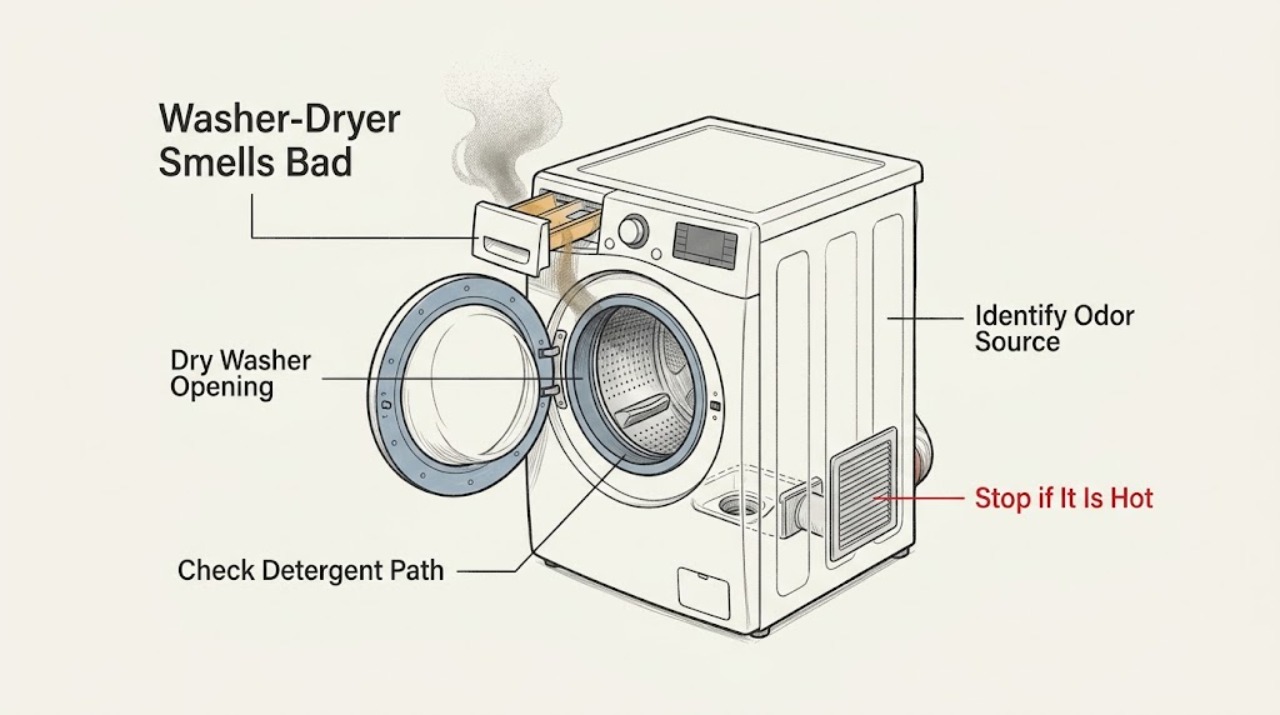
Stop the cycle, remove the load, and first decide whether the odor is musty or detergent-like from the washer, or hot and lint-like from the dryer. If you notice smoke, sparking, a strong electrical or burning odor, or a cabinet or outlet becoming unusually hot, stop using the appliance and arrange qualified service; do not open the cabinet. If the machine is cool and there is no hazardous sign, dry the accessible washer opening, leave a lid or door ajar only where the design permits, check detergent use and visible drain symptoms, and clean the dryer lint filter. Frigidaire recommends prompt clothing removal and moisture control to prevent washer odors, HE detergent with the model's dosage guidance, and lint-filter cleaning after each drying load.
Work through in order
Diagnostic checks
Use only checks that match the exact appliance or system and its official guide.
-
Check 1
Stop the active cycle, remove the laundry if it can be done safely, and let the washer-dryer cool. From a safe distance, identify whether the smell is strongest at the washer opening, dryer filter/exhaust, clothes, outlet, or cabinet.
Expected result: Look for smoke, sparks, a strong electrical or burning odor, an unusually hot cabinet or outlet, or visible scorching. Otherwise classify the smell as musty/sour, detergent-like, hot dust/lint, or only present in the clothes.
Next step: If any hazardous sign is present, stop using the affected appliance, keep clear of the cabinet, and arrange qualified appliance service. If no hazardous sign is present and the unit is cool, continue with the side-specific checks below.
Why this matters
Why: Smoke, sparks, scorching, or a strong electrical/burning odor is not a cleaning diagnosis. A musty or detergent smell points to the washer's moisture or residue path; a hot lint smell points to the dryer airflow path.
-
Check 2
With the washer off and cool, remove any damp load promptly. Wipe the accessible top, sides, and washer opening with a damp cloth or mild soap and water; for a top-loading laundry center, dry the lid opening and underside of the lid. Leave the lid open, or the door ajar only if the model's design and manual allow it.
Expected result: Check whether the odor is concentrated at a damp rim/opening or whether you can see detergent film, lint, or other residue. Do not reach into a locked drum or remove panels, seals, hoses, or pumps for this check.
Next step: Use only the non-abrasive cleaning method and Tub Clean, System Clean, Clean Washer, or other cycle named in the Owner's Guide for the exact model; do not mix cleaners. If the odor persists after the manual-directed clean, continue to the detergent and drain checks, then service if it returns.
Why this matters
Why: Dampness or accessible residue supports a moisture/residue source. No visible change does not rule out residue in the tub, dispenser, drain, or concealed areas.
-
Check 3
Review the detergent product, placement, and dose against the Frigidaire Owner's Guide. For the washer types covered by Frigidaire's detergent guide, use HE detergent, keep liquid or powder below the dispenser's maximum line, and place a detergent pack in the drum rather than the dispenser.
Expected result: Look for excess suds, a sticky dispenser or pack residue, detergent film, or a smell that is clearly perfumed/soapy rather than damp. Note whether the problem began after changing detergent, dosage, or dispensing method.
Next step: Correct only the product and dose permitted by the manual, clean the accessible dispenser as instructed, and run the model's appropriate empty rinse or cleaning cycle. If the dispenser is damaged, blocked internally, or the smell remains, stop disassembly and request service.
Why this matters
Why: Excess product, the wrong detergent type, or residue in the dispensing route can leave odor or film and can contribute to drainage trouble. This does not prove that a valve, pump, or control part has failed.
-
Check 4
If there is no burning or electrical warning and the washer is cool, run only the empty rinse or drain function named by the Owner's Guide. Observe the end of the cycle without opening panels; check the accessible drain hose for a visible kink and the nearby drain opening for an obvious external blockage.
Expected result: Water drains fully and the odor decreases, or water remains/pools, drains slowly, or the smell is strongest around stagnant water.
Next step: If water remains or draining is slow, stop using the washer and have the drain path and pump checked; do not tip the stacked unit or open the pump housing. If it drains normally but the odor returns, arrange service for concealed residue, seal, venting, or another internal cause.
Why this matters
Why: Remaining water or a restricted drain path can keep the tub damp and support recurring odor. A drain problem that is not solved by an accessible hose correction is not evidence to replace the pump yourself.
-
Check 5
If the smell is strongest on the dryer side and the dryer is cool, remove and clean the lint screen or filter. If it has residue, wash it with warm soapy water, dry it thoroughly, and reinstall it. Inspect only the visible outdoor exhaust outlet or reachable vent connection; do not open the cabinet.
Expected result: The filter is heavily loaded or coated, the exhaust airflow is weak, drying takes longer than usual, or the hot smell returns even with a clean filter.
Next step: Do not run the dryer when a hot/burning odor, smoke, scorching, or poor airflow persists. Arrange qualified inspection of the dryer and exhaust path; concealed cabinet and vent cleaning are service work.
Why this matters
Why: Frigidaire identifies lint buildup as an airflow restriction. Persistent hot odor, smoke, scorching, weak exhaust, or lint collecting in concealed areas raises a fire and equipment-risk boundary rather than a routine cleaning task.
-
Check 6
Only after the appliance is cool, the visible cleaning is complete, there is no standing water, and no burning/electrical symptom exists, run one short empty washer or dryer test using a cycle permitted by the Owner's Guide. Stay nearby and stop immediately if the odor changes or intensifies.
Expected result: No odor returns, the odor returns only in the washer, it returns only in the dryer, or it returns with smoke, scorching, unusual heat, or electrical symptoms.
Next step: If the smell returns, do not keep repeating cycles or substitute unlisted chemicals. Record the side, cycle, load state, odor description, drainage/airflow symptom, and model number for qualified service. Stop immediately for smoke, sparks, scorching, or unusual heat.
Why this matters
Why: A clean empty test that stays odor-free supports a load/product or accessible-residue cause but is not a guarantee. A repeated side-specific odor indicates an unresolved appliance or vent-path fault; hazardous signs require immediate stop.
Use your observations
Decision map
Find the observation that best matches what you see, then follow the next safe action.
-
PATH 01Next step
What you see
Smoke, sparks, scorching, strong electrical/burning odor, or unusually hot cabinet/outlet
Do this next
Stop using the appliance and keep clear. If it can be done without approaching smoke, heat, or exposed wiring, remove power using the normal safe disconnect; otherwise leave it alone and arrange qualified emergency appliance/electrical service. Do not open the cabinet or restart it to test.
-
PATH 02Next step
What you see
Musty or sour smell is strongest at the washer opening, with dampness or accessible residue
Do this next
Remove damp laundry, wipe the accessible surfaces, reduce moisture buildup, and run only the model's manual-directed Tub Clean or equivalent cycle. Escalate if the odor returns.
-
PATH 03Next step
What you see
Detergent or perfumed smell with excess suds, film, or dispenser residue
Do this next
Check the manual's HE detergent and dosage instructions, keep product below the marked maximum, and use the model-specific dispenser or drum placement. Do not disassemble the dispenser or substitute mixed cleaners.
-
PATH 04Next step
What you see
Water remains in the washer, drains slowly, or odor is strongest around stagnant water
Do this next
Stop use after checking only an accessible kink or external obstruction. Request service for the drain path or pump if the issue is not immediately resolved; do not tip a stacked unit or open the pump housing.
-
PATH 05Next step
What you see
Hot dust/lint smell, weak dryer exhaust, or odor returns after cleaning the lint filter
Do this next
Keep the dryer off and request qualified inspection of the dryer cabinet and exhaust path. Do not continue cycles to see whether the smell clears.
-
PATH 06Next step
What you see
The empty appliance is odor-free but clothing retains the smell
Do this next
Treat the clothing, detergent, and laundry-storage environment as the next branch: rewash according to the fabric and detergent instructions, and do not use the appliance if the odor returns during a loaded or empty cycle.
Helpful context
Understand the symptom
Start by locating the odor
A washer-dryer can produce a smell from two different air and water paths. A damp, sour, or detergent-like smell that is strongest at the washer opening points toward retained moisture, residue, or a drain problem. A hot, dusty, or lint-like smell that is strongest at the dryer filter or exhaust points toward airflow and lint. Do not keep testing a burning or electrical smell: the safe diagnostic result is to stop and obtain qualified service.
Why the washer side can smell
Moisture left around the washer opening and residue left in the tub or detergent path can make the odor return after a load. Frigidaire's care guidance specifically links prompt clothing removal and reducing moisture buildup with odor prevention. The correct cleaning cycle and any cleaner are model-dependent, so use the Owner's Guide for the exact cycle and chemical instructions rather than mixing products or opening sealed parts.
Why the dryer side can smell
Lint and residue can restrict dryer airflow. The filter is a user-accessible checkpoint, but the cabinet, blower, and concealed exhaust path are not ordinary odor-cleaning areas. If the filter is clean and a hot smell, weak exhaust, smoke, or repeated odor remains, stop using the dryer and have the appliance and vent path inspected by a qualified technician.
When checks do not resolve it
Need a professional?
Call qualified appliance service when the odor returns after the safe, model-directed cleaning checks., Arrange service when the washer leaves standing water, drains slowly, or the drain problem requires pump or internal access., Arrange dryer and exhaust inspection for persistent hot/burning odor, smoke, scorching, weak airflow, or lint in concealed areas., Use the model's Owner's Guide or qualified service for door seals, pumps, valves, wiring, controls, cabinet interiors, and any stacked-unit movement or disassembly.
Read the exact guide
Official sources
- Dryers - How often do I need to clean my dryer or the lint screen/filter to optimize my drying performance?Frigidaire · Frigidaire dryer lint-filter cleaning and exhaust/vent airflow maintenance
- Laundry Washers - Detergent GuideFrigidaire · Frigidaire front-load and top-load washer detergent type, placement, and dispenser limits
- Laundry top loading washer is not draining.Frigidaire · Frigidaire top-loading washer standing-water and drain-path checks
- Top Load Washers - How do I care and clean my Frigidaire Top Load washer?Frigidaire · Frigidaire top-load washer odor prevention, moisture control, accessible cleaning, and model-dependent Tub Clean guidance
- Laundry Centers - What detergent is best to use with my Frigidaire Laundry Center?Frigidaire · Frigidaire laundry-center washer detergent selection, placement, and model-specific product instructions
Community feedback
Share a repair observation
Share a plain-text repair observation. Accepted observations are published automatically; this page may take a moment to update.