
On this page
Start here
Quick answer
An Electrolux washer-dryer can feel less hot and take longer when it uses a heat-pump drying system; that low-temperature behavior alone does not prove overheating. Treat an unusually hot cabinet or drum, burning smell, smoke, scorching, repeated shutdown, or a persistent warning as a stop condition. If there is no danger sign, check the selected drying program and load, clean only the user-accessible air or fluff filters fitted to your model, check the drain filter only as the manual allows, and keep the appliance's airflow clear. Retry at most once under supervision. If the overheating sign returns, the machine stops repeatedly, will not start after drying, or a leak or damaged cord is present, stop using it and arrange Electrolux-authorized service; do not open the cabinet or test live heating parts.
Before you begin
Safety first
- This article covers ordinary-access observation and model-approved cleaning of user-accessible filters only. Authorized service must handle cabinet access, live electrical measurement, heating or fan diagnosis, temperature-control parts, wiring, and safety-device evaluation.
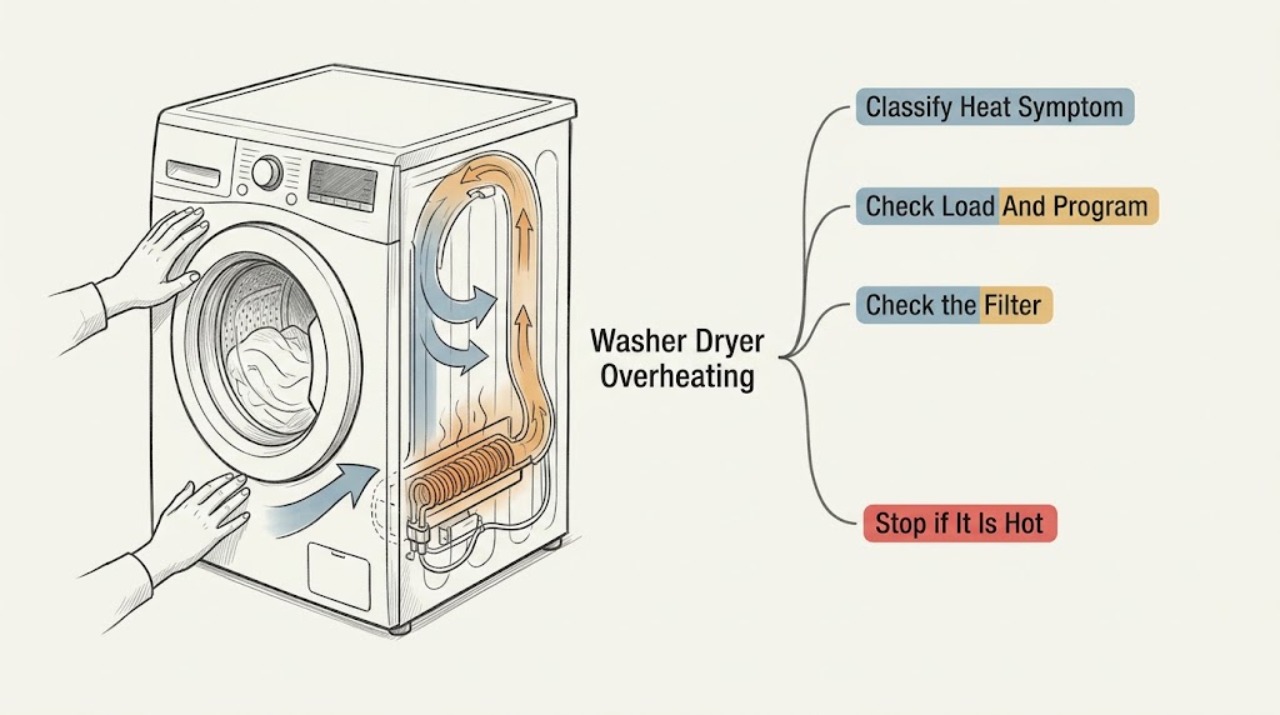
Work through in order
Diagnostic checks
Use only checks that match the exact appliance or system and its official guide.
-
Check 1
Stop the cycle if it is producing smoke, scorching, a burning smell, or an unusually hot cabinet; otherwise, from a safe position, note whether the appliance is a heat-pump model and compare the current warmth and drying time with its normal behavior.
Expected result: Record warm-but-gentle drying with no odor, or abnormal heat, odor, smoke, scorching, repeated stop, or a returning warning; do not touch hot surfaces to measure them.
Next step: For any smoke, scorching, burning smell, damaged cord, repeated electrical trip, or unusually hot cabinet, stop using the appliance, keep clear until it cools, and arrange authorized service. If none is present, continue to the load and program check.
Stop if: Do not restart an appliance that smokes, smells burnt, scorches laundry, repeatedly trips protection, or becomes too hot to approach safely; never remove the cabinet or test live parts.
Why this matters
Why: Gentle warmth can be normal for heat-pump drying. An abnormal heat or safety sign is not a filter-cleaning experiment and may indicate a temperature-control, fan, heater, or other internal fault.
-
Check 2
After the appliance has cooled and only through normal controls, review the drying program, fabric setting, and amount of laundry; keep the drying load within the model's drying capacity, which may be lower than its wash capacity.
Expected result: Record whether the load was packed tightly, whether it exceeded the stated drying capacity, whether the selected program matches the fabric, and whether a smaller correctly sorted load dries normally.
Next step: Remove excess laundry only when it is safe to handle, select the model-specified program, and supervise one normal drying cycle. If the abnormal heat or stop returns, stop and request service rather than repeating cycles.
Stop if: Do not handle laundry that is scorching or too hot, and do not keep retrying an overloaded or overheating machine to force a result.
Why this matters
Why: An excessive or unsuitable load can extend the drying cycle and make the appliance work harder; correcting it is a user-level check. A correctly sized load that still overheats or repeatedly stops points beyond load selection.
-
Check 3
With the appliance off and cool, inspect only the air, fluff, or lint filters that the exact Electrolux model identifies as user-accessible; clean and refit them exactly as the manual directs, without removing heat-exchanger, fan, heater, or control covers.
Expected result: Record whether a fitted filter is visibly blocked with lint or residue, clean and seated, damaged, or not present on this model; note whether it can be refitted without force.
Next step: If the manual permits cleaning, clean and fully refit the filter, then perform no more than one supervised normal cycle. If heat remains abnormal, the filter is damaged, or access requires a cover to be removed, stop and arrange authorized service.
Stop if: Do not run with a filter missing or loose, scrape delicate filter media, force a housing, or open covers around the heat exchanger, fan, heater, or controls.
Why this matters
Why: A blocked filter can restrict drying airflow and contribute to long drying or overheating risk. A clean, damaged, missing, or inaccessible filter does not establish a user repair and may indicate a model-specific or internal service issue.
-
Check 4
Only if the exact manual permits user cleaning, inspect the drain pump filter with the washer-dryer off, disconnected through the normal accessible isolation point, and cooled; place a shallow container for residual water and never reach into hot water or force the filter.
Expected result: Record whether the drain filter is blocked, clear, leaking after correct refitting, or inaccessible without removing a panel; stop if water is hot, the filter will not move normally, or the housing is damaged.
Next step: Clean and refit only by the model's instructions, dry the accessible area, and check for a leak during a supervised permitted cycle. If leakage, blockage, or access uncertainty remains, stop use and request service.
Stop if: Do not open the filter while water may be hot, operate with a leaking or incorrectly seated filter, remove a cabinet panel, or improvise a drain repair.
Why this matters
Why: Electrolux's washer-dryer maintenance guidance links the drain filter to routine care, but a drain blockage or leak is distinct from proving an overheating component fault. Incorrect refitting can itself cause a leak.
-
Check 5
From ordinary access, check that the washer-dryer base openings and surrounding ventilation are not covered by a mat, lint, storage, or a tight obstruction, and confirm the room is within the range stated for the applicable heat-pump drying system; do not move a built-in appliance or remove panels.
Expected result: Record a clear airflow path and suitable room condition, or a blocked opening, restricted installation space, excessive room heat or cold, or an obstruction that cannot be removed safely.
Next step: Remove only loose external obstructions without touching hot or powered parts; then supervise one normal cycle if no stop sign exists. If ventilation depends on moving a built-in unit or the problem returns, use authorized service.
Stop if: Do not cover ventilation openings, wedge doors or panels open, relocate a built-in machine, or dismantle the installation to create airflow.
Why this matters
Why: Electrolux explains that insufficient airflow can cause overheating, poor drying, and component failure in heat-pump drying systems. A clear path with recurring overheating shifts suspicion toward an internal fault or installation issue.
-
Check 6
After only the applicable user-level checks, run at most one normal drying cycle while remaining nearby and using the controls normally; do not use a cycle as a test with covers removed or safety devices bypassed.
Expected result: Record normal gentle heat and drying, persistent excessive heat, a repeated stop or warning, a leak, a burning smell, or failure to switch on after the drying cycle.
Next step: Keep the appliance out of service for recurring heat, smell, smoke, repeated stops, leaks, damaged cord, or failure to restart after drying; give the technician the model, cycle, load, filter condition, and sequence of observations.
Stop if: Stop immediately for smoke, scorching, burning smell, unusually hot surfaces, water near electrical parts, repeated protection trips, or any need to open the cabinet.
Why this matters
Why: A single normal result after correcting a blocked filter, load, program, or external airflow issue supports that condition as a contributor but does not authorize internal repair. Any recurring abnormal result requires professional diagnosis.
Use your observations
Decision map
Find the observation that best matches what you see, then follow the next safe action.
-
PATH 01Safety boundary
What you see
The appliance uses heat-pump drying, feels gently warm rather than dangerously hot, has no burning odor or smoke, and completes an appropriate cycle.
Do this next
Use the model-specified program and load, keep the filters clean as instructed, and monitor for a change in behavior.
Why this path and its safety boundary
Why it matters: Lower-temperature drying can be expected; warmth alone does not prove an overheating fault.
Safety stop: Stop if an odor, smoke, scorching, repeated shutdown, or unusually hot cabinet develops.
-
PATH 02Safety boundary
What you see
The drying load exceeded the model's drying capacity, the program was unsuitable, or a user-accessible filter was visibly blocked, and there is no smoke, burning smell, or other immediate danger sign.
Do this next
Correct the condition according to the model instructions and supervise one normal cycle only; escalate if the heat remains abnormal or the stop repeats.
Why this path and its safety boundary
Why it matters: Load selection, program choice, or restricted airflow may be contributing to long or abnormal drying, but this does not confirm an internal temperature fault.
Safety stop: Do not keep repeating cycles, run without a correctly seated filter, or access internal covers.
-
PATH 03Safety boundary
What you see
There is smoke, scorching, a burning smell, an unusually hot cabinet or drum, repeated stopping, a damaged cord, or repeated protection trips.
Do this next
Stop using the washer-dryer, keep clear until it is cool, and arrange authorized appliance service. Do not restart it to reproduce the symptom.
Why this path and its safety boundary
Why it matters: This is outside safe user-level troubleshooting and may involve an internal heating, fan, temperature-control, wiring, or control fault.
Safety stop: Do not open the cabinet, bypass a thermal or electrical safety device, or perform live electrical tests.
-
PATH 04Safety boundary
What you see
The permitted drain-filter check finds blockage, the filter cannot be refitted without force, or water leaks after cleaning.
Do this next
Stop use if water can reach electrical parts, keep the appliance off and cool, and request service when the manual procedure does not restore a dry, secure filter area.
Why this path and its safety boundary
Why it matters: There is a drain or sealing issue that should not be treated as proof that changing a heater or sensor will solve the problem.
Safety stop: Do not handle hot water, remove panels, force the filter, or operate with a leak.
-
PATH 05Safety boundary
What you see
The washer-dryer will not switch on after a drying cycle, or a warning returns after the safe user-level checks.
Do this next
Leave the appliance out of service and contact an Electrolux-authorized service provider with the model and sequence of events.
Why this path and its safety boundary
Why it matters: Electrolux treats this as a technical problem requiring service rather than a reason to repeatedly reset or open the appliance.
Safety stop: Do not repeatedly restart, defeat a lock or limiter, or work inside the machine.
Helpful context
Understand the symptom
First decide whether the heat is abnormal
A heat-pump washer-dryer may dry with a gentler temperature than a conventional heater, so warm rather than very hot air is not by itself a fault. The concern is a change from the appliance's normal behavior: an unusually hot cabinet or drum, burning smell, smoke, scorching, repeated stopping, or a warning that returns after the user-accessible checks. Do not continue a cycle to see whether a burning smell or smoke clears. Stop, let the appliance cool without touching hot surfaces, and use authorized service for an internal temperature, fan, heater, or control diagnosis.
Keep the drying path clear without opening the cabinet
Lint and restricted airflow can make drying take longer and can raise the risk of overheating in a heat-pump drying system. Use only filters the exact model identifies as user-cleanable, clean and refit them as instructed, and do not remove covers around the heat exchanger, fan, heater, or controls. A drain filter check is a separate, model-dependent task: the machine must be off, disconnected through a normal accessible isolation point, and cool before any permitted filter cleaning; do not handle hot water or force a filter.
Use the result to choose one safe next step
If the load was larger than the drying capacity, the wrong cycle was selected, or a fitted filter was visibly blocked, correct only those user-level conditions and supervise one normal cycle. If the appliance remains unusually hot, stops again, will not start after a drying cycle, leaks, or produces a burning smell, the cause is no longer established as a simple load or filter issue. Preserve the model information and the observed sequence for the technician instead of bypassing a limiter, running with covers removed, or replacing an unconfirmed part.
Safety boundary
Stop conditions
- Stop immediately for smoke, scorching, a burning smell, an unusually hot cabinet or drum, repeated shutdown, a damaged cord, or repeated electrical protection trips.
- Do not open the cabinet, remove covers around the heat exchanger, fan, heater, wiring, or controls, perform live electrical tests, or bypass a thermal or electrical safety device.
- Do not run the washer-dryer with an air or fluff filter missing, loose, damaged, or incorrectly fitted, and do not force any filter or housing.
- Do not handle hot water or operate with a leaking drain filter; use the model manual's cool, disconnected procedure only for a permitted user-accessible check.
- Do not keep repeating drying cycles to reproduce overheating. If safe checks do not restore normal behavior, keep the appliance out of service and arrange authorized professional diagnosis.
Only after diagnosis
Potential parts
- temperature sensor or thermal limiter
Consider this category only after a qualified diagnosis confirms that the appliance's temperature-sensing or thermal-protection circuit is faulty and rules out load, filter, drain, and airflow causes.
Confirm the exact washer-dryer model and the manufacturer's fit information with the service provider; do not bypass or substitute a safety device. - drying fan or airflow assembly
Consider this category only when service diagnosis finds inadequate internal airflow after the user-accessible filters and external ventilation are clear.
Confirm the exact model, assembly revision, and manufacturer's fit information; internal fan access is not a user troubleshooting step. - heating or heat-pump drying assembly
Consider this category only when an authorized technician identifies an internal heating or heat-pump fault after ruling out simpler airflow, load, program, and filter conditions.
Confirm the exact model and professional diagnosis before selecting any assembly; do not infer fit from appearance or open the cabinet.
When checks do not resolve it
Need a professional?
Arrange Electrolux-authorized appliance service when smoke, scorching, burning smell, unusually high heat, repeated stops, a returning warning, failure to start after drying, a damaged cord, a persistent leak, or abnormal heat after the load, program, filter, drain, and external airflow checks. Internal heating, fan, temperature-control, wiring, and control diagnosis is professional work; do not remove the cabinet or bypass a safety device.
Safety scope: This article covers ordinary-access observation and model-approved cleaning of user-accessible filters only. Authorized service must handle cabinet access, live electrical measurement, heating or fan diagnosis, temperature-control parts, wiring, and safety-device evaluation.
Common questions
FAQ
Can an Electrolux heat-pump washer-dryer feel less hot without being faulty?
Yes. Electrolux says heat-pump drying uses a low temperature, so gentle warmth alone is not proof of overheating. Treat unusual heat, burning smell, smoke, scorching, or repeated stopping as a reason to stop and request service.
What should I check first when the washer-dryer gets too hot?
First classify the symptom and stop for smoke, scorching, burning smell, or dangerously high heat. If no danger sign exists, check the load and drying program, then clean only user-accessible filters that the exact model manual identifies; supervise no more than one retry.
Can a blocked filter cause an Electrolux washer-dryer to overheat?
Restricted airflow can contribute to long drying and overheating risk in heat-pump drying systems. Clean and refit only the filters the model manual permits, and escalate when heat remains abnormal or a cover would need to be removed.
Should I keep running the washer-dryer to reproduce overheating?
No. Do not repeat cycles when there is smoke, scorching, burning odor, unusually high heat, repeated shutdown, a damaged cord, or protection trips. Keep it out of service and arrange authorized diagnosis.
When does an overheating washer-dryer need professional service?
Use authorized service for recurring abnormal heat, smoke, scorching, burning smell, repeated stops, a returning warning, failure to start after drying, a persistent leak, damaged cord, or any diagnosis that would require cabinet access, live electrical measurement, or bypassing a safety device.
Read the exact guide
Official sources
- How to clean and maintain your Electrolux washer dryer and extend its lifeElectrolux · Electrolux washer-dryer maintenance guidance; filter presence and user access vary by model, so the exact manual controls.
- Drying cycle of washer dryer takes too long, too short or not drying at allElectrolux · Electrolux support guidance for washer-dryers; exact model instructions control which filters and checks are user-accessible.
- Heat pump dryer's drying cycle is too longElectrolux · Electrolux heat-pump dryer guidance used here for the same heat-pump drying mechanism when fitted to a washer-dryer; the exact washer-dryer manual controls.
- Washer - dryer does not switch on after a drying cycleElectrolux · Electrolux support guidance specifically for washer-dryers that do not switch on after drying.
Community feedback
Share a repair observation
Share a plain-text repair observation. Accepted observations are published automatically; this page may take a moment to update.