
On this page
Start here
Quick answer
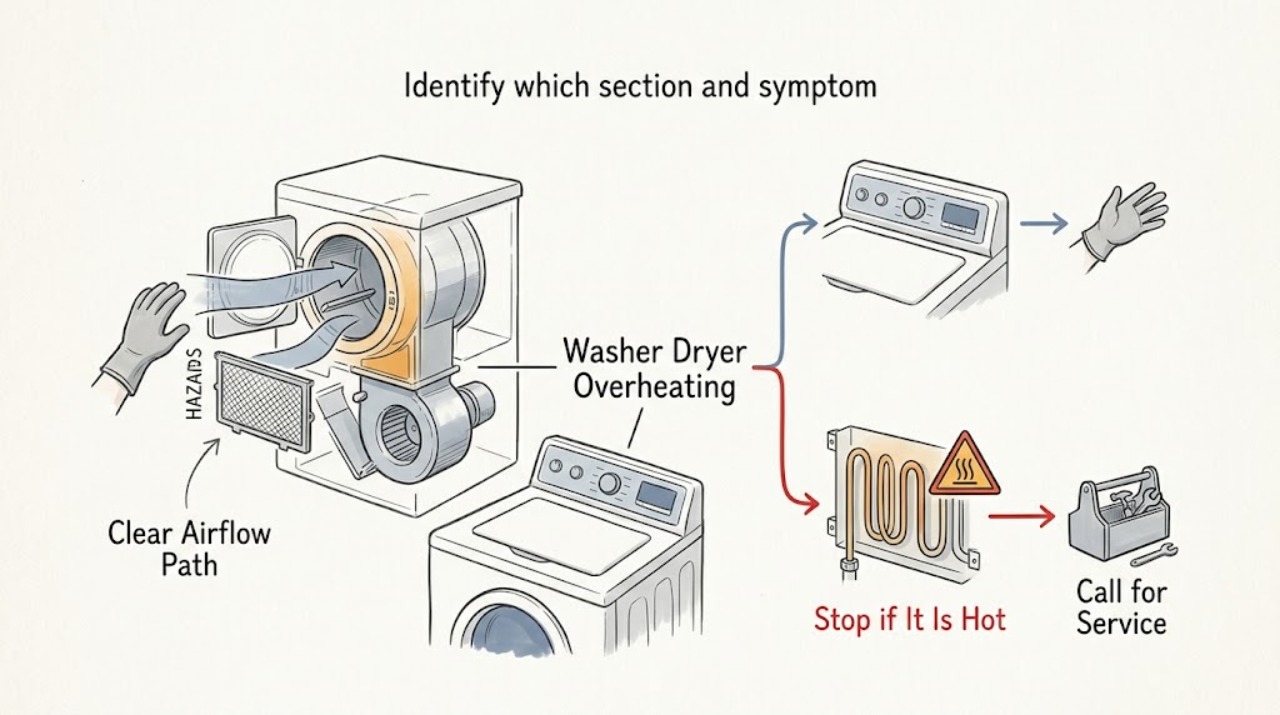
First identify whether the dryer section, washer section, or the shared cabinet is actually overheating. A dryer will feel warm during operation, but intense heat, clothes that are too hot, a burning smell, smoke, or heat that continues with poor airflow is not normal. Stop the cycle and let the appliance cool, then check the selected dryer cycle, lint screen, exhaust duct, outside hood, load size, and whether the duct is crushed or blocked. Maytag says restricted airflow can overheat a dryer and that an overheating dryer may shut off automatically. If the washer controls or cabinet become unusually hot, or if there is a burning smell, smoke, damaged wiring, or a repeated breaker trip, stop using the laundry appliance and arrange qualified service rather than opening panels.
Work through in order
Diagnostic checks
Use only checks that match the exact appliance or system and its official guide.
-
Identify which section and symptom is hot
From a safe position, note whether the heat is coming from the dryer drum or exhaust, the washer cabinet or controls, the cord or outlet, or a shared enclosure. Record the selected cycle, whether the drum tumbles, whether clothes are unusually hot, whether air is moving at the outside hood, and whether a warning or automatic shutdown occurred.
Expected result: Warm dryer air during use can be expected, but intense heat, very hot clothes, poor exhaust flow, burning odor, smoke, or an automatic shutdown indicates a dryer overheating branch. Heat at a washer control, cord, or cabinet is an electrical or component safety concern rather than a lint-screen adjustment.
Next step: If smoke, burning odor, sparks, damaged wiring, a hot cord or outlet, or repeated breaker trips are present, stop immediately and arrange service. If only the dryer is warm without warning signs, continue with the dryer cycle and airflow checks after cooling.
Why this matters
Why: The washer and dryer portions have different heat sources and safety boundaries; locating the heat prevents applying dryer advice to a washer fault.
-
Check the dryer cycle and load before testing airflow
After the dryer has cooled and no safety symptom is present, record whether Timed Dry, Automatic, Sanitize, or another high-heat option was selected. Compare the setting with the fabric and load size, remove an obviously overloaded load, and use the model manual for the correct temperature and dryness option. Do not keep running a high-heat cycle to see whether the heat settles.
Expected result: Maytag explains that cycle temperatures vary, that Timed Dry can over-dry a load, and that Automatic cycles sense temperature or moisture and stop at the selected dryness. A smaller, suitable load on the correct cycle that dries normally makes an incorrect setting more likely than an uncontrolled heater.
Next step: Use one supervised cycle at the model-approved setting only if airflow and safety conditions are normal. If clothes remain intensely hot, the dryer shuts down, or the symptom returns, stop use and inspect the exhaust path or call service.
Why this matters
Why: A selected high-temperature or timed cycle can explain warm clothes, but it does not explain smoke, scorching, a burning smell, or heat with absent exhaust flow.
-
Check the lint screen and exhaust airflow
With the dryer off and cool, clean the lint screen using the model's care instructions. Inspect the accessible exhaust duct for a crush, sharp bend, visible lint blockage, or a disconnected section, and check the outside hood for lint, debris, snow, plants, or an animal nest. Do not reach into the blower or remove duct sections that require moving a stacked or gas appliance.
Expected result: Maytag identifies a dirty lint screen, crushed or obstructed duct, and blocked outside hood as airflow restrictions that can make a dryer overheat. Little or no air at the outside hood while the dryer is operating points toward a vent-path problem, although a clear hood does not prove the internal blower or heater is healthy.
Next step: Clear only accessible lint or debris safely and restore the duct to the manual's routing. If airflow remains weak, the duct is inaccessible, or overheating returns, stop using the dryer and arrange qualified vent or appliance service.
Why this matters
Why: The exhaust system must carry hot, moist air away from the drum; a restricted path can create high heat even when the selected cycle is correct.
-
Check cabinet clearance and installation conditions
Without pulling a loaded or stacked appliance, verify that the dryer is not pressed against the wall, its exhaust is not crushed, and the room or closet has the ventilation clearance specified by the installation manual. Keep lint, boxes, and other materials away from the exhaust and around the dryer.
Expected result: A dryer that was recently moved, stacked, or installed in a tight enclosure may have a crushed duct or restricted intake and exhaust clearance. If the duct and clearance are correct but the cabinet is still intensely hot, the cause may be an internal airflow or heat-control component.
Next step: Correct only an obvious clearance or duct-position issue that the manual permits. Do not relocate a heavy or stacked unit alone; call service if the duct cannot be inspected safely or the symptom persists.
Why this matters
Why: Installation geometry can create overheating without a failed part, while persistent heat after the external path is correct needs qualified diagnosis.
-
Check washer-side heat and laundry-care conditions separately
If the washer section or its controls feel unusually hot, stop using the entire laundry appliance and allow it to cool. From a safe position, note whether the washer was overloaded, vibrating, leaking, or running a hot cycle, and inspect only the visible hose and door-seal area for leaks or damage. Do not open the washer cabinet or continue a cycle to compare temperatures.
Expected result: Maytag's maintenance guidance treats overloading, hose or connection deterioration, door-seal condition, and leaks as washer maintenance concerns. Those conditions do not make a hot control, cord, or cabinet normal; a localized electrical or motor heat symptom requires service.
Next step: If the washer controls, cord, outlet, or cabinet remain hot, or if a leak reaches electrical parts, keep both sections out of use and arrange qualified appliance or electrical service. Do not reset or restart the washer to force a comparison.
Why this matters
Why: Washer heat is not diagnosed by the dryer's lint path. Separating visible maintenance issues from abnormal cabinet or electrical heat avoids a dangerous cross-appliance assumption.
-
Use the model manual for a shutdown or heat alert
Record any display message, warning light, or automatic shutdown before clearing it. Compare the message with the exact Maytag manual. If the dryer has stopped because it detected excessive heat, do not immediately restart it; let it cool and correct only the manual-approved airflow or cycle condition.
Expected result: Maytag notes that a dryer may automatically shut off when it detects overheating and that smart models may show a vent-related code. A recurring shutdown or alert after the lint and duct checks indicates an unresolved airflow, blower, heater, sensor, or control issue.
Next step: Stop after one cool-down and manual-approved correction. If the alert returns, heat remains intense, or the dryer will not cool normally, keep it out of use and arrange qualified service.
Why this matters
Why: Automatic shutdown is a protective response, not evidence that the dryer is safe to run repeatedly without finding the cause.
-
Perform one supervised confirmation only after cooling
After the appliance is cool and an obvious cycle, lint, duct, or clearance issue has been corrected, run one supervised test with a suitable load at the model-approved setting. Stay nearby and observe the outside airflow, cabinet temperature, clothes, control display, and any odor. Stop immediately if heat rises sharply, airflow falls, smoke or odor appears, or the appliance shuts down again.
Expected result: Normal airflow and moderate warmth without warning signs support the corrected external cause. Repeated intense heat, weak airflow, very hot clothes, automatic shutdown, or any electrical symptom indicates a persistent fault.
Next step: Stop using the appliance and arrange qualified service for a failed test. Do not open panels, bypass thermal protection, or continue testing an appliance that has overheated.
Why this matters
Why: One controlled test distinguishes a corrected installation or setting issue from a failed blower, heater, sensor, control, or wiring condition without repeated overheating cycles.
Use your observations
Decision map
Find the observation that best matches what you see, then follow the next safe action.
-
PATH 01Next step
What you see
The dryer is warm during a normal cycle, exhaust airflow is present, clothes are not scorching, and there is no odor, smoke, or warning.
Do this next
Confirm the selected cycle and load are appropriate, then continue normal use while following the model maintenance guidance.
-
PATH 02Next step
What you see
The dryer is intensely hot, airflow at the outside hood is weak, or the duct, lint screen, or hood is visibly blocked or crushed.
Do this next
Stop the cycle, let it cool, clear only accessible restrictions, and arrange qualified vent service if airflow is not restored or heat returns.
-
PATH 03Next step
What you see
The dryer repeatedly shuts down, shows a vent or heat warning, or overheats after the exhaust path and cycle are correct.
Do this next
Keep the dryer out of use and arrange qualified service for the blower, heater, sensor, control, or internal duct diagnosis.
-
PATH 04Next step
What you see
The washer controls, cord, outlet, or cabinet become unusually hot, or the washer leaks near electrical parts.
Do this next
Stop using both sections, avoid opening the appliance, and obtain qualified appliance or electrical service.
-
PATH 05Next step
What you see
Smoke, burning odor, sparks, a damaged cord or outlet, or repeated breaker operation is present.
Do this next
Stop immediately, keep clear of the appliance, and seek qualified help from a safe location. Do not restart the appliance.
Helpful context
Understand the symptom
Overheating is not the same as normal warmth
A dryer exhaust and cabinet can be warm during a cycle, and a high-temperature setting can make laundry feel hotter than a low-temperature setting. The useful warning signs are intense or increasing heat, a burning smell, smoke, scorching, unusually hot clothes, a long or interrupted cycle, or little air leaving the exhaust. A washer should not have a hot control panel, cord, or cabinet.
Stop before inspecting a hot laundry appliance
Turn the affected cycle off using its normal control and keep clear while it cools. Do not open panels, reach into a drum or blower, handle a hot heating element, probe wiring, or bypass a thermal or door safety device. If smoke, burning odor, sparks, damaged wiring, or a repeated breaker trip is present, leave the appliance out of use and obtain qualified help from a safe location.
Only after diagnosis
Potential parts
- dryer blower or internal duct
Consider this only when a qualified diagnosis finds poor air movement or a mechanical blower fault after the accessible exhaust path is clear.
Blower wheels, ducts, and mounts are model-specific; verify the exact model before ordering. - dryer heating element or gas heating assembly
Consider this only when a technician confirms an uncontrolled or incorrect heat source for the exact electric or gas model.
Electric and gas heating systems are different and require qualified testing and model-matched parts. - temperature sensor or thermal protection
Consider this only after qualified testing shows that the sensor or thermal protection is causing a recurring heat-control or shutdown fault.
Sensor and thermal-device fit is model-specific; never bypass the device to keep the dryer running.
When checks do not resolve it
Need a professional?
Arrange qualified Maytag washer or dryer service when overheating returns after the correct cycle and accessible airflow checks, when the dryer repeatedly shuts down or shows a vent or heat warning, when clothes scorch, or when the washer cabinet or controls become unusually hot. Stop immediately for smoke, burning odor, sparks, a hot or damaged cord or outlet, a leak near electrical parts, or repeated breaker trips. Do not bypass thermal protection, open panels, or keep running an overheated appliance.
Common questions
FAQ
Is it normal for a Maytag dryer to feel warm?
A dryer and its exhaust can be warm during normal operation, but intense heat, scorching, a burning smell, smoke, unusually hot clothes, or poor airflow is not normal. Stop the cycle and check the model-approved cycle and exhaust conditions after cooling.
Can a blocked vent make a Maytag dryer overheat?
Yes. Maytag identifies blocked or crushed ducting, a dirty lint screen, and a blocked outside hood as airflow restrictions that can make a dryer overheat. Clear only accessible restrictions and arrange qualified service if airflow remains weak.
Why did my Maytag dryer shut off while it was hot?
Maytag says a dryer may automatically shut off when it detects overheating. Let it cool, check the cycle and accessible airflow path, and do not repeatedly restart it; a recurring shutdown needs qualified diagnosis.
What if the washer part of my Maytag washer-dryer is hot?
Stop using the laundry appliance if the washer controls, cord, outlet, or cabinet are unusually hot, or if a leak reaches electrical parts. Do not apply dryer vent advice or open panels; arrange qualified appliance or electrical service.
Read the exact guide
Official sources
- How Hot Does a Dryer Get? Dryer Temperatures & TipsMaytag · Expected warmth, overheating signs, restricted vent airflow, blower, lint screen, heating element, and crushed duct guidance
- Dryer Too HotMaytag Product Help · Dryer cycle choice, lint screen, exhaust duct, outside hood, airflow, and service escalation
- HOW TO MAINTAIN YOUR WASHER & DRYER: TIPS & CHECKLISTSMaytag · Washer overload, door seals, hoses, connections, leaks, and dryer lint and duct maintenance
Community feedback
Share a repair observation
Share a plain-text repair observation. Accepted observations are published automatically; this page may take a moment to update.