
On this page
Start here
Quick answer
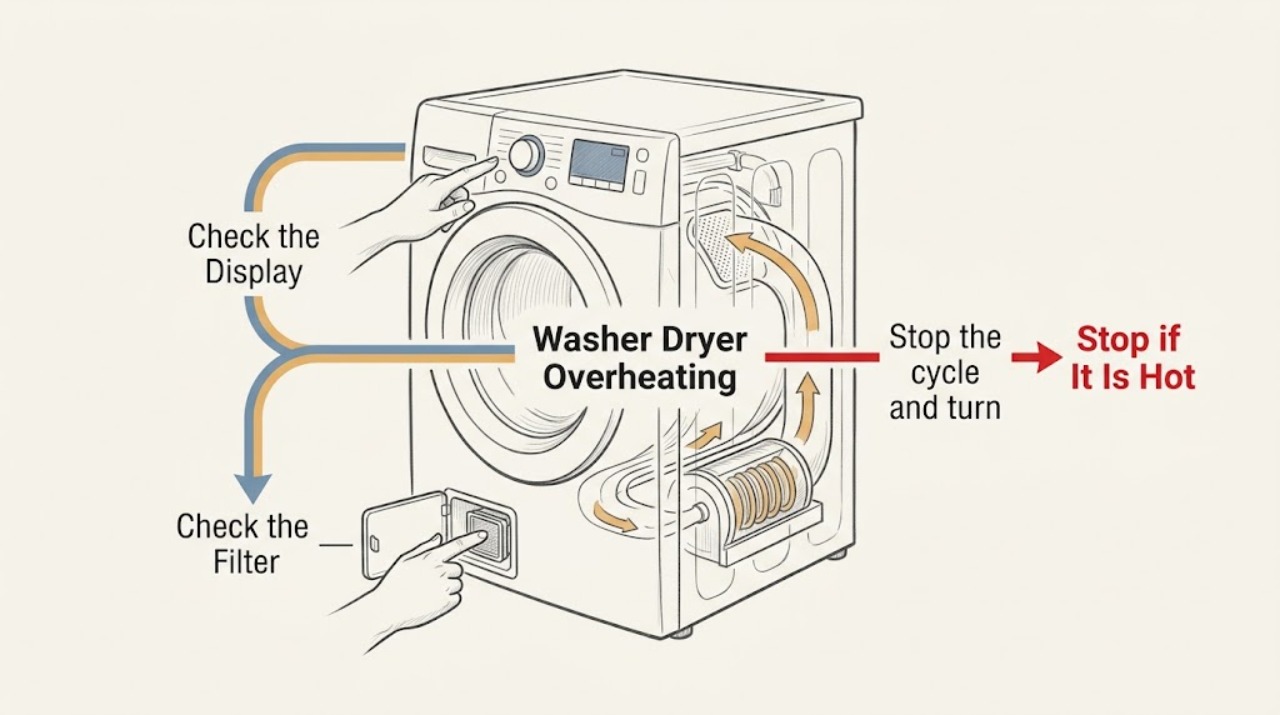
Stop the GE washer dryer immediately if there is smoke, a burning smell, scorching, sparking, a damaged cord, or a circuit trip. If the heat is on the dryer side, the first user-level cause to investigate is restricted airflow: clean the lint filter, inspect the metal exhaust duct for a kink or collapse, check the outside wall cap for an obstruction, and keep the dryer air intake clear. Use the correct heat setting and load size. If the washer side is hot, the duct is clear but the dryer still overheats, or the condition returns after the external airflow checks, leave the appliance off and arrange qualified service. Never operate a gas dryer with its vent disconnected.
Work through in order
Diagnostic checks
Use only checks that match the exact appliance or system and its official guide.
-
Check 1
Stop the cycle and turn the appliance off; disconnect power only if it is safe. Check for smoke, a burning odor, scorching, sparks, a damaged cord, water near electrical parts, or a breaker that has tripped.
Expected result: A fire, heat, electrical, water, or repeated-trip warning is present, or the appliance is simply warmer than expected without those signs.
Next step: If any warning sign is present, keep the washer dryer off, move away from smoke or fire, and contact qualified emergency or appliance service as appropriate. If there is no warning sign, continue only with external airflow and operating-condition checks after the appliance has cooled.
Why this matters
Why: The first observation separates an immediate safety event from a ventilation-performance problem. GE warns that lint accumulation and trapped dryer heat can become a safety issue, while damaged electrical parts are not an ordinary cleaning task.
-
Check 2
Identify whether the heat is on the dryer side during a drying cycle or on the washer side during washing, draining, or spinning; note whether the dryer drum is hot, the washer controls are hot, or both functions are affected.
Expected result: Heat is concentrated at the dryer drum or exhaust path, heat is concentrated at the washer controls or motor area, or the location cannot be identified safely.
Next step: For dryer-side heat, continue to the lint-filter and exhaust checks. For washer-side or unclear heat, leave the appliance off and arrange model-specific service rather than running another cycle to locate the heat.
Why this matters
Why: GE's overheating and airflow guidance applies to the dryer exhaust path. A washer-side overheating symptom is outside that airflow diagnosis and should not be treated as a vent blockage.
-
Check 3
When the appliance is cool and unplugged, remove and clean the dryer's lint filter according to the model instructions, then check that the filter is installed before any later test; also clear lint, paper, clothing, and chemicals from around and underneath the dryer.
Expected result: The lint filter or surrounding area is heavily loaded, the filter is damaged or missing, or the filter and surrounding area are clean and correctly fitted.
Next step: If lint or combustible material was found, clean the accessible area and continue to inspect the exhaust duct. If the filter is missing or damaged, do not run the dryer until it is correctly replaced according to the model manual.
Why this matters
Why: GE says to clean the lint filter each time the dryer is used and not to operate the dryer without it. Lint and combustible material around the appliance can worsen heat and fire risk.
-
Check 4
Inspect the exhaust duct from the dryer to the outside for a kink, collapse, lint obstruction, or unsuitable plastic flexible duct; check the outside wall cap or hood for lint, snow, ice, or a nest, and confirm its damper can move freely.
Expected result: The duct is restricted or kinked, the outside cap is blocked or has weak airflow, or the duct and cap appear open and correctly installed.
Next step: If an accessible obstruction is found, keep power disconnected and clean the duct or cap using an appliance brush or vacuum attachment as the model instructions allow. If the duct is damaged, inaccessible, or still restricted, arrange professional vent cleaning or appliance service.
Why this matters
Why: GE states that restricted airflow keeps hot, moist air inside the dryer and can make it hot to the touch. It recommends rigid or flexible metal ducting, regular cleaning, and an unobstructed wall cap.
-
Check 5
Check the operating conditions before a single supervised test: use the correct heat setting for the fabric, do not overload the drum, keep the dryer air intake at floor level clear, and confirm the exhaust routing matches the model installation instructions.
Expected result: The load is excessive, the heat setting is too aggressive for the fabric, clothing blocks the intake, or the installation routing exceeds the model guidance; alternatively, the conditions are normal.
Next step: Correct one external operating condition and monitor one short cycle only if there were no safety warnings. If overheating returns, stop using the dryer and arrange service; do not compensate by selecting a lower setting indefinitely.
Why this matters
Why: GE notes that heat setting, load size, fabric type, location, and vent length or bends affect dryer temperature and drying performance. These conditions can amplify restricted airflow without proving an internal component failure.
-
Check 6
If the model is an electric dryer and the exhaust path has been inspected, use the model's installation and safety instructions before considering any vent-isolation test; never disconnect a gas dryer's vent for a test.
Expected result: The exact model permits a controlled electric-only vent test, the model or fuel type is unknown, or it is a gas dryer.
Next step: If the model or fuel type is unknown, do not disconnect the duct. If it is gas, keep the vent connected and arrange service. If an electric model's manual permits the test and there are no safety warnings, follow that manual exactly; stop and schedule service if the overheating continues.
Why this matters
Why: GE says an electric dryer can be compared with its vent disconnected to help separate a venting problem from a dryer service problem, but explicitly warns not to operate a gas dryer without its vent because combustion fumes can enter the room.
Use your observations
Decision map
Find the observation that best matches what you see, then follow the next safe action.
-
PATH 01Safety boundary
What you see
There is smoke, a burning smell, scorching, sparking, a damaged cord, water near electrical parts, or a repeated breaker trip.
Do this next
Stop the appliance, disconnect power only if safe, keep clear of smoke or fire, and contact qualified emergency, electrical, or appliance service. Do not restart it to test the symptom.
Why this path and its safety boundary
Safety stop: Allow the appliance to cool and continue with the external dryer-side checks.
-
PATH 02Safety boundary
What you see
The dryer drum or exhaust area is hot and the lint filter, duct, wall cap, or intake shows restriction.
Do this next
Correct only the accessible external restriction with power disconnected, then run no more than one supervised test if there are no warning signs.
Why this path and its safety boundary
Safety stop: Continue to the washer-side or persistent-heat branch.
-
PATH 03Safety boundary
What you see
The washer controls, motor, or pump area is hot, or the source of heat cannot be identified safely.
Do this next
Keep the complete washer dryer off and arrange model-specific service. Do not use a dryer vent check to diagnose a washer-side overheating symptom.
Why this path and its safety boundary
Safety stop: Continue with the dryer operating-condition branch.
-
PATH 04Safety boundary
What you see
The filter and exhaust path are clear and correctly installed, but the dryer still overheats, shows a vent alert, or becomes hot again after one corrected test.
Do this next
Stop using the dryer and arrange qualified service. Never bypass a safety thermostat or run a gas dryer with its vent disconnected.
Why this path and its safety boundary
Safety stop: If the appliance remains normal through the supervised test, keep the lint filter clean and follow the model's vent-maintenance schedule.
Helpful context
Understand the symptom
Treat overheating as a safety symptom
A warm cabinet during a normal cycle is not the same as a cabinet that is scorching, smoking, or producing a burning odor. Stop immediately for those warning signs. Do not keep restarting the machine to see whether it improves, and do not bypass a safety control or run the dryer without its required exhaust arrangement.
Identify which half is hot
In a washer-dryer, note whether the heat is concentrated around the dryer drum and exhaust path or around the washer controls, motor, or pump. GE's published overheating guidance is primarily for the dryer function. Heat on the washer side, or heat with no dryer cycle selected, is a reason to keep the appliance off and use the model manual or service support.
When checks do not resolve it
Need a professional?
Use an authorized GE appliance service provider for persistent overheating, a clear vent with continued high heat, a washer-side overheating symptom, damaged wiring, recurring vent alerts, or any suspected internal thermostat, heater, motor, or control fault.
Common questions
FAQ
Why is my GE washer dryer overheating?
If the heat is on the dryer side, restricted airflow is a primary external path to check: clean the lint filter, inspect the exhaust duct and outside cap, and keep the intake clear. If the washer side is hot or the dryer still overheats after those checks, stop using it and arrange service.
Can I run my GE gas dryer with the vent disconnected to test overheating?
No. GE warns that a gas dryer must not be operated without its vent because combustion fumes can enter the room. Keep the vent connected and arrange qualified service if the airflow problem is not safely resolved.
How often should I clean the GE dryer vent?
GE recommends inspecting and cleaning the exhaust duct at least once a year, and sooner when a vent alert, weak outside airflow, long drying time, sweating, or unusual heat appears.
Is a hot GE dryer cabinet always a failed heater?
No. Load, heat setting, duct restriction, wall-cap blockage, and intake clearance can all affect dryer heat. A clear vent with recurring overheating, or any smoke, burning smell, sparking, or breaker trip, needs qualified diagnosis rather than a heater replacement guess.
Read the exact guide
Official sources
- Dryers Minimize the Fire HazardGE Appliances · GE dryer safety guidance for washer-dryer laundry areas; follow product-specific instructions for the appliance and fabrics.
- Dryer - Check Vent Sensor AlertGE Appliances · GE dryer models equipped with a Check Vent sensor; the external duct checks are useful even when an alert is absent.
- Dryer - Things To Check For A Venting IssueGE Appliances · GE dryer venting guidance, including some unitized washer-dryer dryer functions; use the exact installation instructions for the model and fuel type.
- Dryer - Hot to the Touch or SweatsGE Appliances · GE dryer performance guidance; model installation instructions take precedence for vent length, bends, and clearances.
Community feedback
Share a repair observation
Share a plain-text repair observation. Accepted observations are published automatically; this page may take a moment to update.