
On this page
Start here
Quick answer
If a Hoover washer-dryer produces smoke, a burning or melting smell, sparks, a hot or damaged plug or outlet, uncontrolled heating, or a breaker trip, stop the cycle and disconnect power only from a safe position. Do not open a hot door, pour water into the appliance, or restart it to see whether the smell returns. After it has cooled, record whether the heat occurred during wash, spin, or dry, the load, the model, and any code. On Hoover's official guidance, lint and vent restrictions can reduce airflow and lead to overheating or faults; condenser models also need a clean, dry condenser and an emptied water container. Clean and reseat only the user-accessible filter or condenser parts that the exact manual permits, and reduce an excessive load only when no hazard is present. If overheating returns, the filter and airflow are clear but heat remains abnormal, the machine stops with a code, or the fault appears with an electrical symptom, leave it out of service and arrange qualified repair. Do not bypass thermal protection, remove panels, or replace a heater, thermostat, sensor, motor, or board by guesswork.
Before you begin
Safety first
- This article covers ordinary display observation, safe filter or condenser care, external vent inspection, and one low-risk load confirmation only. Internal heating, motor, belt, sensor, thermal, wiring, and electrical diagnosis belongs to qualified service.
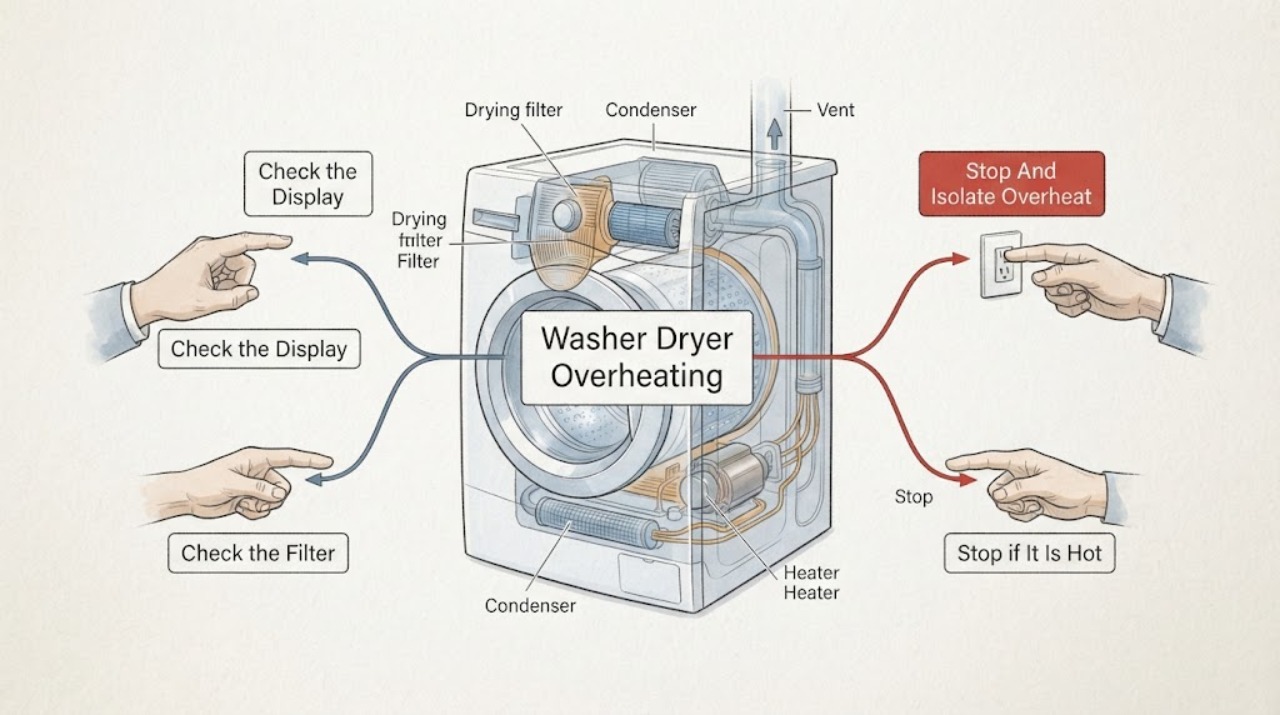
Work through in order
Diagnostic checks
Use only checks that match the exact appliance or system and its official guide.
-
Check 1
Stop the program, keep clear of the door and drum, and disconnect power only if the plug, cord, outlet, floor, and air around the appliance are safe; if there is active smoke or fire, leave the area and follow the household emergency procedure.
Expected result: Record smoke, burning or melting odor, sparks, unexpected heating, a hot or damaged cord or outlet, a breaker trip, a leak, a locked door, and whether the drum is hot or still moving.
Next step: Leave the washer-dryer out of service for any hazard and arrange qualified appliance or electrical help; otherwise allow it to cool completely before ordinary-access inspection.
Stop if: Do not pour water into the machine, touch damaged electrical parts, force a hot door, reset a breaker repeatedly, or restart to reproduce smoke or odor.
Why this matters
Why: These symptoms indicate a thermal, electrical, or fire risk beyond ordinary filter care. A hot but odor-free load after a normal dry program needs cooling and identification, but uncontrolled heat or burning odor requires service without a retry.
-
Check 2
After cooling and safe isolation, photograph the display or LED pattern and record the exact Hoover model, wash/spin/dry phase, selected program, load type and size, door state, water level, and time at which the heat appeared.
Expected result: Classify the event as heat during wash, spin, or drying; a filter or condenser warning; a numeric E code or flash sequence; a stopped cycle; a locked door; or an unknown display.
Next step: Use the exact model manual or Hoover advice centre for the recorded code and appliance type; preserve the photo for service if the code is unknown or returns.
Stop if: Do not guess at a code, open panels to read hidden components, or run another cycle solely to obtain a clearer error when overheating or odor has occurred.
Why this matters
Why: Hoover's error presentation and maintenance parts vary by model. Heat during drying with a clear filter differs from a belt or motor odor during spin, and a code from one model cannot be assigned a meaning on another without the manual.
-
Check 3
With the washer-dryer unplugged, cool, and dry, remove and inspect the user-accessible lint or drying filter exactly as the model manual permits; remove lint, wash only if permitted, dry fully, and reseat it securely.
Expected result: Record whether the filter is heavily blocked, greasy, wet, damaged, missing, incorrectly fitted, or clean; note whether a filter warning clears without a new odor, heat, or stopping symptom.
Next step: Restore the filter and perform no more than the exact manual's safe confirmation; if heat, odor, a warning, or poor drying remains, disconnect the appliance and arrange service.
Stop if: Do not run without the filter, scrape or modify its mesh, insert tools into the cabinet, or continue drying if the appliance smells burnt or becomes unusually hot.
Why this matters
Why: Hoover says buildup can restrict airflow and contribute to overheating or faults, and warns not to run without the filter. A clean or newly seated filter with returning heat indicates a condenser, duct, fan, heater, sensor, or control issue rather than a reason to remove the filter permanently.
-
Check 4
If the exact model is a condenser or heat-pump washer-dryer, check and empty the water container and clean the accessible condenser or secondary filter as instructed; if it is vented, inspect the vent hose for a kink or visible lint restriction with power disconnected.
Expected result: Record a full container, blocked or wet condenser, missing panel, crushed or blocked hose, poor external airflow, or a clean path with continuing heat.
Next step: Dry and reinstall permitted parts, reconnect the vent securely if applicable, and stop if overheating, odor, a warning, or water problem returns.
Stop if: Do not operate with a removed filter, open panel, disconnected vent, wet electrical area, blocked air path, or a condenser that requires internal disassembly to reach.
Why this matters
Why: Hoover identifies condenser and filter maintenance and clear ventilation as part of safe drying performance; a restricted path can make clothes unusually hot and contribute to faults. A clear path does not rule out a heater, fan, sensor, or control problem.
-
Check 5
Only if there is no smoke, burning smell, electrical damage, uncontrolled heating, leak, or repeated trip, allow the appliance to cool, remove part of a very heavy or tightly packed load, and use the exact manual's normal lower-risk program once.
Expected result: Record whether the cycle runs normally, the machine stops again, clothing remains unusually hot or wet, airflow stays weak, or a code returns.
Next step: Stop using the drying function and disconnect the machine if heat, odor, a code, or a stop condition returns; provide the load and program details to service.
Stop if: Do not repeat the test, select a hotter program, increase the load, or run unattended after an overheating event.
Why this matters
Why: Overloading can restrict tumbling and airflow and may make the drying system work harder, but a smaller load cannot correct an internal heater, motor, wiring, sensor, or control fault. A returning symptom requires service.
-
Check 6
Preserve the safe off state and collect the exact model and product code, display photo or flash count, phase and load, filter and condenser condition, vent or water-container observations, odor details, breaker events, and what changed after the one permitted maintenance or load check.
Expected result: Record whether the fault is repeatable, occurs only during drying or spin, follows a large load or blocked filter, happens with an empty drum, or returns immediately after power is restored; do not reproduce a hazardous condition.
Next step: Give the record to Hoover authorized support or a qualified appliance technician and request model-specific inspection of airflow, heating, temperature sensing, motor, and protective devices.
Stop if: Do not probe live circuits, remove covers, test thermal protection, or replace internal components based only on heat or a generic error number.
Why this matters
Why: This record separates a documented airflow or load condition from a motor, belt, heater, fan, sensor, wiring, or control fault without unsafe cabinet access.
Use your observations
Decision map
Find the observation that best matches what you see, then follow the next safe action.
-
PATH 01Safety boundary
What you see
A burning or melting smell, smoke, sparks, uncontrolled heating, a hot or damaged cord or outlet, water near electrical parts, or a repeated breaker trip is present.
Do this next
Disconnect from a safe position, keep the washer-dryer out of service, and request qualified appliance or electrical help; use the household emergency procedure for active smoke or fire.
Why this path and its safety boundary
Why it matters: Hoover treats a burning smell as abnormal and associates it with possible motor, belt, wiring, or trapped-object problems; the condition needs inspection rather than cleaning or another cycle.
Safety stop: Do not restart, pour water into the machine, touch damaged parts, or reset the breaker repeatedly.
-
PATH 02Safety boundary
What you see
The drying filter, condenser filter, condenser, or vent path is blocked or incorrectly seated and there is no burning odor, smoke, or uncontrolled heat.
Do this next
Unplug and cool the appliance, clean and dry permitted filter or condenser parts, restore the vent path, and perform only the model-approved confirmation.
Why this path and its safety boundary
Why it matters: Hoover says lint and dust restriction can make the appliance work harder and contribute to overheating or faults.
Safety stop: Do not run without the filter, leave panels open, or continue if heat, odor, or a warning returns.
-
PATH 03Safety boundary
What you see
A very large or tightly packed load is present, airflow is otherwise clear, and the machine has no hazard or persistent code.
Do this next
Cool the appliance, reduce the load once, and use the exact manual's normal program; stop if the symptom returns.
Why this path and its safety boundary
Why it matters: Restricted tumbling and air movement can lengthen drying and make clothing hotter, but load size does not identify an internal failure.
Safety stop: Do not repeat hot tests, select a hotter setting, or run unattended.
-
PATH 04Safety boundary
What you see
A display code or flash sequence appears, the cycle stops, or the machine will not continue after safe filter and load checks.
Do this next
Turn off and unplug as the exact manual directs, retain the code image or flash count, and arrange service if the message returns.
Why this path and its safety boundary
Why it matters: Hoover models use model-specific codes and flash patterns; an unlisted or recurring code may require authorized service.
Safety stop: Do not guess the code, repeatedly clear it, or bypass the associated sensor, door, or thermal protection.
-
PATH 05Safety boundary
What you see
The filter and permitted condenser or vent checks are clear, the load is reasonable, but overheating returns, occurs with an empty drum, or comes with abnormal motor noise or continuing heat.
Do this next
Leave the washer-dryer disconnected and arrange qualified Hoover or appliance service with the complete evidence record.
Why this path and its safety boundary
Why it matters: A heater, thermostat, temperature sensor, fan, motor, belt, wiring, or control fault remains possible and cannot be identified safely by symptom alone.
Safety stop: Do not open panels, test live circuits, bypass thermal protection, or install a generic internal part.
Helpful context
Understand the symptom
Make the first decision from the symptom, not the code
Heat after a completed dry cycle can be normal, but a burning smell, smoke, sparks, melting material, a hot plug, or continued heating after cancellation is not a cleaning reminder. Stop immediately and isolate the machine if it is safe to do so. Hoover's guidance treats a burning smell as a reason to turn off and unplug the washer and have a technician inspect it; do not try to identify a belt, motor, heater, or wiring fault while the appliance is energized.
Restore airflow only through user-accessible maintenance
Hoover explains that lint buildup in filters and vents can slow drying and contribute to overheating or faults. Depending on the model, a washer-dryer may have a lint filter, condenser filter or unit, water container, and external ventilation. The exact manual controls what can be removed. Clean only accessible parts with the machine unplugged and cool, dry washable parts completely, and never run without the filter or with a blocked vent path.
A code is a clue, not permission to bypass protection
Hoover washer-dryer manuals can show error numbers preceded by E or a repeating flash sequence on models without a display. One Hoover integrated washer-dryer manual instructs users to turn off and unplug for an unlisted code, wait, and contact authorized service if it returns. A code that appears with overheating, a locked door, a leak, or an electrical symptom should be preserved in a photograph and escalated rather than repeatedly cleared.
Safety boundary
Stop conditions
- Stop and disconnect from a safe point for smoke, burning or melting odor, sparks, uncontrolled heat, a hot or damaged cord or outlet, water near electrical parts, or a repeated breaker trip.
- Do not force a hot or locked door, pour water into the appliance, or handle hot water or wet electrical areas.
- Do not run without the lint or drying filter, leave a condenser or vent path blocked, or bypass a filter, door, thermal, or temperature-sensing device.
- Do not repeat a reduced-load or cleaning test when heat, odor, a code, or abnormal noise returns.
- Do not remove panels, probe live circuits, test thermal protection, or replace a heater, fan, motor, belt, sensor, wiring, or control from a generic symptom.
Only after diagnosis
Potential parts
- model-specific lint or condenser filter assembly
Consider only if the exact model uses a replaceable filter and inspection confirms damage or a persistent warning after approved cleaning.
Confirm the exact model, filter design, seating, and any sensor interface; never operate without the required filter. - model-specific heater, thermostat, or temperature sensor
Consider only after qualified diagnosis identifies an internal heat-control fault; overheating alone does not identify the part.
Match exact model and revision and restore thermal protection through qualified service. - model-specific fan, motor, belt, or control assembly
Consider only after service confirms an airflow, drive, or control fault from the recorded phase and symptoms.
Verify exact model, connectors, ratings, mechanical fit, and safety tests before installation.
When checks do not resolve it
Need a professional?
Arrange qualified Hoover authorized or appliance service when overheating returns, a burning smell or electrical symptom appears, a filter or condenser warning persists after the exact model's safe care, a code or flash sequence recurs, the cycle stops with a reasonable load, the door remains locked after cooling, the machine leaks, or heat occurs with an empty drum. Escalate urgently for smoke, sparks, uncontrolled heating, damaged electrical parts, or a repeated breaker trip.
Safety scope: This article covers ordinary display observation, safe filter or condenser care, external vent inspection, and one low-risk load confirmation only. Internal heating, motor, belt, sensor, thermal, wiring, and electrical diagnosis belongs to qualified service.
Common questions
FAQ
Is a warm Hoover washer-dryer after drying always a fault?
Not necessarily; heat can remain after a normal dry cycle. Smoke, burning odor, sparks, uncontrolled heat, a hot cord, or heat that returns after safe filter and airflow care is not normal and needs service.
Can a blocked filter make a Hoover washer-dryer overheat?
Hoover says lint and dust buildup in filters and vents can restrict airflow, make the dryer work harder, and in some cases lead to overheating or faults. Clean and reseat only the parts the exact manual permits, and never operate without the filter.
Should I run a smaller load after my Hoover washer-dryer gets hot?
Only if there is no smoke, burning smell, electrical damage, uncontrolled heat, leak, or repeated trip. Allow it to cool, reduce the load once, and stop if the symptom returns; a recurring overheat needs service.
What should I do with a recurring Hoover washer-dryer error code?
Photograph the code or count the flash sequence, turn off and unplug as the exact manual directs, and contact authorized service if it returns. Do not bypass the door, sensor, or thermal protection.
Read the exact guide
Official sources
- Hoover Washing Machine 8/5 kg Fully Integrated Wi-Fi Washer Dryer Instruction ManualHoover UK · Official Hoover manual for the HBWDO 8514TAHC-80 family; error codes and procedures must be checked against the exact model.
- Washer Dryer Appliance Advice CentreHoover UK · Official Hoover UK support entry point; select the exact product code before applying a procedure.
- How to Clean Tumble Dryer Filters and VentsHoover UK · Official Hoover UK dryer-care guidance; filter and vent access varies by washer-dryer model.
- How do I get rid of the smell in my washing machine?Hoover Home – Hoover UK · Official Hoover UK washer guidance; an odor after a combined washer-dryer cycle still requires model-specific diagnosis.
- How To Clean Your Tumble DryerHoover UK · Official Hoover UK tumble-dryer care guidance; exact components and permitted access depend on the washer-dryer model.
Community feedback
Share a repair observation
Share a plain-text repair observation. Accepted observations are published automatically; this page may take a moment to update.