
On this page
Start here
Quick answer
Do not decode a Maytag washer-dryer message from the letters alone: the same-looking display can mean different things on front-load, top-load, dryer, or combination models. Photograph or write the exact characters, note the model number, and record whether the message appeared during washing, filling, draining, spinning, drying, or at startup. Use the manual for that exact model and appliance stage. A control-lock message or a one-time power-failure message may clear through the documented control, while a repeated F and E service code, a door or lid that will not unlock, water that will not stop, a burning smell, smoke, gas odor, or a dryer overheating or airflow warning is a stop-use condition requiring qualified service.
Before you begin
Safety first
- This article supports recording the display, locating the model manual, and performing only model-listed ordinary-access checks. Do not bypass locks, open the cabinet, handle gas or heating parts, enter technician diagnostics, or test energized components.
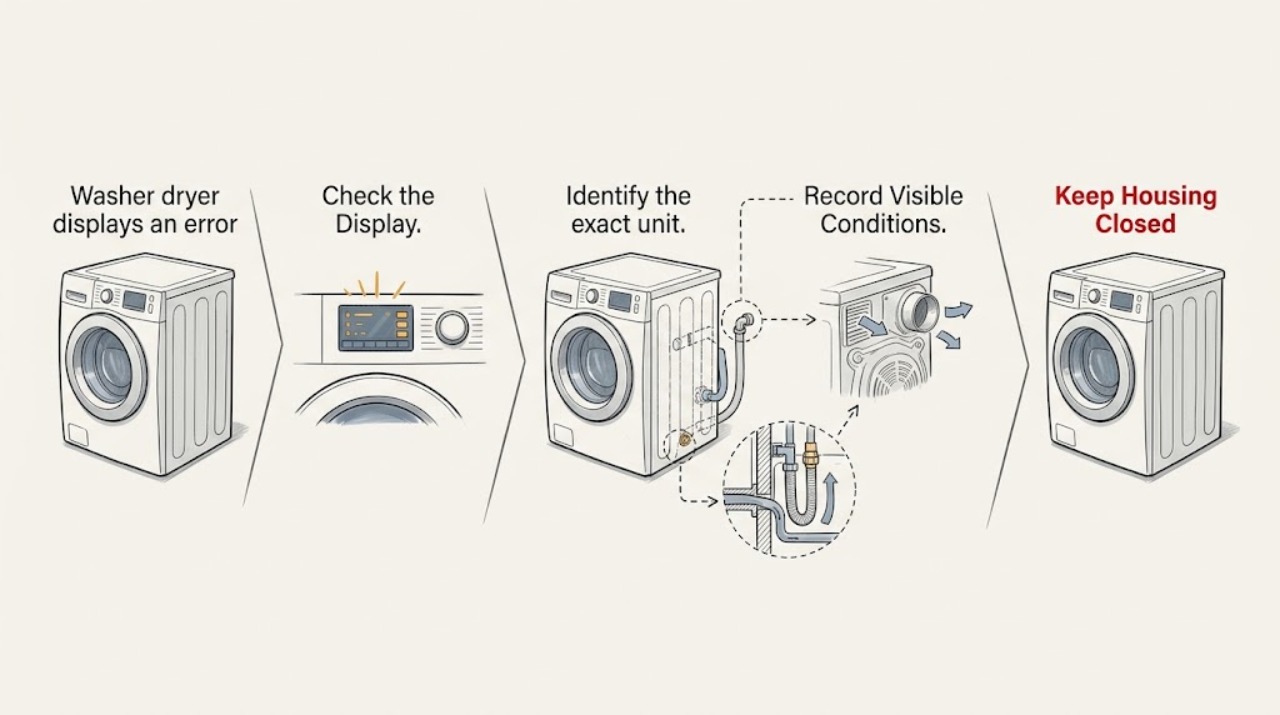
Work through in order
Diagnostic checks
Use only checks that match the exact appliance or system and its official guide.
-
Preserve the display and stop for hazards
Pause or stop the cycle using the normal control if it responds, keep the door or lid closed, and photograph or write the display exactly as shown before switching anything else.
Expected result: The display is stable and readable with no smoke, burning smell, gas odor, unusual heat, water leak, sparking, damaged cord, or forced door or lid; or one of those hazards is present.
Next step: For smoke, fire, gas odor, sparking, a hot or damaged cord, uncontrolled water, or dangerous heat, leave the area when appropriate and seek emergency, gas, electrical, or appliance help from a safe location. Otherwise keep the appliance stopped until the code and model are recorded.
Stop if: Do not force the washer door or lid, reach into a moving drum, or continue a cycle that is smoking, leaking, overheating, or electrically abnormal.
Why this matters
Why: A readable code can be matched to the correct Maytag family and stage, but smoke, burning, gas, sparking, overheating, leaking water, or a forced lock is a stop-use condition rather than a code-clearing exercise.
-
Identify the exact Maytag unit
From ordinary safe access, record the complete Maytag model number and identify whether the appliance is a front-load washer, top-load washer, standalone dryer, or washer-dryer combination; do not remove panels to find the label.
Expected result: The model and appliance type are clear, or the display belongs to a combination unit or an unidentified control layout.
Next step: Use the Maytag manual search with the exact model. If the model is unreadable or the appliance type is uncertain, keep the unit stopped and give a photo of the label and display to Maytag support or a qualified technician.
Stop if: Do not guess the model from appearance, substitute a code from another Maytag appliance, or open the cabinet to locate the label.
Why this matters
Why: Maytag publishes different code lists for front-load washers, top-load washers, and dryers, and a combination unit may use a model-specific manual. A code from a different family cannot establish the cause.
-
Record the wash or dry stage and immediate symptoms
Write down whether the message appeared at startup, during filling, washing, draining, spinning, tumbling, heated drying, cool-down, or end-of-cycle, and note whether water remains, the drum moves, the dryer feels unusually hot, or the door or lid is locked.
Expected result: The message is tied to a water, drain, balance, door or lid, airflow, heat, power, or control stage, or the stage cannot be identified.
Next step: Match the stage and exact display to the model manual. If water, heat, movement, or a lock remains abnormal, leave the appliance stopped and arrange service rather than selecting a different cycle to test it.
Stop if: Do not reach into a drum, bypass a lock, open a hot dryer, or drain or disconnect hoses while the unit is energized or under unsafe conditions.
Why this matters
Why: The same broad complaint can involve a washer fill or drain condition, a lid or door condition, a dryer vent or supply condition, a power interruption, or a control fault. Stage and physical symptoms narrow the correct official guide without proving a part failure.
-
Match the exact characters to the exact Maytag guide
Compare the recorded characters, spacing, capitalization, and display behavior with the code table for the exact Maytag model and appliance family; do not reinterpret an F-and-E pair, dashes, LOC, PF, AF, or another message as a different code.
Expected result: The exact code has a model-specific meaning and permitted check, the code appears only in a different appliance family, or no exact match is found.
Next step: Follow only the listed low-risk check for the exact model. If the code is absent, repeated, or marked for service, keep the unit stopped and arrange qualified appliance service with the photo and stage record.
Stop if: Do not clear a code before recording it, use a service-manual test sequence, or infer a component from the code text alone.
Why this matters
Why: Maytag's public lists are family-specific and may not contain every code for every model. A code that does not match the exact model remains unresolved; an F-and-E service code on a dryer or a repeated system code on a washer is not a generic reset diagnosis.
-
Perform only the guide's ordinary-access check
If the exact guide names a simple external check, perform only that check: verify a closed door or lid, remove an item that visibly prevents closure, check that both water faucets are on when a fill message says so, or inspect and clean the accessible lint screen and vent path for a dryer airflow message without opening the cabinet.
Expected result: The listed external condition is corrected and the code clears, or the condition is normal and the code remains, returns, or is accompanied by water, lock, heat, or airflow trouble.
Next step: Stop and contact qualified service when the external check does not resolve the exact code, when a hose or vent needs disassembly, or when the appliance cannot safely open, drain, cool, or stop.
Stop if: Do not remove panels, bypass a door or lid lock, disconnect a gas line, handle a heater, or reach into moving or hot components.
Why this matters
Why: A corrected door, lid, supply, drain, lint, or vent condition can explain some model-specific messages. A code that remains after the listed check, a blocked or crushed vent that cannot be safely corrected externally, or any abnormal heat, water, or lock indicates service rather than a deeper user repair.
-
Use a model-documented reset once if safe
Only after the appliance is stopped, cool or otherwise safe, dry, and free of smoke, gas odor, leaks, and lock problems, use the exact model's documented control or power reset once; do not repeat a reset to conceal a returning fault.
Expected result: The display clears and the appliance remains normal, or the same code returns, a new code appears, the door or lid stays locked, or water or heat remains abnormal.
Next step: If the code returns or any cycle function is abnormal, keep the appliance out of service and arrange qualified service. Do not run a heated cycle, bypass a lock, or perform a live electrical test to see whether the reset worked.
Stop if: Do not repeatedly cycle power, restore operation after smoke or overheating, or open the appliance to inspect controls.
Why this matters
Why: A power interruption or temporary control state may clear once, but a returning code is evidence that the underlying condition remains. Maytag's code pages direct owners to service when listed checks or reset steps do not resolve the message.
-
Prepare a precise service handoff
Give the technician the exact model, full display text, whether characters alternate, cycle name and stage, load or water state, door or lid state, recent power interruption, and any airflow, heat, leak, odor, or noise observations; include photos of the display and label.
Expected result: The record identifies one repeatable code and stage, or the display is intermittent, unreadable, contradictory, or accompanied by a safety symptom.
Next step: Keep the unit out of service for a recurring, unresolved, or unsafe display and schedule qualified Maytag appliance service. Escalate immediately for smoke, fire, gas odor, electrical damage, uncontrolled water, a locked door or lid with water inside, or overheating.
Stop if: Do not continue operation solely to collect more information when the appliance is unsafe or cannot stop normally.
Why this matters
Why: A precise record lets service use the correct model procedure and distinguish a control message from a water, drain, lock, airflow, heating, power, or internal control fault. An ambiguous or unsafe display needs hands-on diagnosis, not cross-model code matching.
Use your observations
Decision map
Find the observation that best matches what you see, then follow the next safe action.
-
PATH 01Safety boundary
What you see
The display is a model-matched control-lock message or a one-time power-failure message, the appliance is otherwise safe, and the door or lid and water state are normal.
Do this next
Use only the manual's control-lock or power-failure procedure once, then observe normal operation. Stop and request service if the message returns or the cycle does not behave normally.
Why this path and its safety boundary
Why it matters: A control state or interrupted cycle is more likely than a failed washer or dryer part, but the exact model determines how it is cleared.
Safety stop: Do not bypass a lock or keep resetting a message that returns.
-
PATH 02Safety boundary
What you see
A washer code appears during filling, draining, spinning, or door or lid operation and the exact model guide points to water supply, hose routing, load balance, detergent, or lock status.
Do this next
Perform only the model-listed ordinary-access check, such as confirming external faucets, hose condition, visible obstruction, or load distribution. If water remains, the lock will not release, the code repeats, or a hose must be disconnected, arrange service.
Why this path and its safety boundary
Why it matters: An external water, drain, load, or closure condition is possible, but the correct check depends on the washer family and exact code.
Safety stop: Do not force a locked door or lid, reach into a moving drum, disconnect pressurized hoses, or open the cabinet.
-
PATH 03Safety boundary
What you see
A dryer displays AF, F4E3, L2, PF, or another exact model-matched message, and the stage record points to airflow, electrical supply, or a power interruption without smoke or overheating.
Do this next
Follow the exact model guide for the accessible lint, vent, power, or cycle check. If airflow cannot be safely restored externally, L2 persists, the code returns, or the dryer is hot or damaged, stop use and involve qualified appliance or electrical service.
Why this path and its safety boundary
Why it matters: Maytag associates AF or F4E3 with restricted airflow, L2 with low or absent line voltage, and PF with a power failure on the cited dryer guide; these meanings are not universal across all Maytag models.
Safety stop: Do not open the dryer, handle the heater, alter wiring, run a heated cycle to prove an electrical fault, or use it with smoke or overheating.
-
PATH 04Safety boundary
What you see
An F-and-E or other system code returns after the exact listed check or one documented reset, appears in the wrong family guide, or is accompanied by an abnormal cycle, lock, water state, heat, or control response.
Do this next
Keep the washer-dryer out of service and schedule qualified Maytag appliance service with the exact display, model, stage, and prior checks. Do not substitute a component based on a code from another model.
Why this path and its safety boundary
Why it matters: A repeatable internal control, sensor, motor, water, drain, lock, heating, or communication problem is more likely than a temporary display state, but the code alone does not identify the failed part.
Safety stop: Do not run repeated cycles, enter technician diagnostics, bypass an interlock, or test energized components.
-
PATH 05Safety boundary
What you see
The display is truncated, intermittent, unreadable, or from a Maytag washer-dryer combination whose exact code table is not established.
Do this next
Keep the appliance stopped, preserve photos and timing, locate the exact model manual, and ask qualified Maytag or appliance service to identify the display before further operation.
Why this path and its safety boundary
Why it matters: The evidence is insufficient for a safe code interpretation. Guessing from a standalone washer or dryer list could direct the owner to the wrong water, lock, airflow, or electrical action.
Safety stop: Do not clear or recreate an unreadable code, force the door or lid, or use a different appliance guide as a substitute.
-
PATH 06Safety boundary
What you see
The error display is accompanied by smoke, fire, burning smell, gas odor, sparking, damaged cord, uncontrolled water, overheating, a locked door or lid with water inside, or a drum that will not stop normally.
Do this next
Stop using the appliance, leave the area when appropriate, avoid touching wet or damaged electrical equipment, and contact emergency, gas, electrical, or qualified appliance help from a safe location.
Why this path and its safety boundary
Why it matters: This is an immediate stop-use condition, not a code lookup or reset problem.
Safety stop: Do not continue a cycle, force the door or lid, reach into the appliance, or restore power to reproduce the symptom.
Helpful context
Understand the symptom
An error display is a symptom, not a universal diagnosis
Maytag publishes separate code guidance for dryers, front-load washers, and top-load washers. A display such as a control lock, power-failure notice, drain or fill message, or F-and-E service code must be interpreted with the exact model and the cycle stage. Record the characters exactly, including spaces, dashes, and whether they alternate; do not replace a displayed code with a more familiar one.
Record the appliance stage before clearing anything
Write down whether the washer-dryer was filling, washing, draining, spinning, tumbling, heating, cooling, or simply powered on when the display appeared. A code during filling or draining directs attention to water flow and hose routing, while a dryer airflow or supply message has a different check. If a door or lid remains locked, leave it closed and do not force it.
Use one documented reset, not repeated guessing
After a safe stop and only when the exact Maytag instructions permit it, use the model's documented control or power reset once. A code that returns, a code that cannot be read, or a cycle that leaves water, heat, or a locked door needs service information rather than repeated resets. Do not open the cabinet, bypass a door or lid lock, work on the heater or gas system, or test energized parts.
Safety boundary
Stop conditions
- Stop using the washer-dryer immediately for smoke, fire, burning smell, gas odor, sparking, damaged cord, uncontrolled water, overheating, or a drum that will not stop normally; leave the area when appropriate and seek emergency, gas, electrical, or appliance help from a safe location.
- Do not force a washer door or lid, bypass an interlock, reach into a moving drum, or open a locked appliance with water or heat inside.
- Do not open the cabinet, handle the heater or gas system, alter wiring, enter technician diagnostics, or test energized components as a user code check.
- Do not decode a display from another Maytag family or model, substitute a more familiar code, or order a part from the code text alone.
- Do not repeat resets or heated cycles after a code returns, the stage remains abnormal, or an external check does not resolve the exact model message.
When checks do not resolve it
Need a professional?
Arrange qualified Maytag appliance service when an exact code is not listed for the model, an F-and-E or other system code repeats, an error returns after the model's one documented reset, a washer has a persistent fill, drain, balance, or lock condition, a dryer has recurring airflow or supply messages, or a combination unit's display cannot be matched safely. Seek immediate emergency, gas, electrical, or appliance help for smoke, fire, gas odor, sparking, damaged cord, uncontrolled water, overheating, or a locked door or lid with water or heat inside.
Safety scope: This article supports recording the display, locating the model manual, and performing only model-listed ordinary-access checks. Do not bypass locks, open the cabinet, handle gas or heating parts, enter technician diagnostics, or test energized components.
Common questions
FAQ
Can I use any Maytag error-code list for my washer-dryer?
No. Maytag publishes separate guidance for front-load washers, top-load washers, dryers, and model manuals. Record the exact display and match it to the exact model and appliance stage; do not borrow a meaning from another family.
What information should I record before clearing the display?
Record every character, space, dash, alternating pattern, indicator, model number, appliance type, cycle name, and stage. Note whether the unit was filling, draining, spinning, tumbling, heating, cooling, or starting, and whether water, heat, movement, or a door or lid problem remained.
When can I try a reset?
Only after the appliance is safe, dry, stopped, and free of smoke, gas odor, leaks, overheating, and lock problems, and only when the exact Maytag manual or guide documents the reset. Use it once. A returning code or abnormal cycle needs service rather than repeated resets.
What does AF, L2, or PF mean on a Maytag dryer?
Maytag's dryer guide associates AF or F4E3 with restricted airflow, L2 with low or absent line voltage, and PF with a power failure, but the exact model manual still controls. If the message returns, airflow cannot be corrected from the outside, the dryer overheats, or electrical service is suspected, stop using it and arrange qualified service.
What if the code is F and E or does not appear in the Maytag guide?
A recurring F-and-E or unlisted code should not be decoded by guesswork. Keep the washer-dryer stopped, preserve the display photo and cycle-stage record, locate the exact model manual, and arrange qualified Maytag appliance service.
Should I force the Maytag washer door or lid open when an error is displayed?
No. Keep the door or lid closed if it is locked, especially when water or heat may remain inside. Do not bypass the lock or reach into a moving or hot drum; obtain qualified service if the lock will not release through the exact model procedure.
Read the exact guide
Official sources
- Appliance Manuals and Literature | MaytagMaytag · Primary source for matching an error display to the exact Maytag washer, dryer, or combination model before interpreting it.
- Error Codes in Dryers - Product Help | MaytagMaytag Product Help · Dryer-only source used for conditional examples; its meanings must not be transferred to washer or combination models without the exact manual.
- Error Codes - Product Help | MaytagMaytag Product Help · Source showing that dryer codes are organized into multiple code families and that the model's documentation remains necessary.
- Error Codes in Top Load HE Washers - Product Help | MaytagMaytag Product Help · Top-load washer-only source used for conditional examples; code meanings do not transfer to other Maytag families without the exact manual.
- Error Codes in Front Load Washers - Product Help | MaytagMaytag Product Help · Front-load washer-only source used to demonstrate family-specific code interpretation and service escalation.
- Contact Us | MaytagMaytag · Brand support source for locating washer, dryer, and combination model information and preparing an accurate service request.
Community feedback
Share a repair observation
Share a plain-text repair observation. Accepted observations are published automatically; this page may take a moment to update.