
On this page
Start here
Quick answer
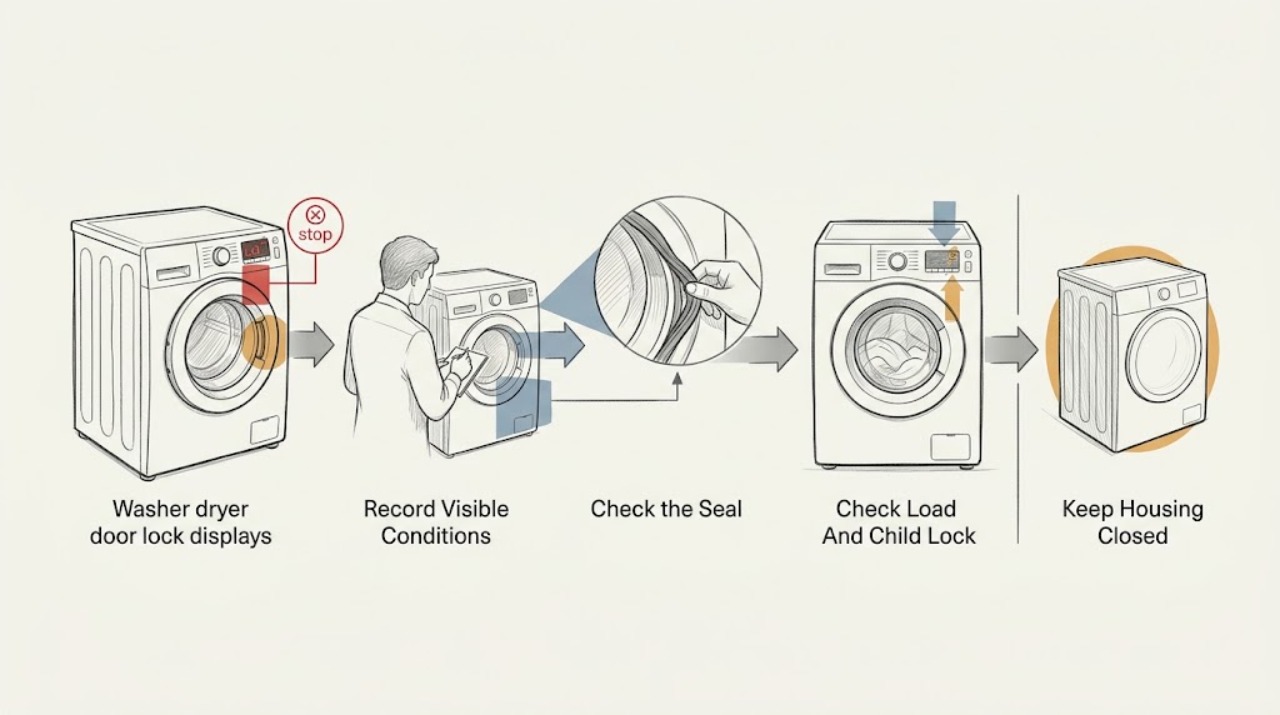
Write down the exact Electrolux washer-dryer model, displayed code, beeps or flashes, cycle stage, and whether water or hot laundry remains before trying to clear a door-lock error. Electrolux's E40 guidance starts with a fully closed door, laundry caught between the seal and glass, overload, and a mechanical child lock where fitted; it says a remaining error may indicate a faulty lock requiring service. Do not force the door, open it while the drum moves, or attempt an emergency release with hot water or a high water level. If the door remains jammed, the lock or handle is damaged, water is present, a leak occurs, or the code returns after the exact model procedure, stop using the washer-dryer, isolate power from a dry safe location, and arrange qualified appliance service.
Before you begin
Safety first
- This article supports code recording and ordinary-access visual checks only. Do not force or bypass the door lock, open panels, disassemble the door, use a release with hot water or a moving drum, touch wet electrical equipment, or test live wiring.
Work through in order
Diagnostic checks
Use only checks that match the exact appliance or system and its official guide.
-
Check 1
From outside the Electrolux washer-dryer, photograph or write down the complete model number, exact error text, beeps or flashes, cycle type, phase, and door-lock icon state.
Expected result: Note whether the message appears at start, during wash, during drain or spin, during drying, or after completion; record water in the drum, hot laundry, a clicking lock, or a control that is unresponsive.
Next step: Use the exact user manual and continue only if the appliance is stable, dry, not hot, and the drum is fully stopped.
Stop if: Stop for smoke, burning or electrical odor, sparking, abnormal heat, water near electrical parts, a leak, or a drum that is still moving.
Why this matters
Why: Codes and lock behavior are model- and phase-specific. An E40 display or four beeps/flashes is addressed by Electrolux as a door-closure/lock issue, but a different code cannot be translated from it.
-
Check 2
With the program stopped, visually inspect the door perimeter, latch opening, and seal-to-glass contact for trapped laundry, packing material, lint, or visible damage; close the door normally without force.
Expected result: Record whether the door meets the frame evenly, a garment was caught, the seal is torn or displaced, the latch clicks normally, and the same error returns when the door is closed.
Next step: Remove only accessible trapped laundry or reduce the load per the model manual, then try one model-approved restart; arrange service for damage or a returning error.
Stop if: Do not slam, pry, bend, or force the door or latch; do not use the appliance if the seal, handle, or lock area is damaged.
Why this matters
Why: Electrolux lists an improperly closed door, laundry caught between seal and glass, and overload as possible E40 causes. A torn seal, damaged latch, or repeated error is not a closure adjustment.
-
Check 3
Compare the load size and the control-panel lock indicator with the exact Electrolux cycle guide, and identify whether a mechanical child safety lock is fitted.
Expected result: Record whether the drum is overfilled, a padlock or child-lock indicator is active, the cycle is blocked before starting, or the machine continues to show the same door-lock code with a suitable load.
Next step: Reduce the load or deactivate the child lock only by the exact model procedure; never bypass the door lock itself.
Stop if: Do not insert tools into the latch, operate with an overloaded or damaged door, or keep testing if the code persists.
Why this matters
Why: Electrolux says overload and a mechanical child safety lock can prevent correct door operation for applicable models. The mechanical lock and electronic control lock are not interchangeable assumptions.
-
Check 4
Before considering any release or restart, observe through the door whether water remains, laundry is hot, the drum is rotating, or a drain phase is still active.
Expected result: Record clear drum versus visible water, cool versus hot laundry, stopped versus moving drum, and whether the cycle ended normally or halted with water inside.
Next step: Wait for the drum and laundry to cool; use only the exact manual's normal drain or release procedure, or arrange service if conditions are unclear.
Stop if: Never force the door, use an emergency release with hot water or a moving drum, or touch a wet plug, outlet, or appliance.
Why this matters
Why: A lock can correctly remain engaged to prevent flooding, burns, or injury. Electrolux's water guidance says water inside requires draining before opening and that hot laundry and a rotating drum must be ruled out first.
-
Check 5
After the appliance is cool, empty of visible water or safely drained by the model procedure, and fully stopped, inspect the handle and visible door-lock area for damage without removing covers.
Expected result: Record a loose or broken handle, door misalignment, latch that will not engage, lock indicator that stays active, or no visible damage despite a repeated error.
Next step: Keep the washer-dryer out of use and provide the code, model, and visible findings to qualified appliance service.
Stop if: Do not disassemble the door, remove the lock, test wiring, or operate with a damaged handle or lock.
Why this matters
Why: Electrolux says a damaged handle or door that remains jammed warrants an engineer and that the lock may be faulty when E40 checks do not resolve the issue. Lack of visible damage does not clear the lock, wiring, or control.
-
Check 6
Only if the exact manual permits it and there is no water, heat, leak, or lock damage, perform one documented power reset or normal cancel-and-drain sequence from a dry, safe location.
Expected result: Record whether the error clears, the lock icon changes, the door releases normally, and whether the same code returns at start, during wash, or during drying.
Next step: Stop after one unsuccessful attempt and arrange service with the exact code, timing, and reset result; do not repeat resets to keep operating.
Stop if: Stop immediately for a returning error with a locked door, water, heat, a leak, abnormal sound, electrical odor, or a breaker event.
Why this matters
Why: A temporary control state may clear, but a returning door-lock error is not proof that the lock is healthy. Electrolux's model-specific guidance directs unresolved symptoms to service.
-
Check 7
Prepare a service record without opening the appliance: model, exact code, beeps or flashes, cycle and stage, door and seal observations, water or heat state, child-lock status, and any reset result.
Expected result: Note whether the fault is repeatable at start or only after wash, drain, spin, or drying, and whether the handle or latch was damaged or the door remained jammed.
Next step: Arrange qualified Electrolux washer-dryer service and provide the record; keep the appliance unplugged and unused if the door-lock fault remains.
Stop if: Do not bypass the lock, operate with a jammed or damaged door, test live wiring, or continue cycles to reproduce the code.
Why this matters
Why: This evidence distinguishes closure, load, lock-function, drainage, heat, handle, control, and wiring patterns without unsafe disassembly or cross-model code interpretation.
Use your observations
Decision map
Find the observation that best matches what you see, then follow the next safe action.
-
PATH 01Safety boundary
What you see
A verified door-lock-related code appears at start and a garment, overload, packing material, or visible seal-to-glass interference is found.
Do this next
Remove only accessible interference or reduce the load under the exact model guide, close the door normally, and make one supervised restart.
Why this path and its safety boundary
Why it matters: Door closure or seal interference is more likely than a failed lock, but the code does not prove that the lock is undamaged.
Safety stop: Do not force the handle, slam the door, or run the machine with a damaged seal or latch.
-
PATH 02Safety boundary
What you see
The exact model shows a mechanical child-safety lock or a clearly identified control-lock indicator, while the door and seal are intact.
Do this next
Use only the model manual's deactivation procedure and verify once; arrange service if the door-lock error remains.
Why this path and its safety boundary
Why it matters: A user-selected lock function may be blocking operation; it is different from a failed door-lock assembly.
Safety stop: Do not defeat the physical door lock or insert a tool into the latch.
-
PATH 03Safety boundary
What you see
The program has just ended, the drum is stopped, no damage is visible, and the door releases after the model's normal short delay once water and heat are absent.
Do this next
Monitor the next use with the exact cycle guide; service any recurring code, jam, or failure to release.
Why this path and its safety boundary
Why it matters: A normal safety delay is more likely than a door-lock failure.
Safety stop: Do not open the door while hot or moving, and do not treat a different-model delay as universal.
-
PATH 04Safety boundary
What you see
The door-lock error or lock icon accompanies visible water in the drum, a drain phase that did not finish, or an appliance that cannot safely release the door.
Do this next
Keep the unit off and use only the exact manual's cool, stopped, model-approved drain procedure; arrange service when water remains or drainage fails.
Why this path and its safety boundary
Why it matters: The lock may be correctly preventing flooding, or a drain/filter/pump issue may be keeping the lock engaged; the lock code alone does not identify the cause.
Safety stop: Never force the door, use a release with hot water or a moving drum, or touch wet electrical equipment.
-
PATH 05Safety boundary
What you see
The door is cool and stopped, closure and load checks are normal, but the handle is damaged, the latch will not engage, or the exact code returns.
Do this next
Keep the washer-dryer unplugged and arrange qualified appliance service with the exact code and model.
Why this path and its safety boundary
Why it matters: A faulty lock or door/handle mechanism is more likely; wiring or control may also require diagnosis.
Safety stop: Do not remove the lock, disassemble the door, bypass the interlock, or continue operation.
-
PATH 06Safety boundary
What you see
The code recurs after one exact model procedure, or the error is paired with leak, heat, burning smell, smoke, abnormal sound, breaker trip, or a damaged seal or cord.
Do this next
Keep the appliance off, isolate power and water only from a dry safe location when appropriate, and arrange qualified service.
Why this path and its safety boundary
Why it matters: The problem is beyond a safe user check and may involve door lock, wiring, control, drainage, or a broader safety fault.
Safety stop: Do not run another cycle, open panels, test live wiring, force the door, or use an emergency release without documented safe conditions.
Helpful context
Understand the symptom
Capture the exact error before resetting anything
A door-lock-related message is not one universal Electrolux diagnosis. Record the full code exactly as shown, the number of beeps or flashes, whether the unit is washing or drying, the cycle stage, door-lock icon, water level, and model number. E40 is one Electrolux washer-dryer code associated with door closure and lock checks in the cited guidance; do not apply E40 steps or meanings to an unverified code.
Check closure and the seal from the front
With the cycle stopped, inspect the door edge, latch area, and door-seal-to-glass contact for a trapped garment, packing material, lint, or visible damage. Electrolux says an E40 error can result from the door not being properly closed, laundry caught between seal and glass, or an overload. Remove only accessible clothing or reduce the load as the manual permits; do not slam the door or force the latch.
Separate child lock, normal delay, and a fault
A mechanical child safety lock may be fitted on some models and has a model-specific procedure. A door may also remain locked briefly after a cycle as a normal safety feature, especially while water or heat remains. The lock must not be bypassed to test the appliance. A repeated error after the exact model checks, or a damaged handle or door, moves the issue to service.
Treat water and drying heat as hard boundaries
Electrolux water-related guidance says a door can remain locked when water is inside and warns that the drum must not be rotating and hot water or laundry must cool before an emergency procedure. A washer-dryer that stopped during drying may have heat even when the door looks ready to open. Never pull the door, insert a tool, or use an emergency release unless the exact manual confirms the conditions and steps.
Do not substitute a part for a diagnosis
A door-lock error can result from closure, seal interference, overload, child lock, water not drained, the lock or handle, wiring, or electronic control. Electrolux directs unresolved E40 symptoms to an authorized service center and recommends providing the exact error code. The displayed code does not establish which component to replace.
Safety boundary
Stop conditions
- Stop for smoke, burning or electrical odor, sparking, abnormal heat, a leak, water near electrical parts, a damaged cord, or a breaker trip.
- Do not force the door, reach into a moving drum, bypass the door lock, insert tools into the latch, or operate with a damaged handle or seal.
- Do not use an emergency door release while water or hot laundry remains or before the drum is fully stopped; follow the exact manual only.
- Do not remove the lock, disassemble the door, open panels, or test live wiring to identify a displayed code.
- Do not apply E40 or another model's code meaning to an unverified code, model, cycle, or washer-dryer design.
- After one safe, model-approved closure/load/lock procedure and reset, arrange service for a returning error, jammed door, or unresolved lock symptom.
Only after diagnosis
Potential parts
- door lock assembly
Consider this category only after the exact code, door closure, seal, load, child-lock, water, and normal-delay checks are completed and qualified diagnosis confirms a lock fault.
Confirm the complete Electrolux model, door-lock design, connector, and service procedure; do not infer fit from a code or another model. - door handle or latch hardware
Consider this category only when the handle or latch is visibly damaged or does not engage after safe closure checks and diagnosis confirms the hardware is the cause.
Confirm the complete Electrolux model, door construction, latch geometry, and compatible hardware. - drain pump, wiring, or control component
Consider this category only when qualified diagnosis links a recurring lock error to unresolved water, wiring, or control behavior after the documented user checks.
Confirm the complete model, appliance design, electrical specifications, and service procedure before selecting any component.
When checks do not resolve it
Need a professional?
Arrange qualified Electrolux washer-dryer service when the exact code returns after checking closure, seal interference, load, and any model-documented child-lock or reset procedure; when the handle, latch, seal, or lock is damaged; when water or heat prevents safe release; or when the appliance has any electrical or leak symptom.
Safety scope: This article supports code recording and ordinary-access visual checks only. Do not force or bypass the door lock, open panels, disassemble the door, use a release with hot water or a moving drum, touch wet electrical equipment, or test live wiring.
Common questions
FAQ
What does E40 mean on an Electrolux washer dryer?
Electrolux's cited washer-dryer guidance treats E40 or four beeps/flashes as a door-closure and lock troubleshooting path: check closure, laundry caught at the seal, overload, and an applicable mechanical child lock. If it remains, the lock may be faulty. Do not apply that meaning to an unverified code.
Why is my Electrolux washer dryer door locked after the cycle?
A short post-cycle lock delay can be normal, and water or heat can keep the door locked to prevent flooding or burns. Wait for the drum to stop and laundry to cool; never force the door. If it stays jammed or an error repeats, arrange service.
Can trapped clothing cause a door-lock error?
Yes. Electrolux lists laundry caught between the door seal and glass as a possible E40 cause. Remove only accessible clothing with the appliance stopped, and arrange service if the seal, latch, or lock is damaged or the error returns.
Can I use the emergency release on an Electrolux washer dryer?
Only if the exact manual documents it and the drum is stopped, water is at a safe level, and laundry is cool. Electrolux warns against opening with hot water or a moving drum. If any condition is uncertain, keep the appliance off and request service.
Is the child lock the same as the door lock?
No. Electrolux's E40 guidance distinguishes an applicable mechanical child safety lock from the appliance door lock. Use only the model-specific child-lock procedure; never bypass the physical door interlock.
When should I stop troubleshooting a door-lock error?
Stop for a jammed or damaged door, standing water, hot laundry, a leak, smoke, burning or electrical odor, abnormal heat, sparking, a breaker trip, or a recurring code after one exact model procedure. Keep the washer-dryer off and arrange qualified service.
Read the exact guide
Official sources
- Handle of the washer - dryer door is faultyElectrolux · Official Electrolux washer-dryer support article; timing and service procedure remain model-specific.
- Washer dryer displays error message E40 or emits 4 beeps / 4 flashesElectrolux · Official Electrolux UK support article for integrated and freestanding washer dryers; only apply E40 steps when that exact code or signal is present.
- How to fix Water Related Issues of Electrolux Washer DryersElectrolux · Official Electrolux Singapore support guidance covering listed washer-dryer families; drain, heat, and release details must be matched to the exact manual.
Community feedback
Share a repair observation
Share a plain-text repair observation. Accepted observations are published automatically; this page may take a moment to update.