
On this page
Start here
Quick answer
An Electrolux washing-machine door that will not close is usually being blocked by laundry, an overloaded drum, a dirty or displaced seal, poor leveling, or a door or lock problem. With the machine off and the floor dry, remove the load pressure and inspect the seal and glass, then confirm the appliance is stable and level. Do not force the door or run a cycle if it leaks, the glass or hinge is damaged, water is escaping, or the lock still will not engage; arrange qualified service.
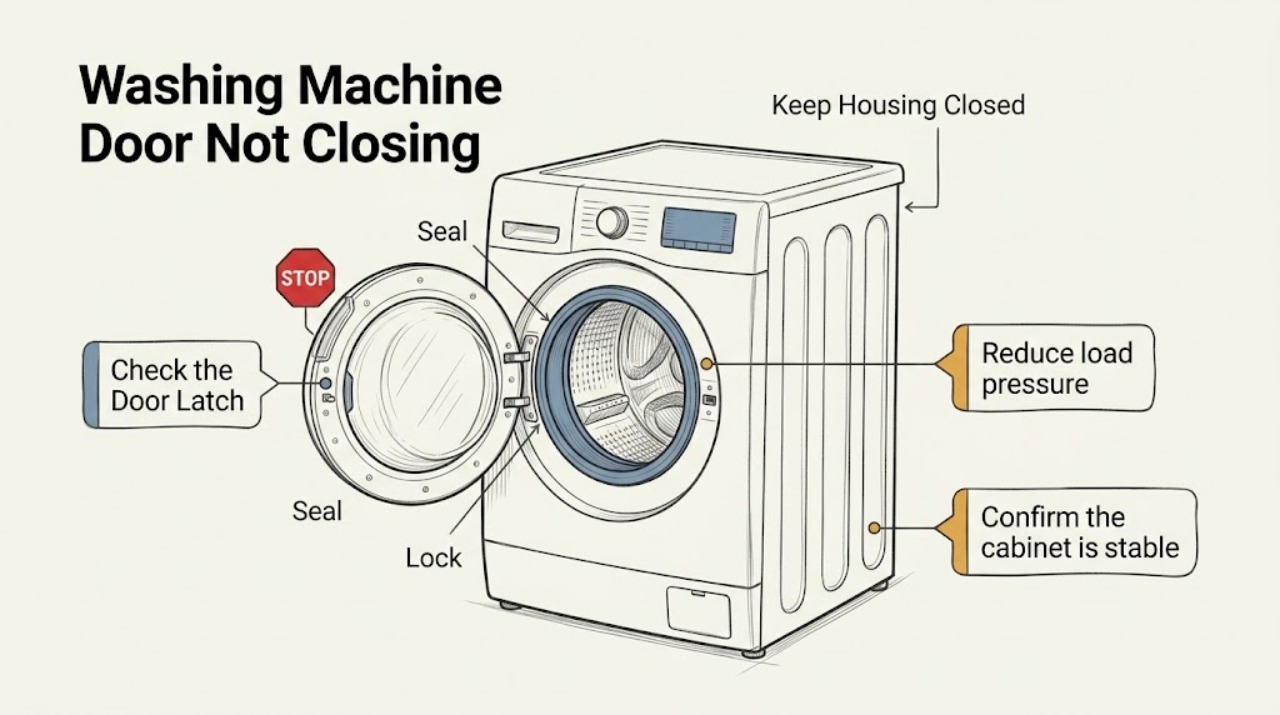
Work through in order
Diagnostic checks
Use only checks that match the exact appliance or system and its official guide.
-
Check the door opening and latch path
Switch the machine off, wait for the drum to stop, and open the door only if no water is pressing against it. Look at the latch opening, the door hook, the inner glass edge, and the rubber seal for a sock, drawstring, detergent residue, lint, or another object preventing the door from reaching the latch.
Expected result: A visible obstruction or material trapped between the seal and glass explains a door that stops short or leaves a gap; a clean, unobstructed path points to load pressure, alignment, or hardware.
Next step: Remove only the item or residue you can reach without tools, wipe the seal and glass with a soft damp cloth, and close the door gently. If the seal, hook, glass, or latch looks damaged, stop and arrange service.
Why this matters
Why: Electrolux warns that trapped laundry can prevent proper closure and can create a leak, so clearing the path is the first low-risk distinction.
-
Reduce load pressure
Take some laundry out until the door can move freely, then check that no garment is lying across the seal. Close the door with even pressure until the latch engages; do not lean or strike the door.
Expected result: If the empty or smaller load closes and the machine can start, excess load or a garment at the seal was pushing against the door. If it still will not close with the drum clear, the cause is not simply overload.
Next step: Run only a normal programme within the model's load guidance after the door closes securely. If the clear drum does not change the symptom, continue to the stability and alignment check.
Why this matters
Why: Electrolux states that an overloaded drum can press against the door and stop it from closing or locking.
-
Confirm the cabinet is stable and level
With the machine empty and safely accessible, check that it stands on a hard, level floor and does not rock. Use a spirit level if available and look for a foot that is not firmly bearing on the floor; adjust feet only as described in the model manual.
Expected result: A rocking or visibly tilted cabinet can change the door position relative to the seal and latch. A stable, level cabinet makes leveling a less likely explanation.
Next step: Correct only the accessible leveling adjustment allowed by the manual and recheck the door without forcing it. If the cabinet is stable but the door sits low, rubs, or needs lifting, have the hinge or alignment inspected.
Why this matters
Why: Electrolux notes that poor leveling can make the door difficult to close and can also increase movement during spin.
-
Interpret a lock warning or programme refusal
If the door reaches the frame but the programme will not start, note any E40, E41, beeps, flashes, or padlock symbol. Verify that the door is fully shut and use only the child-lock control combination shown on the exact model's panel or manual; do not insert a tool into the lock.
Expected result: Electrolux uses E40 and E41 for a door or lid that is not properly closed or detected. A padlock symbol can indicate a child-lock state rather than a broken hinge.
Next step: Clear the child lock only using the documented control sequence and retry once. If the code or refusal remains after the physical checks, stop using the machine and request service for the lock or sensor circuit.
Why this matters
Why: A door can look closed while the safety switch does not detect it, and a child-lock setting can prevent normal operation. The exact button sequence is model-specific.
-
Separate a locked-door water condition from a closing fault
If water is visible in the drum or the door is already locked, do not pull it open. Confirm the drum is not hot or rotating, then follow the exact model manual for a drain or emergency procedure only when the floor, outlet, and drain path are safe.
Expected result: Water in the machine prevents normal opening, and a hot or recently running cycle can keep the lock engaged. A door that remains locked after safe draining and cooling needs professional diagnosis.
Next step: If water is leaking, the drum is hot, the drain path is blocked, or the manual procedure is unclear, leave the door closed and call service. Do not remove a filter or open an access panel with an unsafe water load.
Why this matters
Why: A lock protecting water or heat is different from a door that cannot physically close; forcing it can release water and damage the seal or lock.
-
Retest once after a safe reset
After the door path is clear and the machine is dry, switch it off and disconnect power only if the plug and outlet are safe to reach. Wait for the model's documented reset interval, restore power, close the door normally, and select a short programme without adding a large load.
Expected result: If the door latches and the programme starts, the earlier obstruction, load, lock state, or transient control condition was the likely trigger. If the door still will not latch or the same warning returns, the fault is persistent.
Next step: Stop after this single retest and arrange an authorized appliance technician for a persistent failure. Do not repeat resets to keep operating a machine with a loose or damaged door.
Why this matters
Why: A reset can clear a temporary control state but cannot repair a bent hinge, damaged hook, worn seal, or failed lock sensor.
Use your observations
Decision map
Find the observation that best matches what you see, then follow the next safe action.
-
PATH 01Next step
What you see
Laundry, residue, or a foreign object is caught at the seal or latch.
Do this next
Remove the accessible obstruction, clean the contact area, and retest the door with a smaller load. Stop if the seal or glass is damaged.
-
PATH 02Next step
What you see
The door closes only when the drum is empty or partly loaded.
Do this next
Reduce the load and keep garments away from the seal. If the same load size used to work but now needs lifting or force, request hinge and alignment service.
-
PATH 03Next step
What you see
The door appears closed but E40, E41, a lock symbol, or a refusal to start remains.
Do this next
Check the documented child-lock state and retry once. If the warning persists, treat the lock or sensor as a service issue rather than bypassing it.
-
PATH 04Next step
What you see
Water is visible, the door is locked, or water escapes when the door is moved.
Do this next
Keep the door closed, make the area safe, and use only a model-approved drain procedure. Call service if the drum is hot, the drain is blocked, or there is any leak.
Helpful context
Understand the symptom
What the symptom tells you
A door that physically springs back, stops short of the frame, or closes but will not let the programme start can point to different checks. Inspect with the drum stopped and empty enough to see the opening. Keep the exact model number available because door-lock and child-lock controls vary across Electrolux models.
Flood and injury boundary
Do not force the handle, defeat the interlock, or keep trying a cycle when the door is misaligned. Keep hands away from a rotating or hot drum. If water is present, do not open the door until the model-approved drain procedure has made that safe. Stop for a cracked door glass, torn seal, sharp metal, loose hinge, water near an electrical connection, smoke, or a burning smell.
Only after diagnosis
Potential parts
- door lock assembly
Only consider this after the door closes mechanically, the seal and load path are clear, and diagnosis confirms the machine does not detect the closed door.
Lock wiring and fit vary by exact model; verify the full model identifier and manufacturer documentation before ordering. - door gasket
Only consider a gasket when inspection finds a torn, displaced, swollen, or deformed seal that obstructs closure or allows leaking.
Confirm the exact model and seal design; do not treat a visually similar gasket as compatible. - door hinge or door hook
Only consider hinge or hook parts when the door is visibly low, rubbing, loose, or unable to align with the latch after leveling and load checks.
The hinge, hook, and mounting hardware are model-specific and should be confirmed by a qualified diagnosis.
When checks do not resolve it
Need a professional?
Arrange qualified appliance service when the door will not latch after clearing the seal, reducing the load, and confirming stability; when E40 or E41 persists; or when the door sits low, rubs, springs open, or needs force. Stop immediately for cracked glass, a torn seal, exposed sharp hardware, water near electrical connections, smoke, a burning smell, or a door that opens during a running cycle. If the door opens with water inside, switch the appliance off safely and do not use it until the cause is repaired.
Common questions
FAQ
Why will my Electrolux washing-machine door not close?
Check for trapped laundry or residue, reduce an overloaded drum, and confirm the machine is level and stable. If the clear door still will not align or latch, the hinge, hook, seal, or lock needs service.
Can I force an Electrolux washer door shut?
No. Forcing it can damage the hook, hinge, seal, or interlock. Remove only an accessible obstruction and stop if the door needs force or the glass and seal are damaged.
What do E40 and E41 mean on an Electrolux washer?
They indicate that the door or lid is not properly closed or detected. Check closure, trapped laundry, load size, and the documented child-lock state; persistent warnings need service.
What if there is water in the drum?
Do not open or force the door. Use only the exact model's safe drain guidance when the drum is not hot and the area is safe; call service for leaks, a blocked drain, or an unclear procedure.
Read the exact guide
Official sources
- Washing machine's door opens in the middle of a cycleElectrolux Support · Load pressure, door and lock defects, and service escalation
- The washing machine door does not close properlyElectrolux Support · Door closure, leveling, overload, trapped laundry, and service guidance
- The door of the washing machine cannot be openedElectrolux Support · Door-lock safety, water and heat conditions, safe draining, reset, and service boundaries
- Washing Machine Not Working or Not Turning On – Troubleshooting GuideElectrolux Support · Programme refusal, overload, door closure, child lock, reset, and electrical escalation
- Washing Machine Error Code E40, E41 (4 Beeps / 4 Flashes): Causes & FixesElectrolux Support · E40/E41 closure detection, trapped laundry, overload, child lock, and service escalation
Community feedback
Share a repair observation
Share a plain-text repair observation. Accepted observations are published automatically; this page may take a moment to update.