
On this page
Start here
Quick answer
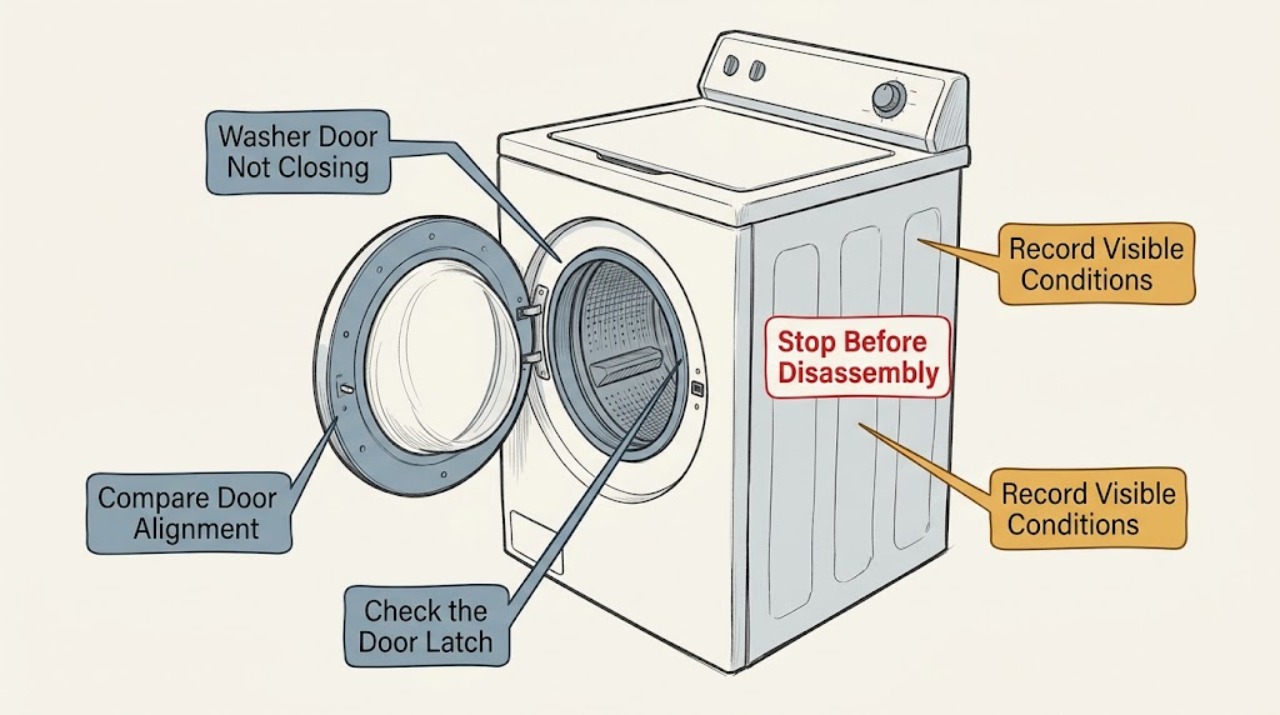
Do not force a Kenmore washer door or bypass its lock. First identify whether the machine is a front-loader with a hinged door or a top-loader with a lid, and record the exact model because Kenmore designs and controls vary. With the washer stopped and power safely disconnected, remove only visible clothing, packaging, detergent residue, or debris from the door or lid contact area. Check that a front-load gasket is not folded and that the door is aligned; for a top-loader, check that the lid and hinge or strike are not visibly bent and that the washer is stable. If water remains, the lock is active, the glass or hinge is damaged, the lid will not latch, or the problem returns after the model manual's normal cancel or reset procedure, stop and arrange qualified service rather than pushing harder.
Work through in order
Diagnostic checks
Use only checks that match the exact appliance or system and its official guide.
-
Check 1
Stop the washer and inspect from the outside for cracked door glass, a sharp or detached hinge, exposed wiring, water reaching the outlet or controls, smoke, a burning smell, or a breaker that trips again.
Expected result: Any glass or hinge damage, wet electrical area, smoke, burning odor, sparking, or repeated electrical trip is present.
Next step: Stop use, keep clear of the hazard, and arrange qualified appliance or electrical service. If there is smoke or fire, follow local emergency guidance.
Stop if: Do not touch wet plugged-in equipment, operate a damaged lock, force broken glass, or repeatedly reset the breaker.
Why this matters
Why: The washer may not be safe to close, energize, or test. A lock or seal should not be defeated to keep the machine running.
-
Check 2
Find and record the complete Kenmore model number, then determine whether the washer is front-load or top-load and whether the symptom is a door that will not physically close, a door or lid that closes but will not lock, or a lock that will not release.
Expected result: The form factor and exact symptom are clear, or the model number cannot be read.
Next step: Use the Kenmore manual search for that model. If the model is unknown, limit the checks to visible obstructions, external damage, power-safe observations, and the appropriate front- or top-load branch below.
Why this matters
Why: Kenmore uses model-specific manuals and controls. A front-load door gasket and lock path is different from a top-load lid and strike, and an active lock may be a normal response to water or a running cycle rather than a broken hinge.
-
Check 3
For a front-load washer only, with the cycle stopped and power disconnected safely, open the door normally and inspect the full rubber gasket, glass edge, latch opening, and strike area for trapped clothing, packaging, coins, detergent buildup, or a folded seal.
Expected result: A visible item or residue is removed and the gasket lies flat, or the door still sits proud, springs back, scrapes, or does not align with the latch.
Next step: Wipe accessible residue with a soft damp cloth, close the door gently, and test only if the model manual permits. If it still will not close or the glass, hinge, gasket, or strike is damaged, stop and request service.
Stop if: Do not pull on the gasket, bend the strike, remove the door, or bypass the lock switch.
Why this matters
Why: Clothing or debris in the gasket or lock opening can prevent full closure. Persistent misalignment after the opening is clear points to a worn latch, hinge, strike, gasket, or cabinet alignment issue rather than something to overcome with force.
-
Check 4
For a top-load washer only, inspect the lid edge, hinge, lid strike or lock opening, and contact area for clothing, packaging, detergent residue, or an object protruding from the basket; check that the lid rests evenly without being forced.
Expected result: The obstruction or residue clears and the lid closes evenly, or the lid remains skewed, loose, cracked, or unable to reach the latch.
Next step: Clean only the accessible contact area with warm water, mild soap, and a soft cloth if the manual permits, then close the lid normally. Persistent failure or damage requires service.
Stop if: Do not tape down, bridge, or otherwise defeat the lid switch or lock, and do not reach into a moving basket.
Why this matters
Why: A top-loader may refuse to start when its lid is not fully closed or its lid-lock contact is blocked. A bent hinge, damaged strike, or uneven lid cannot be corrected by slamming it shut.
-
Check 5
Check for residual water or an active lock indicator without pulling the door or lid open. If the washer is in a cycle, use the model's Pause or Cancel control and wait for the drum or basket to stop; use the exact manual's drain procedure if water remains.
Expected result: The lock releases after the cycle ends or water drains, the lock indicator stays on, or the tub contains water that will not drain.
Next step: Keep the appliance off and follow the exact model's drain and unlock instructions. If water remains, the lock does not release, or the procedure requires removing a panel, call qualified service.
Stop if: Never force a locked door or lid, open it while the drum or basket moves, or remove a panel with water or power still present.
Why this matters
Why: A washer can keep a front door or top lid locked while water, heat, or motion remains. If water cannot drain or the lock stays active after the safe model procedure, forcing the closure or opening can cause flooding or injury.
-
Check 6
With no visible hazard and the door or lid now physically closed, check the control for a lock symbol, paused or delayed cycle, error light, or a required Start/Pause press. Use only the exact Kenmore manual's release or start sequence.
Expected result: The washer starts after the correct control sequence, or it reports a repeatable lock or door error despite a physically closed door or lid.
Next step: Record the exact light or code and stop if it returns. Provide the model and symptom to qualified service rather than trying an unlisted diagnostic combination.
Why this matters
Why: A control lock or an uncompleted cycle can make a correctly closed door appear unusable. A repeatable error means the control is not receiving the expected lock signal or another condition remains; the code cannot be generalized across Kenmore models.
-
Check 7
If the manual allows a power reset and there is no water or electrical hazard, disconnect power once for the manual's stated interval, restore it, and try one empty or normal start without forcing the closure. Observe whether the door or lid latches and whether the washer remains level and stable.
Expected result: The washer latches and starts normally, or the door/lid still will not close, the lock fails again, the cabinet shifts, or a leak or electrical symptom appears.
Next step: Stop using the washer for recurring closure or lock failure, leaks, instability, or any hazard. Arrange service with the model, form factor, exact symptom, and any code.
Stop if: Do not keep cycling power, run a load with a lock bypass, or continue if the washer rocks, leaks, overheats, or trips power.
Why this matters
Why: A successful single reset can clear a temporary control state but does not repair a mechanical hinge, gasket, strike, level, drain, or lock fault. Recurrence or movement points to service.
Use your observations
Decision map
Find the observation that best matches what you see, then follow the next safe action.
-
PATH 01Next step
What you see
Cracked glass, damaged hinge or strike, exposed wiring, wet electrics, smoke, burning smell, sparks, or a repeated breaker trip
Do this next
Stop using the washer and obtain qualified appliance or electrical help; do not touch wet plugged-in equipment or bypass the lock.
-
PATH 02Next step
What you see
The washer is front-load and clothing, debris, residue, or a folded gasket blocks the door
Do this next
Remove only the visible obstruction with power safely disconnected and clean the accessible area gently; persistent misalignment or damage needs service.
-
PATH 03Next step
What you see
The washer is top-load and the lid, hinge, strike, or contact area is blocked or uneven
Do this next
Clear visible items and clean the accessible contact area as the manual permits; do not slam, tape, or bypass the lid lock.
-
PATH 04Next step
What you see
A lock remains active while water, heat, motion, or an incomplete cycle is present
Do this next
Use the model's Pause, Cancel, and drain instructions and wait for motion to stop; never force the door or lid.
-
PATH 05Next step
What you see
The door or lid closes physically but a lock symbol or error returns
Do this next
Record the exact display and model, then request qualified service for the lock signal, control, or related condition.
-
PATH 06Next step
What you see
The door or lid works once but the problem returns after a permitted single reset
Do this next
Treat it as an unresolved mechanical or control fault and arrange service rather than repeating resets or running a load.
Helpful context
Understand the symptom
First identify the washer style
A front-loader's round door closes against a flexible gasket and must engage a lock. A top-loader's lid closes onto a strike or lid-lock area. The checks are not interchangeable: do not look for a front-door boot on a top-loader, and do not assume a top-loader's lid-lock release applies to a front door. Kenmore's manual search requires the full model number; use that manual for the exact lock indicator, cancel procedure, and any model-specific service steps.
What a closing problem can mean
A door that physically bounces open usually has an obstruction, gasket or strike problem, or misalignment. A door that closes but will not lock is a different symptom: the control may be waiting for the lock signal, a cycle may still contain water, or the lock system may be faulty. A lid that sits unevenly can point to hinge, strike, leveling, or cabinet damage. Treat broken glass, a sharp damaged hinge, leaks, wet electrics, and a lock that will not release as service boundaries.
Only after diagnosis
Potential parts
- front-load door gasket
Only consider this category if the exact front-load model's gasket is torn, folded, detached, or preventing closure after visible debris is removed.
Confirm the complete Kenmore model and the manufacturer's fit information; do not stretch or remove the gasket as a first troubleshooting step. - door or lid lock assembly
Only consider this category after the exact form factor, latch alignment, water state, and model-specific error evidence point to a failed lock or latch.
Front-load door locks and top-load lid locks are different; confirm the full model and use qualified installation when wiring or cabinet access is involved. - door hinge or lid hinge
Only consider this category when the door or lid is visibly sagging, skewed, loose, or damaged and the exact model's service diagnosis confirms hinge failure.
Confirm model-specific fit and do not operate a washer with cracked glass or a hinge that cannot safely support the door or lid. - door strike or lid strike
Only consider this category when the door or lid aligns but the visible strike is broken, worn, or missing and the exact model identifies it as the cause.
Verify the model and approved part information; do not defeat the lock if the strike is damaged.
When checks do not resolve it
Need a professional?
Have this ready
- The complete Kenmore model number, front-load or top-load form factor, whether the door/lid physically closes, the exact lock light or code, water level, visible obstruction or damage, and what changed after the manual's normal cancel or reset procedure.
Common questions
FAQ
Why will my Kenmore front-load washer door not close?
Check for clothing, packaging, coins, residue, or a folded gasket in the door opening, then look for a sagging hinge, damaged strike, or misalignment. If the door still will not close or lock after the visible area is clear, stop rather than forcing it and use the exact model manual or qualified service.
What should I check if my Kenmore top-load washer lid will not latch?
Check the lid edge and latch area for clothing, packaging, or residue and confirm the lid rests evenly. Clean only the accessible contact area as the model manual permits; do not tape down or bypass the lid lock. Persistent misalignment or a damaged strike needs service.
Can I force open a locked Kenmore washer door or lid?
No. Water, heat, motion, or an incomplete cycle can keep the lock active. Use the exact model's Pause, Cancel, and drain instructions and wait for the drum or basket to stop. If water remains or the lock will not release, arrange qualified service.
Should I keep resetting the washer when the door will not close?
Only one model-approved power reset is reasonable when there is no water or electrical hazard. A reset cannot repair a broken hinge, gasket, strike, or lock, and repeated breaker trips, leaks, wet electrics, smoke, or burning odor are stop conditions.
Read the exact guide
Official sources
- Lid Locked - Won't Open - WasherWhirlpool · General manufacturer safety guidance for locked lids; use the exact Kenmore manual for any reset or drain procedure.
- Smart Appliances with Kenmore Smart App | Connected Home SolutionsKenmore · Kenmore's general product page confirms washer status and maintenance features for smart models only; it does not establish a control behavior for every Kenmore washer.
- CPSC Urges Flood Victims to Take Steps to Prevent CO Poisoning, Electrocution, Explosion and FiresU.S. Consumer Product Safety Commission · General U.S. safety guidance used only for the stop boundary around water and plugged-in electrical equipment.
- Find Your Manual | Kenmore Appliance Manuals & GuidesKenmore · Use the complete model number to locate the applicable Kenmore washer manual; the site states that model numbers are required and manuals cover Kenmore washers.
- Latching a Front Load Washer DoorWhirlpool · Manufacturer guidance used for front-load mechanics only; Kenmore models may differ and require their own manual.
- Door Will Not Lock or Unlock - Front Load WasherWhirlpool · Manufacturer guidance used for front-load lock behavior only; use the exact Kenmore model instructions.
- Lid Not Latching - WasherWhirlpool · Manufacturer guidance used for top-load lid mechanics only; controls and safety behavior vary by Kenmore model.
Community feedback
Share a repair observation
Share a plain-text repair observation. Accepted observations are published automatically; this page may take a moment to update.