
On this page
Start here
Quick answer
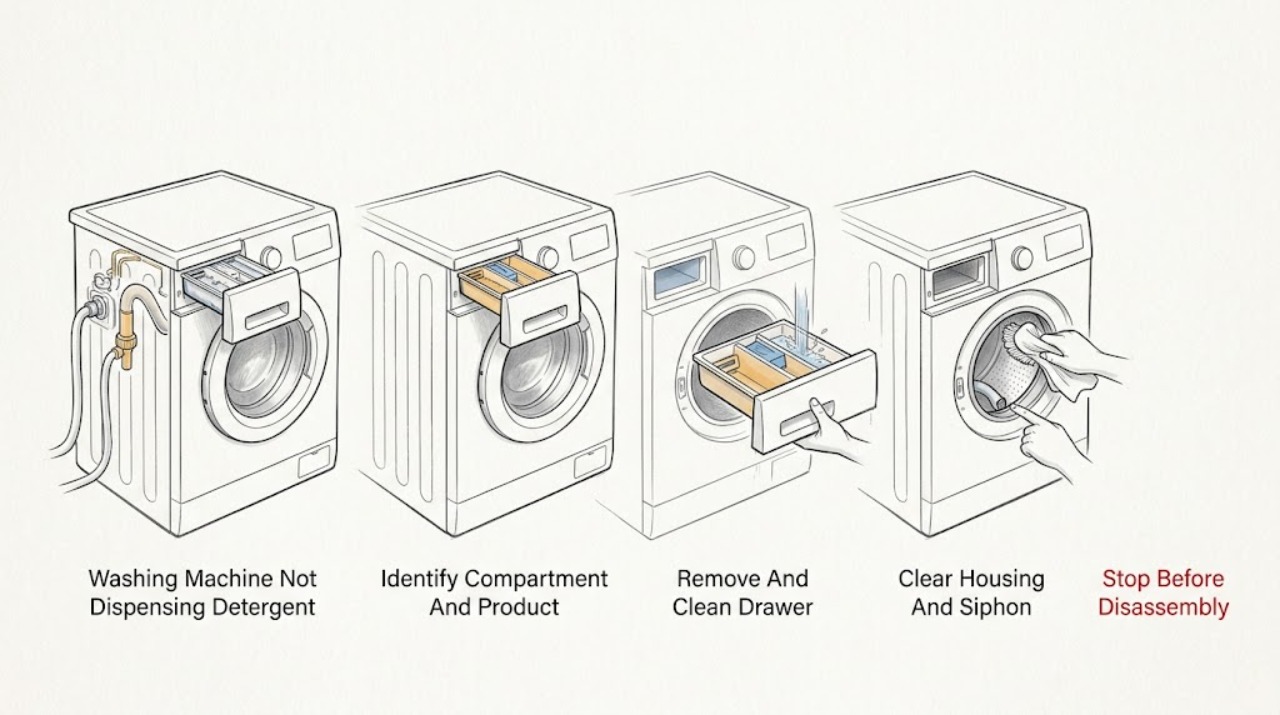
If an Electrolux washing machine leaves detergent or fabric softener in the dispenser, start by identifying which compartment remains full and whether the drawer is blocked, overfilled, or set for the wrong detergent type. With the washer stopped, remove the drawer according to the model manual, rinse residue with warm water, clear the dispenser housing and its water-entry holes with a suitable soft brush, and clean the softener siphon or insert. Use the correct compartment, keep liquid or powder settings aligned with the drawer flap, and do not exceed the marked maximum. If the drawer is clean and correctly fitted but no water reaches it, the drawer leaks, or the problem returns, stop and arrange authorized Electrolux service. [Source: electrolux-drawer-clean; electrolux-detergent-guide; electrolux-liquid-flap; electrolux-not-taking]
Work through in order
Diagnostic checks
Use only checks that match the exact appliance or system and its official guide.
-
Check 1
With the washer stopped, identify whether detergent, fabric softener, bleach, or plain water remains, which compartment is affected, and whether the product is powder, liquid, a pack, or an AutoDose product. Record the selected program and whether the drawer was over the marked maximum.
Expected result: Powder residue, diluted softener, liquid that ran away before the program, and an empty compartment create different branches. A problem limited to one compartment is useful evidence for service.
Next step: Use the exact model manual and detergent guide to confirm the compartment and product arrangement before cleaning or running another load.
Why this matters
Why: Electrolux drawers use separate compartments and model-dependent flaps, inserts, or siphons; the product and compartment must match the dispenser's intended setup.
-
Check 2
Remove the detergent drawer using the model's release button or catch, rinse it with warm water, and remove softened residue from the compartments, additive lid, and siphon or insert. Do not use detergent or bleach to clean the drawer or housing.
Expected result: If hardened powder, gel-like liquid, softener buildup, mold, or limescale is present, the drawer itself was obstructed. If it is visibly clean but the housing or upper water-entry area is blocked, the restriction is still upstream of the drum.
Next step: Continue by cleaning the housing and water-entry holes, then reinstall every insert or lid in its original position. Stop if the drawer or catch is cracked or cannot lock into its rails.
Why this matters
Why: Electrolux states that residue can build up in and around the drawer and prevent detergent from reaching the drum; cleaning the removable parts is a low-risk first correction when done as directed.
-
Check 3
Inspect the recess above and below the drawer, especially the small water-entry or shower holes, and clean accessible residue with warm water and a suitable soft or nylon brush. Clean the fabric-softener siphon tube and compartment lid, then check that the passages are open.
Expected result: A clear housing and siphon with no waxy softener or compacted powder make a drawer blockage less likely. Residue remaining in the upper water-entry area can explain why the drawer looks clean but the product is not flushed out.
Next step: Rinse away loosened residue, dry the accessible parts, and reinstall the drawer. Do not push tools deep into the washer or remove hidden hoses or valves.
Why this matters
Why: Water must enter through the dispenser path to carry the product into the drum; an obstructed housing or siphon can leave product or water behind and may cause a leak.
-
Check 4
Check the drawer flap, liquid insert, and compartment labels against the model manual. Set a changeable flap for the detergent type being used, use only the product allowed for that compartment, and keep every liquid or softener fill below the marked maximum.
Expected result: If liquid stays in the drawer after the flap or insert is corrected, the prior setup was contributing to the symptom. If powder still blocks the drawer, the compartment may be damp, overfilled, or contaminated with old residue.
Next step: Run the model-approved program with the correct product and dose. Do not put a detergent pack in the drawer unless the exact model guide explicitly allows that placement.
Why this matters
Why: Electrolux specifies different flap positions for liquid and powder on applicable drawers and warns that excess or unsuitable product can prevent correct dispensing.
-
Check 5
Reinstall the clean drawer fully on its guide rails, confirm that the lid, siphon, flap, or insert is seated, and run a supervised short or model-approved check while observing whether water enters the affected compartment and whether the drawer leaks.
Expected result: Water entering the compartment and carrying the product away indicates that the dispenser path is functioning after cleaning. Little or no water, a drawer that will not seat, or water escaping from the front points to a continuing mechanical or inlet issue.
Next step: Stop the check for any leak or unusual noise. If water does not reach the compartment or the issue repeats with correct setup, arrange authorized Electrolux service rather than opening the washer.
Why this matters
Why: Correct fit is required for the incoming water to reach the intended compartment. A clean drawer does not rule out an inlet valve, diverter, dispenser housing, or supply-related fault.
-
Check 6
Decide whether the drawer remains clean and correctly fitted but detergent or softener is still left behind, the drawer leaks, the water supply to the dispenser is absent or weak, or the same compartment fails on repeated supervised cycles.
Expected result: A recurring failure after cleaning and correct product setup is not explained by ordinary residue alone. Leaks, no water at the dispenser, or a damaged drawer require the machine to remain out of normal use until diagnosed.
Next step: Leave the washer off if it leaks or cannot dispense correctly and contact an authorized Electrolux service center. Provide the model, affected compartment, product type, cleaning performed, and water or leak observations.
Why this matters
Why: The remaining causes can include an inlet valve, diverter, dispenser assembly, siphon, drawer rail, dosing control, or model-specific water path; the symptom alone does not identify a replacement part.
Use your observations
Decision map
Find the observation that best matches what you see, then follow the next safe action.
-
PATH 01Safety boundary
What you see
The drawer contains visible powder, softener, mold, limescale, or hardened product residue.
Do this next
Remove and clean the drawer, compartments, siphon, and accessible housing with warm water as directed, then reinstall all pieces correctly.
Why this path and its safety boundary
Safety stop: Continue with the product/flap setup and water-entry checks; a clean drawer does not prove that water is reaching it.
-
PATH 02Safety boundary
What you see
Liquid detergent is being used in a drawer with a changeable flap or separate liquid insert.
Do this next
Set the flap or insert for liquid according to the model manual; restore the powder position or remove the insert when changing back to powder.
Why this path and its safety boundary
Safety stop: Check compartment labels and product instructions, especially for AutoDose, softener, bleach, or detergent packs.
-
PATH 03Safety boundary
What you see
A detergent pack or thick/excess product has been placed in the dispenser or above its marked maximum.
Do this next
Remove the excess or unsuitable product, clean the drawer, and use the model's approved placement and dose on the next supervised cycle.
Why this path and its safety boundary
Safety stop: Continue with water-entry and drawer-fit checks.
-
PATH 04Safety boundary
What you see
The drawer is clean, correctly assembled, and seated, but little or no water reaches the affected compartment.
Do this next
Stop troubleshooting inside the cabinet and arrange authorized Electrolux service for the inlet path, valve, diverter, or dispenser assembly.
Why this path and its safety boundary
Safety stop: If water flushes the product away normally, monitor the next load and keep the drawer clean and correctly configured.
-
PATH 05Safety boundary
What you see
The dispenser leaks, the drawer is cracked or cannot latch, or the problem returns after cleaning and correct setup.
Do this next
Stop the washer if water can escape, keep the area dry and safe, and contact an authorized service center with the model and observations.
Why this path and its safety boundary
Safety stop: The issue is likely corrected; follow the model manual's cleaning and dosing guidance on future cycles.
Helpful context
Understand the symptom
First identify what is left behind
Detergent powder clumped in the main-wash compartment, liquid running away before the program starts, softener left with water, and a completely dry compartment do not point to exactly the same check. Note the compartment, product type, amount, and whether the washer fills normally. The model manual remains the authority for drawer layout and release method.
The dispenser depends on a clear water path
Electrolux explains that incoming water flushes detergent and softener from the drawer into the drum. Residue can build up in the drawer, housing, underside, and small water-entry holes, preventing the product from flowing correctly and sometimes causing leaks or mold. Cleaning the drawer alone may not clear the housing.
Product and insert position matter
Liquid and powder may require different flap positions, while some AutoDose or soft-water designs use a separate liquid insert. Detergent packs belong where the applicable Electrolux guide says to place them, not automatically in the drawer. Thick or excessive product can remain even when the water path is clear.
Know when the problem is no longer a cleaning issue
If a clean, correctly reinstalled drawer still receives little or no water, repeatedly overflows, leaks, or leaves product behind, the fault may involve the inlet path, valve, diverter, dispenser assembly, or model-specific dosing control. Do not dismantle the washer or test live components to prove which part failed.
Safety boundary
Stop conditions
- Stop immediately if the dispenser or washer leaks onto electrical components, the drawer is cracked, the catch will not hold, or water continues flowing unexpectedly.
- Do not remove the washer cabinet, test live wiring, disconnect hidden hoses, bypass an inlet or door safety, or force the drawer or siphon parts.
- Do not mix cleaning chemicals in the drawer or use detergent or bleach to clean the drawer or dispenser housing when the Electrolux guide specifies warm water.
- If no water reaches a clean, correctly fitted dispenser or the fault repeats after correct setup, leave the washer out of normal use and arrange authorized service.
Only after diagnosis
Potential parts
- detergent drawer, insert, flap, or siphon assembly
Only consider this part class if the drawer is cracked, cannot latch or seat, or a qualified diagnosis confirms a damaged dispensing insert after cleaning.
Confirm the exact Electrolux model and product-number information before ordering any component. - dispenser housing or water-entry component
Only consider this part class when residue cannot be cleared or qualified service confirms that the housing or water-entry path is damaged or obstructed.
Use model-specific documentation and qualified service confirmation; do not assume drawer assemblies are interchangeable. - water inlet valve or dispenser diverter
Only consider this class if a clean, correctly fitted drawer receives little or no water and qualified testing identifies an inlet or diverter fault.
Verify the exact model, water-path configuration, and installation requirements with authorized service.
When checks do not resolve it
Need a professional?
Contact an authorized Electrolux service center when a clean and correctly installed drawer still does not receive water, a drawer leaks or cannot latch, one compartment repeatedly fails, or the symptom returns after the correct product and flap setup. Include the model, product type, affected compartment, and the result of the supervised check.
Have this ready
- Exact Electrolux model and serial or product-number details
- Whether detergent, softener, bleach, water, or a detergent pack remains and which compartment is affected
- Product type, flap or insert position, amount used, and whether it exceeded the marked maximum
- Whether the drawer, housing, water-entry holes, siphon, and lid were cleaned and reinstalled
- Whether water entered the affected compartment during a supervised check
- Any leak, cracked drawer, unusual noise, error indication, or repeated-cycle behavior
Common questions
FAQ
Why is detergent still in my Electrolux washing machine drawer?
Residue can block the drawer, its housing, or the water-entry holes. Remove and clean the drawer, siphon, and accessible housing, then confirm the flap, insert, compartment, product, and amount match the model guide.
Which way should the Electrolux detergent drawer flap face?
On models with a changeable flap, Electrolux says the position differs for liquid and powder. Check the model guide, set it for the product being used, and restore the powder position or remove the liquid insert when changing product type.
What if the Electrolux dispenser is clean but no water enters it?
A clean, correctly fitted drawer that receives little or no water needs authorized service. The remaining fault may be in the inlet path, valve, diverter, dispenser housing, or model-specific dosing system; do not open the washer or test live components.
Read the exact guide
Official sources
- Laundry Washers - Detergent GuideElectrolux · Electrolux top-load and front-load laundry washers; detergent, detergent-pack, bleach, and softener placement guidance
- Using liquid detergent / What is the flap in my washing machine dispenser for?Electrolux · Electrolux washing machines and washer dryers with changeable dispenser flaps or liquid inserts; liquid and powder setup
- Removing and cleaning a washing machine detergent dispenser drawerElectrolux · Electrolux washing machines and washer dryers; drawer removal, residue, housing, water-entry holes, softener siphon, and service guidance
- Washing machine does not take detergents / water remains in the softener compartmentElectrolux · Electrolux front-load washers and washer dryers; detergent residue, dosing setup, drawer cleaning, flap position, and authorized-service boundary
Community feedback
Share a repair observation
Share a plain-text repair observation. Accepted observations are published automatically; this page may take a moment to update.