
On this page
Start here
Quick answer
When a Whirlpool washing machine does not dispense an additive, first identify whether the problem is detergent, liquid fabric softener, liquid chlorine bleach, or a Load & Go bulk dispenser. Confirm that the selected cycle and dispenser option match the exact model, that the product is allowed for that compartment, and that it is not overfilled, too thick, or left as residue. With the washer stopped and the drawer accessible, clean only the removable drawer or parts that the owner's manual identifies as removable; some Whirlpool bulk dispensers and trim are not removable. Check that the drawer or cartridge is seated, the washer is level, and the visible inlet path is not clogged. Do not mix laundry chemicals, pour products into an internal water path, or remove internal valves or hoses. If the correct product remains in the dispenser, an F8 E2 or other model-specific code appears, water does not reach the compartment, the drawer leaks, or the fault returns after one model-directed cleaning, arrange Whirlpool or qualified appliance service.
Before you begin
Safety first
- This article supports product identification, permitted accessible drawer cleaning, ordinary visual checks, and one model-approved observation only. Do not mix chemicals, open internal water or electrical paths, disconnect hoses, remove fixed dispenser parts, or operate a leaking or electrically unsafe washer.
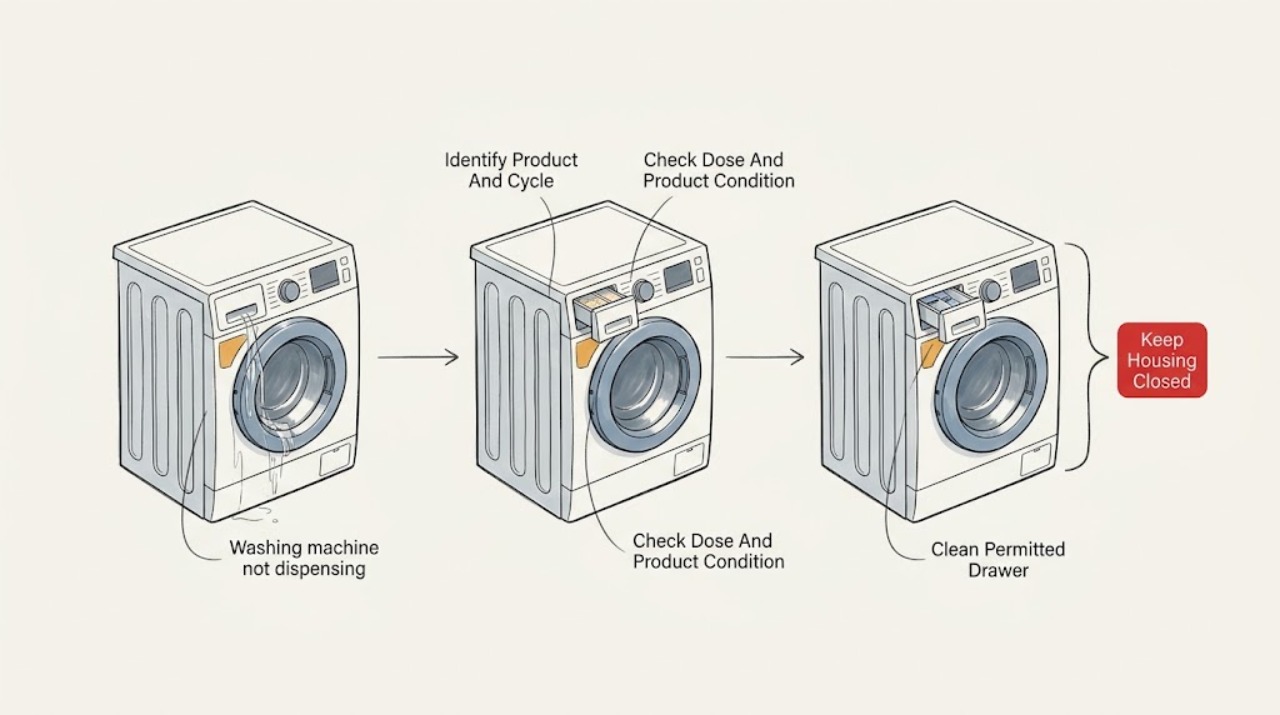
Work through in order
Diagnostic checks
Use only checks that match the exact appliance or system and its official guide.
-
Check 1
With the washer idle, identify the product that remains: HE detergent, liquid fabric softener, liquid chlorine bleach, powder, packet, booster, or a Load & Go reservoir; record the cycle, option, and exact Whirlpool model if available.
Expected result: Record the compartment used, whether the cycle includes that dispensing stage, whether a fabric-softener option was selected, whether Load & Go is enabled, and whether the product was added directly to the drum instead.
Next step: Use the exact owner's manual to confirm the permitted product, compartment, option, and timing before cleaning or testing; do not add a second product to compensate.
Stop if: Stop for a chemical spill, a product in the wrong compartment that cannot be removed safely, an unknown mixed product, or any need to open the internal water circuit.
Why this matters
Why: A product or compartment that the model does not support can look like a dispenser failure. A softener option that was not selected, a disabled bulk feature, or a packet or powder in a bulk reservoir points to setup rather than a failed water path.
-
Check 2
Compare the product amount and condition with the Whirlpool model instructions without adding water, bleach, or another chemical to the dispenser.
Expected result: Note whether detergent or softener is overfilled, unusually thick, dried into residue, clumped, expired or contaminated, or clearly the wrong type for the compartment; note whether the washer displays a suds or dispenser message.
Next step: Keep the product in its original container, use only the model-approved product and dose on the next permitted cycle, and clean the accessible dispenser if the manual allows it.
Stop if: Do not mix detergent, softener, bleach, boosters, or cleaning products, and stop if fumes, heat, skin or eye irritation, or a chemical spill occurs.
Why this matters
Why: Excess or unsuitable product can remain in a compartment, dispense too early, or create excess suds. A clean, correctly dosed product with no visible residue shifts attention to the drawer seating, water inlet path, leveling, or a model-specific fault.
-
Check 3
If the exact Whirlpool manual identifies a removable dispenser drawer, stop the washer, remove only that drawer as instructed, wash it with warm soapy water, rinse it, dry it, and inspect the visible cups, siphon pieces, and openings for residue.
Expected result: Classify the drawer as clear and intact, blocked by removable residue, cracked or missing a piece, unable to release, or part of a fixed dispenser that the manual says is not removable.
Next step: Reinstall the dry drawer fully and squarely, then use one model-approved cycle to observe the result; leave fixed dispensers alone and request service if the manual does not provide a cleaning path.
Stop if: Do not force release tabs, use sharp tools, scrape internal jets, place a prohibited drawer or tray in a dishwasher, or remove fixed dispenser trim.
Why this matters
Why: Removable residue can block water flow through the drawer. A crack, missing insert, stuck drawer, or fixed dispenser requires model-specific parts or service; it is not permission to pry trim or reach into internal hoses.
-
Check 4
Check from ordinary safe access that the dispenser drawer or cartridge is fully seated, the washer is level and stable, and the household hot and cold water valves and visible inlet hoses are open and unkinked; do not disconnect a hose.
Expected result: Record a drawer or cartridge that sits proud, a washer that rocks, a closed or restricted visible valve or hose, low-flow indication, leakage, or no visible issue; note whether the symptom affects all compartments or only one.
Next step: Correct only an obvious permitted seating or valve-position issue, using the installation instructions for leveling; leave the washer unused and call service for leaks, damaged hoses, or an internal supply fault.
Stop if: Stop for water near electrical equipment, a bulging or corroded hose, a leaking valve, a wet floor, repeated fill faults, or any need to remove plumbing or electrical panels.
Why this matters
Why: Poor seating, an unlevel washer, or a visible supply restriction can prevent the intended water path. A single compartment failure with normal seating and supply points toward a dispenser channel or internal valve, while all compartments affected raises a water-inlet or control issue.
-
Check 5
Run no more than one model-approved observation cycle after the drawer is clean and seated, using the correct product and selected dispenser option; record every display code and the stage when dispensing should occur.
Expected result: Record whether the product level changes at the expected stage, remains full, leaks into the washer early, leaves only a small permitted amount, or is accompanied by an F8 E2 dispenser message, a low-flow code, a suds code, or another model-specific code.
Next step: Save the code, model, product, cycle, and result for service; follow only the owner's manual's single reset procedure when it explicitly authorizes one, and do not repeat cycles to force dispensing.
Stop if: Stop for leakage, foam overflow, smoke, burning odor, unusual heat, electrical arcing, repeated tripping, or water entering the cabinet or floor.
Why this matters
Why: A product that dispenses at the correct stage supports a resolved setup or residue issue. A full compartment, early release, code, or no water at the dispenser after correct setup points to a model-specific dispenser, inlet, control, or water-flow diagnosis.
-
Check 6
Use the product identity, compartment, dose, drawer condition, seating, level, visible supply, cycle stage, and error record to decide whether the washer can return to normal use or needs service.
Expected result: Choose normal use only when the exact model setup is correct, the accessible drawer is intact and seated, the washer is stable, no leak or safety symptom exists, and the product dispenses at the intended stage; choose appliance service for a persistent or recurring failure, fixed-dispenser blockage, code, supply fault, or internal water-path issue.
Next step: Leave the washer unused if the failure persists and provide the model, product and dose, compartment, cycle, photos, error code, water-supply result, and cleaning result to Whirlpool or a qualified appliance technician.
Stop if: Stop all further testing for leakage, standing water near electricity, chemical exposure, foam overflow, smoke, burning odor, arcing, repeated tripping, or an internal repair requirement.
Why this matters
Why: The symptom can be narrowed to product/setup, accessible residue, water supply, dispenser channel, or control without proving a failed valve or pump. Internal parts and wiring require model-specific qualified diagnosis.
Use your observations
Decision map
Find the observation that best matches what you see, then follow the next safe action.
-
PATH 01Safety boundary
What you see
The wrong product is in the compartment, a packet or powder is in a Load & Go reservoir, Load & Go is disabled, or the fabric-softener option was not selected.
Do this next
Use the exact model instructions to select the correct option and place the permitted product in its intended path; do not mix products or add a second dose.
Why this path and its safety boundary
Why it matters: The washer may be following the selected configuration rather than failing to dispense.
Safety stop: Stop if a chemical mixture, spill, fumes, or residue cannot be removed without internal access.
-
PATH 02Safety boundary
What you see
A permitted removable drawer is blocked by detergent or additive residue and the manual provides a cleaning procedure.
Do this next
Clean, rinse, dry, and reinstall the drawer exactly as instructed, then make one controlled observation with the correct product and cycle.
Why this path and its safety boundary
Why it matters: Residue can block water through the dispenser and prevent the product from reaching the washer at the intended stage.
Safety stop: Do not force the drawer, scrape jets, use sharp tools, or treat a fixed dispenser as removable.
-
PATH 03Safety boundary
What you see
The drawer or cartridge is not seated, the washer rocks or is unlevel, or a visible water valve is closed or an inlet hose is kinked.
Do this next
Correct only an obvious permitted seating, level, valve, or hose-position issue using the model and installation instructions, then stop if dispensing remains abnormal.
Why this path and its safety boundary
Why it matters: The dispensing path may be affected by installation or household water supply rather than a failed dispenser component.
Safety stop: Do not disconnect hoses, operate a leaking washer, or adjust internal plumbing or electrical parts.
-
PATH 04Safety boundary
What you see
The setup, product, drawer, seating, level, and visible supply are correct, but one compartment stays full, dispenses early, or an F8 E2 or other model-specific code appears.
Do this next
Stop repeated test cycles, save the exact code and stage, and arrange Whirlpool or qualified appliance service with the model and photos.
Why this path and its safety boundary
Why it matters: A dispenser channel, inlet valve, cartridge detection, control, or model-specific water path may need qualified diagnosis.
Safety stop: Do not remove an inlet valve, hose, trim, cartridge sensor, or control panel as a user test.
-
PATH 05Safety boundary
What you see
Water or product leaks into the cabinet or floor, foam overflows, electrical equipment becomes wet, or smoke, burning odor, arcing, repeated tripping, or unusual heat occurs.
Do this next
Stop the cycle, isolate water and power only when it is safe to do so, keep people away from the wet area, and request qualified service; use emergency services for an active fire or dangerous fumes.
Why this path and its safety boundary
Why it matters: This is a water, chemical, fire, or electrical safety event, not a routine dispenser-cleaning issue.
Safety stop: Do not touch wet electrical equipment, keep resetting a breaker, add chemicals, or run another cycle to reproduce the fault.
Helpful context
Understand the symptom
Identify which product is not dispensing
A detergent drawer, fabric-softener cup, liquid-chlorine-bleach cup, and Load & Go reservoir do not all use the same timing or cleaning method. A small amount of liquid left after a cycle may be normal for some softener designs, while a full drawer, a wrong product, or residue at the water path can indicate a problem. Record the product, compartment, cycle, and model before changing anything.
Product concentration and dose can change the result
Whirlpool's guidance calls for HE detergent in the applicable dispenser, warns against putting single-dose packets or powder into a Load & Go reservoir, and says not to overfill a single-load compartment. Thick or excess product can leave residue, create suds, or enter at the wrong time. Use only the product and amount permitted by the model's owner's manual.
Clean accessible parts without opening the water circuit
On models with a removable drawer, Whirlpool describes removing the drawer according to the manual, washing it in warm soapy water, rinsing, drying, and returning it to the slot. Other models have fixed dispensers or trim. Do not force tabs, put the drawer or tray in a dishwasher when the manual prohibits it, or remove an internal inlet valve, hose, or wiring as a user test.
Safety boundary
Stop conditions
- Stop the washer for leakage, standing water near electricity, a wet floor or cabinet, damaged supply hoses, foam overflow, smoke, burning odor, arcing, unusual heat, or repeated electrical tripping.
- Do not mix detergent, softener, bleach, boosters, packets, or cleaning products, and do not add a chemical to an internal water path.
- Do not remove fixed dispenser trim, inlet valves, hoses, wiring, cartridge sensors, or control panels; do not force a drawer or its release tabs.
- Do not put powder or packets in a Load & Go reservoir, overfill a compartment, dilute or overfill fabric softener, or use a product not permitted by the exact model manual.
- Do not repeat full cycles or repeatedly reset the washer to force dispensing; record the code and stage after one model-approved observation.
- Keep the washer unused and arrange qualified appliance service when the correct setup and permitted cleaning do not restore dispensing, when the dispenser is fixed or damaged, or when a code persists.
Only after diagnosis
Potential parts
- dispenser drawer or removable insert
Consider this category only if the exact model's removable drawer or insert is cracked, missing, or unable to seat after permitted cleaning.
Confirm the exact Whirlpool model, drawer layout, insert or siphon design, and manufacturer's fit information; fixed dispenser trim is not automatically replaceable by a drawer. - dispenser cartridge or cap
Consider this category only if the exact model uses a removable bulk-dispenser cartridge or cap and inspection confirms damage or detection failure.
Confirm the exact model and dispenser system; do not substitute a cartridge, cap, or product container based on appearance. - washer water inlet valve or dispenser hose
Consider this category only after qualified diagnosis confirms that a model-specific inlet valve or dispenser hose is not delivering water to the affected compartment.
Confirm the exact model, valve configuration, hose routing, electrical rating, and safe installation procedure with qualified service; do not open the cabinet as a user test.
When checks do not resolve it
Need a professional?
Arrange Whirlpool or qualified appliance service when the dispenser remains full or dispenses at the wrong time after the exact model setup and permitted drawer cleaning are correct, when a fixed dispenser or internal water path is involved, when an F8 E2 or other model-specific code persists, or when a drawer, cartridge, valve, hose, cabinet, or floor leaks. Stop immediately for chemical exposure, foam overflow, smoke, burning odor, arcing, unusual heat, or repeated electrical tripping.
Safety scope: This article supports product identification, permitted accessible drawer cleaning, ordinary visual checks, and one model-approved observation only. Do not mix chemicals, open internal water or electrical paths, disconnect hoses, remove fixed dispenser parts, or operate a leaking or electrically unsafe washer.
Common questions
FAQ
Why is detergent still in my Whirlpool washer dispenser?
Check that the product and compartment match the model, the drawer is clean and fully seated, the washer is level, and the visible water supply is open. A full compartment after those checks or an F8 E2 code needs model-specific service rather than internal disassembly.
Can I put a detergent pod in Whirlpool Load & Go?
No. Whirlpool's Load & Go guidance says single-dose packets and powder should not go into the bulk reservoir. Follow the exact model instructions for where a packet or powder belongs.
Why does fabric softener dispense too early?
The softener option may not have been selected, the dispenser may be overfilled or diluted, or residue may affect the path. Confirm the model instructions, clean only the permitted accessible part, and stop if the drawer leaks or the timing remains wrong.
Is a small amount of water left in the softener dispenser normal?
Whirlpool notes that a small amount of water may remain in some softener dispensers at the end of a cycle. A full compartment, residue, early dispensing, leak, or recurring change from normal behavior should be documented and checked against the model manual.
Should I remove the dispenser hose or inlet valve to test it?
No. Do not remove internal hoses, valves, wiring, or fixed dispenser trim. Record the product, compartment, cycle, code, and visible water-supply result, then arrange qualified appliance service if permitted cleaning does not restore dispensing.
Read the exact guide
Official sources
- Not Dispensing Detergent - Front Load WasherWhirlpool Product Help · Whirlpool front-load washer guidance; drawer release and leveling details vary by model and the owner's manual controls.
- Fabric Softener Not DispensingWhirlpool Product Help · Whirlpool top-load fabric-softener guidance; not all models have a softener dispenser and exact instructions vary.
- Error Codes in Front Load WashersWhirlpool Product Help · Whirlpool front-load error-code guidance; the list is not complete for every model and the owner's manual controls.
- Using the Single Load Dispenser Drawer - Front Load WasherWhirlpool Product Help · Whirlpool front-load single-load dispenser guidance; exact compartments and product rules are model-specific.
- Using the Load & Go Detergent DispenserWhirlpool Product Help · Whirlpool top-load Load & Go guidance for models with that feature; controls, reservoir design, and concentration settings vary by model.
- Home MaintenanceU.S. Environmental Protection Agency · EPA WaterSense household maintenance guidance used for visual leak and water-damage checks; it does not diagnose a Whirlpool dispenser.
Community feedback
Share a repair observation
Share a plain-text repair observation. Accepted observations are published automatically; this page may take a moment to update.