
On this page
Start here
Quick answer
First identify which product remains—main detergent, pre-wash detergent, softener, or bleach—and whether it remains in the drawer, enters too early, or never reaches the tub. Use the compartment and insert shown in the exact model manual, stay below its fill mark, and do not put a powder product in a liquid cup or a pod in a drawer unless the manual explicitly allows it. Then check visible residue, drawer position, washer level, and water flow. Stop for a leak, chemical splash, hot water, smoke, burning smell, sparking, or water near electrics.
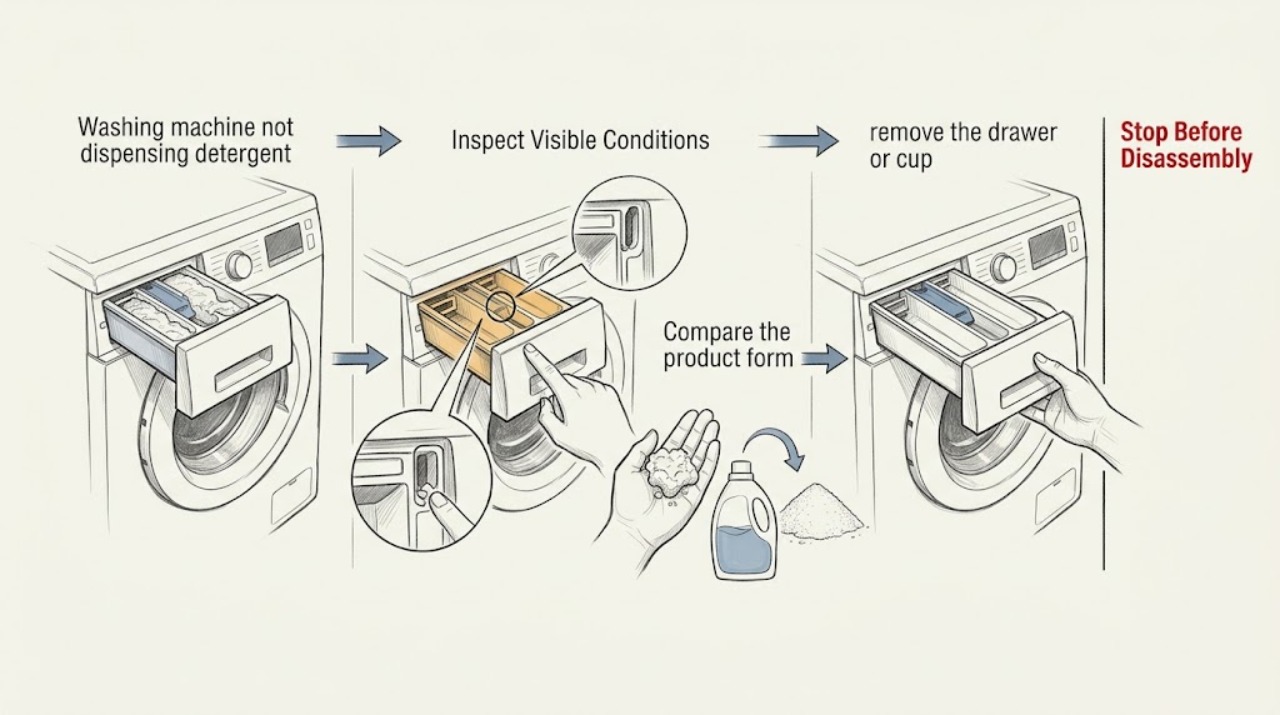
Work through in order
Diagnostic checks
Use only checks that match the exact appliance or system and its official guide.
-
Check 1
Name the product that is not dispensing and observe whether it is left in the drawer, enters the tub immediately, or appears in the tub at the wrong cycle stage; record the washer model and cycle used.
Expected result: A residue-filled compartment suggests a clog or poor water path. Immediate emptying suggests a siphon, fill-level, insert, or drawer-position issue. A product missing only on a pre-wash or rinse stage may be normal for that programme.
Next step: Use the exact model instructions for that product and cycle before changing detergent or ordering a drawer; do not assume all compartments operate at the same time.
Why this matters
Why: The product and timing determine whether to inspect the compartment, its insert, the water jets, the selected programme, or an automatic-dosing setting.
-
Check 2
With the washer stopped and dry, remove the drawer or cup only if the model manual shows it is user-removable; inspect for hardened powder, softener buildup, a blocked siphon, a missing insert, or a drawer that is not fully seated.
Expected result: Residue or a blocked siphon can prevent water from carrying the product through. A liquid cup left in place for powder, or a drawer that is not aligned or closed, can change dispensing or cause an overflow.
Next step: Rinse only the removable parts as the manual permits, dry and reinstall them in the correct position, and stop if the drawer is cracked, jammed, hot, or leaking. Do not force a release tab or dismantle the water inlet.
Why this matters
Why: The drawer is a water path, not just a storage tray. Its inserts and removable parts differ by model and product form.
-
Check 3
Compare the product form with the model instructions: use the main-wash, pre-wash, softener, or bleach compartment intended for that product, keep liquid or powder inserts in the required position, and keep every product below the marked fill limit.
Expected result: Powder in a liquid cup, a missing liquid tray, a pod in a drawer, overfilling, or concentrated softener that is too thick can leave residue, dispense early, clog the inlet, or create excess suds.
Next step: Empty and clean the affected compartment safely, then reload only according to the manual and product label. If the correct setup still fails, continue to the water-flow and service branches.
Why this matters
Why: A dispensing symptom can be caused by product and insert mismatch rather than a failed valve or pump. Do not infer a fixed amount across models or products.
-
Check 4
From a dry, safe position, check that the washer is stable and level and that the visible water supply is available without kinks or a leak; do not remove inlet screens, open panels, or touch wet connections.
Expected result: An unlevel washer can tilt a drawer or disrupt a siphon. Low or interrupted water flow can leave product behind, while a wet hose, valve, or cabinet points to a leak or supply fault.
Next step: Correct only an obvious, dry, accessible hose position or stability issue using the model instructions. Persistent low flow, a leak, or a suspected inlet valve fault needs appliance service.
Why this matters
Why: Dispensing requires the correct water path; a drawer can be clean and still fail if water is not reaching its jets or the machine is not level.
-
Check 5
After a safe drawer and product correction, run one suitable rinse or empty cycle without adding detergent only if there is no active leak, chemical history, hot water hazard, or electrical concern.
Expected result: The drawer should flush cleanly and the product should appear at the stage described by the manual. Residue, early flow, overflow, bubbles, or a drawer that still holds water indicates that the water path or dispenser remains faulty.
Next step: Do not repeat cycles if the washer leaks, produces excess suds, shows an error, or leaves the drawer full. Record the result and arrange appliance service.
Why this matters
Why: A single controlled result can separate a setup or residue problem from a persistent dispenser, inlet, siphon, or control fault.
-
Check 6
Document the product, compartment, insert position, cycle stage, drawer residue, water-flow observation, level, and any error or leak before deciding whether service is needed.
Expected result: A correct drawer with good water flow but persistent non-dispensing points toward an internal valve, jet, siphon, dispenser, or control fault. A leak or overflow at the drawer points to a damaged or blocked water path.
Next step: Request appliance repair for persistent non-dispensing, a cracked or jammed drawer, a valve or control concern, repeated overflow, or any electrical or water-safety symptom.
Why this matters
Why: The evidence distinguishes user setup from an appliance fault without requiring live electrical work or internal water-path dismantling.
Use your observations
Decision map
Find the observation that best matches what you see, then follow the next safe action.
-
PATH 01Next step
What you see
The wrong compartment, insert, product form, fill level, or cycle stage explains the symptom.
Do this next
Arrange qualified service and follow the exact model guidance.
Why this path and its safety boundary
Why it matters: Correct the setup using the exact model manual and product label; do not use fixed cross-model doses or put pods in a drawer unless explicitly allowed.
-
PATH 02Next step
What you see
The drawer, siphon, cup, or water jets contain residue or the drawer is not seated.
Do this next
Arrange qualified service and follow the exact model guidance.
Why this path and its safety boundary
Why it matters: Clean only removable parts as the manual permits, reinstall them correctly, and arrange service if the drawer is cracked, jammed, or still retains product.
-
PATH 03Next step
What you see
The washer is unlevel or visible water flow is weak, kinked, interrupted, or leaking.
Do this next
Arrange qualified service and follow the exact model guidance.
Why this path and its safety boundary
Why it matters: Correct only an obvious dry external setup issue; persistent low flow, valve concerns, or any leak needs appliance or plumbing service.
-
PATH 04Next step
What you see
The drawer remains full or dispensing is still wrong after one safe correction and controlled rinse.
Do this next
Arrange qualified service and follow the exact model guidance.
Why this path and its safety boundary
Why it matters: Stop repeated cycles and request appliance service for the dispenser, inlet, siphon, valve, or control system.
-
PATH 05Next step
What you see
Chemical splash, mixed products, hot water, active leak, water near electrics, smoke, burning smell, sparking, or repeated power trips occur.
Do this next
Arrange qualified service and follow the exact model guidance.
Why this path and its safety boundary
Why it matters: Stop immediately, keep clear of the area and wet electrics, follow the product safety label, and obtain appropriate emergency or qualified service help.
Helpful context
Understand the symptom
Not dispensing can mean several different symptoms: the product is still in its compartment, drains into the tub before the cycle, remains in a cup or siphon, or reaches the tub at the wrong stage. Drawer layouts vary between front-load, top-load, and automatic-dosing designs, so the exact model manual controls the compartment and insert choice.
Treat detergent, softener, and bleach as household chemicals. Do not mix products, pour one product into another compartment, or put your hands into a drawer while water is flowing. Keep the area dry and stop if a leak or chemical exposure occurs.
Safety boundary
Stop conditions
- Stop immediately for a leak, overflow toward a plug or socket, hot water, chemical splash or mixed product, smoke, burning smell, sparking, a hot cord, or repeated breaker trips.
- Do not mix detergents or additives, force the drawer, remove internal inlet parts, reach into a water path while powered, or dismantle the washer.
Only after diagnosis
Potential parts
- detergent dispenser drawer or insert
Consider only when the exact model's drawer or insert is cracked, worn, missing, or confirmed by service to be the dispensing fault.
Confirm the washer model and drawer design before ordering; liquid cups, siphons, and automatic-dosing parts are not universally interchangeable. - water inlet valve or dispenser jet assembly
Consider only after a technician confirms that water is not reaching the drawer because of an inlet or jet fault.
Confirm model-specific fit and have a qualified technician handle internal water or electrical connections.
Common questions
FAQ
Why is detergent still in my washing machine drawer?
Residue, a blocked siphon, a wrong insert, low water flow, an unlevel washer, a drawer that is not seated, or a product that is too thick can prevent dispensing. Use the model manual before changing the product setup.
Can I put powder detergent in the liquid cup?
Only use the product form and insert position specified for your model. A liquid cup left in place for powder can prevent correct dispensing or clog the inlet on some designs.
Why does softener drain into the tub too early?
Overfilling, residue in the siphon, an unlevel drawer, a missing insert, or a damaged dispenser can allow early flow. Clean and reinstall only as the manual allows; persistent early draining needs service.
Read the exact guide
Official sources
- Not Dispensing Detergent - Front Load WasherWhirlpool Product Help · Washer detergent-dispenser residue, cleaning, leveling, and service guidance
- LG Washer - Detergent and Additive UsageLG USA Support · Front-load and top-load washer compartments, liquid and powder inserts, additives, and residue guidance
- How to properly use detergent in your Samsung washerSamsung Support · Washer compartment, product form, level, siphon, and detergent-buildup guidance
- What is an F8 E2 Error Code on a Front Load WasherWhirlpool Product Help · Washer dispenser-system error and residue-cleaning guidance
Community feedback
Share a repair observation
Share a plain-text repair observation. Accepted observations are published automatically; this page may take a moment to update.