
On this page
Start here
Quick answer
If an Indesit washing machine leaves detergent or fabric conditioner in its drawer, first distinguish a small amount of water from a full compartment: Indesit says a little water or conditioner can remain normally, but a full compartment usually points to a blocked drawer or siphon. With the machine stopped and the drawer accessible, remove and wash the drawer in hot soapy water, clear the conditioner siphon and refit every insert. Use the detergent compartment marked for the selected programme, measure the product as its label and model manual require, and dilute concentrated conditioner when the instructions call for it. Check that the drawer closes fully, the machine is level and the cold-water supply and inlet hose are open, unkinked and free of visible leaks. A rinse that does not reach the drawer, a tap indication, persistent residue after cleaning, water leaking from the dispenser, or a machine that stops needs model-specific service. Stop immediately for a flood, water near electrics, damaged hoses, skin or eye exposure, burning odor, smoke, sparks or repeated electrical trips; do not mix cleaning chemicals or open the cabinet.
Before you begin
Safety first
- Do not open panels, loosen pressurized hoses, probe live parts, use sharp tools in hidden channels, mix cleaning chemicals, run with a leak or water near electrics, or continue after burning odor, smoke, sparks or a repeated trip.
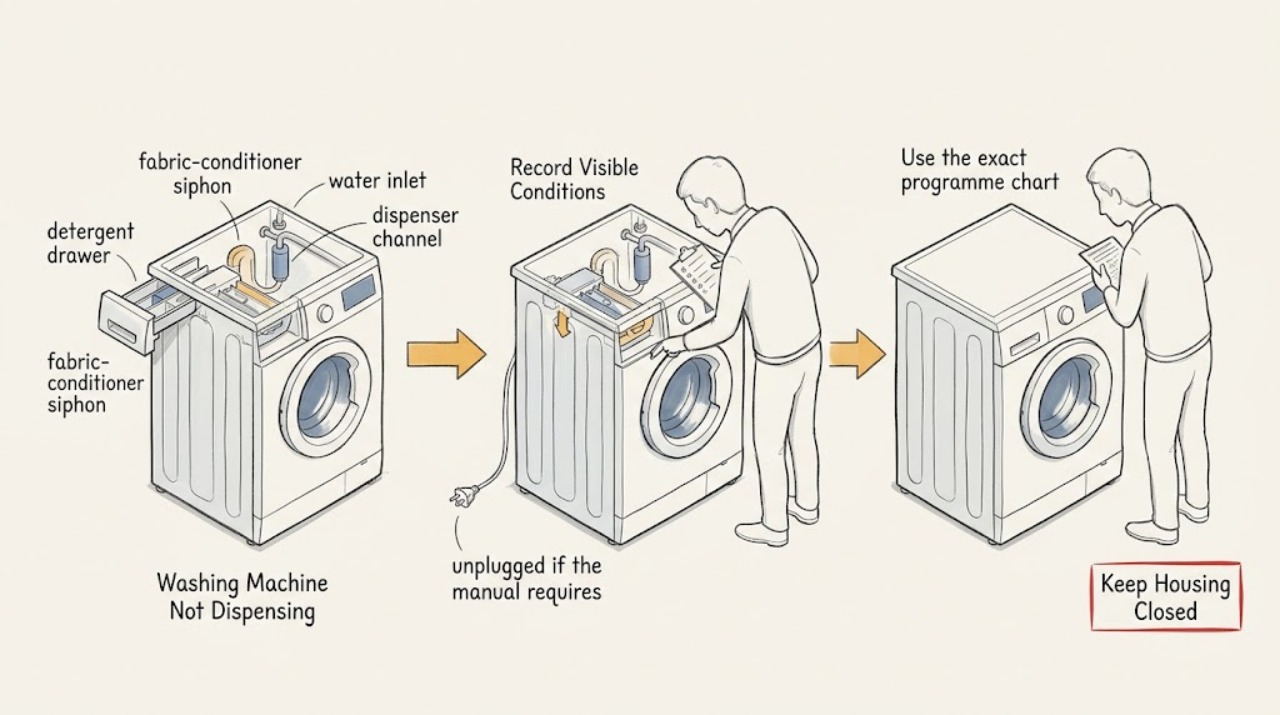
Work through in order
Diagnostic checks
Use only checks that match the exact appliance or system and its official guide.
-
Check 1
Stop the programme and identify the affected product and compartment. Note whether the drawer contains a small amount of water, dry powder, diluted liquid, a thick conditioner plug or a full unchanged dose. Check for a leak or overflow at the drawer, and record the programme, temperature, fill stage, any tap or flashing indication and whether the drum has water in it.
Expected result: Only a small amount remains, one compartment is full, several compartments are unchanged, water leaks from the drawer, the machine never fills or the programme stops.
Next step: If water is near electrical parts, a hose is damaged, the drawer is overflowing, there is a burning odor, smoke, sparking or a repeated trip, stop use and isolate power only from a safe dry position. Otherwise continue with the drawer inspection and water-supply checks.
Why this matters
Why: A small remainder may be normal. One blocked compartment suggests a drawer or siphon issue; all compartments or no fill points toward water delivery or programme timing. A leak or stopped cycle creates a flood or electrical risk beyond a simple residue problem.
-
Check 2
With the machine idle, unplugged if the manual requires it and the drawer accessible, remove the dispenser drawer. Wash the drawer and removable conditioner siphon or cap in hot soapy water, clear visible dried product without sharp tools, rinse the parts and refit each insert in its original position. Clean only the accessible drawer housing; do not force a stuck drawer or reach into the cabinet.
Expected result: A dried detergent or conditioner blockage comes out, the siphon cap is missing or damaged, the drawer or housing is cracked, or the channels appear clear but the product still remains.
Next step: Reassemble only the correct parts for the model and leave the drawer able to slide and close fully. Replace a damaged drawer or siphon only after checking the complete model. If the channels were clear or the fault returns after cleaning, continue to product, level and water checks.
Why this matters
Why: Indesit identifies dispenser blockage and unused conditioner as common reasons for conditioner not being taken away. A damaged or incomplete siphon cannot create the correct draw even when it is clean; clear channels shift attention to water flow, levelling, product use or an internal valve.
-
Check 3
Use the exact programme chart and product instructions. Put detergent in the compartment assigned to the selected programme, keep powder dry until the fill, do not exceed the marked level, and dilute concentrated conditioner when the product or Indesit guidance requires it. Check that the drawer is not overfilled, that the front closes without resistance and that no item or residue blocks the drawer opening.
Expected result: The wrong compartment was used, the product is above its level, concentrated conditioner is thick or undiluted, the drawer cannot close fully, or the dose and drawer position are correct.
Next step: Correct only the product, dose, dilution and drawer position supported by the label and model manual. Do not add extra detergent to compensate for a failed rinse. If the drawer remains full with a correct dose and closed drawer, continue to water and level checks.
Why this matters
Why: A wrong compartment, excessive dose, thick conditioner or incomplete drawer closure can leave product behind even when water flow is normal. Correct dosing and placement are necessary before judging the dispenser mechanism.
-
Check 4
Check the accessible water path without dismantling the machine: confirm the cold-water tap is fully open, the inlet hose is not kinked or crushed, and the hose connections show no leak. Check the drawer front and the machine position; Indesit says a machine that is not level or is too low at the front can prevent conditioner from being rinsed away. If the model has an inlet screen that the manual labels user-cleanable, follow that manual only.
Expected result: The tap is closed, the hose is kinked or leaking, the machine is visibly out of level, a tap symbol or fill indication appears, or the accessible supply and position are normal.
Next step: Open the supply, correct a safe hose kink, stop for any leak and level the appliance only as the installation instructions permit. Do not loosen pressurized fittings or remove the cabinet. If all accessible checks are normal but dispensing fails, arrange service.
Why this matters
Why: Insufficient or mistimed water can leave every product compartment unchanged, while a front-low or unlevel machine can affect the conditioner siphon. A leak or persistent fill indication may require a hose, inlet or valve diagnosis.
-
Check 5
After the drawer is clean, correctly assembled and loaded, the water path is safe and the machine is dry, run at most one suitable programme check while present. Observe whether water reaches the correct compartment, whether the product is drawn away, whether the drawer leaks, and whether the cycle completes. Stop at once for overflow, unusual noise, burning odor, smoke, sparks, abnormal heating or an electrical trip.
Expected result: The drawer dispenses normally, only one programme fails, all compartments remain full, the drawer leaks, the machine stops or the same tap or fault indication returns.
Next step: Stop repeated tests and arrange Indesit service for a returning fault, leak, fill indication, stopped cycle or internal diagnosis. Provide the model, affected compartment, product type, programme, cleaning result, water observations and any hazard symptom.
Why this matters
Why: A successful check supports a blockage, product, programme or level cause. A programme-specific failure may involve programme timing or a valve channel. Persistent failure across programmes suggests an inlet valve, pressure-sensing, wiring or control issue that cannot be identified safely from the drawer.
Use your observations
Decision map
Find the observation that best matches what you see, then follow the next safe action.
-
PATH 01Next step
What you see
Only a small amount of water or conditioner remains in the conditioner compartment after the wash.
Do this next
Check the next load for correct dosing, drawer closure and wash results. Investigate further only if the compartment stays full, the product is unchanged or the drawer leaks.
Why this path and its safety boundary
Why it matters: Indesit says a small remainder can be normal and does not by itself prove a dispensing fault.
-
PATH 02Next step
What you see
Powder, liquid or conditioner is left in one compartment and dried residue or a conditioner plug is visible.
Do this next
Remove the drawer and removable siphon parts, wash them in hot soapy water, rinse and refit them. Do not use sharp tools or mixed chemicals; service a damaged drawer or recurring blockage.
Why this path and its safety boundary
Why it matters: A drawer or siphon blockage is the leading accessible explanation.
-
PATH 03Next step
What you see
The wrong compartment, excessive dose, thick undiluted concentrated conditioner or an incompletely closed drawer is found.
Do this next
Correct the compartment, dose and dilution using the product label and exact model manual, then close the drawer fully. Do not add more product to a failed cycle.
Why this path and its safety boundary
Why it matters: Product placement, viscosity, dose or drawer position can prevent the water from carrying the product away.
-
PATH 04Next step
What you see
All compartments remain full, the machine shows a tap or fill indication, or the drawer receives little or no water.
Do this next
Check the accessible tap and hose for an open supply, kink or leak, then use the model manual for any user-cleanable inlet screen. If flow remains abnormal, request service without opening the cabinet.
Why this path and its safety boundary
Why it matters: The cold-water supply, inlet hose, inlet screen, valve, pressure sensing or programme timing may be involved.
-
PATH 05Next step
What you see
Water leaks or overflows from the drawer, the appliance is out of level or too low at the front, or the cycle stops with water inside.
Do this next
Stop the programme, close the water supply if safe and isolate power only from a dry position when water is near electrics. Do not loosen pressurized fittings or continue testing; arrange qualified service.
Why this path and its safety boundary
Why it matters: Excess pressure, levelling, a drain or fill issue, or an internal leak may be involved; continued operation can cause water damage.
-
PATH 06Next step
What you see
The drawer is clean, the dose and programme are correct, the water supply is normal, but dispensing still fails across programmes.
Do this next
Keep the machine off if the issue includes leakage, electrical symptoms or a stopped cycle, and arrange Indesit service with the model and observations. Do not remove panels or test live parts.
Why this path and its safety boundary
Why it matters: An inlet valve channel, pressure sensor, drawer housing, wiring or control fault may remain.
Helpful context
Understand the symptom
Confirm what failed to dispense
A small amount of water or conditioner left after a cycle can be normal. A compartment still full of powder, liquid or conditioner is different. Record which compartment was affected, whether the machine filled and rinsed normally, whether water entered the drawer, whether the drawer overflowed, and whether the problem occurs on every programme or only one.
Keep the cleaning boundary simple
The drawer and its removable siphon parts are user-accessible on many Indesit models, but the arrangement varies. Clean with hot soapy water and a soft brush only when the manual permits. Do not poke into hidden channels with metal, mix bleach with acids or other cleaners, or remove the cabinet to reach an inlet valve.
Dispensing depends on water and level
The drawer needs the correct water flow at the correct point in the programme. A closed or restricted cold-water supply, kinked hose, inlet screen restriction, excessive pressure, a machine that is low at the front or a drawer that cannot close can change where water goes. Check only accessible connections and use the exact model manual for any pressure or installation requirement.
Safety boundary
Stop conditions
- Water leaking or overflowing toward electrical parts
- A damaged hose, plug, outlet or repeated electrical trip
- Burning odor, smoke, sparks or abnormal heating
- Skin or eye exposure to detergent or cleaning product
- A drawer or siphon that is cracked, loose or cannot be safely refitted
- Any need to open the cabinet, loosen pressurized fittings or test live components
Only after diagnosis
Potential parts
- detergent drawer or conditioner siphon insert
Consider replacement only when the drawer, cap or siphon is cracked, missing or still fails after correct cleaning and reassembly.
Confirm the complete Indesit model and drawer layout before selecting a part. - water inlet hose or inlet filter
Consider this only when the accessible hose is damaged or a qualified diagnosis confirms restricted inlet flow; do not remove a pressurized connection as a user test.
Match the model, connection type and installation instructions. - water inlet valve or pressure sensor
Consider only after drawer, product, programme, supply, hose and levelling checks pass and a qualified technician identifies the internal fault.
Internal water and electrical components are model-specific and require qualified installation.
When checks do not resolve it
Need a professional?
Arrange Indesit service for persistent non-dispensing after drawer and product checks, no water reaching the drawer, a recurring tap indication, a damaged drawer or siphon, dispenser leakage or overflow, a stopped cycle, an internal valve or pressure-sensing diagnosis, or any electrical, burning or water-safety symptom.
Safety scope: Do not open panels, loosen pressurized hoses, probe live parts, use sharp tools in hidden channels, mix cleaning chemicals, run with a leak or water near electrics, or continue after burning odor, smoke, sparks or a repeated trip.
Common questions
FAQ
Why is my Indesit washing machine not dispensing conditioner?
A small amount of water or conditioner can remain normally, but a full compartment commonly means a blocked drawer or siphon. Remove the accessible drawer, clean it with hot soapy water, refit the parts, dilute concentrated conditioner when instructed, and check that the machine is level. If it still fails, service may be needed.
Can too much detergent stop an Indesit dispenser working?
An excessive dose can leave product behind and poor wash results can follow. Use the correct compartment and the amount on the product label and model guidance. Do not add more detergent to compensate for a drawer that is not receiving water.
How do I clean an Indesit washing-machine detergent drawer?
With the machine idle and the drawer accessible, remove the drawer and removable conditioner siphon parts, wash them in hot soapy water, rinse and refit them in their original positions. Do not use sharp tools, mix chemicals or force parts; follow the exact model manual if the drawer differs.
What if no compartment in my Indesit washer gets detergent?
Check the cold-water tap, inlet hose for a kink or leak, the programme and any tap or fill indication. If the drawer is clean and all compartments remain dry, an inlet, pressure or control issue may need qualified diagnosis.
When should I stop using an Indesit washing machine that is not dispensing?
Stop for a leak or overflow, water near electrics, a damaged hose, burning odor, smoke, sparks, abnormal heating, a repeated breaker trip, skin or eye exposure, or a drawer that cannot be safely refitted. Close the water supply and isolate power only when safe, then arrange qualified service.
Read the exact guide
Official sources
- Indesit Parts and CareIndesit Parts · Indesit drawer care and model-specific genuine part lookup
- Washing Machines TroubleshootingIndesit Service · Indesit washing-machine dispenser, conditioner, water supply, levelling and safety troubleshooting
- Washing Machine RepairsIndesit Service · Indesit model variation, programme, fill, door and error guidance
Community feedback
Share a repair observation
Share a plain-text repair observation. Accepted observations are published automatically; this page may take a moment to update.