
On this page
Start here
Quick answer
An Electrolux washer may appear not to spin because it is still in the normal pause between wash and spin, has not drained, has detected an unbalanced load, or is not recognizing a closed door or lid. Keep the washer stopped if water is standing, turn power off and wait for the lid or door to unlock before redistributing laundry, and check only the external drain hose for a kink or obstruction. Then verify the selected cycle, Start command, Delay Start or pause state, door or lid closure, outlet, and load balance. Do not force a locked door, reach into a moving drum, open a wet pump filter, remove panels, or bypass a lock. If the washer still will not spin after the load is balanced and water can drain, or if it makes a grinding sound, leaks, trips power, or shows a recurring fault, arrange qualified service.
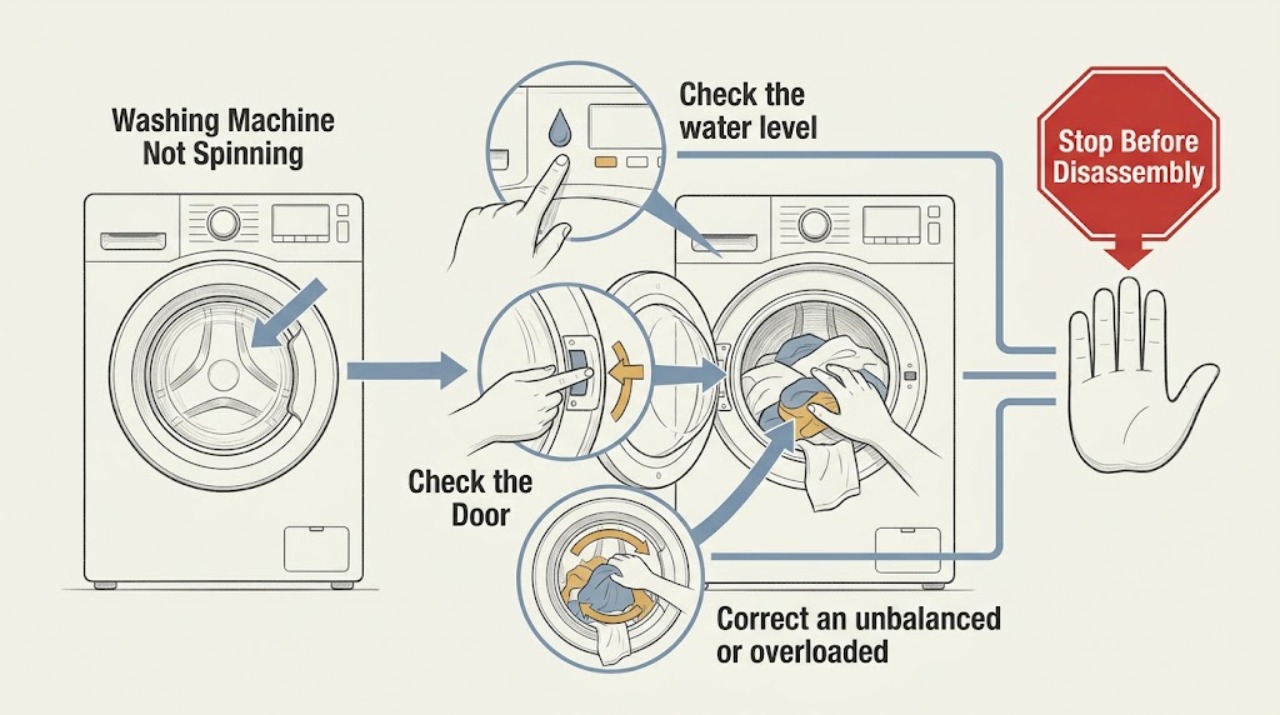
Work through in order
Diagnostic checks
Use only checks that match the exact appliance or system and its official guide.
-
Check the water level and stop for hazards
Press Cancel or turn the washer OFF using the normal control. Look through the door or lid without forcing it open and note whether water is covering the clothes, only a small amount remains, or the tub is empty. Look for water on the floor, a burning smell, smoke, a damaged cord, or a door or lid that will not safely unlock.
Expected result: The tub is full or partly full, the tub is empty, or a leak, burning smell, smoke, electrical damage, or unsafe locked door or lid is present.
Next step: Do not force the door or lid, bail water into an electrical area, or reach into the drum. If there is a leak near power, smoke, burning smell, cord damage, or a violent movement, leave the washer off and arrange qualified service. If water remains but there is no hazard, inspect only the external drain path next.
Why this matters
Why: A washer that cannot complete draining may withhold the high-speed spin, while an empty tub points toward cycle, lock, balance, or drive conditions. Hazard symptoms or a lock that will not release change this from a user check to a stop and service situation.
-
Verify the cycle, Start command, and door or lid closure
With the drum stopped and the door or lid closed, check that the intended cycle includes a final spin, that Start was pressed, and that Delay Start, Control Lock, or a pause state has not been selected. Check that no clothing or debris is preventing the door or lid from closing and that the latch or striker engages normally; do not bypass or hold the lock closed by hand.
Expected result: The washer was paused, delayed, not started, set to a cycle without the expected spin, or not recognizing the closed door or lid, or all visible controls and closure appear normal.
Next step: Correct only the visible cycle or control selection and close the door or lid normally. If it still will not lock or the control reports a door or lid fault, stop and arrange service. If the door or lid is recognized, continue without opening it during operation and check the load and level.
Why this matters
Why: Electrolux says a pause can occur between wash and spin, and the washer will not operate when the lid is not properly closed. A selected delay or missing Start command can look like a spin failure; a normal latch and cycle shift the concern toward draining or load balance.
-
Correct an unbalanced or overloaded load
Turn power OFF and wait for the door or lid to unlock. Redistribute clothing evenly around the drum or basket; remove a visibly overloaded amount, or add one or two similar items only when the remaining load is very small and the model guidance permits it. Confirm the washer stands firmly on a solid floor and is not rocking; do not reach under a running machine to adjust feet.
Expected result: The load was bunched, a single heavy item was present, the washer rocked or shook, or the load was already even and the washer remained stable.
Next step: Close the door or lid and run the same cycle or the model's appropriate spin option once. If the washer immediately bangs, walks, or refuses to accelerate again, stop it and arrange service rather than repeatedly restarting. If balance was not the issue, check drainage.
Why this matters
Why: Electrolux identifies an unbalanced load and an unlevel washer as causes of vibration and interrupted or reduced spin behavior. A corrected load that reaches spin points to balance; a stable, evenly distributed load that still will not spin points elsewhere.
-
Inspect the external drain hose and drain condition
If water remains, keep power OFF and inspect only the visible drain hose and household drain connection. Look for a kink, crushing, a hose pushed too tightly into the standpipe, or a visibly blocked drain. Do not open a pump filter or remove a hose while the tub is full unless the exact model manual gives a safe controlled-drain procedure and you can contain the water safely.
Expected result: The hose is kinked or trapped, the household drain is visibly backed up, the hose is installed too tightly, or the external drain path looks clear while water still remains.
Next step: Straighten only an accessible hose without pulling on connections and correct an obvious external obstruction according to the installation guide. Do not run another high-speed spin while water remains. If the drain path is clear but the washer cannot empty, stop and arrange service rather than opening the pump area with water inside.
Why this matters
Why: Electrolux identifies a kinked or blocked drain path as a cause of slow draining and notes that a suspected clogged pump may require service. A washer that cannot remove water may not proceed to spin; a clear external path with retained water shifts the concern to the pump or an internal blockage.
-
Check for excess suds or a displayed fault
Observe the display or indicator lights and the water in the tub. If there is a suds warning or unusually persistent foam, do not add more detergent; use only the model-specific cancel or rinse procedure. Record any error code exactly as shown, but do not guess its meaning from a different model.
Expected result: The washer shows a suds or other fault indication, there is substantial foam, or there is no code and the water is not unusually foamy.
Next step: Use the exact manual's reset or rinse instructions and the recommended detergent amount; do not use a guessed code procedure. If the warning returns or the washer cannot drain, stop and arrange service. If there is no suds issue, perform only one controlled test after confirming the tub is empty or drained.
Why this matters
Why: Electrolux documents an oversuds condition that can add rinse phases and delay completion. A code or heavy foam can explain a missing final spin, while no code and normal water shifts the decision back to balance, drain, lock, or internal service.
-
Run one controlled spin check and set the service boundary
Only when there is no standing water, the load is balanced, the door or lid closes and locks normally, and there is no hazard, select the model's appropriate spin or rinse-and-spin cycle and observe from outside. Stop the cycle if the drum does not accelerate, the washer bangs or walks, the lock releases unexpectedly, a leak appears, or an abnormal grinding or burning sound occurs.
Expected result: The washer reaches a normal spin, tumbles without accelerating, stops with water still present, repeats a lock or fault indication, or produces violent movement or abnormal noise.
Next step: If the washer spins normally, monitor the next load and avoid overloading. If it still will not spin or shows any hazard, leave it off and arrange qualified appliance service. Provide the technician with the water level, cycle, door or lid result, load balance, drain observations, codes, and sound or movement details.
Why this matters
Why: A successful controlled spin after correcting the load or drain condition supports a temporary balance or setup issue. Failure with an empty or balanced load and a clear drain points toward the door or lid interlock, motor or drive, pump, control, or another internal fault.
Use your observations
Decision map
Find the observation that best matches what you see, then follow the next safe action.
-
PATH 01Next step
What you see
The washer was paused, delayed, not started, or waiting for a normally closed door or lid.
Do this next
Correct the visible control or closure condition and run the model's cycle once. If the latch or lock is not recognized, stop and arrange service.
-
PATH 02Next step
What you see
The load was bunched, too heavy, too small to balance, or the washer was unstable, and it spins after safe redistribution or leveling.
Do this next
Use balanced loads and monitor. Stop if the washer bangs, walks, or repeatedly refuses to accelerate.
-
PATH 03Next step
What you see
Water remains and the external drain hose or household drain is kinked or blocked.
Do this next
Correct only the accessible external obstruction according to the model installation guidance. If water remains or a pump blockage is suspected, arrange service and do not open a full pump filter.
-
PATH 04Next step
What you see
A suds warning, recurring fault code, or excess foam is present.
Do this next
Follow only the exact model manual's cancel or rinse procedure and use the specified detergent amount. Arrange service if the warning or no-spin condition returns.
-
PATH 05Next step
What you see
The tub is empty or drained, the load is balanced, the door or lid is recognized, and the washer still will not spin or produces abnormal movement or noise.
Do this next
Leave the washer off and arrange qualified service for the interlock, pump, motor, drive, control, or internal mechanical system.
-
PATH 06Next step
What you see
There is a leak near electrical parts, smoke, burning smell, damaged cord, repeated breaker operation, violent movement, or an unsafe locked door or lid.
Do this next
Stop immediately, keep clear, and disconnect power only if this can be done without touching a hazard. Seek qualified emergency or appliance service from a safe location.
Helpful context
Understand the symptom
Start with the state of the tub, not the motor. If water remains, the washer may be waiting for a drain condition before it permits high-speed movement. If the tub is mostly empty but the drum only tumbles, the control may be balancing the load, waiting for a closed door or lid, or still in a normal pause. The exact sequence varies by model, so use the model's Use and Care guide for cycle names and lock behavior.
Keep all checks outside the moving and electrical mechanisms. Turn the washer off before handling laundry, wait for the door or lid to unlock, and never defeat a lock or reach into a moving drum. A burning smell, leaking water near electrical parts, a damaged cord, repeated breaker trips, or a violent movement is a stop condition requiring qualified help.
When checks do not resolve it
Need a professional?
Arrange qualified service when the washer will not drain or spin after an accessible hose check and a balanced-load check, when the door or lid lock is not recognized, when an error or suds condition returns, or when an empty or balanced washer still tumbles without reaching spin. Stop immediately for smoke, burning smell, damaged cord, repeated breaker trips, leaks near electrical parts, violent movement, or any need to open panels or a full pump area.
Common questions
FAQ
Why is my Electrolux washer not spinning but still tumbling?
Check whether the washer is paused between wash and spin, waiting for a closed door or lid, detecting an unbalanced load, or unable to drain. Turn power off before redistributing laundry. If the tub is empty, the load is balanced, and it still will not accelerate, arrange qualified service.
Can an unbalanced load stop an Electrolux washer from spinning?
Yes. Electrolux identifies an unbalanced load and an unstable or unlevel washer as causes of vibration and altered spin behavior. Turn power off, wait for the lock to release, redistribute the load, and stop if the washer bangs, walks, or repeatedly refuses to spin.
Should I open the drain filter when my Electrolux washer will not spin?
Do not open a pump filter with a full tub unless the exact model manual provides a safe controlled-drain procedure and you can contain the water. First check the accessible external drain hose for a kink or obstruction. If the washer still cannot empty, arrange service.
Read the exact guide
Official sources
- What should I do if my washer is draining slowly?Electrolux · Electrolux washer external drain-hose, household drain, detergent, and suspected pump checks
- Laundry Washers Noises GuideElectrolux · Electrolux laundry washer balance, leveling, spin behavior, and load-related troubleshooting
- What should I do if my washer does not start?Electrolux · Electrolux washer start, pause, delay, lid, power, water, and circuit checks
- Laundry front loading washer displaying Error Code SU dS too many suds.Electrolux · Electrolux front-load washer oversuds indication and rinse recovery
- Laundry front loading washer displaying Error Code E41 door is open.Electrolux · Electrolux front-load washer door closure, latch, and obstruction checks
Community feedback
Share a repair observation
Share a plain-text repair observation. Accepted observations are published automatically; this page may take a moment to update.