
On this page
Start here
Quick answer
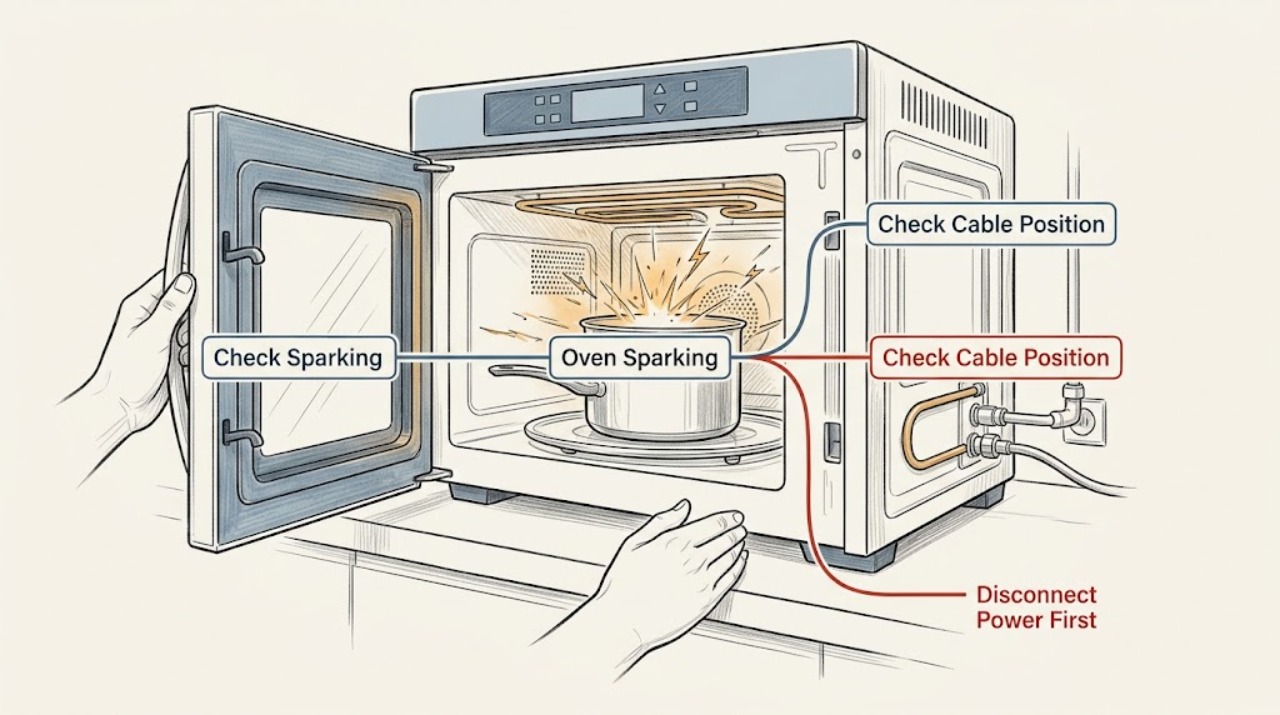
Press Cancel/Off and stop the cooking cycle as soon as you see a spark. Keep the door closed if there is smoke or a flame, and disconnect power or switch off the circuit only if it is safe. After the oven is cool, identify whether the sparks occurred during microwave or combination cooking, where metal, foil, a rack, twist-tie, gold-rimmed dish, temperature probe, spilled food, or an empty cavity may be involved. Remove only an accessible cause and clean the cavity with the model-approved method; never remove a waveguide cover, defeat a door interlock, or run the microwave empty. If sparking recurs with approved cookware, occurs in a conventional oven around an element, comes from the controls or supply, or is accompanied by smoke, burning odor, gas odor, a damaged door, or a breaker trip, leave the appliance off and arrange Fisher & Paykel trained service.
Before you begin
Safety first
- Do not open the cabinet, remove the waveguide cover, defeat the door interlock, test live circuits, run the microwave empty, or work on gas or high-voltage parts.
Work through in order
Diagnostic checks
Use only checks that match the exact appliance or system and its official guide.
-
Check 1
Stop the cycle at the first spark: press Cancel/Off, keep the door closed for smoke or flame, and note whether the spark was inside the cooking cavity, at the door edge, behind the control panel, near an element, or at the wall connection. Disconnect or isolate power only when it can be done without touching a wet or damaged area.
Expected result: A brief flash inside a microwave or combination cavity during cooking is an arcing event. A spark at the door, control, wiring, element, outlet, or cabinet is not a cookware adjustment. Smoke, flame, a burning smell, gas odor, or a breaker trip turns this into an immediate stop and service branch.
Next step: Leave the appliance off until it is cool and safe to inspect. If the spark was outside the cavity or any hazard remains, arrange qualified service without another test.
Why this matters
Why: The safe next step depends on the location and mode. Fisher & Paykel says to press Cancel/Off when arcing occurs, while its safety instructions prohibit user repair of electrical or protected microwave components.
-
Check 2
For a spark during microwave, speed-cook, or microwave-plus-convection operation, remove only accessible cooking materials after the cavity has cooled. Check for foil or metal touching a wall, metal cookware, a wire rack in a microwave mode, twist-ties, poultry pins, gold-rimmed dishes, recycled paper towels with metal pieces, or a temperature probe touching a rack or shelf.
Expected result: A visible metal contact, foil edge, or metallic decoration near the wall explains a mode-specific flash. If no such material is present, do not assume the appliance is safe: a repeated spark with a compliant setup points toward the cavity, waveguide area, door system, or internal electronics.
Next step: Remove the incompatible material and keep it out of microwave or combination modes. If the cavity, cover, door seal, or interior wall is damaged, or sparking recurs without a visible material cause, stop and call service.
Why this matters
Why: Fisher & Paykel defines arcing as sparks in the oven and lists these materials as causes. The microwave and speed-oven manuals do not authorize removal of the waveguide cover or internal microwave parts.
-
Check 3
Inspect the cooled microwave or combination cavity for baked-on food or grease splatter, a loose or damaged interior cover, scorch marks, or a cracked door or seal. Clean only accessible surfaces with the exact manual's gentle method; do not scrape with metal, spray into openings, or remove the waveguide cover.
Expected result: Fisher & Paykel's microwave troubleshooting identifies spilled food as a possible sparking cause and says the waveguide cover must remain in place. A blackened spot, hole, loose cover, damaged seal, or repeated flash after cleaning is a component or safety fault rather than ordinary soil.
Next step: Leave the oven disconnected if damage or recurring sparks remain. Photograph the location and provide the model and mode to Fisher & Paykel service; do not test by running it empty.
Why this matters
Why: Food residue can heat and arc, but damage to the cavity or protected microwave path can expose a fire or energy hazard. Cleaning cannot restore a damaged cover, door, or seal.
-
Check 4
Confirm the turntable, roller guide, rack, tray, and any temperature sensor are installed exactly as the model guide requires before considering a single supervised retry. Use only cookware or accessories approved for the selected mode and keep food in the cavity for microwave operation; do not use a bare rack or run the cavity empty to ‘see if it sparks.’
Expected result: If the spark stops after an incorrectly placed accessory or unsuitable dish is removed, the setup was the likely trigger. If a compliant accessory arrangement still produces a flash, or the spark follows the rack, sensor, tray, or door regardless of food, stop testing.
Next step: Use the exact model guide for accessory placement. If sparking returns, disconnect the oven and request trained service for the protected cavity, interlock, control, or power section.
Why this matters
Why: Fisher & Paykel manuals distinguish microwave-safe materials from accessories intended for convection or grill use, and warn that microwave operation requires food to absorb energy. A successful single check does not justify using a damaged or intermittently arcing oven.
-
Check 5
If the spark happened during conventional bake, broil, or a gas-range oven function rather than microwave energy, look only after cooling for foil or a pan touching a heating element, a visibly failed element, grease or food flare-up, or an object contacting the cavity. For a gas model, check only the external absence of a gas odor; do not inspect an igniter, burner, or gas valve internally.
Expected result: A foil contact, food flare-up, or visibly damaged element is a stop-and-service condition if it cannot be removed safely. A spark from the element, wiring, controls, or gas ignition system is not corrected by changing cookware. Any gas odor or persistent ignition failure requires leaving the area and using the local gas emergency or supplier process.
Next step: Do not restart the oven when an element, wiring, door, or gas component is damaged or when smoke or odor persists. Arrange an appliance technician or qualified electrician/gas professional as appropriate.
Why this matters
Why: The professional-range guide separates electrical no-power causes from no-gas causes and requires qualified service for repairs. Conventional oven and gas ignition parts can remain hot or energized after the control is turned off.
-
Check 6
Record any F__ or other display code, the cooking mode, whether the door closes and latches normally, and whether the breaker trips. Apply only the model guide's documented Cancel/Off or power reset once after the appliance is cool and no hazard is present.
Expected result: A code or recurrence after a documented reset indicates an unresolved control, sensor, door-interlock, or power fault. A door that is bent, loose, or not sealing, a breaker that trips again, or controls that behave unpredictably makes further use unsafe.
Next step: Leave the oven off and give service the model, code, spark location, mode, materials used, and photos. Do not keep resetting the breaker or bypass the door system.
Why this matters
Why: Fisher & Paykel tells users to note persistent F__ codes and contact Customer Care or a trained technician. The manufacturer also treats damaged door seals and interlocks as safety-critical, not user-adjustable.
Use your observations
Decision map
Find the observation that best matches what you see, then follow the next safe action.
-
PATH 01Next step
What you see
Sparks occur during microwave or combination cooking and a metal, foil, unsuitable rack, twist-tie, decorated dish, probe, or empty cavity is identified.
Do this next
Stop the cycle, remove only the accessible incompatible material after cooling, and follow the model guide for approved cookware and accessories. Do not retest if the cavity, cover, door, or seal is damaged.
-
PATH 02Next step
What you see
Sparks recur with food and approved cookware, or the waveguide area, cavity wall, door, or seal is scorched or damaged.
Do this next
Leave the oven disconnected and arrange Fisher & Paykel trained service. Never remove the waveguide cover or defeat a microwave interlock.
-
PATH 03Next step
What you see
A spark comes from a conventional heating element, control panel, wiring, outlet, or outside the cavity.
Do this next
Do not operate the oven or retry the breaker. Arrange qualified appliance or electrical service after isolating power safely.
-
PATH 04Next step
What you see
Smoke or a flame remains in the cavity.
Do this next
Keep the door closed, cancel the cycle, and disconnect power or shut off the circuit only if safe. Leave the oven off until the cause and any damage are professionally assessed.
-
PATH 05Next step
What you see
A gas odor, hissing, or abnormal ignition occurs on a gas range.
Do this next
Do not operate switches or attempt another ignition nearby. Leave the area and follow local emergency gas guidance or contact the gas supplier from a safe location.
-
PATH 06Next step
What you see
An F__ code, door-interlock issue, repeated breaker trip, or recurring spark remains after one documented reset.
Do this next
Record the exact code and model, keep the appliance off, and request Fisher & Paykel Customer Care or a trained service technician.
Helpful context
Understand the symptom
First locate the spark and identify the cooking mode
‘Sparking’ can mean microwave arcing inside a combination oven, a foil or rack touching an element in a conventional oven, or an electrical fault outside the cooking cavity. Fisher & Paykel's microwave and speed-oven guides specifically call out metal, foil, metal cookware, wire racks, twist-ties, gold-rimmed dishes, paper with metal pieces, and an empty cavity. Record the exact model, selected mode, spark location, whether food was present, and whether smoke, odor, or a code appeared.
Stop the energy source before inspecting anything
Press Cancel/Off and do not open the door immediately if there is a flame or smoke; keep the door closed and disconnect power or shut off the circuit only if doing so is safe. Do not touch hot metal, use water on an electrical or grease fire, reach through a damaged door, remove a waveguide cover, defeat a microwave or oven-door interlock, or remove cabinet panels. Fisher & Paykel requires electrical work to be done with mains power disconnected and directs other servicing to trained technicians. If gas odor is present on a range, leave the area and follow local emergency gas guidance rather than operating switches.
Safety boundary
Stop conditions
- Stop immediately for recurring sparks, smoke, flame, a burning smell, gas odor, a damaged door or seal, a scorched cavity or control, a wet or damaged cord, arcing outside the cavity, or a breaker that trips again.
- Do not run a microwave or combination oven empty, use metal or foil in a microwave mode, remove a waveguide cover, bypass a door interlock, test live wiring, or spray water into vents or electrical openings.
- Do not restart a conventional or gas oven after an element, igniter, control, wiring, or gas component sparks. Leave internal repair and any gas work to qualified professionals.
Only after diagnosis
Potential parts
- microwave waveguide cover or cavity protection component
Consider this class only when a trained technician confirms a damaged or contaminated protected cover after the appliance is isolated; a cover should never be removed or bypassed as a user test.
Confirm the full model and service documentation. Do not infer fit from a similar-looking microwave cover. - oven heating element or terminal assembly
Consider this class only when a conventional heating element or its terminals are visibly damaged or a technician confirms an element fault after a spark near the element.
Isolate mains power and verify exact model, element type, and electrical rating through qualified service documentation. - oven door interlock or latch assembly
Consider this class only when the door does not close or latch correctly, an interlock fault is recorded, or a technician confirms the safety switch has failed.
Never bypass an interlock. Confirm exact model and have a trained technician install and test the safety circuit.
When checks do not resolve it
Need a professional?
Arrange Fisher & Paykel trained service when sparks recur after approved cookware and a clean cavity, a waveguide cover or door is damaged, the spark comes from an element, control, outlet, or wiring, an F__ code returns, the breaker trips, or any smoke, fire, gas, or electrical hazard occurs.
Safety scope: Do not open the cabinet, remove the waveguide cover, defeat the door interlock, test live circuits, run the microwave empty, or work on gas or high-voltage parts.
Common questions
FAQ
Why does my Fisher & Paykel oven spark when using microwave or combination mode?
Stop with Cancel/Off and check after cooling for foil, metal cookware, an unsuitable rack, twist-ties, decorated dishes, a temperature probe touching a rack, food splatter, or an empty cavity. If the setup is compliant or the cavity is damaged, leave it off and arrange service.
Can I keep using the oven after it sparks once?
Do not keep using it automatically. Remove a clearly identified, accessible cookware cause only after the oven is cool and the cavity is undamaged. Any recurrence, scorch mark, smoke, odor, door damage, or spark from an element, control, or wiring needs qualified service.
Is a spark from a Fisher & Paykel oven element or gas ignition safe?
Treat it as unsafe until diagnosed. Leave the oven off and isolate power only if safe; for gas odor or hissing, leave the area and follow local emergency gas guidance. Do not test or replace internal electrical or gas parts yourself.
Read the exact guide
Official sources
- USER GUIDE NZ AU CONVECTION SPEED OVEN PROFESSIONALFisher & Paykel · Fisher & Paykel OM76NPX1 professional convection-speed oven models; confirm the exact model before applying settings
- CONVECTION-SPEED OVENFisher & Paykel · Fisher & Paykel OM30 convection-speed and combination oven models listed in the guide; apply model-specific details conditionally
- Help & SupportFisher & Paykel Appliances Ltd · Fisher & Paykel appliances; regional manuals and service options vary by model and location
- TROUBLESHOOTINGFisher & Paykel · Fisher & Paykel RGV2 and RDV2 professional range models; gas details apply only to a matching gas configuration
- OVER THE RANGE MICROWAVE OVENFisher & Paykel · Fisher & Paykel MOH30SS1 over-the-range microwave models in the linked guide; use only the matching model's controls and accessories
Community feedback
Share a repair observation
Share a plain-text repair observation. Accepted observations are published automatically; this page may take a moment to update.