
On this page
Start here
Quick answer
If a GE oven sparks, stop the cooking cycle immediately and keep clear of the hot cavity. For an electric or gas oven, turn the oven control off; if the area is dry and the disconnect can be reached without touching a hot, wet, damaged, or arcing appliance, isolate power safely. Do not run the oven again to reproduce the flash. If there is smoke, flame, sustained arcing, a strong burning or gas smell, a door that blows open, or a breaker that trips, leave the area and use the appropriate emergency, gas, electrical, or appliance-service path. A flash around food, foil, a metal utensil, or a microwave/combination accessory can be caused by the cooking setup, while a flash from a bake or broil element, receptacle, cord, control, wiring, or an unknown location is an appliance or supply fault until a qualified professional says otherwise. Do not reach into a hot oven or attempt live or internal repair.
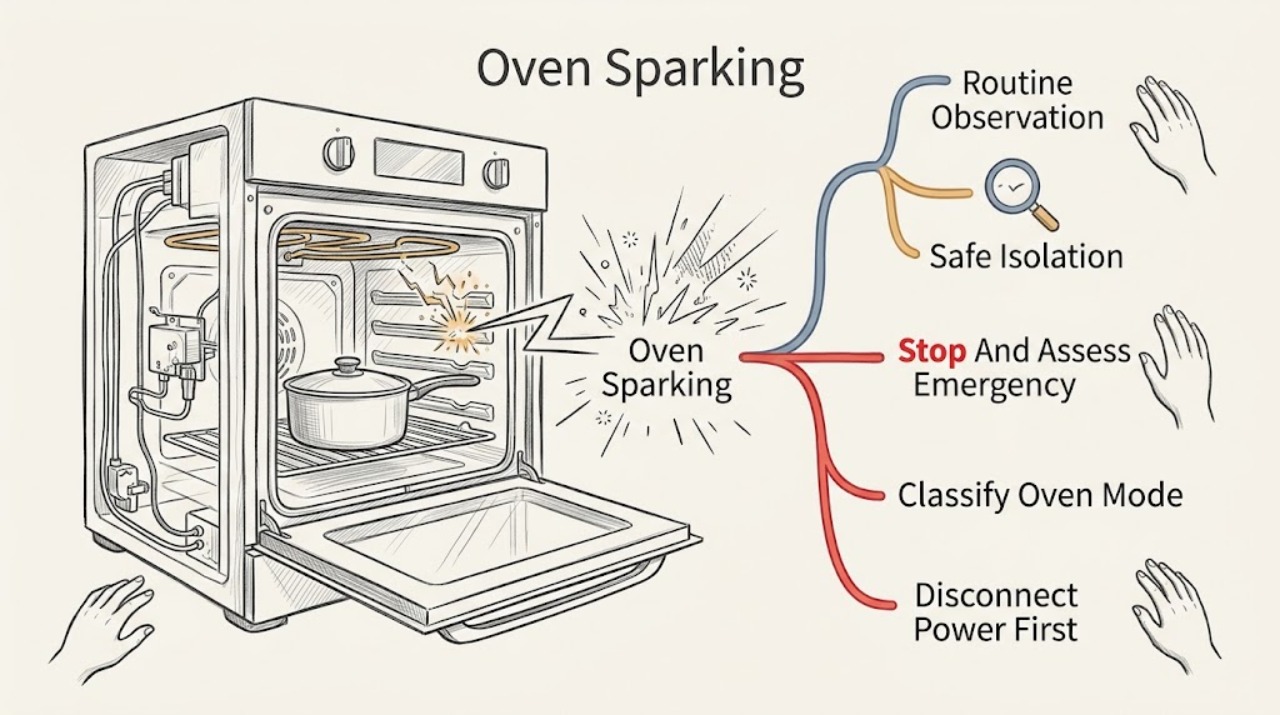
Work through in order
Diagnostic checks
Use only checks that match the exact appliance or system and its official guide.
-
Check 1
Stop the cooking cycle from a safe position if the control can be reached without approaching flame, smoke, sustained arcing, a hot door, or a wet electrical area, then step away and keep people clear.
Expected result: From a distance, note whether the flash stopped, whether there is smoke, flame, continuing crackling, a strong burning or gas smell, unusual heat, a door that blew open, or a breaker or outlet device that operated.
Next step: Leave the area and use the local emergency path for fire, smoke, sustained arcing, or a flammable-gas atmosphere. Otherwise keep the oven unused and arrange qualified appliance or electrical service.
Stop if: Do not open a door into flame, touch hot cookware or damaged electrical parts, throw water on an electrical fire, or operate a switch in a suspected gas atmosphere.
Why this matters
Why: Smoke, flame, continuing arc, gas odor, abnormal heat, or a door blowout is an immediate stop or emergency branch. A flash that stops is not permission to restart; the oven remains out of service until its cause is identified.
-
Check 2
Only when the floor, hands, controls, plug area, and disconnect path are dry and visibly safe, isolate power using the normal accessible disconnect without touching a damaged cord, wet receptacle, hot surface, exposed conductor, or arcing appliance; if it is not safe to reach, do not attempt it.
Expected result: Record whether the oven is no longer energized and whether the breaker or outlet protection is off, without opening a panel or using a meter to prove isolation.
Next step: Leave the oven isolated and arrange service; do not restore power or start a test cycle even if the spark is no longer visible.
Stop if: Do not stand in water, pull a cord by its cable, touch a wet plug or receptacle, open an electrical panel, or approach smoke or flame to disconnect power.
Why this matters
Why: Safe isolation prevents another heating or ignition cycle from energizing the fault. An inaccessible, wet, hard-wired, or damaged installation needs an electrician or qualified technician to isolate and inspect it.
-
Check 3
After the oven is off and the area is safe, identify from the control panel and model label whether the event occurred in a conventional electric bake or broil mode, a gas bake or broil mode, or a microwave/combination mode; do not open panels to identify components.
Expected result: Record the selected mode, whether microwave energy was active, whether an exposed bake or broil element was glowing, whether an igniter or burner was involved, and whether the flash appeared at food, cookware, the cavity wall, an element, or outside the oven.
Next step: Follow the matching branch and provide the mode and apparent location to the technician; keep the oven unused until the branch is resolved.
Stop if: Do not touch an element, igniter, rack, probe, cavity wall, or hot food to investigate the flash.
Why this matters
Why: Metal or loose foil in microwave or combination operation can create food-side arcing. A conventional element flash, a gas ignition abnormality, or a flash outside the cavity points toward an appliance or supply fault and requires service.
-
Check 4
Only after the oven and cookware are completely cool and power is safely isolated when required, visually inspect the food, pan, rack, foil, probe, twist ties, and other items without scraping or forcing anything from the cavity.
Expected result: Record whether metal or foil touched a cavity wall, foil had loose or raised edges, a metal tie or probe was present, recycled paper was used, an item was empty or overheated, or the cavity shows scorch marks, chipped coating, a hole, or fused foil.
Next step: Leave any fused, scorched, or damaged material in place, photograph it from a safe position, and arrange qualified service; do not resume cooking to verify the conclusion.
Stop if: Do not use a knife, metal scraper, abrasive pad, heater, or unauthorized solvent, and do not reach into a hot or energized cavity.
Why this matters
Why: A setup-specific cause is plausible only when the mode and visible item match the manufacturer's guidance. Fused foil, a damaged cavity, repeated arcing without the item, or an unknown source is not a cleaning problem and requires service.
-
Check 5
From outside the cool, isolated oven, record whether the flash was near a bake or broil element, gas burner or igniter, door, receptacle, cord, control panel, or unknown location; do not remove an element, burner cover, liner, or control panel.
Expected result: Note an element that has a visible rupture or hole, a burning-plastic odor, a breaker trip, delayed ignition, a boom, a door movement, abnormal flame color, or a gas odor; do not touch or probe the part.
Next step: Keep the oven out of service and give the symptom record to qualified appliance, electrical, or gas service as appropriate; do not operate another mode as a workaround.
Stop if: Do not test an element, ignition system, gas valve, wiring, or receptacle while energized and do not bypass a safety control.
Why this matters
Why: GE identifies a shorted heating element as a possible source of sparks, breaker trips, and burning odor. Gas ignition or flame abnormalities require gas-professional assessment, and a receptacle or cord symptom requires electrical inspection.
-
Check 6
Record the model number, oven type, selected mode, spark location and timing, food or cookware present, visible damage, odors, flame behavior, and breaker or outlet response, then provide the record to qualified service without reconnecting or rerunning the oven.
Expected result: Confirm whether the oven remains unused and safely isolated, whether any gas or water hazard remains, and whether smoke, heat, odor, arc damage, or a damaged cord is still present.
Next step: Arrange the appropriate qualified appliance, electrical, or gas service and keep the oven out of service until the professional confirms the repair and safe operation.
Stop if: Do not run a diagnostic cycle, switch to another cooking mode, reconnect power, bypass a door or flame safety, or perform internal repair.
Why this matters
Why: A complete event record helps separate food-side microwave arcing from a heating-element, gas-ignition, cavity, control, cord, or house-circuit fault. Unknown or persistent symptoms remain unsafe to test at home.
Use your observations
Decision map
Find the observation that best matches what you see, then follow the next safe action.
-
PATH 01Safety boundary
What you see
Sparking continues, smoke or flame is present, heat is spreading, or material inside the oven is igniting.
Do this next
Leave the area, keep others away, and use the local emergency path from a safe location. Do not return to retrieve cookware or operate controls.
Why this path and its safety boundary
Why it matters: This is a fire and life-safety event rather than an ordinary appliance diagnosis.
Safety stop: Do not throw water on an electrical fire, approach the oven, or re-enter until responders clear the area.
-
PATH 02Safety boundary
What you see
There is an unburned-gas or rotten-egg odor, a boom, delayed ignition, abnormal flame, or a door that blows open.
Do this next
Do not operate electrical switches or the oven; leave the area, extinguish flames only if safe, and contact the gas utility or emergency responders from outside the affected area. Arrange gas-professional service.
Why this path and its safety boundary
Why it matters: The gas path or ignition sequence may be unsafe and cannot be confirmed by another trial.
Safety stop: Do not relight the burner, reset power, operate controls, or re-enter until the responsible gas or emergency professional clears it.
-
PATH 03Safety boundary
What you see
The spark occurred only in microwave or combination mode and a metal item, loose foil edge, probe, rack, tie, or recycled paper product was present.
Do this next
After cooling and safe isolation, remove only the accessible item without scraping the cavity, follow the exact model manual for permitted cookware, and arrange service if the cavity is scorched, chipped, holed, or the spark returns without the item.
Why this path and its safety boundary
Why it matters: The cooking setup is a plausible source of microwave arcing, but the oven must still remain off until it is cool and the item can be removed safely.
Safety stop: Do not cover the cavity or rack with foil, use loose foil edges, use an unapproved metal accessory, or resume cooking to test the diagnosis.
-
PATH 04Safety boundary
What you see
The flash was at a bake or broil element, receptacle, cord, control, cabinet, or unknown external location, or it came with a breaker trip or burning-plastic odor.
Do this next
Keep the oven disconnected and arrange qualified appliance and electrical inspection. Provide the spark location, mode, odor, and protection response.
Why this path and its safety boundary
Why it matters: A failed element, wiring, control, cord, receptacle, or house circuit is possible; the source cannot be safely identified by a home test.
Safety stop: Do not replace an element, open the control panel, remove a cover, reset the breaker repeatedly, or plug the oven into another circuit as a test.
-
PATH 05Safety boundary
What you see
Foil or a liner is fused to the oven bottom, the cavity is scorched or damaged, or material cannot be removed without force.
Do this next
Stop using the affected oven and arrange qualified service; leave fused or damaged material in place and provide safe photos and the model number.
Why this path and its safety boundary
Why it matters: GE does not provide an ordinary-user removal method for fused foil, and cavity or coating damage can create further shock, fire, or arcing risk.
Safety stop: Do not scrape, pry, heat, sand, or run self-clean to remove fused material, and do not operate the damaged cavity.
-
PATH 06Safety boundary
What you see
Sparking recurs after the visible food or cookware item is gone, occurs in more than one mode, or cannot be located safely.
Do this next
Keep the oven unused and isolated and arrange qualified appliance, electrical, or gas service according to the mode and symptoms; do not perform another test run.
Why this path and its safety boundary
Why it matters: The event is not explained by a single cooking setup and may involve the oven, supply circuit, ignition, heating system, or hidden damage.
Safety stop: Do not switch modes to compare, bypass a door or flame safety, open panels, or restore power for observation.
Helpful context
Understand the symptom
Stop before opening a hot or arcing oven
Turn the oven control off only if it is safe to approach, then step back and let the cavity cool. Do not open the door into flame, reach for cookware, touch a damaged cord or receptacle, or use water on an electrical fire. If food or a paper product ignites, keep the door closed if you can do so without approaching a dangerous area, turn the oven off, leave the area for smoke or flame, and use the local emergency path. If an unburned-gas smell is present, do not operate electrical switches or create another spark; leave and contact the gas utility or emergency responders from outside the affected area.
Food-related arcing and electrical sparking are different branches
In a GE Advantium or other microwave/combination model, metal, loose foil edges, twist ties, metal racks or probes, and some recycled paper products can arc when microwave energy is active. In a conventional electric range or wall oven, a bake or broil element can short against its outer sheath and spark, sometimes with a breaker trip or burning-plastic odor. A gas oven can have a normal ignition click, but a boom, delayed ignition, abnormal flame, gas odor, or an electrical flash still requires professional attention. The oven type and exact operating mode therefore change the safe next step.
Do not improvise with foil, panels, or live tests
GE warns against lining an electric oven bottom with foil and against covering the bottom, slots, holes, or an entire rack in a gas oven. Foil that has fused to a liner is a service issue rather than a scraping job. After the oven is safe and cool, record the model, mode, spark location, food or cookware present, odors, and protection response. Use the model manual and a qualified technician for any cavity, element, ignition, wiring, control, or sealed gas-system work.
Only after diagnosis
Potential parts
- bake or broil heating element
Consider this only when a qualified diagnosis links the spark, rupture, or breaker response to a failed element.
Confirm the exact GE oven model and the manufacturer's fit information before ordering; do not replace an element based only on a flash description. - oven power cord or receptacle component
Consider this only after an electrician or appliance technician identifies damage at the cord, plug, receptacle, grounding, or supply connection.
The installation and exact model determine the required connection; do not substitute a cord or outlet by appearance. - ignition or control component
Consider this only when qualified gas or appliance service traces delayed ignition, abnormal flame, or an electrical flash to a specific component.
A qualified professional must identify the component and confirm exact model fit before replacement.
When checks do not resolve it
Need a professional?
Professional service is required for any unexplained spark, arc mark, element flash, damaged cavity, fused foil, breaker or outlet trip, burning odor, damaged cord or receptacle, repeated event, or gas-ignition abnormality. Use the local emergency path for smoke, flame, sustained arcing, rapidly spreading heat, or a flammable-gas atmosphere. Do not operate the oven again until qualified service has inspected the appliance and implicated circuit or gas system.
Common questions
FAQ
Should I run my GE oven again to locate the spark?
No. Stop using it and keep power isolated when safe. A second run can turn a small arc or food flash into fire, shock, or additional damage.
Can aluminum foil cause sparking in a GE oven?
In microwave or combination modes, metal and loose foil edges can arc. In a conventional electric or gas oven, foil lining can trap heat, melt, damage the appliance, and create shock, fire, or airflow hazards. Follow the exact manual and do not test by restarting.
What if the spark came from the bake or broil element?
Keep the oven out of service. GE identifies a shorted heating element as a possible source of sparks, a breaker trip, and burning odor; arrange qualified appliance service rather than touching or replacing the element yourself.
When is GE oven sparking an emergency?
Smoke, flame, sustained arcing, rapidly spreading heat, a door blowout, or an unburned-gas odor requires leaving the area and using the local emergency or gas-utility path from a safe location.
Read the exact guide
Official sources
- GE Appliance - Circuit Breaker TripsGE Appliances · GE appliance breaker and fuse trip guidance including ovens
- Advantium Oven - Reasons for Sparking And ArcingGE Appliances · GE Advantium microwave and combination oven arcing
- IMPORTANT SAFETY INFORMATIONGE Appliances · GE microwave oven arcing and metal or foil safety
- Aluminum Foil Fused in OvenGE Appliances · GE oven fused aluminum foil and liner damage
- Gas Range - What is Normal Operation vs What Requires ServiceGE Appliances · GE gas oven ignition, flame, delayed ignition, and unburned-gas safety
- Range & Wall Oven - Using Aluminum Foil or Silicone LinersGE Appliances · GE electric and gas range or wall oven foil safety
- Range & Wall Oven - Oven Heating Element FailureGE Appliances · GE electric range and wall oven bake or broil element failure
- Microwave/Convection Oven Use and Care GuideGE Appliances · GE microwave and convection oven fire, arcing, foil, and power safety
Community feedback
Share a repair observation
Share a plain-text repair observation. Accepted observations are published automatically; this page may take a moment to update.