
On this page
Start here
Quick answer
Treat visible sparking from a Frigidaire oven as an abnormal event until the exact model manual explains otherwise. Turn the oven off from a safe position and do not keep cycling it to reproduce the spark. Once the oven is fully cool and there is no smoke, gas odor, burning smell, or electrical danger, record where the spark occurred and make only visual checks for a damaged heating element, foil or metal touching a heater, scorch marks, or a damaged visible cord or plug. A cracked element can short and spark, but the same symptom can come from wiring, an igniter, controls, or an installation fault that cannot be diagnosed safely from the cavity. Leave the oven unused and arrange qualified appliance service for any true arc, repeat event, damage, odor, breaker trip, or need to remove a panel.
Before you begin
Safety first
- This article covers safe shutdown, observation, manual lookup, and service handoff only. A qualified professional must handle internal electrical, heating, ignition, gas, wiring, and live-testing work.
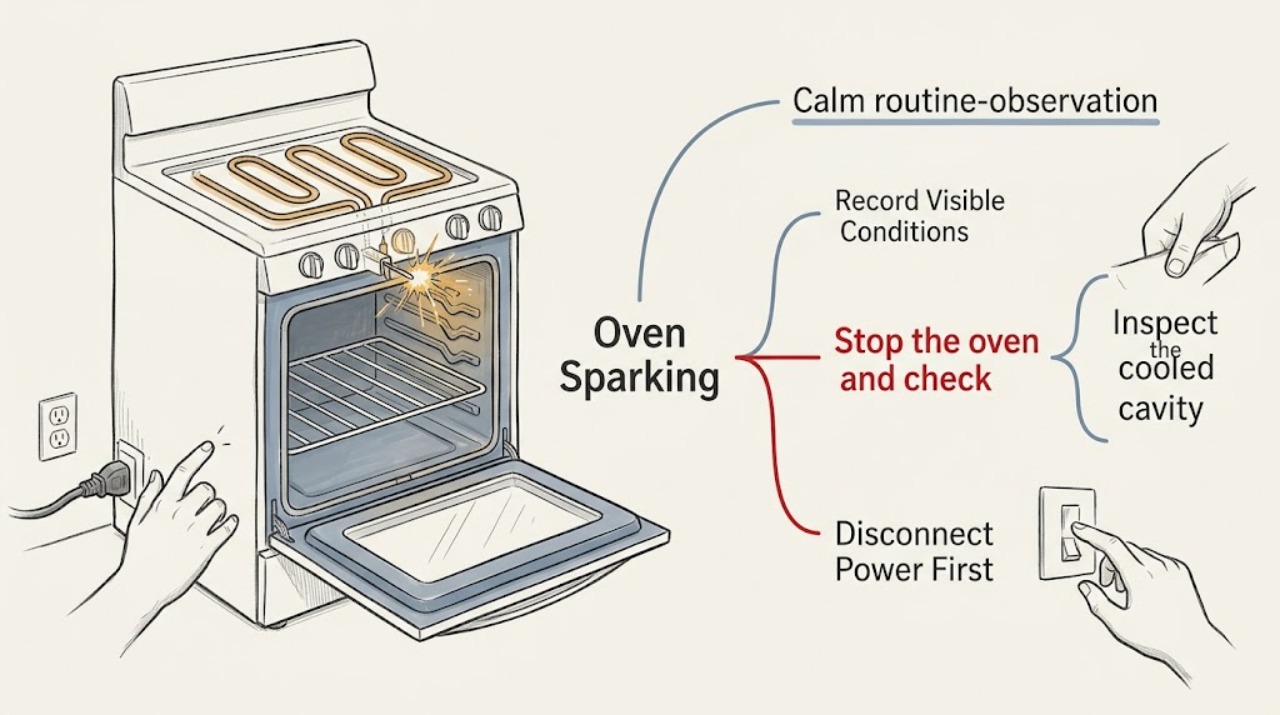
Work through in order
Diagnostic checks
Use only checks that match the exact appliance or system and its official guide.
-
Stop the oven and check for an immediate hazard
From a dry, safe position, turn the oven control OFF and keep people away from the appliance. Do not reach into a hot cavity, touch a cord or plug that is hot or damaged, or use the controls again to reproduce the spark. If a fire is present, follow the fire response for the home and do not put water on an electrical appliance fire.
Expected result: The spark stops, continues, or is accompanied by smoke, flame, a gas odor, a strong burning smell, visible heat damage, or a breaker that trips again.
Next step: For smoke, flame, or an expanding fire, leave the area and contact local emergency help; for a gas odor, leave without operating switches or making a flame. Otherwise keep the oven OFF, isolate its circuit only if the disconnect is safely reachable, and arrange qualified appliance service.
Stop if: Do not restart the oven, reset a tripped breaker repeatedly, open the door to investigate flames, or touch wet, hot, scorched, or exposed electrical parts.
Why this matters
Why: Continuing arcing, smoke, flame, a gas odor, burning signs, or repeated protective-device operation is a stop condition rather than a routine cleaning clue. A quiet oven is safer to document but is not proof that the fault is gone.
-
Record the mode and exact spark location
When the oven is cool and remains switched off, write down whether the event occurred during Bake, Broil, preheating, self-clean, or another mode, and whether it was at a visible heater, the cavity wall or floor, the control or power area, or a surface burner. Use the model label or manual to identify whether the appliance is electric or gas without pulling the unit out.
Expected result: The location is clearly at a bake or broil heater, inside the cavity away from a heater, near a control or connection, or not identifiable.
Next step: Photograph the cooled area from outside the appliance and give the mode, timing, fuel type, and location to the technician. Do not remove a cover to improve the view.
Stop if: Stop the inspection if the cavity is still hot, a gas smell is present, smoke returns, or the only way to locate the spark is to open a panel or move the appliance.
Why this matters
Why: A visible heater fault, a cavity-side mark, and a connection-side spark lead to different professional checks. An unknown location is not evidence that the oven is safe to use.
-
Inspect the cooled cavity for visible contact or heater damage
After the oven has fully cooled and power is safely isolated, look through the normal opening for foil, a metal utensil, spilled material, a cracked or blistered bake or broil element, loose visible trim, or a scorch mark. Remove only loose cookware that the exact Use and Care manual permits; do not scrape a heater, lift a cover, or reach behind the cavity liner.
Expected result: A metal object or residue is touching a heater, the heater sheath is cracked or ruptured, a scorch mark is present, or the cavity looks clear and undamaged.
Next step: Leave the oven unused and provide the photograph and finding to qualified service when there is any damage, scorch mark, true spark, or recurring symptom. Follow the model manual for ordinary cleaning only when no safety symptom is present.
Stop if: Do not chip residue, bend an element, remove the oven floor, bypass a heater, or perform a live continuity or voltage test.
Why this matters
Why: An object or visible heater rupture can explain where the event appeared, but a clear cavity does not rule out wiring, control, igniter, or installation faults. A damaged heater should not be operated to see whether it sparks again.
-
Check the visible power path without touching live parts
From a dry position, inspect only the visible cord, plug, receptacle, or user-accessible isolation switch and note whether the breaker or protective device is off. Do not pull out a built-in oven, remove a junction-box cover, loosen a terminal, use an extension cord, or probe a receptacle.
Expected result: The visible cord or plug is cracked, loose, hot, or scorched; the protective device has tripped; or the visible supply looks normal and the oven still sparked.
Next step: Keep the appliance isolated and arrange qualified electrical or appliance service for damage or a repeated trip. Give the technician the circuit behavior instead of restoring power for another test.
Stop if: Stop immediately for heat, smoke, arcing, odor, a wet area, exposed conductor, or any need to open an electrical enclosure.
Why this matters
Why: A damaged connection or repeated trip can be an electrical fire or shock risk. A normal-looking supply does not clear the oven because an internal element, igniter, control, or wiring fault may remain.
-
Use the exact Frigidaire manual to classify the appliance
With the model number recorded safely, read the matching Frigidaire Use and Care or installation guidance for the fuel type and operating mode. Compare the documented normal ignition or heating sequence with the event you saw; do not start a new cycle merely to check whether the spark returns.
Expected result: The manual describes a normal ignition glow or sound that differs from the observed arc, the manual identifies a model-specific warning, or the manual does not cover the event.
Next step: Save the manual section and provide it with the model, mode, photographs, and event history to Frigidaire or a qualified appliance technician. Keep the oven off until the cause is assessed.
Stop if: Do not bypass an interlock, manually light a gas oven, remove an igniter shield, or repeat a cycle after a true spark or abnormal odor.
Why this matters
Why: A model manual can identify an expected sequence, but it cannot make a visible arc, scorch mark, repeated spark, or incomplete heating sequence safe to retest. An uncovered symptom needs qualified diagnosis.
-
Prepare a complete service handoff
Record the model and serial information if safely visible, the selected mode, whether the oven was heating, the exact spark location, whether a flame was present, breaker behavior, smoke or odor, recent spill or cleaning, and whether the event has happened before. Do not include a guessed failed part as a diagnosis.
Expected result: The event is isolated and documented, or it is recurring, unexplained, associated with damage, or requires access beyond normal user maintenance.
Next step: Leave the oven unused and request qualified appliance service; include photographs and state clearly that no panels, wiring, gas parts, or heater covers were opened.
Stop if: Do not order a replacement part or resume cooking based only on the symptom name or a spark that stopped.
Why this matters
Why: A precise timeline helps separate an element or ignition symptom from a supply or control problem, but only service can confirm the component and safe repair boundary.
Use your observations
Decision map
Find the observation that best matches what you see, then follow the next safe action.
-
PATH 01Safety boundary
What you see
Smoke, an uncontrolled flame, a gas odor, a strong burning smell, continuing sparks, or a repeated breaker trip is present.
Do this next
Stop immediately, keep people clear, leave for fire or gas danger, and contact local emergency or gas assistance from a safe location. Arrange qualified appliance or electrical service before any further use.
Why this path and its safety boundary
Safety stop: Do not operate switches near a suspected gas leak, use water on an electrical fire, or restore power to a smoking or arcing oven.
-
PATH 02Safety boundary
What you see
The cooled cavity shows a cracked or ruptured heater, scorch mark, or metal contact after a true spark.
Do this next
Keep the oven off and arrange qualified appliance service for the heater, wiring, controls, or related damage; do not perform a confirming retest.
Why this path and its safety boundary
Safety stop: Do not bend, scrape, remove, or replace the heater without model-specific qualified diagnosis.
-
PATH 03Safety boundary
What you see
The cavity is clear and the visible power path looks normal, but a true spark occurred or the event returns.
Do this next
Treat the fault as unresolved and request service. Provide the mode, location, timing, photographs, and protective-device behavior.
Why this path and its safety boundary
Safety stop: Do not keep cycling the oven or open the control, wiring, igniter, or junction-box area.
-
PATH 04Safety boundary
What you see
The event cannot be distinguished from a normal model-specific ignition indication and there is no smoke, odor, damage, or repeated fault.
Do this next
Follow the exact Frigidaire manual for classification and monitor only after the manual supports normal operation; stop immediately if a true arc or other warning returns.
Why this path and its safety boundary
Safety stop: Do not assume an unfamiliar flash is normal or use another heating cycle as a diagnostic experiment.
Helpful context
Understand the symptom
Why the location matters
A spark seen at a bake or broil element points to a different service path from a flash at the plug, control area, or a gas-oven ignition point. A mark on the oven floor can also be a trace left by a fault rather than the place where the electrical problem began. The checks below are for identification and safe handoff, not for opening the range or proving a component with live testing.
Do not turn a one-time spark into a repeated fault
Keep the oven out of service after a true spark. The exact Frigidaire model and fuel configuration determine which user checks are allowed, and Frigidaire directs owners to the Use and Care manual and qualified service when a problem remains. Do not remove the oven bottom, heater, igniter, control panel, wiring, or gas components based only on the symptom.
Safety boundary
Stop conditions
- Do not restart the oven after a true spark, scorch mark, smoke, burning smell, gas odor, uncontrolled flame, or repeated breaker trip.
- Do not open panels, remove the oven floor or heater shield, make live measurements, adjust gas components, or bypass an interlock.
- Do not use water on an electrical appliance fire; leave and seek emergency help if flames escape or the fire is not immediately controlled by safe appliance shutdown.
- Do not choose an element, igniter, control, or wiring part from the symptom alone; confirm the model and cause through qualified service.
Only after diagnosis
Potential parts
- bake or broil heating element
Consider this category only if a qualified diagnosis confirms a ruptured or electrically failed visible heater and the exact model identifies the correct element.
Confirm the full model, fuel configuration, connector arrangement, dimensions, and manufacturer fit information before ordering; a spark does not prove this is the failed part. - oven igniter or ignition component
Consider this category only for a gas-configured model when qualified testing identifies an ignition fault rather than a heater, control, wiring, or gas-supply problem.
Match the exact model and fuel system through the manufacturer or technician; do not manually light the oven or replace an ignition component from the symptom alone.
When checks do not resolve it
Need a professional?
Arrange qualified appliance service for any true spark or arc, a repeated event, a cracked or scorched heater, incomplete ignition or heating, a damaged cord or connection, a tripped breaker, or any symptom that requires a panel to be removed. Seek urgent local emergency or gas assistance for smoke, an uncontrolled flame, a gas odor, continuing arcing, or an expanding fire. Keep the oven off while waiting.
Safety scope: This article covers safe shutdown, observation, manual lookup, and service handoff only. A qualified professional must handle internal electrical, heating, ignition, gas, wiring, and live-testing work.
Have this ready
- Frigidaire model and serial information if safely visible
- Mode, timing, and exact location of the spark
- Whether the oven was electric or gas and whether a flame appeared
- Photographs of the cooled cavity and visible power path
- Smoke, odor, scorch, error, breaker, spill, or cleaning history
- Checks completed and panels or live parts deliberately left unopened
Common questions
FAQ
Is a spark from a Frigidaire oven ever normal?
Do not assume it is normal. Some models have a documented ignition sequence, but a visible arc, repeated snap, scorch mark, smoke, odor, or incomplete heating sequence should end testing. Use the exact model manual for classification and keep the oven off if the event is unexplained.
Can a damaged heating element cause the oven to spark?
Yes, a manufacturer troubleshooting page explains that an element can short against its outer sheath, spark briefly, trip protection, and stop heating. That mechanism does not prove the Frigidaire element is the failed part; leave the oven unused and arrange qualified diagnosis.
What should I do if the sparking is followed by smoke or flames?
Turn the oven off only from a safe position. If flames escape or the fire is not immediately controlled by safe shutdown, leave the home and contact local emergency help. Do not use water on an electrical appliance fire and do not restart the oven.
Should I replace the bake element or igniter first?
No. Sparking can involve the heater, igniter, wiring, control, power connection, or fuel system. Confirm the model and have a qualified technician identify the cause before selecting a replacement part.
Read the exact guide
Official sources
- Oven - Is Not Hot EnoughFrigidaire · Frigidaire's opened support article is specific to electric range and wall ovens; it supports the model-manual and qualified-service boundary but does not identify the cause of every sparking event.
- Range & Wall Oven - Oven Heating Element FailureGE Appliances · This manufacturer guidance is used for the general heating-element mechanism only; it does not establish compatibility or a Frigidaire-specific repair procedure.
- Appliance and Electrical Fire SafetyU.S. Fire Administration · Government fire-safety guidance used for major-appliance supply, cord, outlet, and damaged-equipment boundaries.
- Cooking Fire SafetyU.S. Fire Administration · Government cooking-fire guidance used for the emergency branch when an oven fire or escaping flames are present.
Community feedback
Share a repair observation
Share a plain-text repair observation. Accepted observations are published automatically; this page may take a moment to update.